Demand Generation vs Demand Capture: 9 Stats Every Marketer Should Know
Most B2B marketing budgets are built to catch buyers who are already looking. The problem is how few of them there are.
Demand generation vs demand capture is the split that decides whether your pipeline grows or just gets more expensive. Demand capture harvests buyers who are ready now: search ads, review sites, comparison pages, demo forms. Demand generation creates future buyers who don’t know they need you yet: thought leadership, brand, content, community. You need both. The question is how much of each.
These 9 stats, each with its primary source, show where the balance should sit. (New to the term? Start with our definition of demand generation.)
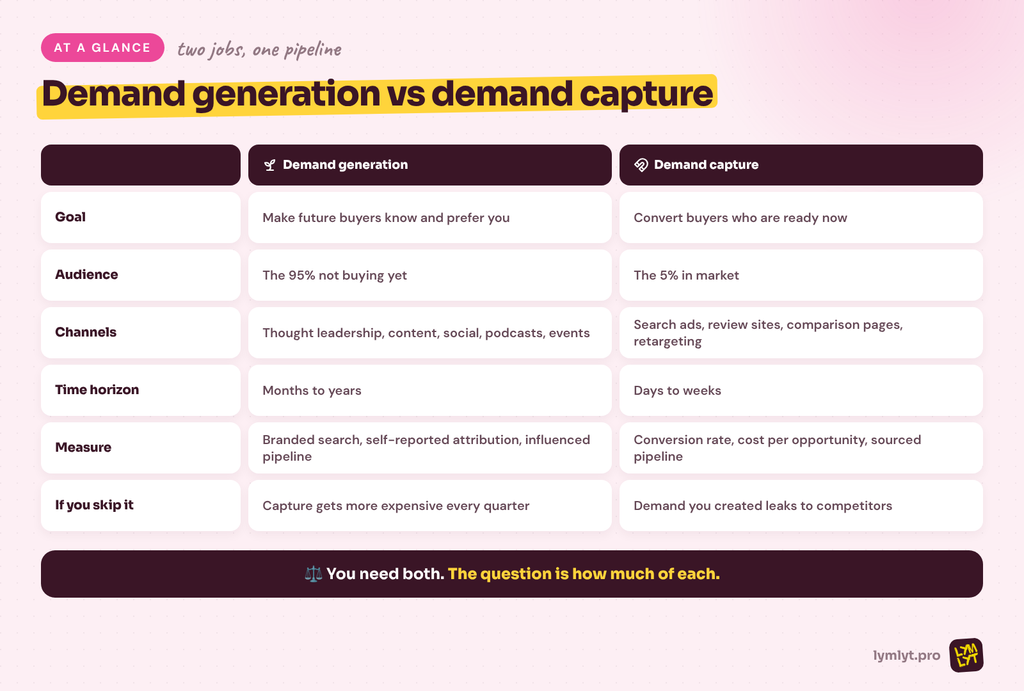
Demand generation vs demand capture at a glance
| Demand generation | Demand capture | |
|---|---|---|
| Goal | Make future buyers know and prefer you | Convert buyers who are ready now |
| Audience | The 95% not buying yet | The 5% in market |
| Channels | Thought leadership, content, social, podcasts, events | Search ads, review sites, comparison pages, retargeting |
| Time horizon | Months to years | Days to weeks |
| How to measure | Branded search, self-reported attribution, influenced pipeline | Conversion rate, cost per opportunity, sourced pipeline |
| What happens if you skip it | Capture gets more expensive every quarter | Demand you created leaks to competitors |
9 stats every marketer should know
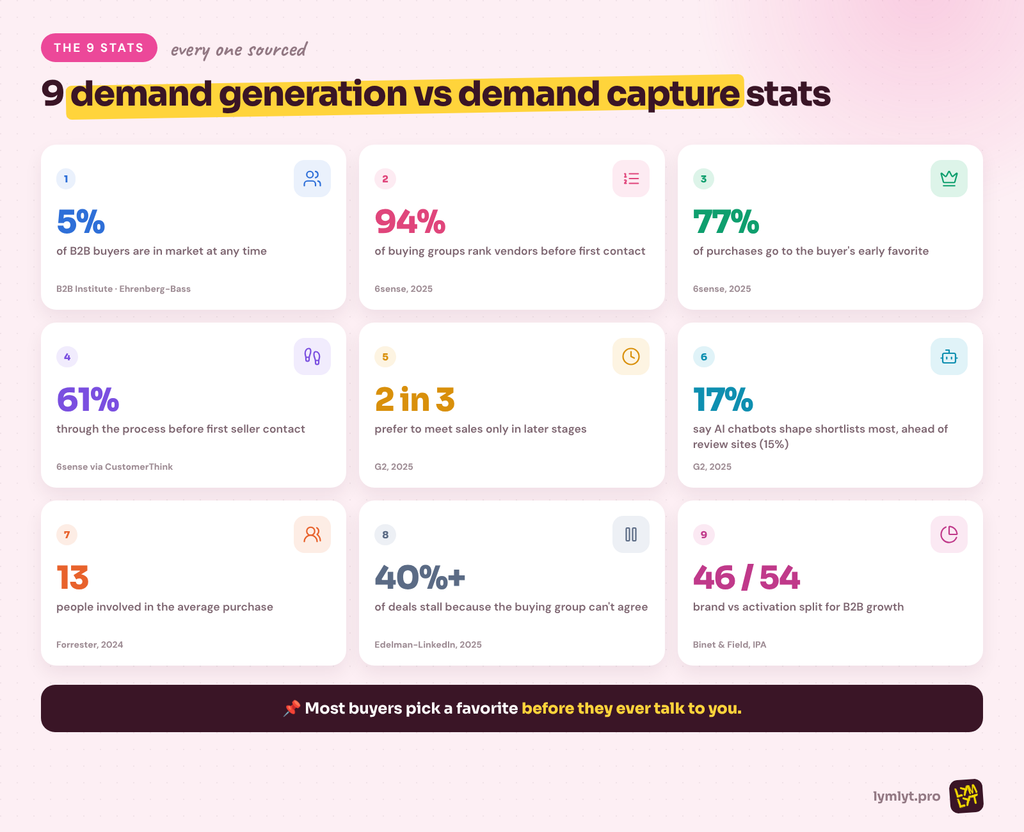
1. Only 5% of B2B buyers are in market at any time
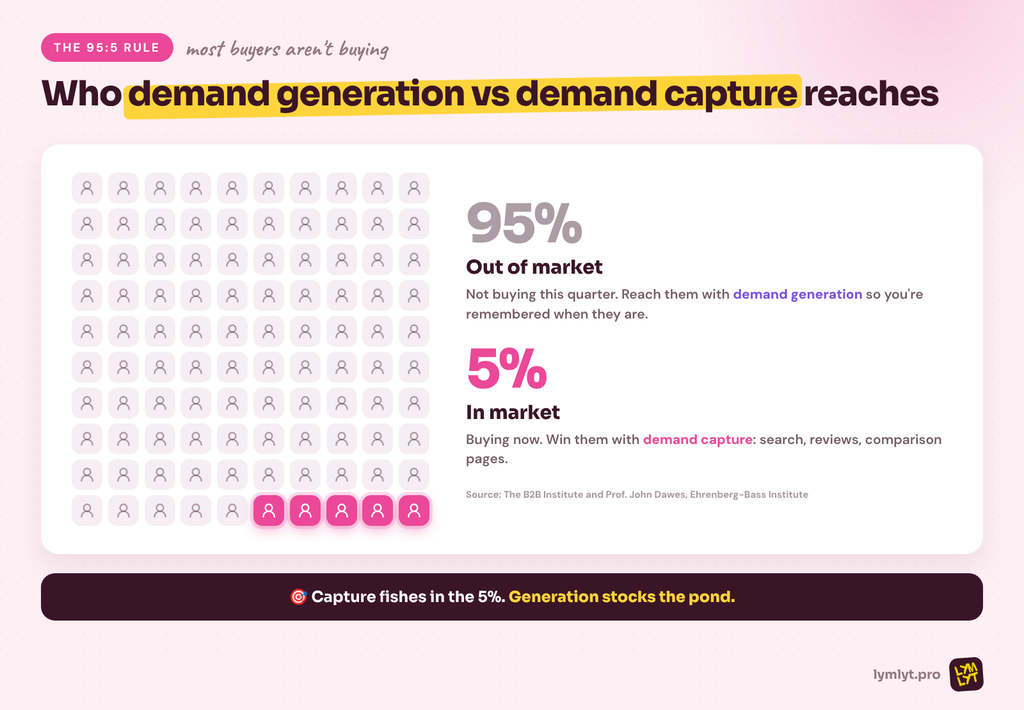
The B2B Institute, LinkedIn’s research arm, worked with Professor John Dawes of the Ehrenberg-Bass Institute to show that roughly 95% of B2B buyers are out of market at any given moment. Their banking example: if companies switch banks every five years, only about 20% are in market in a year, and about 2% in a month (Marketing Week).
What it means: demand capture only reaches the 5%. Demand generation builds memory with the 95% so they think of you when they enter the market.
2. 94% of buying groups rank their preferred vendors before first contact
6sense’s 2025 Buyer Experience Report, based on more than 4,000 buyers, found 94% of buying groups had already ranked their preferred vendors before they spoke to a seller (Business Wire).
What it means: the shortlist forms before your demand capture ever fires. If you weren’t known before the search, you’re competing for a spot that’s already taken.
3. 77% of purchases go to the vendor buyers favored before talking to sales
In the same 6sense report, 77% of purchases went to the buyer’s preliminary favorite (Business Wire).
What it means: winning the shortlist is most of the battle. That’s demand generation’s job.
4. First contact with sellers happens 61% of the way through the buying process
6sense found the average point of first contact came when buyers were 61% through their buying process (CustomerThink).
What it means: most of the decision happens in research you never see. Our guide to how the B2B buying journey starts before your marketing funnel does covers what fills that gap.
5. Nearly two in three buyers prefer to meet sales only in later stages
G2’s 2025 Buyer Behavior Report, a survey of 1,169 B2B decision-makers, found nearly two in three buyers prefer to engage vendor salespeople only in the later stages, up 17 points from 2024 (Business Wire).
What it means: buyers want to self-educate. Content that answers their questions early is demand generation that sales can’t replace. Gated PDFs often get in the way; see which B2B lead magnets still work.
6. Generative AI chatbots are now the top influence on vendor shortlists
The same G2 report found generative AI chatbots (17%) and software review sites (15%) were the top two sources influencing vendor shortlists, and 29% of buyers start research in an LLM more often than in Google (Business Wire).
What it means: AI answers are a new layer of demand capture, and the content AI cites is built by demand generation. Our shortlist prompts research shows what buyers ask, and why AI has entered the buying committee.
7. The average buying decision involves 13 people
Forrester’s State of Business Buying 2024 found 13 people involved in the average purchase, with 89% of purchases spanning two or more departments (Forrester).
What it means: capture usually reaches the one person filling in the form. Generation reaches the other twelve. See who they are in our guide to the B2B buying committee.
8. More than 40% of B2B deals stall because the buying group can’t agree
The 2025 Edelman-LinkedIn B2B Thought Leadership Impact Report, drawing on nearly 2,000 professionals, found more than 40% of B2B deals stall due to internal misalignment within buying groups. It also found 79% of decision-makers are more likely to champion a vendor during an RFP if it consistently publishes quality thought leadership (Demand Gen Report).
What it means: demand generation doesn’t stop at awareness. It arms the champion to win the internal argument. Our guide on how to create thought leadership content shows what earns that trust.
9. B2B brands grow best with roughly 46% brand and 54% activation
Les Binet and Peter Field’s analysis of IPA data, published by the B2B Institute, found B2B businesses grow best with roughly 46% of budget on brand building and 54% on activation (LinkedIn).
What it means: nearly half the budget belongs to long-term demand generation. Most B2B teams spend far less, then wonder why capture costs keep rising. HubSpot shows the other side: it lost most of its blog traffic while revenue rose 19%, because brand demand carried it.
How to balance demand generation and demand capture
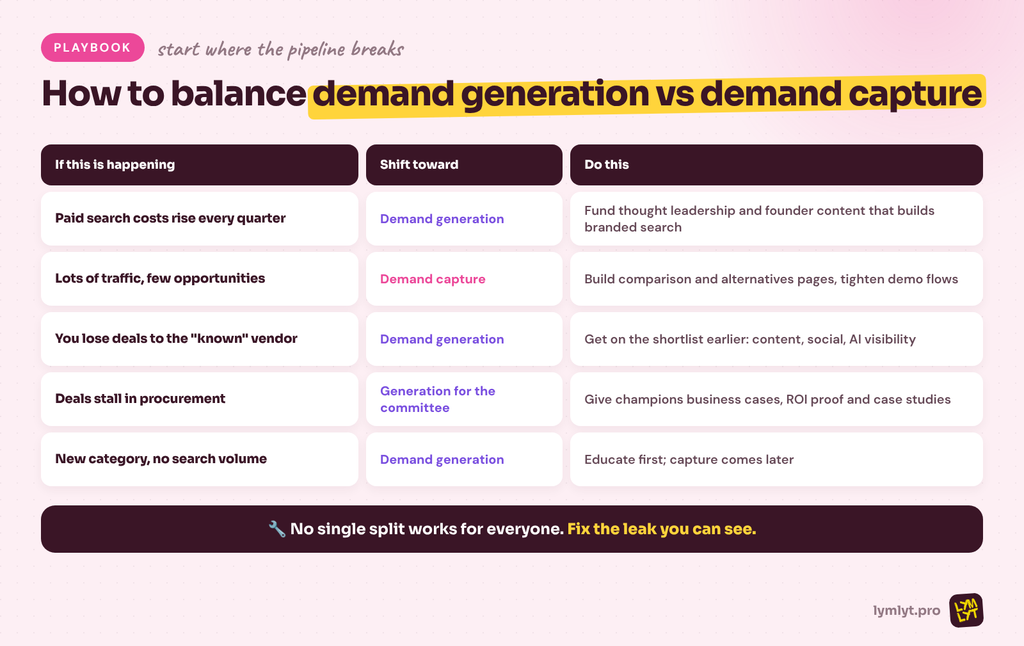
There’s no single split. Start from where your pipeline breaks.
| If this is happening | Shift toward | Do this |
|---|---|---|
| Paid search costs rise every quarter | Demand generation | Fund thought leadership and founder content that builds branded search |
| Lots of traffic, few opportunities | Demand capture | Build comparison and alternatives pages, tighten demo flows |
| You lose deals to the “known” vendor | Demand generation | Get on the shortlist earlier: content, social, AI visibility |
| Deals stall in procurement | Generation for the committee | Give champions business cases, ROI proof and case studies |
| New category, no search volume | Demand generation | Educate first; capture comes later |
Demand capture that works in 2026
- Comparison and alternatives pages. Buyers comparing vendors are ready, and vs keywords show exactly who ranks when they do. Our guide to B2B SaaS comparison pages covers the format, and why losing a row wins the deal.
- AI answers. Get cited where buyers shortlist. Start with AI visibility for B2B SaaS.
- Review sites and case studies. Proof at the moment of decision. See our guide to B2B SaaS case studies.
Demand generation that works in 2026
- Thought leadership with original insight. Not generic takes AI could write. See our guide to B2B positioning for what to say instead.
- People, not logos. Buyers follow people on LinkedIn, YouTube and Instagram. Our piece on why B2B marketing now lives across socials explains the shift, and these employee advocacy statistics show why people beat company pages.
- Original research. Stats like these get quoted and cited. Our study on original statistics and AI citations shows why.
How to measure each side
Demand capture is easy to measure and easy to over-credit. Demand generation is hard to measure and easy to cut. Measure them differently:
- Capture: sourced pipeline, conversion rate and cost per opportunity. Most B2B marketing attribution tools handle this well.
- Generation: branded search volume, self-reported attribution (“How did you hear about us?”) and influenced pipeline.
Then report both in finance language. Our guide on how to prove marketing ROI lists the 11 metrics a CFO trusts, and the recommendation that never appears in your CRM shows why self-reported attribution matters. Treat MQLs with caution: more MQLs can still mean less pipeline. And ask buyers directly: win-loss analysis shows where the winning vendor first got on their radar.
The bottom line
Demand generation vs demand capture isn’t a choice. Capture harvests the 5% who are buying today. Generation decides whether you’re on their list when they start. The data says most buyers have picked a favorite before they talk to you, so the budget that builds preference early is the budget that wins deals later.
If you need the demand generation half built, LymLyt creates the content, thought leadership and comparison pages that do both jobs. See our pricing, from $1,499/month.
Every stat above links to its source. Check our piece on the AI citation telephone game before you quote a stat you found secondhand.

Jay is the co-founder of LymLyt and an AI partnership consultant helping B2B SaaS companies grow through content strategy, SEO, and AI integration. He writes about content marketing, what makes B2B content convert, and how SaaS teams can build content systems that drive real pipeline.