AI Visibility for B2B SaaS: The Complete Guide
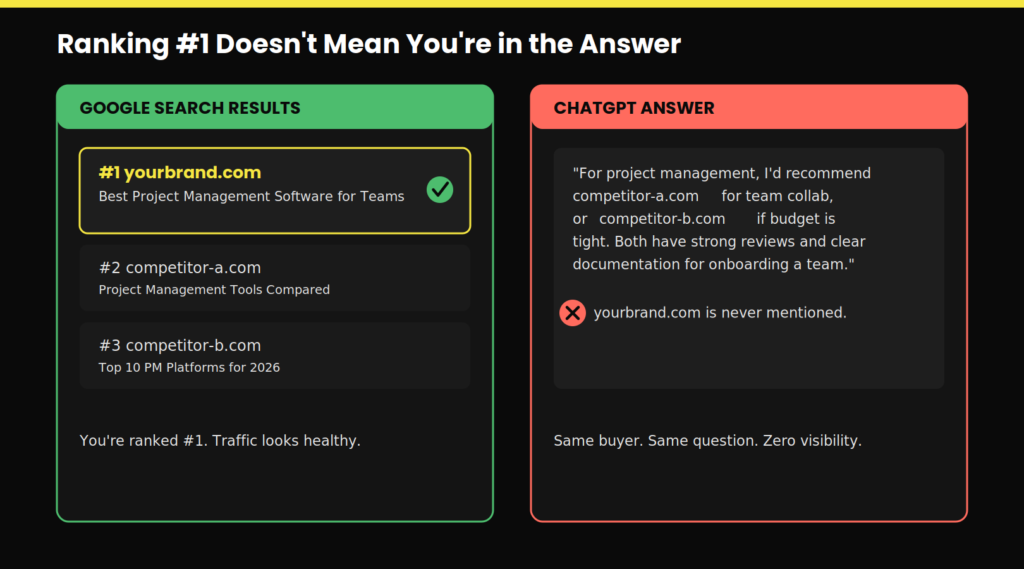
Your B2B SaaS company probably ranks on page one of Google for your main keyword. Open ChatGPT and ask the same question a buyer would ask. There is a real chance your AI visibility is close to zero, even with strong rankings sitting right there in Google.
That gap is exactly what AI visibility exists to fix. AI visibility is whether your brand gets mentioned, cited, and recommended when someone asks an AI tool a question your product answers, not whether you rank in a list of blue links underneath it. A study of roughly 350,000 B2B SaaS articles across 10,382 keywords found that only 14% of the URLs AI engines cite appear anywhere in Google’s top 20, and barely 30% of Google’s top-20 pages get cited by AI at all. Ranking and being cited are now two different games, and most companies are only playing one of them.
This guide covers what AI visibility actually is, why it broke away from traditional SEO, how AI models decide what to cite, and the concrete steps to start building real AI visibility this month. If you want the numbers behind the shift first, our AI SEO statistics roundup collects what has actually been measured. Along the way, this guide links out to the deeper, more tactical guides already covering pieces of this puzzle, so treat this as the map, not the only stop.
What AI visibility actually means
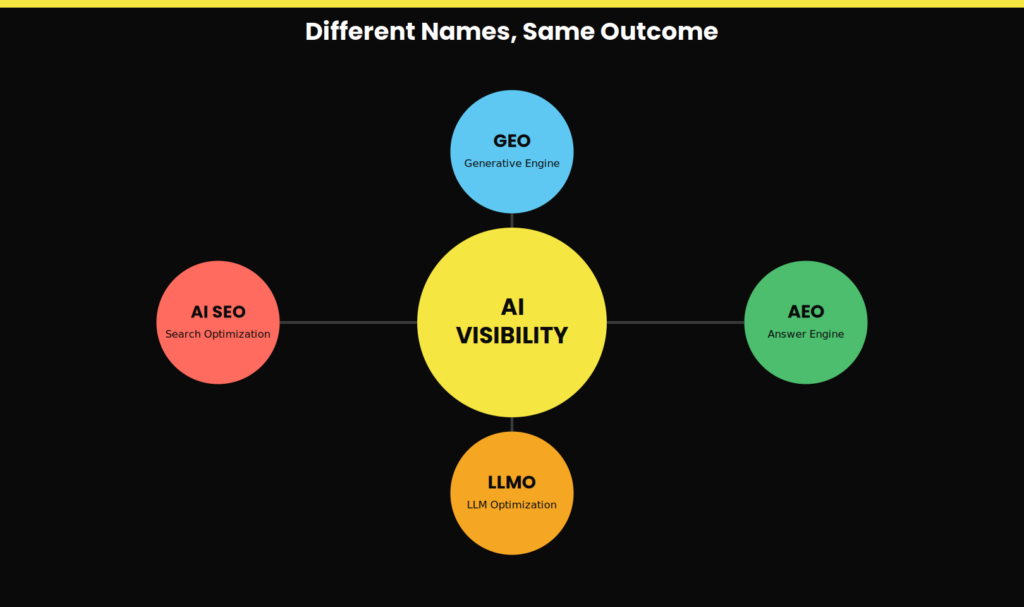
The terminology in this space is a mess on purpose. Generative Engine Optimization (GEO), Answer Engine Optimization (AEO), LLM Optimization (LLMO), and AI SEO all get used to describe roughly the same goal: getting your brand surfaced inside AI-generated answers instead of just indexed underneath them. The overlap is real, but the terms are not quite interchangeable, and the differences that do matter are narrower than most explainers claim.
AI visibility is the outcome all of those terms are chasing. It is not a single tactic. Rather, it is the sum of three separate things working together:
- Technical accessibility. Can AI crawlers actually read, parse, and understand your site.
- Content citability. Is your content specific and well-structured enough that a model would want to quote it.
- Off-site authority. Do other trusted sources on the web mention and validate your brand in ways models pick up on.
Traditional SEO optimized primarily for the first two. AI visibility, however, depends heavily on the third, which is the part most companies still ignore completely. If you want the deeper mechanics of the content-and-citation side specifically, our guide to what GEO actually is goes further into that layer alone.
Why AI visibility matters more in 2026 than it did two years ago
Buyer behavior has moved faster than most marketing teams have adjusted to. The majority of B2B buyers now use AI tools somewhere in their vendor research, often before they ever land on a company’s website. Consequently, when that happens, the AI tool’s answer becomes the shortlist. If your brand is not in it, you are not being excluded from a search result. You are being excluded from the buyer’s decision entirely, which is a far more expensive problem than a missed keyword.
Three shifts explain why AI visibility is becoming urgent now specifically:
AI answers are replacing the click. When someone gets a complete answer inside ChatGPT or a Google AI Overview, they often never visit a website at all. As a result, the traffic that used to flow to the best-optimized page now stays inside the AI conversation, invisible to your analytics.
Citation and ranking have decoupled. Google rankings and AI citations used to correlate closely. They no longer do. A page can dominate page one and still be completely invisible inside AI-generated answers, because the two systems weigh different signals. This is the same disconnect covered in why B2B SaaS content isn’t converting, traffic and outcomes are not the same thing, and neither are rankings and AI visibility.
Off-site signals now matter more than on-site ones. Research suggests roughly 85% of top-of-funnel LLM citations originate from sources other than the brand’s own website: third-party articles, Reddit threads, LinkedIn posts and YouTube transcripts, comparison posts, and other domains models already trust. Therefore, a company that only optimizes its own blog is addressing a fraction of the actual AI visibility problem.
How AI models actually decide what to cite
Models do not browse the web live the way a person does. Instead, they draw on a mix of training data and, for tools with live retrieval like ChatGPT with browsing or Perplexity, real-time crawling of pages they can access and trust. Understanding that process explains almost every tactic that actually improves AI visibility.
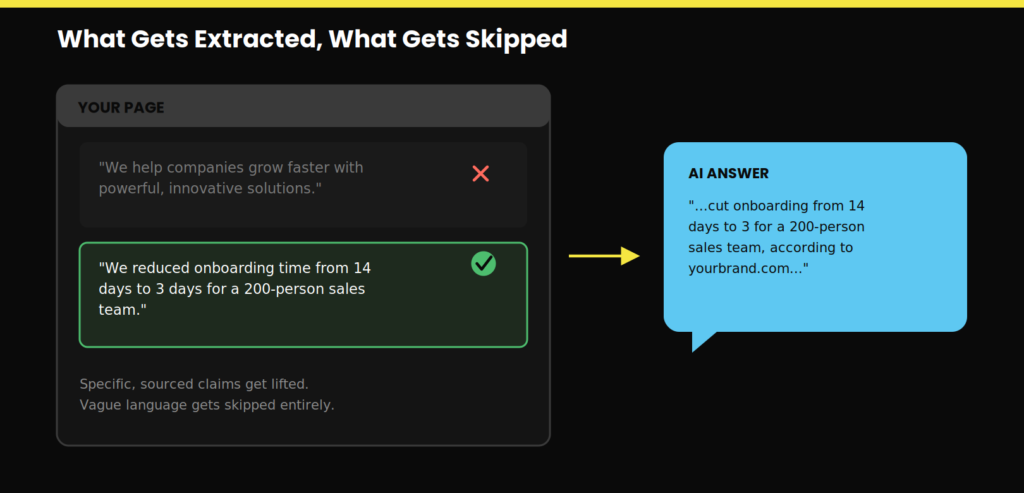
Models extract, they do not summarize loosely.
A model pulls directly stated, specific claims from content, not vague or hedged language. A sentence like “we help companies grow” gives a model nothing to cite. By contrast, a sentence like “we reduced onboarding time from 14 days to 3 days for a 200-person sales team” gives it something concrete to lift and attribute. This is the same discipline behind good SEO content writing, specificity beats polish every time.
Structure matters as much as substance.
Content organized with clear headers, direct answers near the top, and well-defined sections is easier for a model to parse and extract from cleanly. Meanwhile, dense, unstructured paragraphs get skipped even when the underlying information is good.
Trust is inherited from the domain, not just the page.
A claim published on a site the model already treats as authoritative carries more weight than the identical claim on an unknown domain. This is why digital PR, guest content on trusted publications, and mentions on sites like Reddit and G2 do more for AI visibility than most teams expect, and it is also why topical authority matters so much here: a domain that has clearly earned expertise on a subject gets trusted faster by both Google and AI models alike.
Consistency across the web reinforces confidence.
If ten different sources describe your product the same way, a model treats that description as more reliable than a single, unconfirmed claim on your own site. Inconsistent positioning across your website, your G2 profile, and your press coverage actively works against your AI visibility.
The three layers of AI visibility
Building real AI visibility means working all three layers at once, not picking one and hoping it carries the other two.
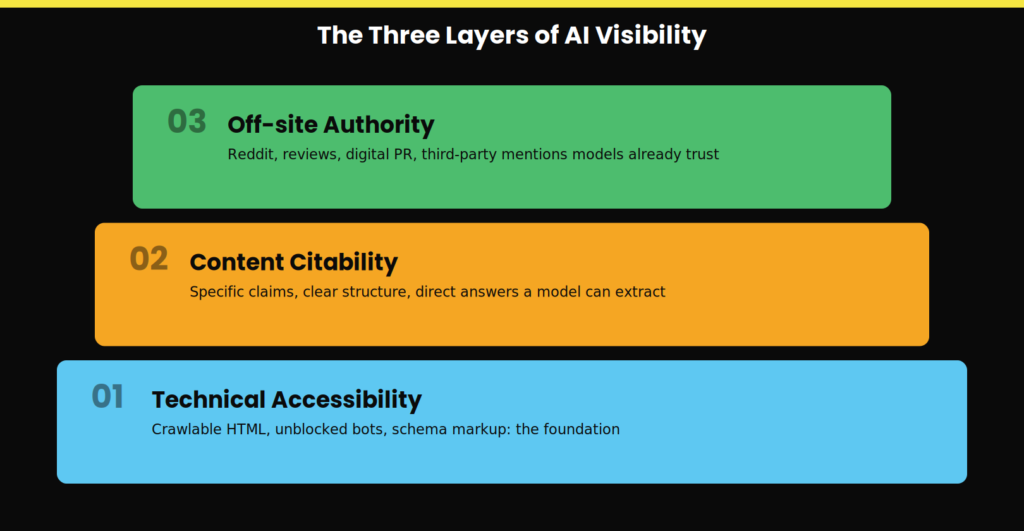
Layer 1: Technical accessibility
Before any content can be cited, AI crawlers need to be able to reach and read it. This layer is unglamorous but foundational, and skipping it undermines every other AI visibility effort built on top of it.
- Confirm AI crawlers can access your site. Check robots.txt is not accidentally blocking GPTBot, ClaudeBot, PerplexityBot, or Google-Extended.
- Use clean, semantic HTML. Content buried behind heavy JavaScript rendering is harder for many crawlers to extract than plain, well-structured HTML. The gap is wider than most teams assume: AI crawlers render JavaScript far less than Google does, so a page that looks fine in Search Console can be close to empty by the time ChatGPT reads it.
- Add schema markup. Structured data helps both traditional search engines and AI systems understand what a page is about, who wrote it, and how it relates to other entities. Our guide to the Google Knowledge Graph covers how entity data like this feeds into both classic and AI-driven search, and by extension, your overall AI visibility.
- Consider an llms.txt file. The protocol is still experimental and its impact is unproven, some agencies have publicly found it makes no measurable difference yet, but it costs little to implement and signals intent as the standard matures. Our full breakdown of what llms.txt is covers who is actually honouring it and whether it belongs on your list at all.
Layer 2: Content citability
This is where most of the actual writing work happens, and it overlaps directly with good SEO content writing practice generally, just with a sharper edge toward specificity that AI visibility demands.
- Lead with the direct answer. Put the clearest, most quotable version of your point in the first few sentences of a section, not buried at the end after three paragraphs of setup.
- Use real numbers, not vague claims. Specific data points get extracted. Generic marketing language does not, no matter how well it is written.
- Structure for extraction. Clear H2s and H3s, short paragraphs, and bulleted lists all make content easier for a model to parse into a clean citation.
- Answer the actual question being asked. Write content around the real questions your buyers type into AI tools, not just the keywords they type into Google. These often overlap but are not identical, and missing that distinction is part of why your ICP doesn’t read your blog in the first place, the content answers the wrong question for the wrong person.
If your team is producing this content in-house, plugging AI visibility checks into your existing B2B SaaS content calendar keeps this from becoming a one-off audit that nobody repeats.
Layer 3: Off-site authority
This is the layer with the highest leverage for AI visibility and the one most B2B SaaS companies invest in least.
- Earn mentions on sites models already trust. Digital PR, guest posts on established industry publications, and inclusion in comparison or “best of” content on other sites all build the off-site signal models rely on.
- Show up in community conversations. Reddit threads and forum discussions are disproportionately represented in the sources models cite, more than most brands expect from channels that feel low-priority. Review sites are the exception worth understanding: G2 and Capterra earn far fewer citations than the standard advice implies, and where they do land depends heavily on the engine and the query.
- Keep your positioning consistent everywhere. Your website, your G2 listing, your press mentions, and your social presence should describe your product the same way. Contradictions dilute the confidence a model assigns to any single claim, and by extension, your overall AI visibility.
- Track how AI tools currently describe you. You cannot fix a misrepresentation you have not found. Manually asking ChatGPT, Perplexity, and Gemini your own category questions is a free starting point before investing in dedicated tracking tools.
How to measure AI visibility
Traditional analytics were not built for this. Google Search Console shows nothing about ChatGPT. So here is what to track instead, starting with what is free before moving to paid tools. Worth setting expectations first: most AI visibility ROI numbers are guesses, and knowing which of these metrics survives a CFO conversation saves you reporting the wrong one for a quarter.
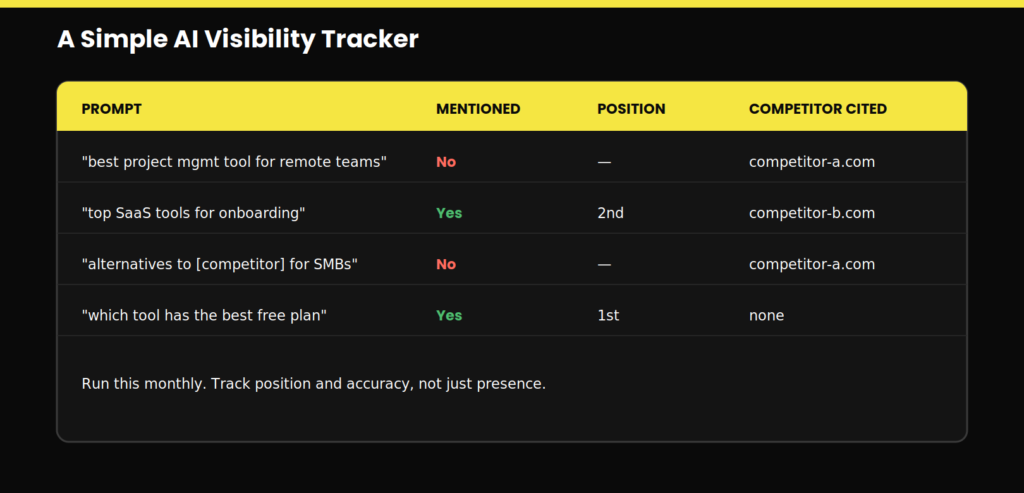
Manual prompt testing. Ask the AI tools your buyers actually use the questions they would ask when evaluating your category. Note whether you appear, in what position, and how accurately you are described. Do this monthly at minimum, since AI visibility shifts as models update.
Referral traffic from AI platforms. Check your analytics for sessions originating from chat.openai.com, perplexity.ai, and similar referrer domains. This tells you when AI-driven traffic actually converts into a site visit, which is the same pipeline-first lens covered in SaaS content marketing metrics that actually matter.
Share of voice against named competitors. Once you are tracking a consistent set of prompts, note who else gets mentioned alongside or instead of you. This is where dedicated AI visibility tracking tools start to earn their cost, since manual tracking does not scale past a handful of prompts. Our roundup of the best AEO tools for B2B SaaS covers which ones track share of voice properly and which just count mentions.
Citation accuracy, not just presence. Being mentioned is not the same as being described correctly. Track whether pricing, positioning, and feature claims that AI tools state about you are actually accurate.
Where to start building AI visibility this week
AI visibility rewards depth over breadth, so resist the urge to do a little of everything at once.
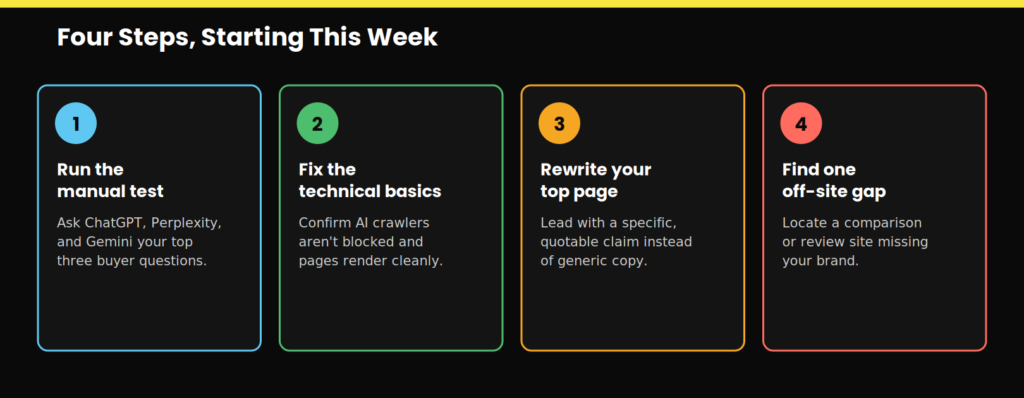
- Run the manual test. Ask ChatGPT, Perplexity, and Gemini the three questions your best-fit buyer would ask before choosing a vendor like you. Write down exactly what comes back.
- Fix the technical basics. Confirm AI crawlers are not blocked and your core pages are readable without heavy JavaScript dependency.
- Rewrite your most important page for extraction. Take your highest-intent page and rewrite the opening section to lead with a specific, quotable claim instead of a generic value proposition. Our best keyword research tools guide is a useful starting point if you are not sure which page to prioritize first.
- Identify one off-site opportunity. Find one comparison article, review site, or community thread where your category gets discussed and is missing your brand. Start there before trying to build a full digital PR program.
How AI visibility fits into a broader content strategy
AI visibility is not a separate discipline from the rest of your content program, rather, it is a lens that should run through all of it. The same topical authority principles that help you rank in Google also help you get cited in AI answers, because both systems reward comprehensive, well-linked coverage of a subject over scattered, isolated posts. That is also the logic behind topic clusters over keyword lists: a single optimized page will always lose to a connected body of work that proves genuine expertise.
If your team is trying to build this in-house, start by auditing your B2B SaaS SEO strategy for the technical and content gaps this guide covers. From there, treat AI visibility as an ongoing part of building your SaaS content engine, not a one-time project that gets audited once and forgotten.
If you would rather bring in outside help, our best AI SEO agencies guide breaks down real agencies, real pricing, and which ones fit which stage of company. For broader agency options that also fold in AI visibility as part of a wider mandate, best SaaS content marketing agencies, best B2B SEO agencies, and best AI marketing agencies are all worth comparing against a pure AI-visibility specialist, since the right fit depends on how much of your broader content operation you want under one roof. Earlier-stage companies may find best SEO agencies for startups a better budget fit for the same underlying work.
And measurement matters here just as much as it does anywhere else in content. Our SaaS content marketing metrics guide covers how to connect any content initiative, AI visibility included, back to pipeline instead of vanity numbers.
The bottom line on AI visibility
AI visibility is not a trend to bolt onto your existing content plan. It is a real shift in how buyers form their shortlist, and it rewards the same fundamentals that have always mattered: specific claims, real structure, and genuine authority, just measured against a new set of engines.
The companies that treat AI visibility as a technical checkbox will get partial credit. The companies that treat it as a real content and authority discipline, the way they would treat SEO five years ago, will be the ones AI tools actually recommend, cite, and send buyers to.
Want a clear-eyed audit of where your AI visibility currently stands, and what it would actually take to close the gap? Book 30 minutes with Rashmita. No pitch deck, no pressure.

Jay is the co-founder of LymLyt and an AI partnership consultant helping B2B SaaS companies grow through content strategy, SEO, and AI integration. He writes about content marketing, what makes B2B content convert, and how SaaS teams can build content systems that drive real pipeline.