B2B Positioning: 12 Overused Claims and What to say Instead
Open five competitor homepages in your category. Count how many say “all-in-one,” “AI-powered” or “seamless.” That’s the B2B positioning problem in one exercise: most companies describe themselves with the same words, so buyers can’t tell them apart.
It costs more than you’d think. PitchKitchen’s 2026 State of B2B Homepage Messaging scored 250 homepages against a messaging rubric. Only two named a concrete cost of inaction. Pages with no AI mentions in the hero averaged 24 out of 36, while pages with three or more averaged 12 (PitchKitchen). (The scoring was done by an AI model against the rubric, so treat the numbers as directional.)
This guide covers 12 claims that show up on almost every B2B site, why each one fails and what to say instead. You’ll also get a simple test for your own homepage and a framework to find positioning that’s actually yours.
What is B2B positioning?
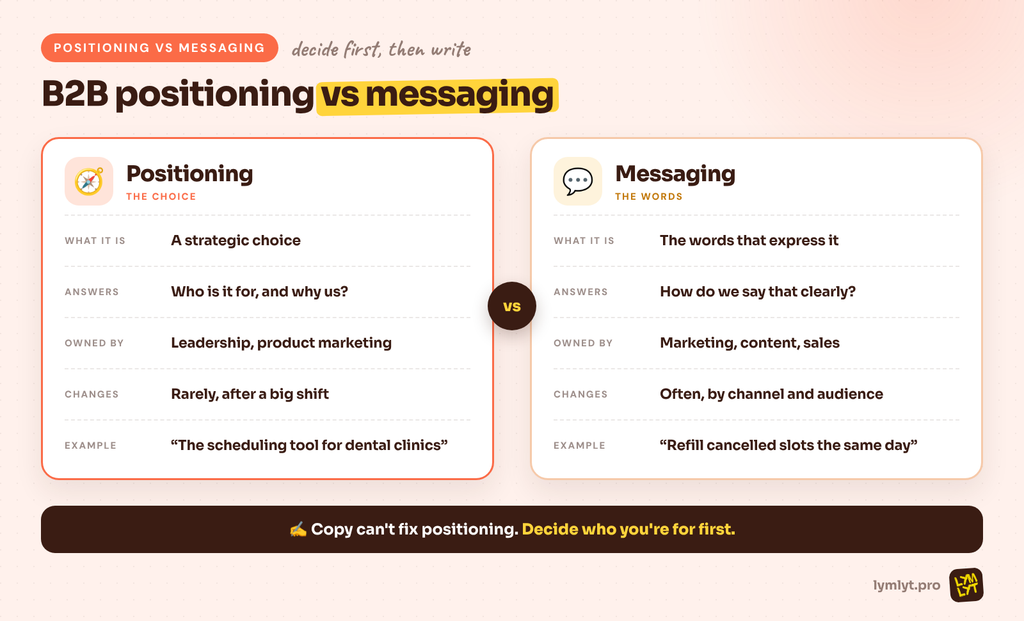
B2B positioning is the choice of who you’re for, what you replace and why you’re the better option for them. It’s a strategic decision, made before anyone writes a headline.
Messaging is how you express that decision in words. Positioning comes first; a messaging framework turns it into copy.
| Positioning | Messaging | |
|---|---|---|
| What it is | A strategic choice | The words that express it |
| Answers | Who is it for, and why us over the alternatives? | How do we say that clearly? |
| Owned by | Leadership, product marketing | Marketing, content, sales |
| Changes | Rarely, after a big shift | Often, by channel and audience |
| Example | “The scheduling tool for dental clinics, not every business” | “Refill cancelled slots the same day” |
Why B2B positioning turns generic
Nobody sets out to sound like everyone else. It happens for a few predictable reasons:
- Copying competitors. Teams study the category leader’s site and borrow its language.
- Fear of excluding anyone. Saying who you’re for feels like saying who you’re not for.
- Committee edits. Every reviewer softens one specific claim until nothing specific is left.
- No clear ICP. If you don’t know your best customer, you can’t write for them. Start with our guide on how to build an ideal customer profile.
- Feature-first thinking. Describing what the product does instead of what changes for the buyer.
The 12 overused B2B claims, and what to say instead
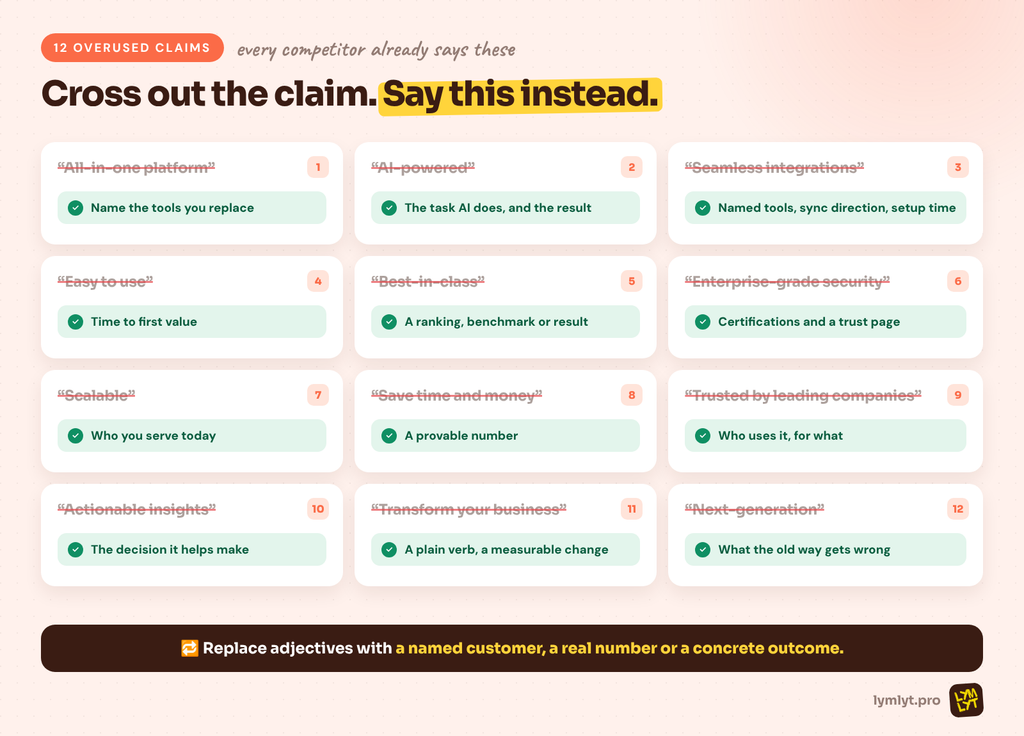
Each claim below is fine as an internal shorthand. On your homepage, it reads as noise. The examples are fictional, to show the pattern.
1. “All-in-one platform”
- Why it fails: it promises everything, so it proves nothing. Buyers assume each part is weaker than a specialist tool.
- Say instead: name the tools you replace and for whom.
- Example: “Replace your booking form, reminder app and waitlist spreadsheet with one tool built for clinics.”
2. “AI-powered”
- Why it fails: in 2026, almost every product says it. “AI-powered” describes how you built it, not what the buyer gets.
- Say instead: the task the AI does and the result.
- Example: “Drafts a reply to every support ticket in your tone. Agents edit and send.”
3. “Seamless integrations”
- Why it fails: every vendor says it, and every buyer has been burned by an integration that wasn’t.
- Say instead: name the integrations, the direction of sync and the setup time.
- Example: “Two-way sync with Salesforce and HubSpot. Set up in 15 minutes, no developer needed.”
4. “Easy to use” or “intuitive”
- Why it fails: no vendor claims to be hard to use. It’s an expected baseline, not a difference.
- Say instead: time to first value, or who can use it without training.
- Example: “Your sales team sends their first sequence on day one. No training call required.”
5. “Best-in-class” or “industry-leading”
- Why it fails: it’s an opinion with no proof attached. Buyers skip it.
- Say instead: the evidence: a ranking, a benchmark, a customer result.
- Example: “Rated highest for ease of setup by 400 reviewers on G2.” (Only if it’s true and current.)
6. “Enterprise-grade security”
- Why it fails: security reviewers don’t trust adjectives. In G2’s 2026 Buyer Behavior Report, IT security review was the biggest delay after selection for 39% of software buyers, and 50% of enterprise buyers (G2 via Webull).
- Say instead: the certifications and policies, with a link to your trust page.
- Example: “SOC 2 Type II and ISO 27001. Data stays in your region. See our security docs.”
7. “Scalable” or “grows with you”
- Why it fails: it’s vague and future-tense. Buyers care about now.
- Say instead: the size of customers you serve today, and what changes as they grow.
- Example: “Used by teams of 5 and 5,000. Pricing stays per seat; features don’t get locked behind tiers.”
8. “Save time and money”
- Why it fails: everything claims to. Finance wants a number. G2’s 2026 report found 49% of software buyers had a CFO veto an already-approved purchase in the past year (G2 via Webull).
- Say instead: a specific, provable outcome, ideally from a customer. Finance, IT and end users each need different proof; our guide to the B2B buying committee covers what each role looks for.
- Example: “Customers cut month-end close from 10 days to 4. Here’s how Acme did it.”
9. “Trusted by leading companies”
- Why it fails: a logo wall without context tells buyers nothing about fit.
- Say instead: who uses it, for what, with a short result.
- Example: “Used by 120 Series B fintechs to pass their first bank audit.”
10. “Actionable insights”
- Why it fails: every dashboard claims this. “Insights” is not a job anyone is hired to do.
- Say instead: the decision the data helps make.
- Example: “See which accounts will churn next quarter, and why, before renewal calls start.”
11. “Transform,” “supercharge” or “unlock” your business
- Why it fails: big verbs with no object. They sound like every other SaaS homepage.
- Say instead: a plain verb and a measurable change.
- Example: “Cut onboarding from three weeks to three days.”
12. “Next-generation” or “reimagined”
- Why it fails: it says you’re newer, not better. Buyers don’t buy “new”; they buy “less risk” or “more result.”
- Say instead: what the old way gets wrong, and what you do differently. Salesforce did this well in 2000 by attacking on-premise software head-on with its “No Software” campaign (our breakdown).
- Example: “Spreadsheets break at 50 reps. We were built for the forecast call, not for data entry.”
The swap test: is your positioning really yours?
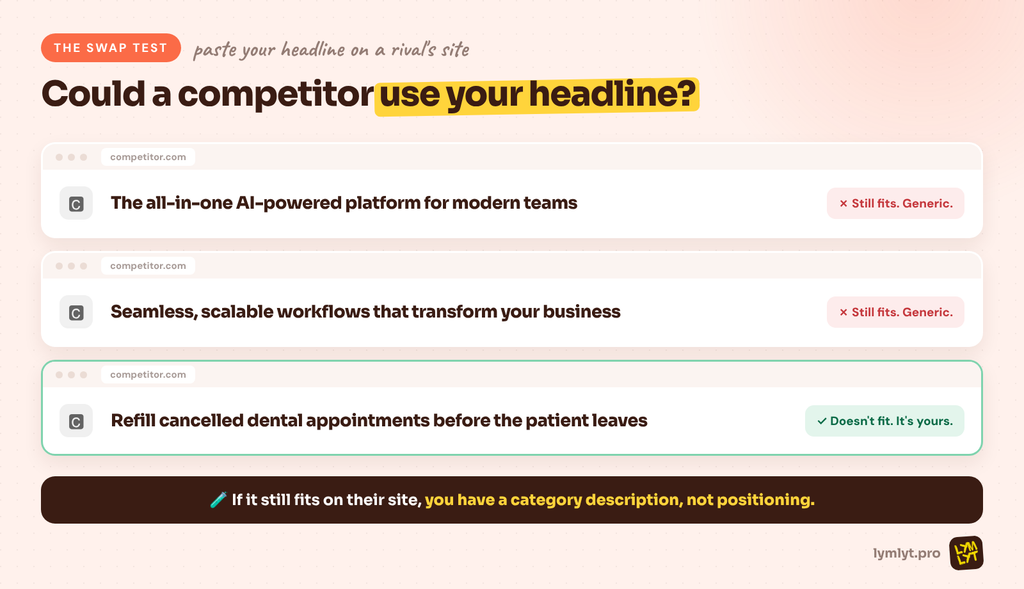
Take your homepage headline and subheadline. Paste them onto a competitor’s homepage. Would they still make sense?
If yes, you don’t have positioning. You have category description. Run these four checks:
- The swap test: could a competitor use this line unchanged?
- The “so what” test: after reading, does the buyer know what changes for them?
- The proof test: is every claim backed by a number, name or example?
- The reader test: does it name a specific buyer or situation?
How to find positioning that’s actually yours
A good framework helps here. April Dunford’s Obviously Awesome breaks positioning into five parts. Work through them in this order:
- Competitive alternatives. What would customers use if you didn’t exist? Often it’s a spreadsheet, an agency or “do nothing,” not another vendor.
- Unique attributes. What do you have that those alternatives don’t? Features, a model, expertise.
- Value. What does each attribute make possible for the customer? Turn features into outcomes.
- Target customers. Who cares most about that value? This is where your ICP comes in.
- Market category. What frame makes your value obvious? Pick the category where you win, not just the biggest one.
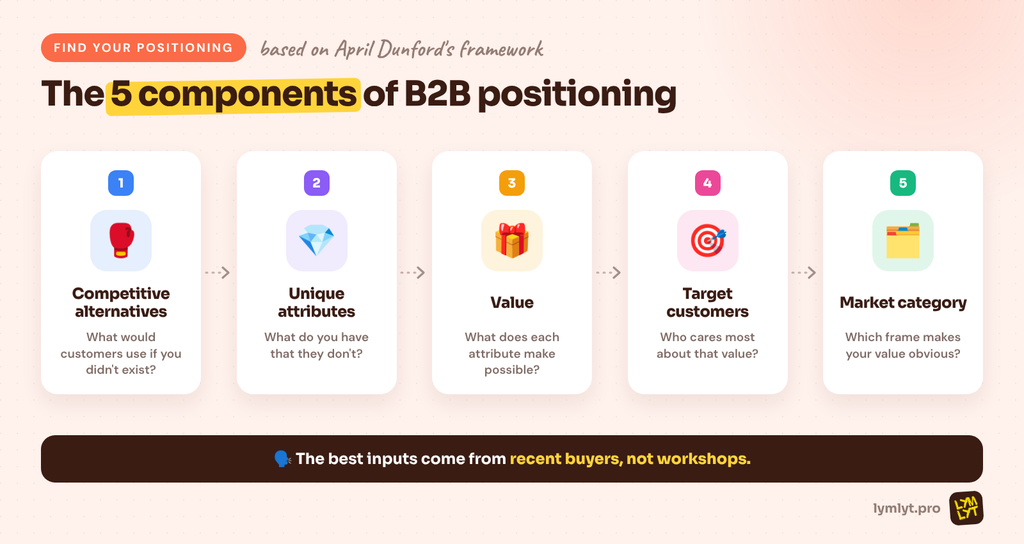
The best inputs come from customers, not workshops. Read win-loss notes, interview recent buyers and ask: “What would you have done if we didn’t exist?” Our list of the best competitive intelligence tools covers software that helps with this.
A simple B2B positioning statement template
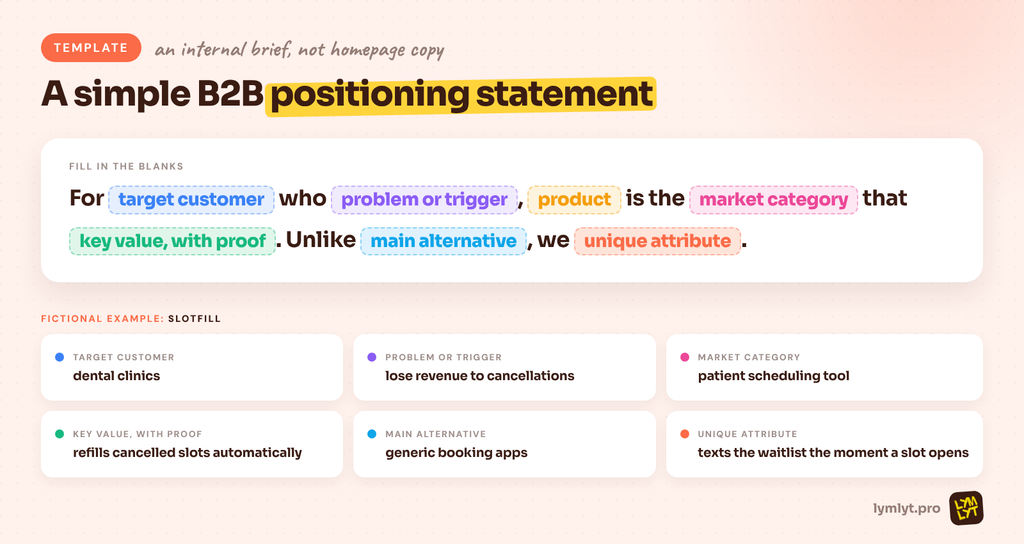
Once you’ve worked through the five parts, write one internal statement. It’s not homepage copy. It’s the brief your copy has to deliver on.
For [target customer] who [problem or trigger], [product] is the [market category] that [key value, with proof]. Unlike [main alternative], we [unique attribute].
Example (fictional): For dental clinics that lose revenue to last-minute cancellations, SlotFill is the patient scheduling tool that refills cancelled appointments automatically, with clinics recovering an average of 11 slots a month. Unlike generic booking apps, we text waitlisted patients the moment a slot opens.
Where your positioning should show up
Positioning that lives in a slide deck changes nothing. Check these places first:
| Asset | What to check |
|---|---|
| Homepage hero | Does it pass the swap test? See our guide to writing homepage content |
| Landing pages | Is each one written for a specific segment? Here are the elements of a high-converting landing page |
| Comparison pages | Do they name the alternative honestly? See why losing a row on a vs page can win the deal |
| Sales deck | Does slide two match the homepage? |
| AI answers | What do ChatGPT and Perplexity say you’re for? Run an AI visibility audit |
That last one matters more every year. Buyers now ask AI tools to compare vendors (see the four shortlist prompts buyers ask before deciding), and those tools repeat whatever your site says. If your site says “all-in-one AI-powered platform,” that’s what they’ll repeat.
The bottom line
Strong B2B positioning is specific. It names who you’re for, what you replace and why you’re better for them, with proof. The 12 claims above are the fastest way to spot where your site has drifted into generic. Replace each one with a named customer, a real number or a concrete outcome, and run your headline through the swap test.
If you want help with the words, our team writes landing pages for B2B SaaS built on your positioning, or compare options in our list of the best SaaS landing page copywriting services.

Jay is the co-founder of LymLyt and an AI partnership consultant helping B2B SaaS companies grow through content strategy, SEO, and AI integration. He writes about content marketing, what makes B2B content convert, and how SaaS teams can build content systems that drive real pipeline.