The B2B Buying Journey Starts Before Your Marketing Funnel Does
Imagine you need a new tool for your team.
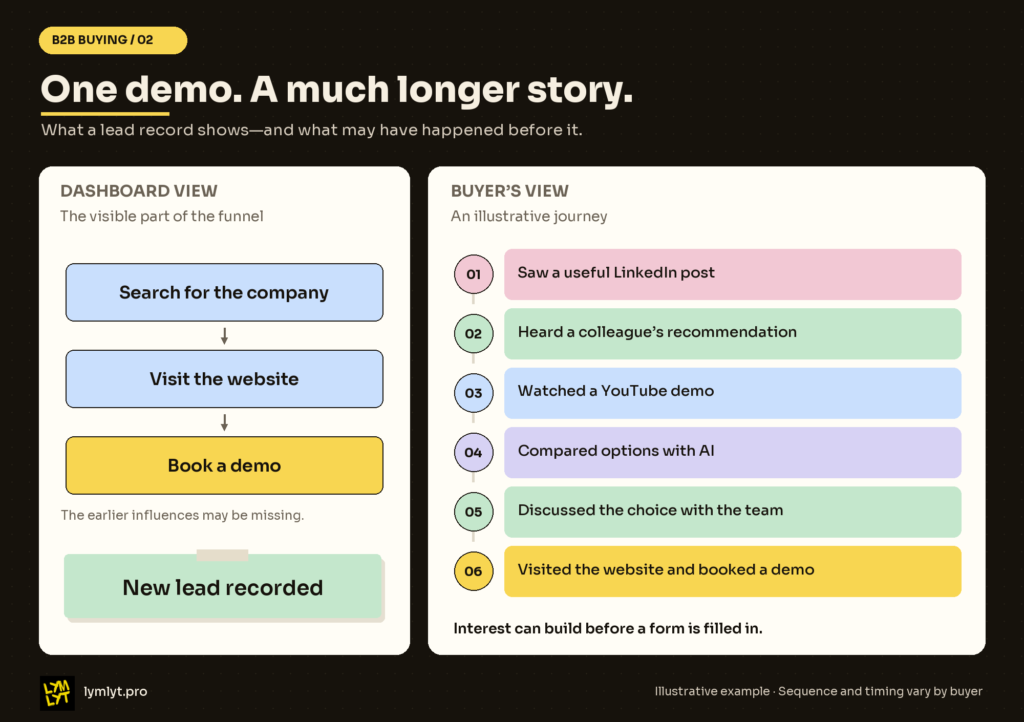
You remember a company you have seen on LinkedIn. A colleague suggests another. You watch a product video on YouTube, read a Reddit discussion, and ask an AI tool to compare the options.
Then you visit a website and book a demo.
For the company, you have just entered the marketing funnel. For you, the decision has been taking shape for a while.
This is an example, but it points to a real gap: the first action a company can track may happen well after the buyer starts forming an opinion.
What has changed
| Familiar marketing assumption | What a buyer may actually do | What to look at |
|---|---|---|
| A website visit starts the journey | Hear about you through a peer or a social post first | Reported discovery alongside website sources |
| A download means buying interest | Read to learn, with no current purchase planned | Company fit and evidence of a real problem |
| One lead represents one decision | Share research with several colleagues | People involved in the same buying project |
| The final click explains the sale | Return through search after weeks of other influences | Tracked actions, buyer accounts, and business outcomes |
These are possible patterns, not a fixed journey everyone follows.
The funnel shows what the company can see
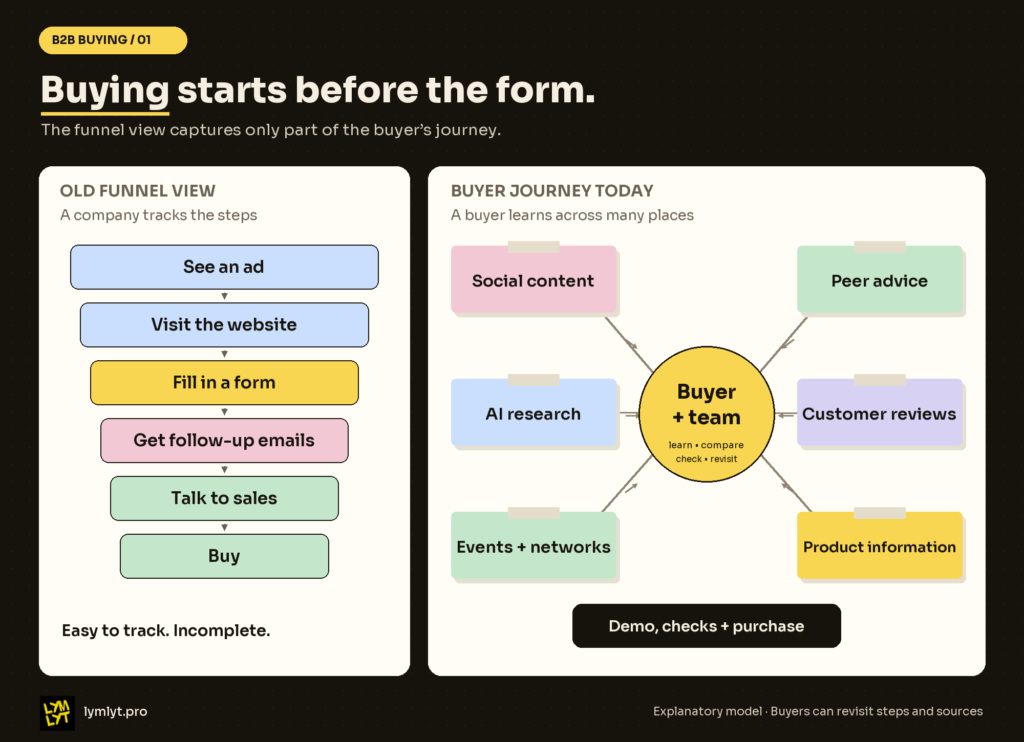
A marketing funnel describes how someone moves from hearing about a company to becoming a customer. The familiar picture looks something like this:
See an ad → Visit a website → Fill in a form → Get follow-up emails → Talk to sales → Buy.
That picture is useful. It helps teams organize their work and track progress. LymLyt’s guide to mapping content to the SaaS funnel explains how different content helps buyers at different stages.
The difficulty starts when we assume the picture describes everything a buyer does.
Someone can learn about your product, hear good things about your team, and decide you are worth considering without filling in a single form. Someone else can download three guides and have no plans to buy.
Both are real people. Your dashboard may make the second person look more interested.
Buyers can have a shortlist before sales gets involved
A shortlist is simply the small group of companies a buyer is seriously considering.
In 6sense’s 2025 research, which studied nearly 4,000 B2B buyers, the winning vendor was on the buyer’s initial shortlist 95% of the time. These were often substantial purchases: the median annual purchase value was between $200,000 and $300,000.
That makes getting considered early an important part of marketing.
If a buyer already knows three companies that seem capable, the next search may help them compare those companies. A company they have never heard of has more work to do to earn a place.
This helps explain why a good sales conversation sometimes feels too late. The buyer may arrive with a favorite, and use the conversation to check whether that preference holds up.
AI gives buyers another way to do their homework
Buyers can now ask an AI tool questions such as:
- Which tools are suitable for a team our size?
- How do these two products compare?
- What problems do customers report?
- What should we ask before signing up?
AI can organize information that would otherwise take several searches and many open tabs.
In G2’s 2025 survey of 1,169 B2B decision-makers, nearly eight in ten respondents said AI search had changed how they researched software. Twenty-nine percent said they started research with tools such as ChatGPT more often than with Google.
Yet research is only part of buying. In the same 6sense study, widespread AI use had not reduced buyers’ reliance on vendor interactions or third-party experts. People still needed to check what they were being told.
For marketers, this adds another question: what will buyers learn about us when they research without speaking to us?
LymLyt’s guide to the questions buyers ask AI before deciding is a useful way to explore that question.
Social media can make a company familiar before there is a project
People do not spend every working day shopping for software or choosing an agency. They still encounter ideas, experts, and companies that they may remember later.
A useful LinkedIn post can explain a problem they recognize. A YouTube demonstration can show how a product works. An Instagram video can introduce a customer or make a complicated idea easier to understand.
For example, StoryChief documents a Notion Instagram video featuring its customer Loom at work. It is a simple example of using a social feed to show the people and work connected to a business product.
Each format gives a buyer a different opportunity to get to know a company. Which ones deserve investment depends on where your buyers spend time and what they need to understand.
This also extends beyond the person who eventually books the demo. Edelman and LinkedIn’s 2025 research examines “hidden buyers”: people who influence a purchase without being the obvious sales contact. They also read and evaluate expert content.
A useful post might reach the colleague who later says, “We should take a look at this company.”
“Hidden buyers actively discover, consume, and evaluate thought leadership just like target buyers.”
— Edelman–LinkedIn, 2025 B2B Thought Leadership Impact Report
A recommendation can change the starting point
When a decision affects your budget, your team, and your reputation, it makes sense to ask someone you trust.
That has always been part of B2B buying. AI has joined a process that already includes personal judgment and other people’s experience.
In a LinkedIn post about his Exit Five community, Dave Gerhardt shared a member’s question about whether to renew ZoomInfo or consider Cognism or Apollo. The member was asking peers for advice on a real purchasing decision.
A Reddit discussion about research before website visits raises another useful point. The person who started the thread said they often asked AI about brands they had already heard of. They then asked where people learn about products before actively researching them.
These are individual accounts, but they illustrate something easy to miss: discovery can happen through people and everyday exposure before someone starts a formal search.
A conference conversation or a customer introduction can serve the same purpose. It gives a company a place in someone’s mind before there is a sales opportunity to record.
Why the lead numbers can tell an incomplete story
A marketing-qualified lead, or MQL, is a person whose actions meet a company’s rules for further sales attention. Those rules often include downloads, registrations, or repeated website visits.
Now consider a buyer who watches your videos, discusses your product with a colleague, and reads a comparison elsewhere. They may be interested, but none of that necessarily produces an MQL.
This does not explain every fall in lead volume. It does explain why fewer form fills alone cannot tell you whether fewer people are considering you.
The reverse matters too. More registrations do not automatically mean more people are ready to buy.
In another LinkedIn post, Gerhardt describes social posts, videos, newsletters, and community interactions building familiarity over time. His point is that the eventual sale can be easier to record than the full set of influences behind it.
Marketing still needs to connect its work to business results. Doing that well means looking at qualified opportunities and revenue, while also asking customers what helped them discover, consider, and choose you.
How should attribution work when parts of the journey are invisible?
Attribution means assigning credit to marketing interactions for a result. It helps answer “which recorded activities get credit?” It does not automatically answer “what caused this person to buy?”
Google Analytics describes attribution as assigning credit using rules or a data-driven model. Those models work with the information available to the system. A different model cannot, by itself, reconstruct a conversation between colleagues that was never recorded.
Imagine a buyer discovers you through a founder’s LinkedIn post, receives a recommendation, and later searches your name. An attribution report may credit search. That can be a useful record of the visit while leaving the earlier influences unexplained.
Keep the tracking. Add evidence around it.
| Evidence | What it can help answer | What it cannot settle on its own |
|---|---|---|
| Tracked visits and campaign activity | How did a recorded visit or action happen? | Every earlier influence on the buyer |
| Buyer interviews and “how did you hear about us?” answers | What does the buyer remember helping them? | The exact contribution of each activity |
| Qualified opportunities, wins, costs, and deal timing | Is the business getting suitable demand at a workable cost? | Which channel caused a change |
| A well-designed test with a comparison group | Did this activity create additional results? | Whether the result applies to every audience or future period |
The last row is about incrementality: what happened because of the activity that would not otherwise have happened. Google’s Conversion Lift explanation illustrates this with groups that do and do not receive ads. Tool eligibility and enough data matter; not every small B2B program can run a useful lift study.
For a smaller team, start with a consistent tracking setup, a few buyer questions, and one report linking spending to qualified opportunities and customers. Use longer windows for longer sales cycles. Review a group of opportunities over time, rather than judging a program from one sale.
Ask buyers where they first heard about you, what put you on their shortlist, and what gave them confidence to proceed. Keep their answers separate from the tracked source. Memory has gaps too, so neither record should overwrite the other.
Leave genuinely unknown sources unknown. “Direct” traffic does not prove word of mouth. A rise in branded searches can be encouraging, but it does not prove which activity produced it.
Where you can run a fair test, use it to improve confidence. Where you cannot, compare the evidence and state what remains uncertain. Harder attribution calls for better judgment and measurement, not a blank cheque for marketing.
What should marketing do differently?
Start with the questions a buyer needs answered, including before they contact you.
- Help people understand their problem. Publish explanations and examples they can use in their work.
- Make your expertise easy to encounter. Share useful ideas where your buyers already spend attention.
- Help people compare honestly. Explain who your product suits, what it does well, and where another option may fit better. LymLyt’s guide to honest comparison pages explores this approach.
- Make proof easy to share. Provide customer stories, demonstrations, and clear answers a buyer can send to colleagues.
- Ask about the journey. “How did you first hear about us?” and “What made you include us?” can reveal different parts of the same decision.
You still need a clear website, useful follow-up, and a good sales process. They become more helpful when buyers can arrive informed and confident.
Becoming a lead is one moment in the buying journey. Marketing has work to do well before that moment.
Before your next campaign, ask: if someone needed our kind of solution next month, what would make them think of us today?
Frequently asked questions
Is the marketing funnel still useful?
Yes. It helps organize visible stages and follow-up. Use it alongside a fuller view of discovery, research, recommendations, and the people involved in the decision.
Should we stop tracking clicks and form fills?
No. They help diagnose distribution and conversion. Connect them with buyer fit, qualified opportunities, and customer feedback so they do not become the only definition of success.
How can we justify marketing we cannot attribute to a sale?
Set out its job, the audience, the cost, the expected signals, and the review period before investing. Look for relevant audience response and commercial progress; use buyer accounts and controlled tests where practical. If evidence remains weak, adjust the program. A missing last-click conversion is not proof of no value, and claimed influence is not proof of value.

Rashmita is content marketer with 8 years of experience building and growing SaaS brands. Now she tests various AI tools for marketers and shares her feedback on this blog, LinkedIn, Instagram, and YouTube.