Original Statistics and AI Citations: Do They Help?
The link between original statistics and AI citations comes up in nearly every GEO checklist: add numbers to your content and AI engines will quote you more. The advice traces back to one academic paper, which found that adding statistics lifted a page’s visibility in AI answers by 30% to 40%. It is a real study, peer reviewed and widely cited.
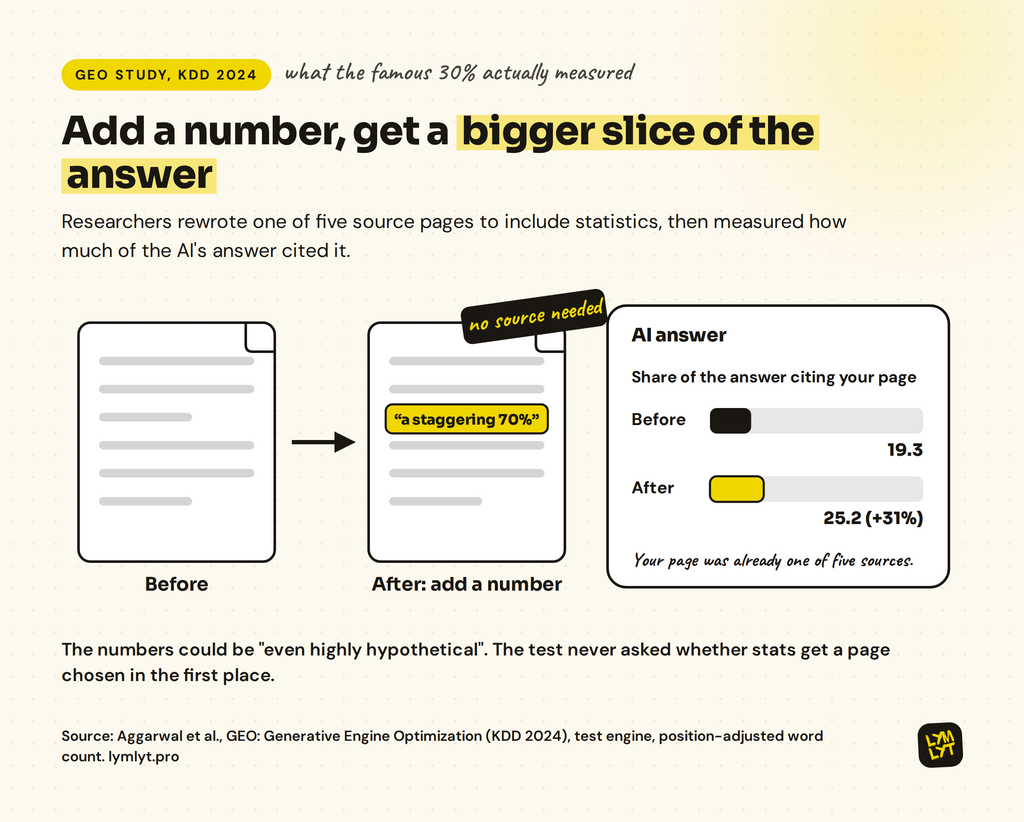
Read the method, though, and two things stand out. The statistics did not have to be original, or even real: the researchers’ rewriting instructions allowed hypothetical numbers. And the study measured how much space a page got inside an answer, among pages the engine had already picked, not whether it got picked in the first place.
So what is the real link between original statistics and AI citations? Below is what the research shows, what it does not, what we saw in our own tracking, and how to publish numbers that earn citations for the right reasons.
The short answer:
| Question | What the evidence says |
|---|---|
| Does adding statistics increase AI visibility? | In lab tests, yes. Statistics Addition lifted visibility about 30% in the original GEO study |
| Did those statistics have to be original? | No. The method allowed hypothetical figures |
| Do AI-cited pages carry more statistics? | Yes. About 4.2 per article against 1.2 for uncited ones, in one B2B SaaS dataset |
| Does that prove statistics cause citations? | No. That data is observational |
| What makes original statistics worth it? | Other pages have to cite you to repeat them, and the number travels with your name |
Where “add statistics to get cited” comes from
The source is “GEO: Generative Engine Optimization” by Aggarwal and colleagues from Princeton and IIT Delhi, published at KDD 2024 (arXiv). It is the paper that named GEO.
The researchers built a benchmark of 10,000 queries called GEO-bench. For each query, they took the top five Google results, rewrote one of them using a specific method, and measured how visible that page became in the answer an AI model generated. They tested nine methods, including Statistics Addition, Quotation Addition, Cite Sources and Keyword Stuffing (GEO paper).
Here is how Statistics Addition performed, measured against unmodified pages:
| Test setup | Position-adjusted word count | Subjective impression |
|---|---|---|
| Their test engine (GPT-3.5 answering from top five Google results) | 25.2 vs 19.3 baseline, about +31% | 23.7 vs 19.3, about +23% |
| Perplexity, a live engine | 26.2 vs 24.1, about +9% | 33.9 vs 24.7, about +37% |
| Keyword Stuffing, for comparison | 17.7 vs 19.3, worse than doing nothing | Not a top method |
The headline “up to 40%” comes from the best method on the best metric. Statistics Addition sits in the 30% range on the main metric, and its gain on live Perplexity was much smaller on word count.
What the study did not test
Before you add a number to every paragraph, read the method.
- The statistics could be made up. The rewriting prompt asked for compelling statistics, “even highly hypothetical” ones (GEO paper, v2). One example the paper highlights added “a staggering 70% increase in robotic involvement in the last decade” to a page, with no source, and visibility rose 65.5%.
- It measured share of the answer, not selection. Every page tested was already one of the five sources the engine read. Visibility meant how many words of the answer cited that page. Whether statistics help a page get chosen at all was never tested.
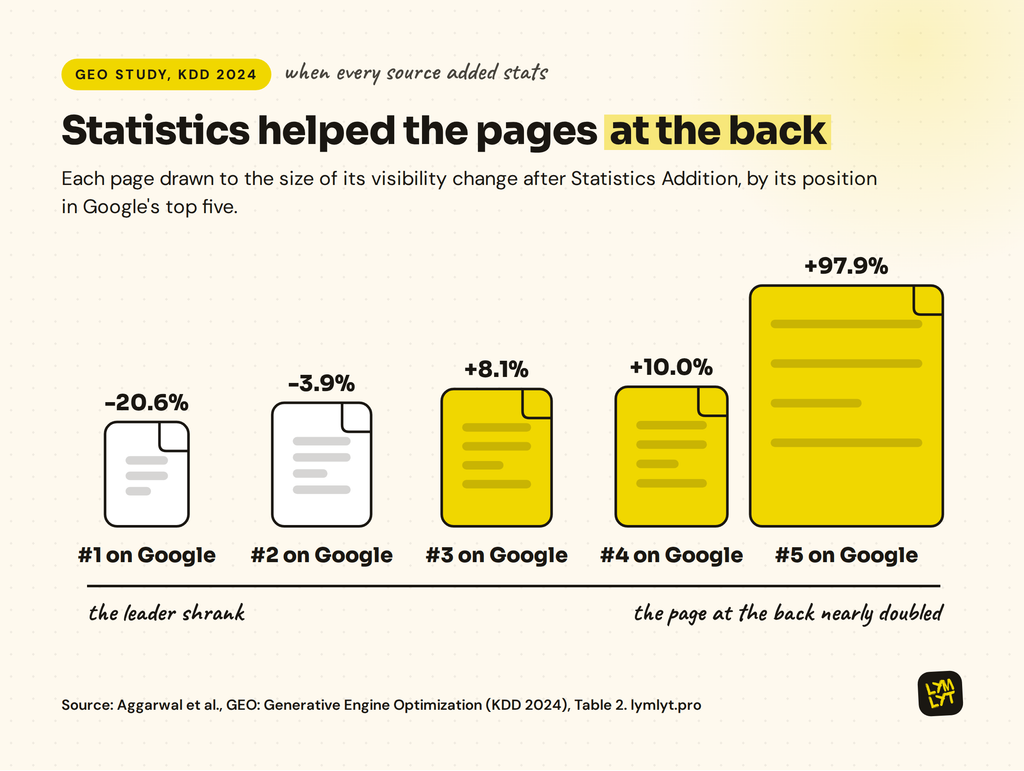
- It mostly helped pages that were already behind. When every source was rewritten at once, Statistics Addition raised visibility 97.9% for the fifth-ranked page and cut it 20.6% for the first-ranked one.
- Results varied by topic. Statistics helped most on law and government, debate and opinion queries.
So the study shows that AI answers lean on specific, quantified sentences. It does not show that original statistics earn citations, because originality was never part of the test.
What the correlation data adds
Large datasets point the same way, with the usual caveat. Citera’s 2026 analysis of about 350,000 B2B SaaS articles found that AI-cited articles averaged 4.2 statistics, against 1.2 for articles that were not cited (Citera).
That is a big gap, but Citera calls its comparisons observational and not controlled for domain authority. Pages full of data also tend to be longer, better researched and published by stronger sites. Reading “cited articles have more stats” as “add stats to get cited” is the correlation-to-causation drift we traced in the AI citation telephone game.
Put the two studies together and you get a narrower, more useful claim: statistics make a page easier for an AI engine to quote. Neither study shows that the numbers need to be yours.
Original vs borrowed: what our own tracking showed
We are tracking how fast AI engines notice our newest articles. One early result cuts straight to this question.
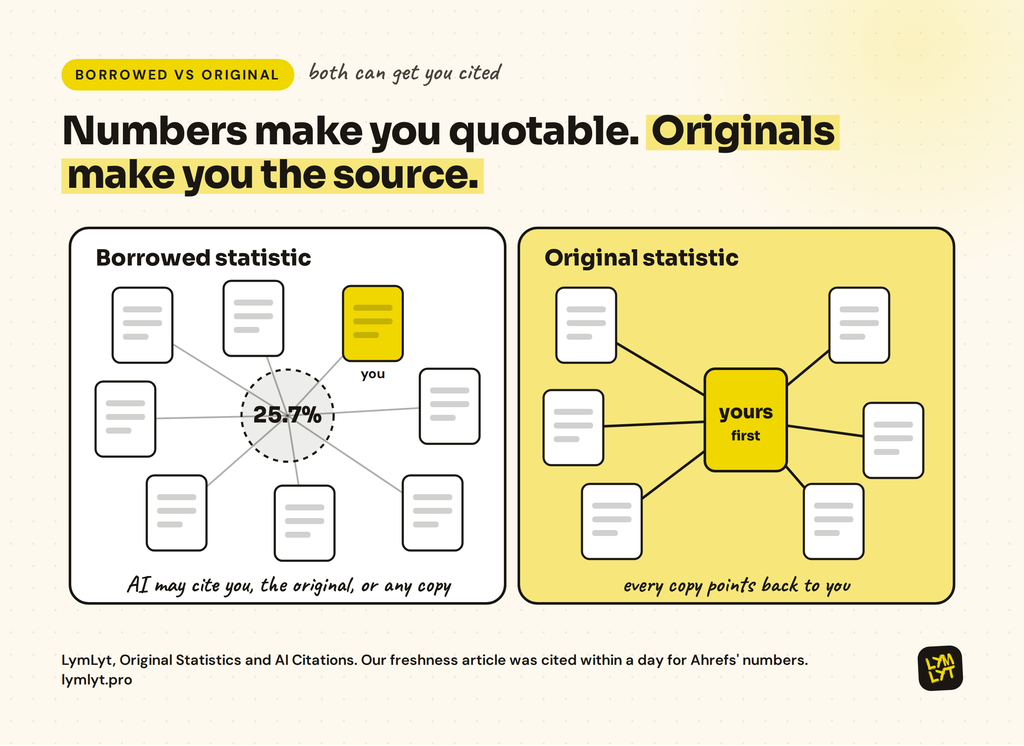
Within a day of publishing our content freshness article, Google AI Mode cited it in an answer about freshness and AI citations. The numbers it quoted from us, like ChatGPT citing pages up to 458 days newer than Google’s results, came from Ahrefs’ research, not ours. We were cited as the source for someone else’s statistics.
In the same test, ChatGPT told a user that LymLyt “cites” two freshness figures from an older post of ours, statistics we did not produce. The numbers traveled with our name attached.
Two lessons follow:
- Borrowed statistics can win you citations, because AI engines often cite the page that explains a number clearly, not the one that produced it. Roundups like our AI SEO statistics page work this way. The Tow Center found AI search tools regularly cited copies of articles instead of the originals (source).
- Original statistics win you something better. When the number is yours, every copy has to point back to you, and the claim stays attached to your brand across every retelling.
What makes a statistic citable
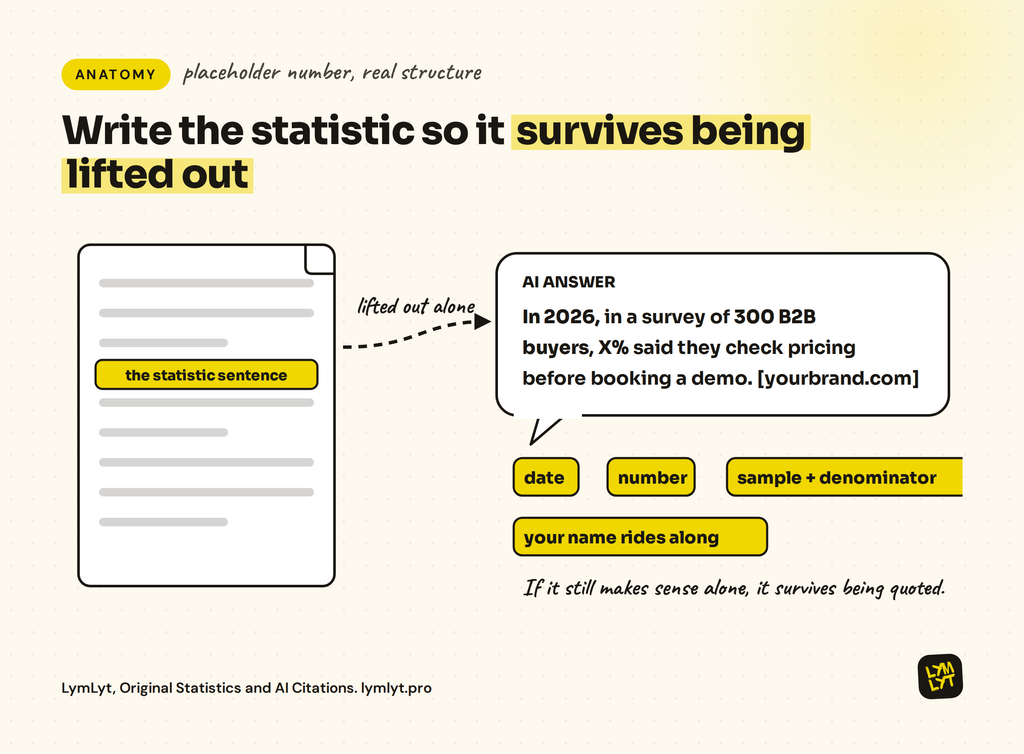
Whether a number is yours or borrowed, it gets quoted correctly only if it survives being lifted out of your page. Write each one so it can stand alone:
| Element | Example | Why it matters |
|---|---|---|
| One complete sentence | “In a 2026 survey of 300 B2B buyers, X% …” | AI engines quote sentences, not paragraphs |
| The denominator | “X% of the 300 buyers we surveyed” | Without it, the number drifts |
| The date | “In 2026” in the same sentence | Stops the year changing as it is copied |
| The method, nearby | Sample, dates, what was tested, in plain text | Lets engines and readers trust it |
| Visible on the page | Not only in a chart image or markup | AI chatbots read visible text, as our schema markup study found |
| Something only you know | Your product data, your survey, your test | The only kind of number every copy must credit |
Where B2B SaaS teams get original statistics
Original data does not need a research department. Most B2B SaaS teams already sit on some:
- Product usage data. Aggregated and anonymised, for example how many teams use a feature or how long setup takes.
- Customer outcomes. Results from your case studies, pooled across customers.
- Small surveys. Fifty to three hundred responses from your audience, with the sample stated.
- Repeatable tests. Running the same queries across AI engines, as we did in our pricing prompts study, our AI comparison queries study and our B2B SaaS AI citation study.
- Sales and support patterns. The objections or questions that come up most, counted.
One rule overrides the rest: never invent a number to fill a gap. The GEO study rewarded hypothetical statistics because its test engine could not check them. Live AI engines repeat whatever they find, so a made-up figure on your page becomes a made-up figure in an answer, with your name on it.
FAQ
Do statistics help AI citations? In lab tests, adding statistics raised a page’s visibility in AI answers by about 30% in the original GEO study. That measured how much of an answer cited the page, among pages already selected, not whether statistics get a page selected.
Do the statistics have to be original? Not for the visibility effect in the study, which allowed hypothetical figures. Originality matters for a different reason: other pages have to cite you to repeat your numbers.
Do AI-cited pages contain more statistics? Yes. In Citera’s 2026 B2B SaaS dataset, AI-cited articles averaged 4.2 statistics against 1.2 for uncited ones. The data is observational, so it does not prove the statistics caused the citations.
Can borrowed statistics still get my page cited? Yes. In our own tracking, Google AI Mode cited our article within a day for numbers that came from Ahrefs. AI engines often cite the page that explains a number clearly.
How should I present original statistics so AI quotes them correctly? Put each statistic in one complete sentence with its denominator, sample and date, in visible text, with the method on the same page.
Conclusion: numbers make you quotable, originals make you the source
The case for original statistics and AI citations is stronger than the hype and narrower than the checklists. The famous 30-40% lift came from adding numbers of any kind, real or not, to pages AI had already chosen. What original data adds is ownership: when the number is yours, every page that repeats it has a reason to point back to you.
Publish fewer numbers, make each one yours where you can, and write it so it survives being copied.
We build research-led B2B SaaS content with original data that AI engines quote and credit. See how we approach AI visibility.
Sources

Jay is the co-founder of LymLyt and an AI partnership consultant helping B2B SaaS companies grow through content strategy, SEO, and AI integration. He writes about content marketing, what makes B2B content convert, and how SaaS teams can build content systems that drive real pipeline.