Employee Advocacy and B2B Trust Statistics for 2026
Your company page is the least trusted, least followed voice your company has. Your employees are the opposite.
That’s the short version of every serious set of employee advocacy statistics. People trust people more than brands, employees’ networks dwarf company followings, and B2B buyers make up their minds long before they talk to sales. This page collects the numbers worth quoting in 2026, each linked to its source, plus what they mean for a B2B team.
One rule before the numbers: check the date and the source. Some of the most quoted advocacy stats are years old. We flag them below. (Here’s why that matters: the AI citation telephone game.)
What is employee advocacy?
Employee advocacy is when people inside your company share its ideas, expertise and news through their own channels: LinkedIn posts, YouTube videos, newsletters, podcasts and conversations. In B2B, the strongest form isn’t resharing the company’s posts. It’s experts writing in their own voice about problems buyers care about, which is why it overlaps so much with thought leadership.
Key employee advocacy statistics at a glance
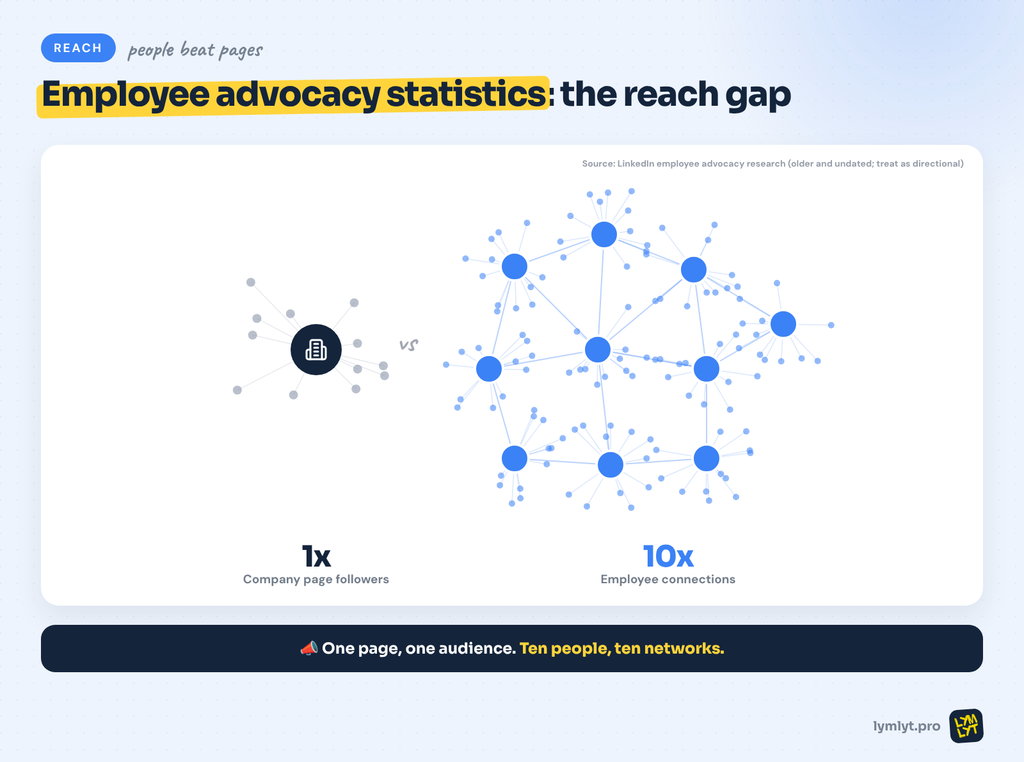
| Stat | Source |
|---|---|
| 78% of employees trust their employer | Edelman Trust Barometer 2026 |
| 64% of people trust business, the most trusted institution | Edelman Trust Barometer 2026 |
| Employees have 10x more connections than their company has followers | |
| Employees get 2x the click-through rate on the same content | |
| Personal profiles average 2.60% engagement vs 1.60% for company pages | Metricool, 2026 |
| 79% of decision-makers are more likely to champion a vendor that publishes quality thought leadership | Edelman-LinkedIn, 2025 |
| 94% of buying groups rank preferred vendors before first contact | 6sense, 2025 |
| 77% of software buyers read user reviews before buying | TrustRadius, 2025 |
Trust statistics
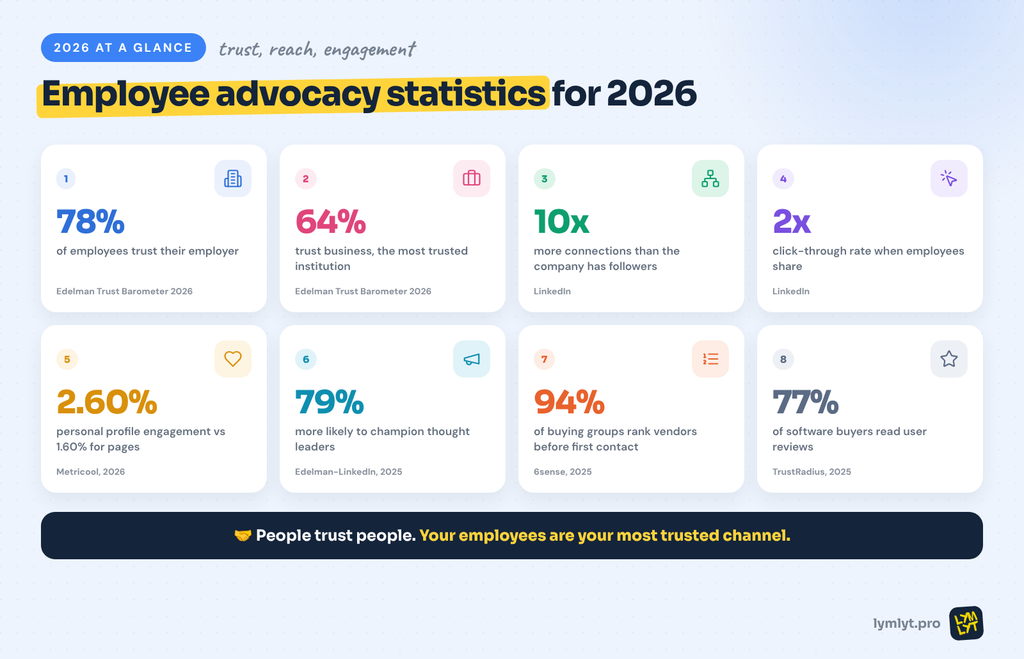
78% of employees trust their employer. The 2026 Edelman Trust Barometer, a survey of nearly 34,000 people in 28 countries, found “my employer” trusted by 78% of employees, higher than business in general (64%) and government (53%) (Edelman).
Business is the only broadly trusted institution. At 64%, business sits ahead of government in the same Edelman study. Edelman also notes that supervisors and co-workers can play “critical trust-brokering roles.”
What it means: employees are the most trusted messengers your company has. When they explain what you do, people listen in a way they don’t to a logo. Keep the message consistent with a clear brand voice, but let each person sound like themselves.
Reach statistics
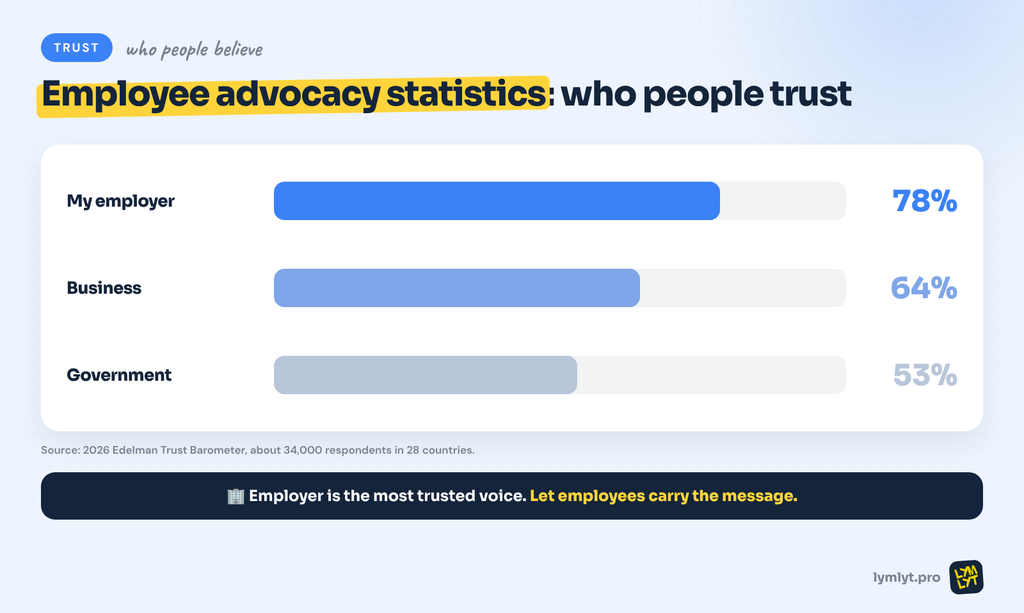
Employees have 10x more connections than their company has followers. LinkedIn’s employee advocacy research found that, on average, a company’s employees have ten times as many connections as the company has followers (LinkedIn).
Employees see 2x the click-through rate on the same content. In the same LinkedIn research, employees sharing identical content saw twice the click-through rate their company did.
3% of employees drive 30% of engagement. LinkedIn found only 3% of employees share company content, but those shares drive a 30% increase in total company engagement. Our SaaS content distribution playbook shows how to build sharing into every launch.
LinkedIn has more than 1.2 billion members. That’s the network your employees bring with them, as Microsoft CEO Satya Nadella reported in October 2025 (IANS).
A note on dates: the LinkedIn figures above come from its Elevate employee advocacy research, which is several years old and undated, so treat them as directional. Use them to make the case, not as a 2026 benchmark.
Engagement statistics
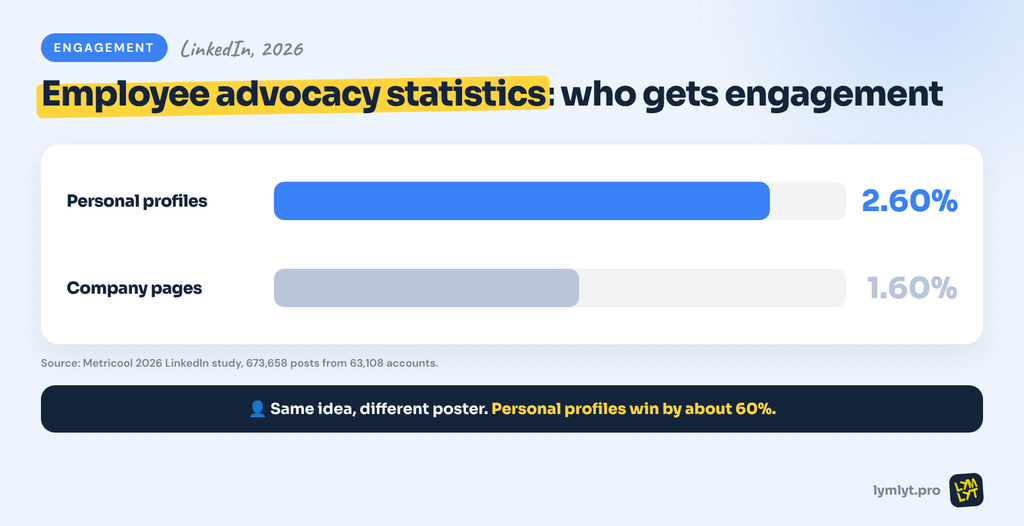
Personal profiles out-engage company pages. Metricool’s 2026 LinkedIn study, analyzing 673,658 posts from 63,108 accounts, found personal profiles average a 2.60% engagement rate, compared with 1.60% for company pages (Metricool).
What it means: the same idea posted by a person beats the same idea posted by a page. That’s the case for building founder and expert voices, not just a brand channel. But watch who writes them: most “founder-led” posts are actually marketer-led, and audiences can tell.
Sales and revenue statistics
Salespeople who share content are 45% more likely to exceed quota. LinkedIn’s advocacy research found salespeople who regularly share content were 45% more likely to beat their number (LinkedIn).
Socially engaged companies are 57% more likely to increase sales leads. Also from LinkedIn’s research. The same dating caveat applies to both.
What it means: advocacy isn’t just reach. When sellers share useful content, buyers arrive warmer. It also shows up where your CRM can’t see it: the recommendation that never appears in your CRM is often a post someone remembered.
B2B buyer trust statistics
These numbers explain why employee voices matter so much in B2B buying.
- 94% of buying groups rank their preferred vendors before first contact, per 6sense’s 2025 Buyer Experience Report of more than 4,000 buyers (Business Wire). Employees posting expertise are often how a vendor gets on that list.
- 79% of decision-makers are more likely to champion a vendor in an RFP if it consistently publishes quality thought leadership, per the 2025 Edelman-LinkedIn B2B Thought Leadership Impact Report of nearly 2,000 professionals (Demand Gen Report).
- More than 40% of B2B deals stall because buying groups can’t agree, per the same Edelman-LinkedIn report. Visible experts give the whole committee something to trust.
- 77% of software buyers read user reviews and 54% talk to a current user before buying, per TrustRadius’s 2025 buyer research (TrustRadius). Buyers want to hear from people, not pages.
- The average B2B purchase involves 13 people, per Forrester’s State of Business Buying 2024 (Forrester). Your employees can reach the ones sales never meets. See who they are in our guide to the B2B buying committee.
How to turn these stats into a program
- Start with five voices, not fifty. Founders, product leads and your best sellers. Depth beats headcount.
- Give them ideas, not scripts. Share talking points from your best content and let them write in their own voice. Our guide on how to create thought leadership content lists nine sources AI can’t copy.
- Make it easy. A weekly prompt, a shared library and a scheduling tool. See the best social media scheduling tools for B2B SaaS.
- Go beyond LinkedIn. B2B buyers also watch YouTube and scroll Instagram; see why B2B marketing now lives across socials. Those platforms feed AI answers too: Reddit, LinkedIn and YouTube are the channels you ignore.
- Measure what reaches pipeline. Track self-reported attribution and influenced pipeline, not just likes. Our guide to how to prove marketing ROI covers the metrics.
Employee advocacy mistakes to avoid
- Copy-paste posts. Fifty employees sharing the same caption looks like a campaign, not belief. Give ideas, not scripts.
- Only promoting the company. Advocates build trust by helping their audience. Mostly teach, occasionally sell.
- Forcing it. Pick people who want a voice. Reluctant posters are easy to spot.
- No support. Without topics, editing help and a little recognition, programs fade after a month.
- Measuring likes only. Engagement is a means. Track what reaches pipeline.
If your executives don’t have time to write, that’s what executive ghostwriting is for. Compare options in our lists of the best executive ghostwriting agencies, thought leadership agencies and social media and influencer agencies, or have LymLyt run your social content.
The bottom line
The employee advocacy statistics point one way. Employees are trusted more than brands, reach far more people than company pages and get more engagement for the same idea. In B2B, where buyers pick favorites before they talk to sales, those voices decide who makes the shortlist.
Build a few strong voices, feed them real insight, and measure what reaches pipeline. Pair it with a clear demand generation plan and the brand starts showing up before the buyer goes looking.

Jay is the co-founder of LymLyt and an AI partnership consultant helping B2B SaaS companies grow through content strategy, SEO, and AI integration. He writes about content marketing, what makes B2B content convert, and how SaaS teams can build content systems that drive real pipeline.