The AI Citation Telephone Game: How Statistics Get Distorted
The AI citation telephone game starts before anyone misquotes anything. In September 2026, Prefer asked four AI engines the same 80 questions about AI search, three times each. On ChatGPT, two runs of the same question shared, on average, 37% of the sites cited across both. On Gemini, 35%. The question did not change. The sources did.
Then the AI citation telephone game really gets going. A statistic drifts as it moves from its original source into blogs, posts and summaries, each copy dropping a qualifier or a denominator. AI search adds one more layer: the engine may retrieve the original, a derivative version, or several competing versions, and blend them into one confident answer with a citation attached.
The problem is older than AI. CEB’s 2012 finding that B2B buyers are 57% through the purchase process before engaging sales is quoted today as 80%, sometimes 90%. We cover two classics briefly, then trace three chains from 2026 AI search research itself, including one we caught happening while writing this article.
What this article covers:
- Two classic stats that drifted before AI search existed
- Three 2026 chains, from the original study to the version people repeat
- What we found in our own AI runs
- The 8 ways statistics mutate, and why AI search accelerates the problem
- How to publish numbers that survive being copied, plus a checklist before you quote anyone
What is the AI citation telephone game?
A statistic changes a little every time someone copies it. No single step is a lie. The damage is cumulative, and AI search adds a final step where the engine picks from whatever versions it finds on that run.
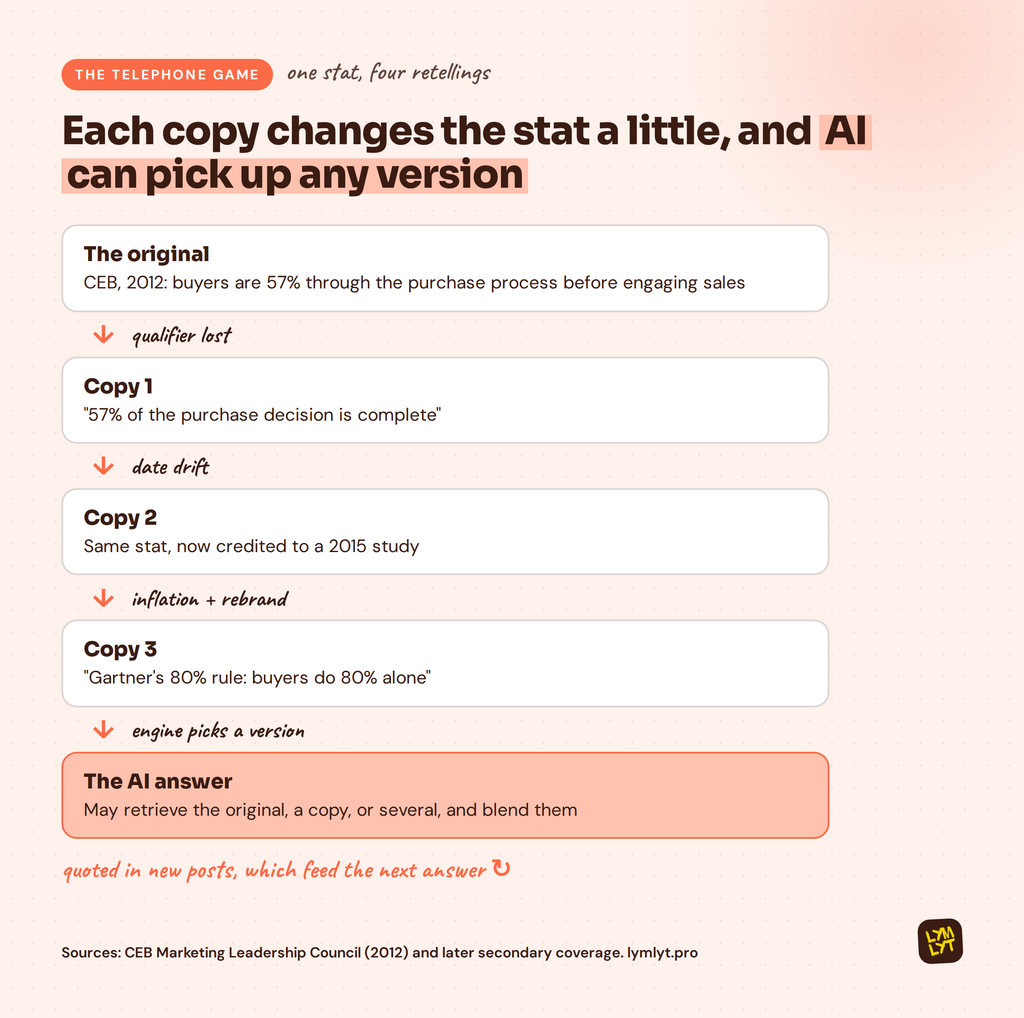
Each arrow is a small, honest-looking edit. By the time the stat reaches an AI answer, it may carry a new number, a new year and a new source, and that answer gets quoted in fresh posts that feed the next one.
The classics: two stats that drifted before AI
Two statistics B2B marketers still quote show the pattern in its pre-AI form. Each left its source years ago and has been changing since.
| Stat as quoted today | What the original actually said | What changed |
|---|---|---|
| “Buyers complete 80% of the journey before talking to sales” | CEB, 2012: buyers are 57% through the purchase decision-making process before engaging a supplier sales rep | Inflated from 57%, redated to 2015, rebranded as Gartner after Gartner acquired CEB (example) |
| “Google traffic will fall 25% by 2026” | Gartner, Feb 2024: a forecast that traditional search engine volume would drop 25% | Total search volume became your site’s traffic, and a prediction became a fact (example) |
The Gartner one matters most for marketers, because search volume and clicks to your site are separate problems. It is how HubSpot lost most of its blog traffic while its revenue went up 19%.
Neither needed AI to spread. What is new in 2026 is a faster loop and an extra layer: the engines themselves, which choose between versions and sometimes cite different ones each time you ask.
Chain 1: Same question, different AI sources
In September 2026, Prefer sent the same 80 questions about AI search to ChatGPT, Perplexity, Gemini and Claude, three runs each, 960 answers in total (Prefer AI answer study). The three runs of each question came back within 23 seconds of each other. The sources still moved.
| Engine | Sources cited per answer | Site overlap between two runs of the same question |
|---|---|---|
| Perplexity | 19.48 | 96% |
| Claude | 4.58 | 68% |
| ChatGPT | 3.05 | 37% |
| Gemini | 8.64 | 35% |
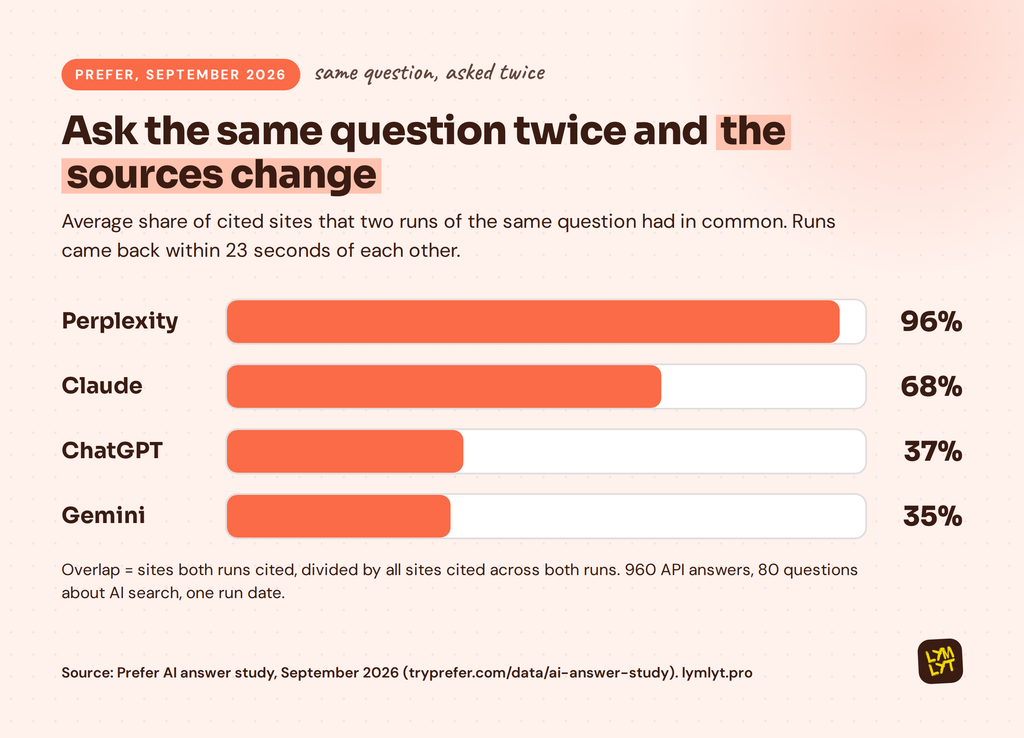
That breaks the simple version of the telephone game. There is no single copy the AI reads. Ask twice on ChatGPT or Gemini and the same stat can arrive from a different set of pages.
Perplexity was the steady exception, one more reason getting cited in Perplexity works differently from the other engines. The same study found Reddit was the most-cited site overall while Claude never cited it once, the platform split we cover in Reddit, LinkedIn and YouTube as AI citation channels.
Then the study’s own numbers drifted
Then the study’s own numbers started drifting. While researching this article, we asked an AI assistant to summarize the new research for us. Here is what it reported, next to what Prefer actually published:
| What the AI summary said | What the study says | What got lost |
|---|---|---|
| “72.7% of cited sites appeared in only one engine. Only 2.2% were cited by all four.” | True. But 338 of those single-engine sites were cited in one answer only, and 23 of the 25 most-cited sites were cited by three or four engines | The half of the finding that points the other way |
| “Ask the same question twice and ChatGPT’s two answers shared only 37% of cited sites” | 37% is the sites both runs cited, divided by all sites cited across both, averaged over pairs. Prefer states it is not the share of one run’s sites that reappear | The definition of the number |
| Not mentioned | API answers, questions about AI search only, one run date | The scope |
Every number in that summary is real. Read alone, it still suggests the engines agree on almost nothing, which the study does not claim.
Chain 2: One overlap, two opposite headlines
In May 2026, Citera analysed about 350,000 B2B SaaS articles across 10,382 keywords, comparing Google’s top 20 with what ChatGPT, Claude, Perplexity and AI Overviews cited (Citera). 42,586 articles showed up in both sets. That single overlap produces two very different headlines, depending on what you divide it by.
| Divide the 42,586 overlap by | Result | Headline it produces |
|---|---|---|
| All 301,604 AI-cited articles | 14.1% also rank in Google’s top 20 | “Ranking on Google barely matters for AI” |
| All 143,117 Google top-20 articles | 29.8% also get cited by AI | “Rank on Google and you have a 1-in-3 shot at AI citations” |
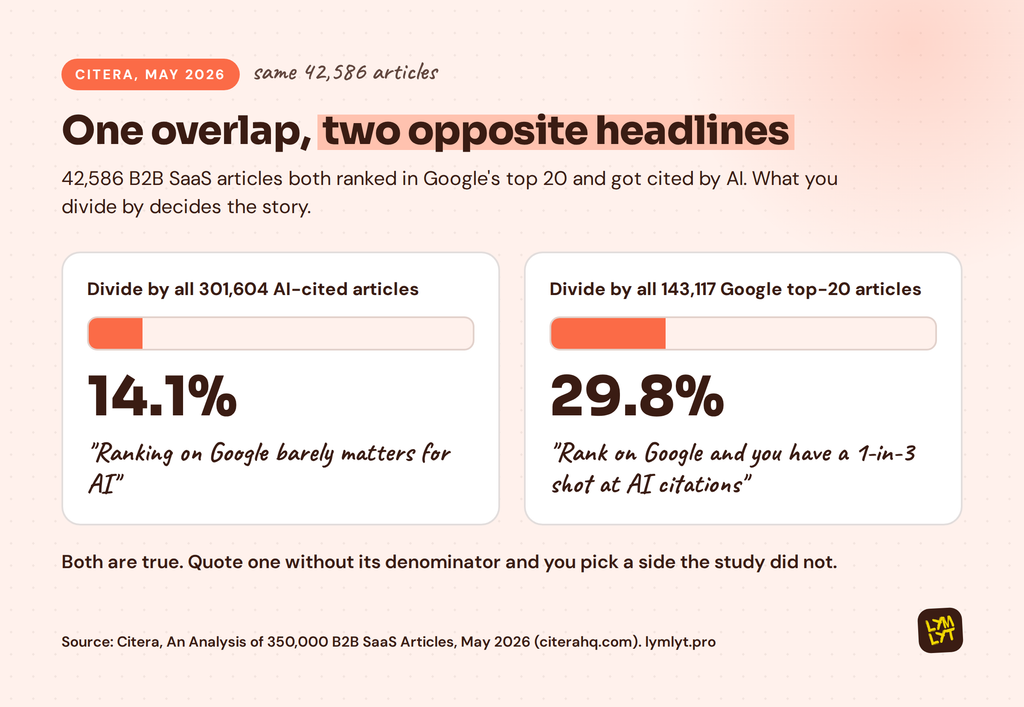
Both are accurate, and Citera puts both in its abstract. Quote one without its denominator and you have picked a side the study did not pick. The AI summary we received quoted the 14% and left out the 30%.
The same study has a second drift waiting to happen. AI-cited articles averaged 4.2 statistics, against 1.2 for articles that were not cited. The easy retelling is “add statistics and AI will cite you”. Citera says its comparisons are observational and not controlled for domain authority, and points to Princeton’s GEO experiments as the causal evidence. A correlation becoming a recipe is the most common upgrade a stat gets on its way into a LinkedIn post.
Chain 3: An AI citation study gets miscited
This one is the punchline. A study measuring how badly AI search cites sources was itself distorted within days of publication.
In March 2025, Columbia Journalism Review’s Tow Center tested eight AI search tools on a narrow task: identify the source of 200 news excerpts each, 1,600 queries in total. Collectively, the tools answered more than 60% of those queries incorrectly. Perplexity was wrong on 37%, ChatGPT Search on 67%, and Grok 3 on 94% (CJR, Tow Center).
Here is what the headlines did with it:
| Headline version | What changed |
|---|---|
| “Over 60% of AI chatbot responses are wrong” | A news-source identification test became all chatbot responses |
| “AI search engines cite incorrect sources at a 60% rate” | Closer, but drops that the task was news excerpts only |
| “Over 60% of AI-generated search results were identified as containing misinformation” | Wrong attribution became misinformation in search results generally |
| “Your AI search results are probably wrong” | A news-citation test became your search results, and Grok 3’s 94% error rate was reported as 97% |
None of these is a lie. Each is one step further from what was measured. A reader who meets only the last version comes away believing something the researchers never tested.
What we found in our own AI runs
The same drift shows up when AI engines describe products, not just research. In our pricing prompts study, we asked ChatGPT, Claude, Google AI Mode and Perplexity what Ahrefs, Semrush, HubSpot and LymLyt cost.
- Qualifier loss, product edition. The headline prices were mostly right. The errors sat around them: billing basis, plan names, add-ons. The most common mistake was a correct number attached to the wrong commitment, an annual price quoted as monthly or the reverse.
- Copies over the original. Google AI Mode’s answer about Ahrefs pricing cited six SEO blogs and not Ahrefs itself. Perplexity was the only engine that cited the vendor’s pricing page directly.
- Scope creep, by geography. All four engines put HubSpot Professional in roughly the same US dollar range, while HubSpot’s Indian site lists localized rupee pricing. The answer was right for one market and served to another.
In our comparison query study, ten of fifteen answers cited nothing at all. When there is no source attached, there is nothing to check the claim against, which makes the telephone game invisible.
The 8 ways statistics mutate
Every example above uses the same handful of moves. Learn to spot them and you can audit any stat in about two minutes.
| Mutation | What happens | Example from this article | Spot it by asking |
|---|---|---|---|
| Denominator loss | The number stays, the base disappears | Citera’s 14% quoted without its 30% mirror | 14% of what? |
| Qualifier loss | The definition or careful wording drops out | Prefer’s 37% overlap quoted without how it was calculated | What were the original words? |
| Correlation to causation | An association becomes a recipe | “Cited articles have more stats” retold as “add stats to get cited” | Was this tested, or observed? |
| Scope creep | A narrow finding is applied to everything | A news-source test became “all AI responses are wrong” | What exactly was tested, on what sample? |
| Inflation | The number grows with each retelling | CEB’s 57% became 80%, then 90% | Does the number match the original exactly? |
| Source laundering | A source gets swapped for a bigger name | CEB’s research rebadged as “Gartner’s 80% rule” | Who actually collected this data? |
| Tense shift | A forecast is quoted as a result | Gartner’s “will drop 25%” quoted as fact | Was this measured or predicted? |
| Date drift | The year changes, usually forward | A 2012 study cited as 2015 | When was the data collected? |
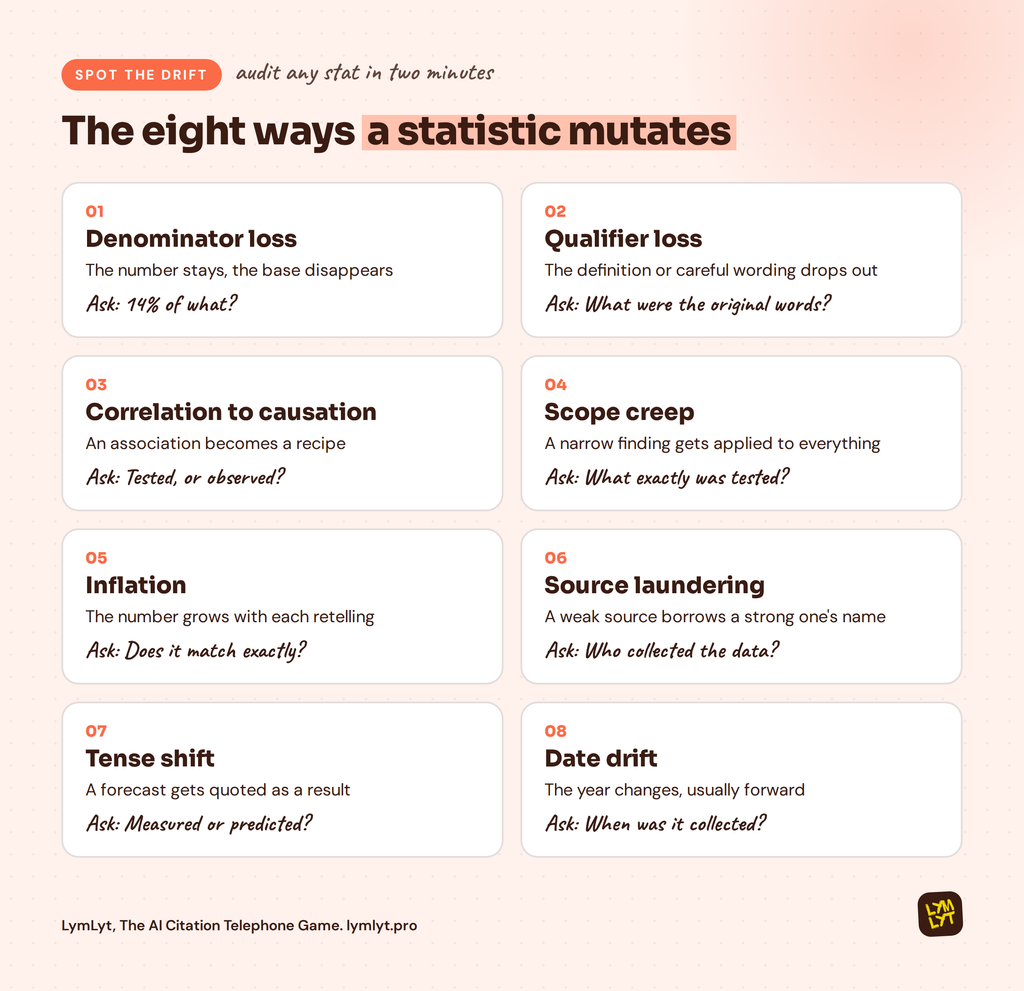
Most distorted stats carry two or three of these at once. The 80% version of the CEB number carries inflation, date drift, qualifier loss and source laundering. The AI summary of Prefer’s study managed denominator loss and qualifier loss in two sentences.
Why AI search accelerates the problem
The telephone game used to take years and a lot of blog posts. AI search shortens it, for three mechanical reasons.
1. AI may cite the original, a copy, or a different mix each time. An engine retrieves what it finds on that run. The Tow Center found AI search tools regularly cited syndicated and copied versions of articles rather than the original (source). In Prefer’s 2026 study, two ChatGPT runs of the same question shared 37% of cited sites, so even the set of copies changes between asks. In one ChatGPT dataset we covered, only 11.6% of citations for a recommended tool pointed at that tool’s own site (our G2 and Capterra analysis).
2. Summarising is compression, and qualifiers compress first. An answer engine turns five pages into two sentences. The words that get cut are the careful ones: “through the process”, “predicted”, “in news queries”, “in a sample of 545”. What survives is the number and a confident verb.
3. The answer sounds certain. In the Tow Center test, ChatGPT got 134 of 200 articles wrong and signalled uncertainty only 15 times (source). A distorted stat delivered with a citation and no hedge looks more trustworthy than the original ever did.
The result can become a loop. AI answers repeat a drifted version, people quote the AI answer in new posts, and those posts join the pool the next answer draws from.
How to make your statistics survive the chain
You cannot stop people paraphrasing you. You can make the accurate version the easiest one to copy. Each fix below targets one or more of the eight mutations.
| Fix | What to do | Stops |
|---|---|---|
| Write the stat as one complete sentence | Number, what it measured, sample and date in a single sentence: “In a 2026 survey of 300 B2B buyers, 41% …” | Qualifier loss, scope creep |
| Give the denominator every time | Say what the percentage is of, and if the mirror figure tells a different story, publish both, as Citera did | Denominator loss |
| Put the year next to the number | “In 2026” in the same sentence, plus a visible published or updated date on the page | Date drift |
| Label forecasts and correlations | “We predict”, “we expect” or “associated with” in the sentence itself, never only in a footnote | Tense shift, correlation to causation |
| Show your method on the same page | Sample size, dates, what was and was not tested, in plain text | Scope creep, source laundering |
| Publish the number in text | Not only inside a chart image or a PDF. An llms.txt file will not do this for you | Copies outranking you |
| Check what AI says about your data | Ask the engines about your own findings every quarter, run each question more than once, and log both the citations and the mentions | Inflation spotted early |
| Correct the copies | When a site misquotes you, email them the exact sentence and the link | The chain at its source |
The first fix does most of the work. A sentence that carries its own scope and date can be copied whole, and a copied whole sentence cannot drift.
The 2-minute checklist before you quote a stat
Run this before any number goes into a post, deck or landing page. If you cannot tick all eight, paraphrase without the number or find a better source.
- I opened the original source, not a blog or an AI summary quoting it
- The number matches the original exactly
- I know the denominator: the percentage is of what
- I know who collected the data, and it is the name I am citing
- I know whether it was measured or predicted
- I know whether it shows a correlation or a tested cause
- I know the sample, the dates and what exactly was tested
- The year I am citing is the year the data was collected
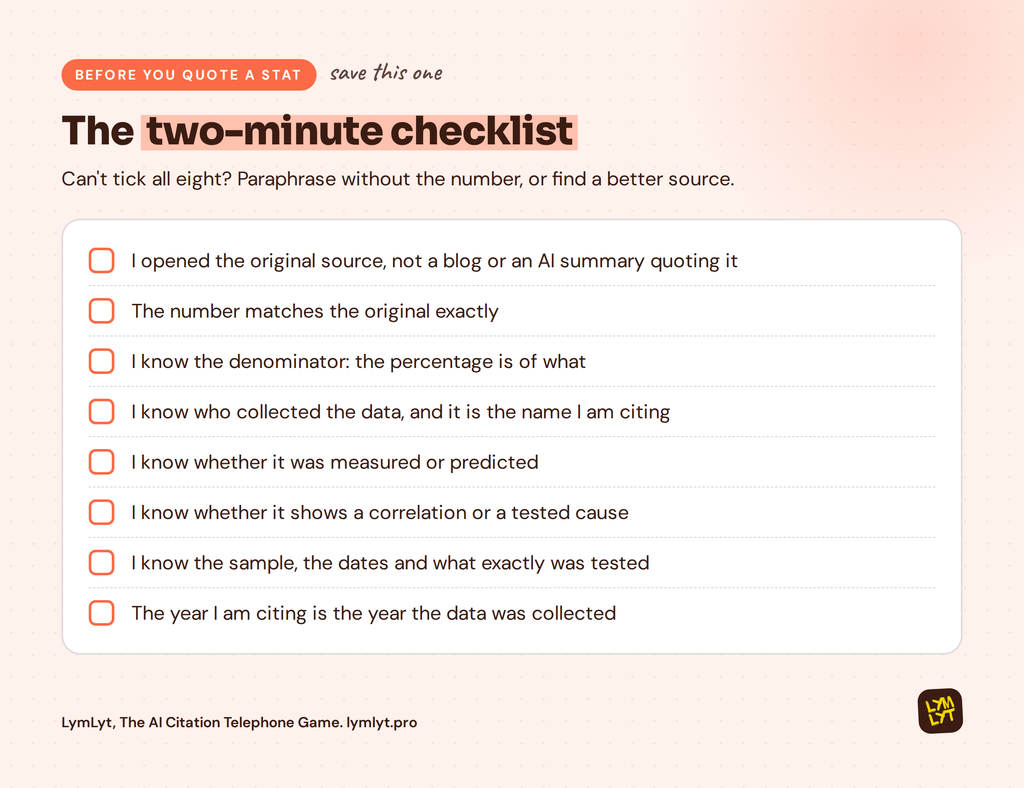
One habit covers most of it: link to the original, never to the article where you found it. If you cannot find the original, that tells you something too.
If you need numbers to start from, our AI SEO statistics roundup links the study behind each figure, so you can check it yourself.
FAQ
What is the AI citation telephone game? It is what happens when a statistic is copied from source to blog to blog to AI answer, changing slightly at each step. The number inflates, the denominator or the careful wording disappears, and AI engines may then serve the drifted version, the original, or a blend of both.
Do AI engines cite the same sources if you ask the same question twice? Not always. In Prefer’s September 2026 study, two runs of the same question shared on average 96% of cited sites on Perplexity, 68% on Claude, 37% on ChatGPT and 35% on Gemini.
Does ranking on Google mean AI will cite you? It helps less than you might think, and how you phrase it matters. In Citera’s 2026 B2B SaaS study, 30% of Google top-20 articles were cited by AI, while only 14% of AI-cited articles ranked in Google’s top 20.
Do AI engines cite the original source of a statistic? Sometimes. They retrieve what they find on that run, which can be the original, a copy, or several versions blended into one answer.
How do I stop AI misquoting my data? Publish each stat as one complete sentence with its sample, scope and year, in text on the page. Then ask AI engines about your findings every quarter and correct the sites that misquote you.
Conclusion: the original is still out there
Every stat in this article still exists in its original form. The 57% is in a 2012 PDF. Prefer and Citera publish their definitions and limits on the same page as their numbers. The drift happened in the copies, and in one case in an AI summary of them.
The fix is unglamorous. Open the original. Quote it exactly. Publish your own numbers so the accurate version is the easiest one to copy.
We write research-led content for B2B SaaS that is built to be quoted correctly, by people and by AI engines. See how we approach AI visibility.

Jay is the co-founder of LymLyt and an AI partnership consultant helping B2B SaaS companies grow through content strategy, SEO, and AI integration. He writes about content marketing, what makes B2B content convert, and how SaaS teams can build content systems that drive real pipeline.