B2B SaaS Case Studies: The Complete Guide
Ask a B2B SaaS marketing team whether a B2B SaaS case study influences deals and almost all of them say yes. Demand Gen Report’s buyer survey found 79% of B2B buyers rated case studies as important or very important when evaluating vendors, and a separate figure putting the number at 73% gets quoted so often it has become received wisdom in the category.
Then ask the same teams how many they published last year. The common answer is three or four.
That gap is the entire problem, and it is worth sitting with before we get to structure and interviews. If a case study genuinely moves deals, and you have ten opportunities open at any given time, four case studies a year means most of your pipeline is being asked to imagine themselves in a story about somebody in a different industry with a different problem.
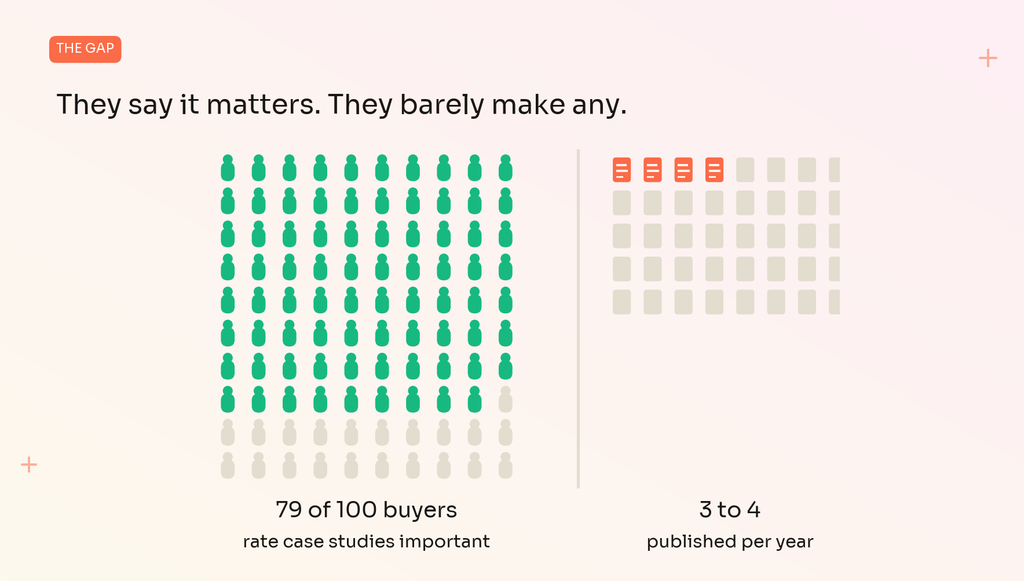
One caveat on that production figure, because it conflicts with another number in circulation. Some analyses report SaaS companies maintaining an average of 64 case studies on their sites. Both can be true: 64 is a stock built over many years, three to four is the annual flow. But it does mean the average case study a buyer reads is several years old, describing a version of your product that no longer exists.
Case studies sit alongside the rest of your program, not apart from it, and the sequencing advice in content marketing for SaaS startups applies here too.
This guide covers what a B2B SaaS case study actually needs to contain, how to choose which customer wins are worth the effort, how to run the interview, what to do when the numbers cannot be shared, and how to get more than one asset out of each story.
What a B2B SaaS case study actually is
A case study is a documented account of a specific customer achieving a specific measurable outcome using your product, told in enough detail that a similar buyer can see themselves in it.
Three things that are not case studies, despite frequently being labelled as such:
- A testimonial. A quote saying your product is great is social proof, not a case study. There is no situation, no obstacle, and no result.
- A logo wall. Evidence that someone bought, not evidence that it worked.
- A feature story wearing a customer’s name. If the narrative is really about what your product does and the customer appears as a prop, buyers can tell.
The distinction matters because the three cheap versions are what most teams produce when the real thing feels too hard. They fill the page and do none of the work.
Why case studies carry more weight than they used to
Two shifts, both recent, both pushing in the same direction.
Buyers decide before they contact you. Research consistently finds most of the B2B buying journey now happens without a salesperson present, and that buyers arrive with a preferred vendor already in mind. One 2026 analysis reports that 92% of buyers begin their journey with a vendor in mind and that the large majority of winning vendors were on the buyer’s shortlist from day one. If that is even directionally right, your proof has to work while nobody from your company is in the room. A case study is one of the few assets that does, and unlike a review profile on G2 or Capterra, it is proof you own and control.
Specific claims get cited by AI, vague ones do not. Research into what AI answer engines actually cite keeps landing on the same trait: content containing specific, verifiable, numerical claims is retrieved and quoted far more readily than content making general assertions. A case study is the densest concentration of specific numbers your marketing produces. That makes it unusually well suited to the retrieval logic behind AI visibility for B2B SaaS, and it is one reason the format is worth more now than it was five years ago.
Most teams publish case studies as gated PDFs and never think about them again. That decision throws away the second benefit entirely.
The structure that works
Every durable case study format is a variation on the same four-part shape. The labels differ, the sequence does not.
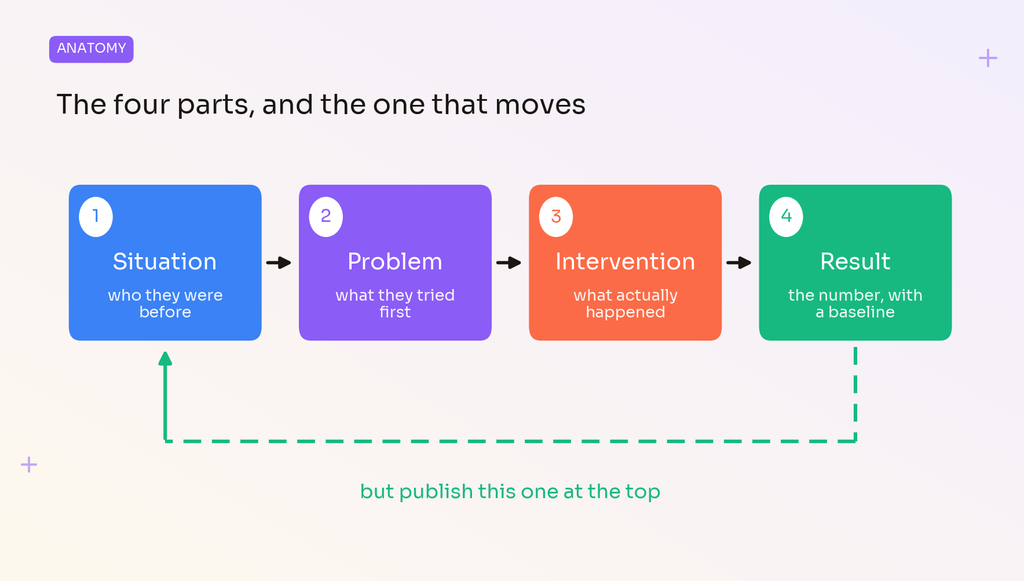
1. The situation. Who the customer is, what they do, and crucially what their world looked like before. Specific enough that the right reader recognises themselves: company size, team structure, tooling, market. “A fast-growing SaaS company” describes nobody. “A twelve-person marketing team at a Series B fintech, running content on two freelancers and a spreadsheet” describes someone.
2. The problem. Not the problem your product solves. The problem the customer had, in their words, including what they tried first and why it did not work. The failed attempt is the most persuasive paragraph in most case studies and the one most often cut for length.
3. The intervention. What actually happened. Which parts of the product, in what order, over what timeframe, with what involvement from whom. This is where most case studies go vague, and vagueness here is what makes a story unbelievable.
4. The result. The measurable change, with a stated baseline and a stated timeframe. A number without a baseline is decoration.
Two structural notes for the web version. Lead with the result rather than building to it, because most readers will not reach the end. And use a pull-out summary near the top with the headline metrics, because that block is what gets screenshotted, quoted in sales emails, and extracted by AI answer engines. The same passage-level discipline behind good SEO content writing applies directly.
The metrics buyers actually trust
Not all numbers persuade equally. In rough order of credibility:
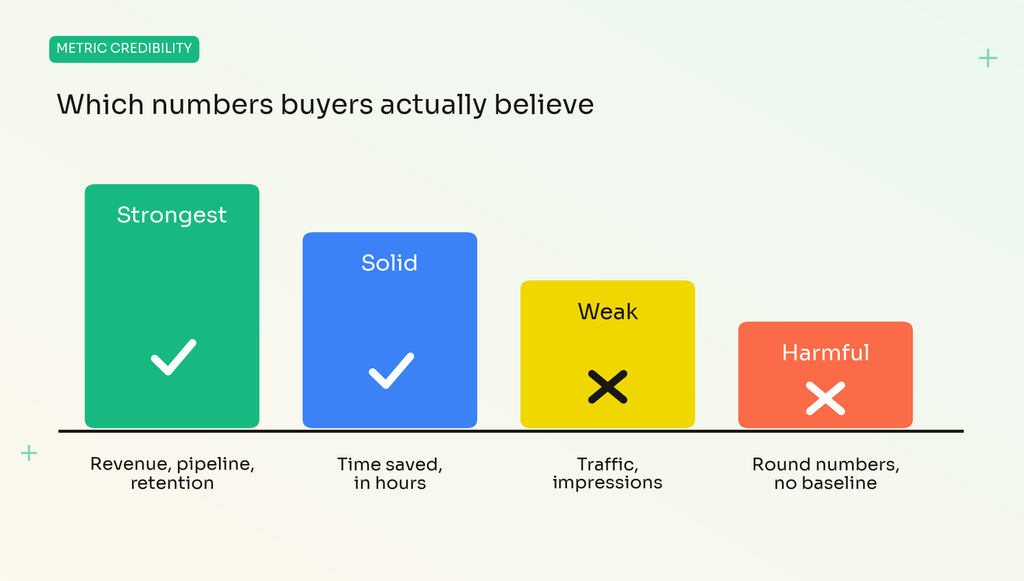
Strongest. Revenue, pipeline, conversion rate, retention, and cost, each with a baseline and a timeframe. “Demo requests went from 11 to 34 per month over five months” is nearly impossible to dismiss.
Solid. Time saved, expressed in hours per person per week rather than as a percentage. Percentages hide the base.
Weak. Traffic, impressions, followers, and anything the buyer’s own CFO would not recognise as an outcome. These are the metrics we argue against in SaaS content marketing metrics that actually matter, and they are just as weak in a case study as in a dashboard.
Actively harmful. Round numbers with no baseline. “10x growth” and “300% increase” read as marketing rather than measurement. If the real figure is 287%, say 287%. The odd number is the credibility.
Choosing which wins to write up
Most teams pick whichever customer says yes first. That is how you end up with three case studies about the same kind of company.
Score candidates on three axes:
ICP match. Does this customer look like the buyers you want more of? A great story about a company outside your target segment is a great story that converts nobody. If you have not done this work, why your ICP doesn’t read your blog covers the underlying problem.
Measurability. Did something change that can be counted, and does the customer have the data? Enthusiasm without numbers produces a testimonial, not a case study.
Objection coverage. Which sales objection does this story answer? The most valuable case study in most B2B SaaS libraries is the one that addresses the specific reason deals stall. If your deals die on implementation risk, the story you need is about a customer who was live in three weeks.
Score it before you ask anyone, the same way a content brief forces the decisions before drafting starts. Run this as a scored list, not a conversation. Ten candidate wins ranked against three criteria will produce a different top three than the customer who happened to reply first.
Running the interview
The interview is the whole job. Everything downstream is transcription and craft.
Interview the customer, not your account manager. Second-hand accounts lose the detail that makes a story credible, and they smooth out the parts where things were hard.
Ask about the before, at length. Most of the interview should cover what life looked like previously. That is the section buyers use to recognise themselves, and it is the section customers find easiest to talk about.
Ask what they tried first. This single question produces the most useful material in most interviews. It also produces the honesty that makes the rest believable.
Ask for numbers twice. Once directly, once obliquely later. “What did that look like in the numbers?” often gets a different and better answer than “what were your metrics?”
Ask what nearly stopped them. Every real deal has a moment of doubt. Including it makes the story credible in a way that no amount of polish can.
Record it, transcribe it, and write from the transcript rather than from notes. The customer’s own phrasing is the raw material for voice, and it is what stops the finished piece reading like your product marketing.
When the customer will not share numbers
This is the objection that quietly kills most case study programs, and it is worth having an answer ready before it comes up.
Options, in order of preference:
Ranges instead of exact figures. “Reduced onboarding time by 40 to 50%” is nearly as persuasive as a precise number and clears most legal reviews.
Relative rather than absolute. “Tripled qualified pipeline” without disclosing the base. Weaker than a baseline, far stronger than nothing.
Anonymise the company, keep the numbers. “A Series B fintech with a twelve-person revenue team” preserves everything that makes the story useful except the logo. Many buyers care more about the shape of the company than the name.
Lead with the qualitative, supported by process detail. If no numbers are available at all, the story can still work if the operational detail is specific: what changed in the workflow, who stopped doing what, how long it took.
What does not work is publishing a vague story and hoping nobody notices. A credible anonymous case study beats a named one with nothing in it.
One story, several formats
A case study sitting on a PDF in a folder does nothing. The production cost is almost entirely in the interview and the first draft, which means every additional format is cheap.
From one approved story:
- A web page structured for search and for AI retrieval
- A designed PDF for sales to attach
- A one-page summary for the deck
- Two or three social posts built around single quotes or the headline number
- A short section in a nurture email sequence
- A data point for your own blog content
The web version is the one most teams skip, and it is the one that compounds. A gated PDF cannot be found, cannot be linked to, and cannot be cited by an AI answer engine. The same story published as an indexable page does all three.
This is also where case studies connect to the rest of your content operation. Each one becomes supporting evidence in comparison pages, pillar posts, and topical authority clusters you are already building.
Common mistakes
Writing it as a product story. If the customer could be swapped out without changing the narrative, it is a feature page.
Cutting the failed first attempt. It is the most persuasive part and the first thing edited out for length.
Using percentages to hide small numbers. Going from 2 to 6 is a 200% increase and reads as one when a buyer works it out.
One case study per segment and then stopping. Buyers want to see the pattern, not the exception.
Publishing and never updating. A case study describing results from three years ago is describing a product that has changed. Add a refresh line, or revisit the customer.
Gating everything. A gated case study can only be used by sales. An ungated one works while you sleep.
How many do you actually need
Enough that a buyer in your primary segment finds a story that looks like them.
Practically, that means one per major ICP segment, one per top use case, and one per common objection. For most B2B SaaS companies that is somewhere between six and twelve to reach useful coverage, then a steady cadence of one per quarter to keep the library current.
The realistic constraint is rarely writing. It is customer availability and legal approval, which means the pipeline needs to run continuously rather than in bursts. This is exactly the kind of recurring workflow a documented SaaS content engine exists to make sustainable. Building it into your content calendar as a standing item, rather than a project someone remembers each spring, is the difference between a library and a folder with three files in it.
Where to start
If you have none, start with your single best ICP match and give the interview a full hour. If you have three and they are all a year old, refresh one rather than starting a fourth. If you have a dozen and none of them rank, the problem is that they are PDFs and the fix is publishing web versions, slotted into your wider B2B SaaS SEO strategy rather than parked in a resources folder.
You can see how we approach this in our own case studies, or read what a full engagement covers on our case study writing service page.
If you would rather talk it through, book a 30-minute call and we will look at which of your customer wins is worth writing up first.
Frequently asked questions
How long should a B2B SaaS case study be? The web version works at 800 to 1,200 words. Longer than that and the result gets buried. The constraint is specificity, not length: a tight 900-word study with real numbers beats a 2,000-word one padded with context.
Should case studies be gated? Publish the web version ungated and use the designed PDF as the gated or sales-sent asset. Gating the only version means it cannot be found in search, linked to, or cited in an AI answer, which removes most of its compounding value.
How do we ask a customer to participate? Ask shortly after a measurable win, ask for a specific time commitment, and offer to do the work. Most refusals come from customers assuming it will take hours and require them to write something. Naming a 45-minute interview and full approval rights removes most of the objection.
What if legal blocks the case study? Ask what would need to change rather than accepting the no. Anonymising the company, converting exact figures to ranges, or removing named individuals clears most reviews. Legal is usually objecting to a specific element, not the concept.
How often should case studies be updated? Review annually. If the product has changed materially or the customer’s results have moved, either refresh with new numbers or add a dated note. A case study describing a discontinued workflow damages credibility rather than building it.

Jay is the co-founder of LymLyt and an AI partnership consultant helping B2B SaaS companies grow through content strategy, SEO, and AI integration. He writes about content marketing, what makes B2B content convert, and how SaaS teams can build content systems that drive real pipeline.