Shortlist Prompts: The Four Questions B2B Buyers Ask AI Before Deciding
Every AI visibility tool on the market measures the same thing: whether you appear when someone asks for the best tools in your category. That question gets asked once, early, by people who are not buying yet. Almost nobody measures shortlist prompts, the questions buyers ask once they already know your name.
Those come later and look nothing like the category question. There are four of them, and they are what a buyer types once they have two or three options and are trying to eliminate one. (If the terms around this are new, the AI visibility glossary covers them.)
This post defines the four, shows what we found when we ran two of them, and explains why a strong score on category prompts tells you almost nothing about whether you win. It is the framework behind everything else we publish on AI visibility.
The shortlist is decided before anyone talks to you
6sense surveyed close to 4,000 B2B buyers for its 2025 Buyer Experience Report and found that 95% of the time, the vendor that won was already on the shortlist the buyer wrote on day one. Buying groups rank that shortlist in order of preference before contacting anyone, and the vendor ranked first wins roughly 80% of deals.
Gartner’s 2025 survey of 632 buyers found 61% would rather buy with no sales rep involved at all.
Put those together and the picture is uncomfortable. The list forms early, it gets ranked privately, and the ranking happens in research you never see. Increasingly that research happens inside an AI assistant, which is the shift we traced in seven ways search behaviour changed.
So there are two separate visibility problems, not one. Getting onto the list is an awareness problem. Surviving the ranking is an evaluation problem. Shortlist prompts are how the second one gets decided, and they are the half nobody instruments.
The four shortlist prompts
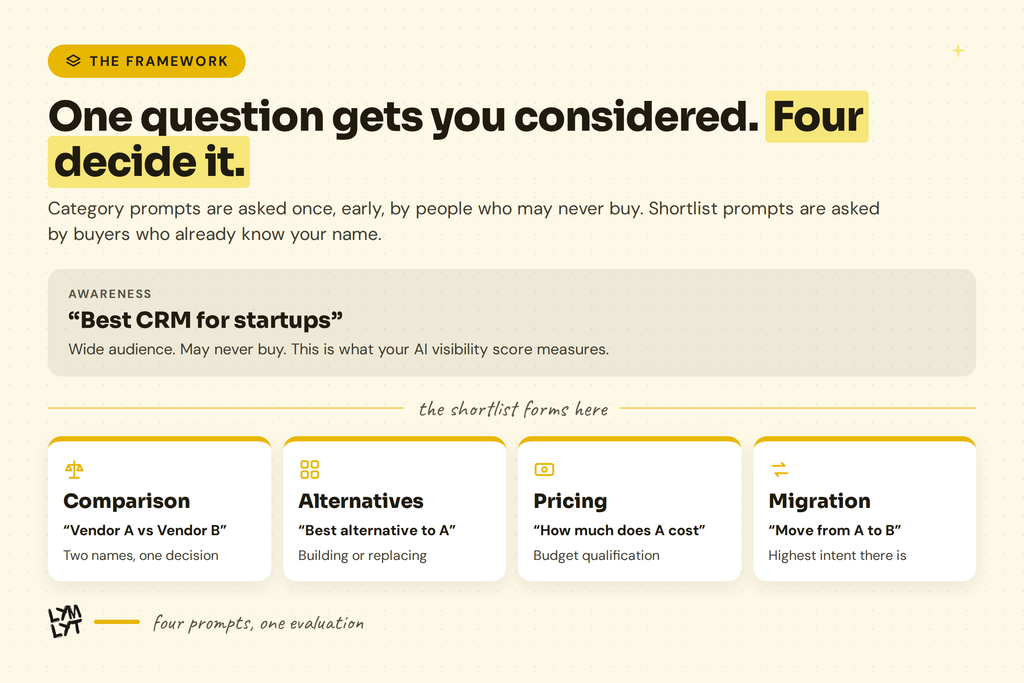
Every evaluation we have looked at reduces to four question types.
1. Comparison. “Vendor A vs Vendor B.” Two names, one decision, the buyer trying to eliminate one.
2. Alternatives. “Best alternative to Vendor A.” Either the shortlist is being built or an incumbent is being replaced.
3. Pricing. “How much does Vendor A cost.” Budget qualification, and the answer is frequently wrong.
4. Migration. “How do I move from Vendor A to Vendor B.” The highest-intent question a buyer can ask, because nobody researches migration unless they are seriously considering it.
Those four cover the entire evaluation stage. A category prompt like “best CRM for startups” sits before all of them and gets asked by people who may never buy anything.
The distinction matters because the content that wins each one is different, the sources AI pulls from are different, and the teams optimising for category prompts are optimising for the wrong audience.
What we found on comparison prompts
We ran five B2B software matchups through ChatGPT, Claude and Google AI Mode and published the whole thing.
Ten of the fifteen answers cited nothing at all. No links, no sources panel. Claude cited zero sources across all five. ChatGPT cited on one of five.
That single finding reframes the work. When there is no retrieval step, no page wins, because no page was consulted. What decides the answer is what the model already absorbed about your category, which is the aggregate of years of reviews, forum threads, documentation and third-party coverage. Our wider citation study found third parties carrying most of that load, and Reddit, LinkedIn and YouTube doing more of it than most teams measure.
When the engines did cite, vendor pages won. Which engine you test matters more than most teams assume, since they retrieve and cite very differently, as our comparison of ChatGPT, Claude, Gemini, Perplexity and Grok lays out. Every Google AI Mode answer that cited anything included at least one vendor-owned page, including both vendors’ own comparison pages in one case.
So comparison prompts are winnable in a way category prompts are not. The candidate pool collapses to a handful of sources, and yours can be one of them. Whether your page is any good is a separate question, covered in why conceding a row wins the deal.
What we found on alternatives prompts
We ran five “best alternative to” prompts as a control. Every single time, the top recommendation was the competitor from our original pair. Salesforce returned HubSpot. Zapier returned Make. Semrush returned Ahrefs. Five for five.
Two things follow.
The comparison prompt and the alternatives prompt resolve to the same rivalry, so both shortlist prompts funnel a buyer to the same two names. On organic search the same rivalry gets exploited by third parties, including on your own brand name, as the Basecamp case showed. That is an argument for treating your single biggest competitor as a page rather than a row in a roundup.
And the shortlists ran six or seven names deep. Salesforce alternatives returned Dynamics, Zoho, Pipedrive, Freshsales, Close and Monday. Being absent from that list is being absent at the exact moment it forms, which is a different problem from not showing up in ChatGPT at all.
The format question, which page answers which prompt, is covered in alternatives page or vs page.
The two we have not run yet
Pricing prompts. We have not tested these and we are not going to guess. What we do know from adjacent work is that third-party content carries stale pricing routinely: our outreach tools roundup found four of ten prices wrong across the roundups that list them, and one tool listed everywhere had been offline for a year. If that is the source material an engine draws on, the number a buyer hears is a coin flip.
Migration prompts. Also untested. The hypothesis is that answers come from documentation, support forums and community threads rather than vendor pages, because almost no vendor publishes a migration guide for leaving a competitor. If that holds, it is the cheapest content gap in B2B SaaS, and the switchers who made that move are also your best case study material.
Both are in the next two runs of the benchmark. We will publish whatever comes back, including if it contradicts the hypothesis.
Why category scores miss all four
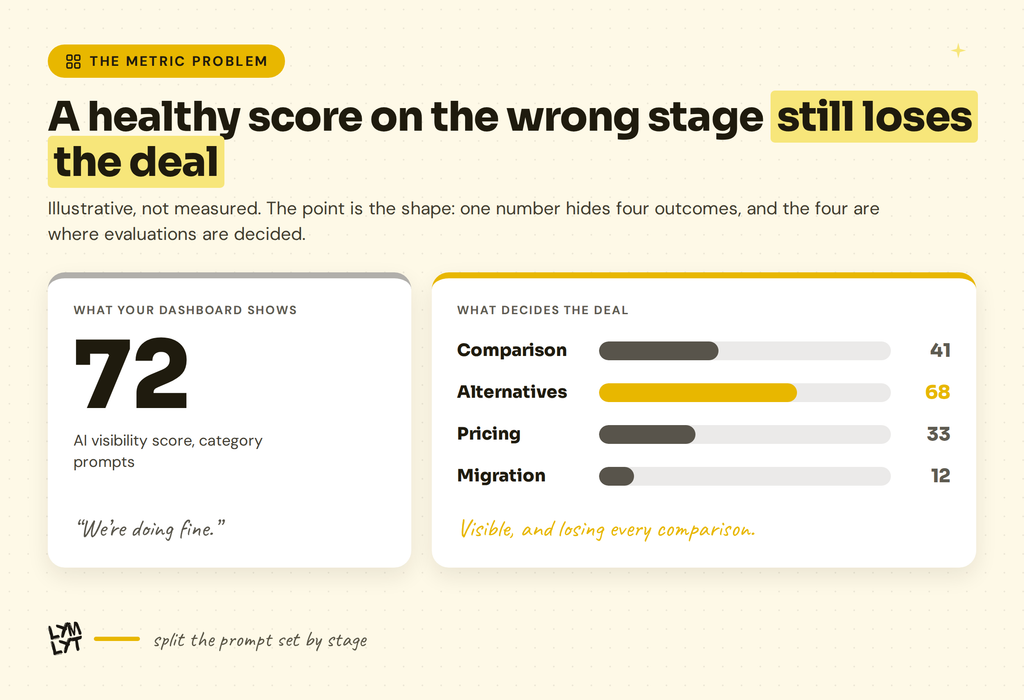
The AI visibility platforms mostly score you on a prompt set built from category questions. DerivateX bench-marked 50 B2B SaaS companies across 1,400 prompts and reported an average AI Presence Score of 56.9, with 44% scoring below 50.
Useful numbers. They tell you whether you are in the running. They tell you nothing about whether you win.
A brand can hold strong category visibility and still lose every comparison prompt, because different sources feed each one. Category answers lean on listicles and review platforms. Comparison answers lean on vendor pages and a thin field of third parties, which is what our organic teardown found on the same queries.
Measuring one and reporting it as AI visibility is like measuring impressions and calling it pipeline. The number moves. The deals do not, which is the same lesson HubSpot learned at scale.
Split your prompt set by funnel stage, and score shortlist prompts separately. Tracking tools will let you do this. Most teams have not asked them to.
What content answers each shortlist prompt
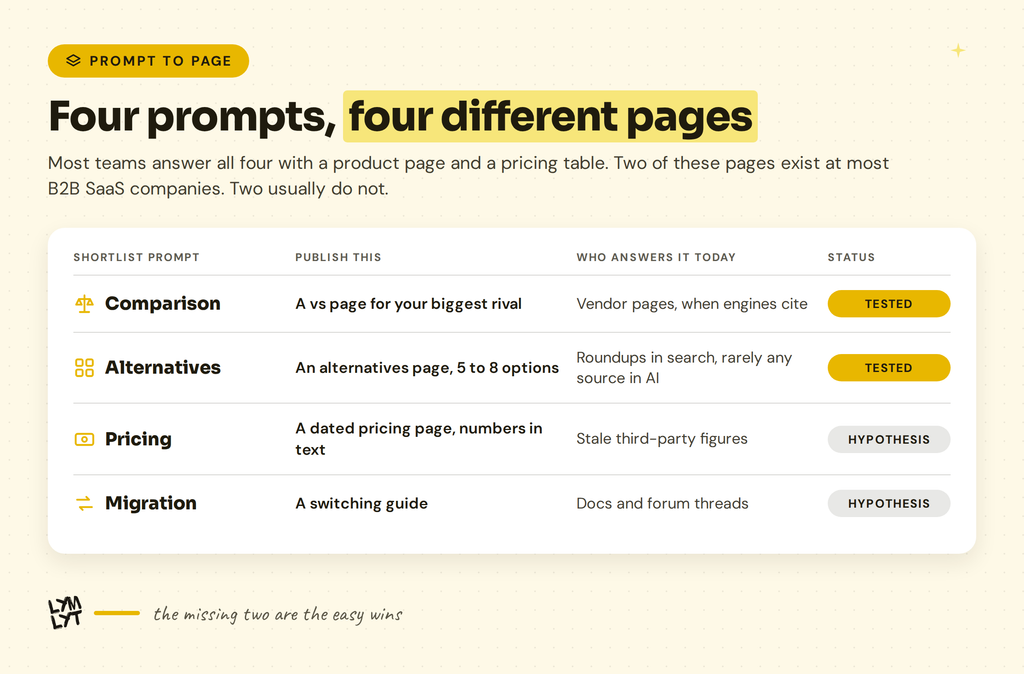
Knowing the four shortlist prompts is only useful if you know what to publish for each. They are not answered by the same page, and most teams try to answer all four with a product page and a pricing table.
Comparison prompts are answered by a dedicated vs page for your biggest rival, written as an assessment rather than a pitch. This is the one we have evidence for: vendor pages got cited on these when the engines cited anything.
Alternatives prompts are answered by an alternatives page that covers five to eight options honestly, including the ones that are not you. It gets you onto the list. The vs page wins the seat.
Pricing prompts are answered by a pricing page that states numbers in text, carries a date, and explains what changes the cost. Our hypothesis is that engines fall back on stale third-party figures when the vendor page is vague or image-based.
Migration prompts are answered by a switching guide: what transfers, what does not, how long it takes, and who does the work. Almost nobody publishes one. It doubles as sales enablement, and the customers who switched are your strongest case study material.
Two of those four pages exist at most B2B SaaS companies. The other two usually do not, which is where the easiest wins in shortlist prompts are hiding. If the pages themselves are the gap, landing page structure is the place to start.
Build the prompt library
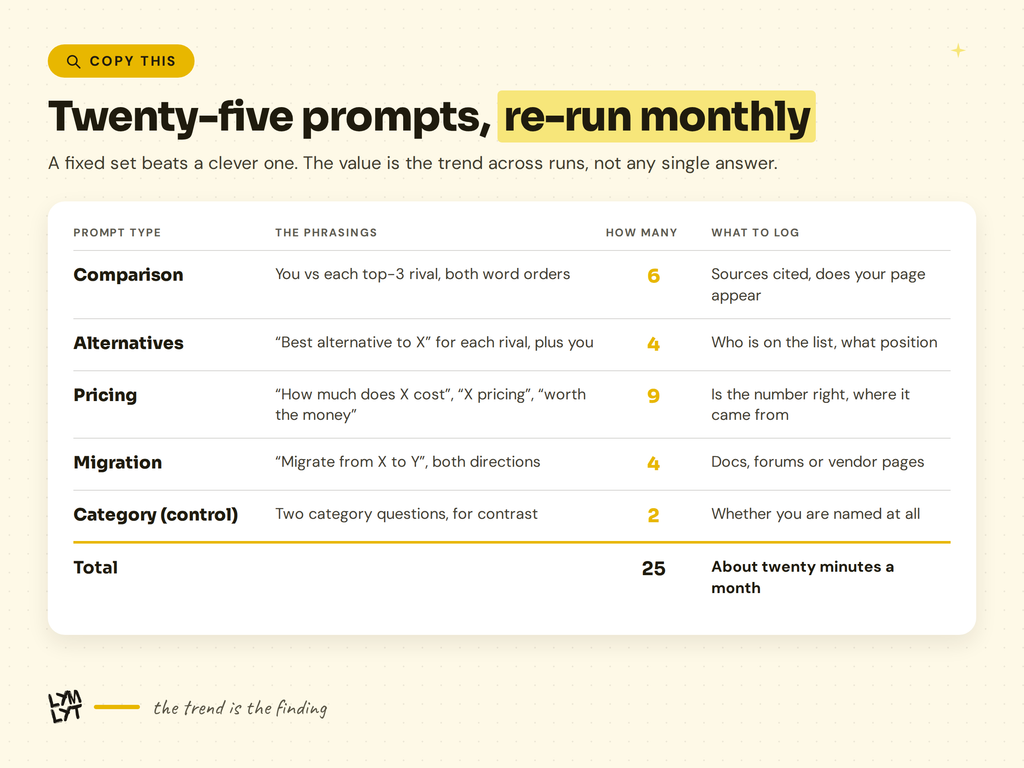
The practical output of this framework is a fixed list you re-run on a schedule.
Comparison. Your brand against each of your top three competitors, in both word orders. Buyers type both.
Alternatives. “Best alternative to X” for each of those three, plus your own name.
Pricing. “How much does X cost”, “X pricing”, and “is X worth the money”, for you and the top two. Keyword tools will show most of these as near-zero volume, which is a known blind spot rather than evidence nobody asks.
Migration. “How to migrate from X to Y” in both directions for your closest rival.
That is roughly 25 shortlist prompts for most companies. Log which sources get cited, whether your page appears, and what the answer says about you. Monthly is enough. Run them in at least three engines, and add Perplexity if you can, since getting cited there follows its own rules.
Our AI visibility checklist covers the on-site half, and the brief generator turns gaps into something a writer can start on.
FAQ
Is this just GEO by another name? Generative engine optimisation is the discipline. Shortlist prompts are a way of segmenting it by funnel stage, so you can tell whether the work is moving awareness or moving evaluations.
How are shortlist prompts different from bottom-of-funnel keywords? They overlap but are not the same, which is the wider SEO versus AI search distinction applied to one funnel stage. A keyword is typed into a search box and produces links. A prompt is typed into an assistant and produces an answer with a verdict already in it. The intent is similar. What you are competing for is not.
Should we stop tracking category prompts? No. Track both, separately. A category score answers whether you are considered. A shortlist score answers whether you win.
What if our product has no direct competitor? Then comparison and alternatives prompts matter less, and pricing and migration matter more, because the buyer is comparing you to doing nothing or to building it themselves.
We rank for these and still get no demos. Why? Visibility and conversion are separate problems. If buyers are reaching the page and not converting, that is usually a content and offer problem, not a visibility one.
How often should we re-run them? Monthly for a fixed set, and judge on the trend across several runs rather than any single answer. Results move week to week.
Category visibility gets you considered. Shortlist prompts decide whether you win. Most teams are measuring the first and reporting it as though it were the second.
That is the job we do. See how we approach AI visibility and how we write comparison pages, look at our work, check pricing.

Jay is the co-founder of LymLyt and an AI partnership consultant helping B2B SaaS companies grow through content strategy, SEO, and AI integration. He writes about content marketing, what makes B2B content convert, and how SaaS teams can build content systems that drive real pipeline.