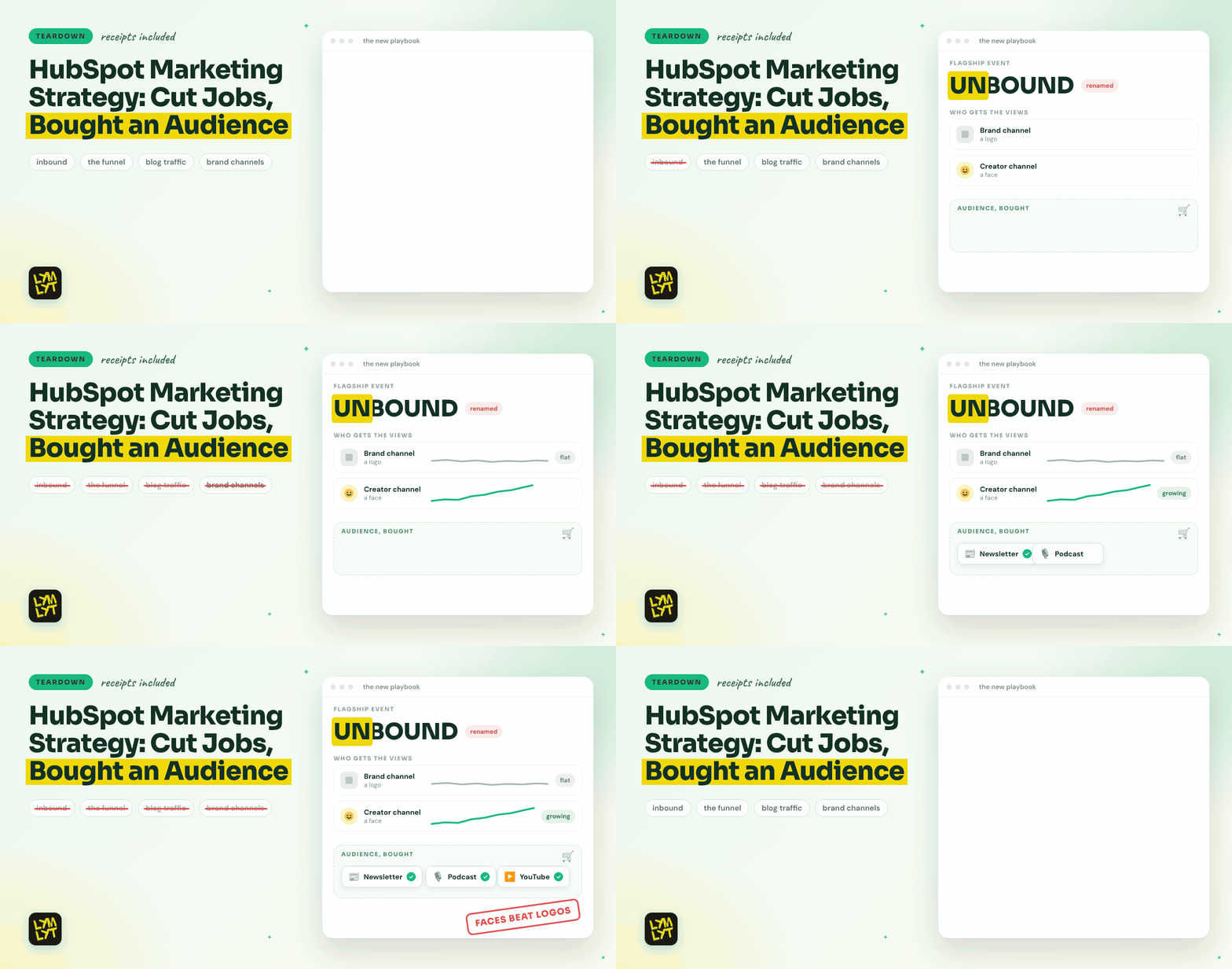
What is HubSpot doing for Marketing? 660 Jobs Cut, Revenue Up 20%, and an Audience Bought Outright
On October 6, HubSpot cut about 660 jobs. One quarter earlier, its revenue grew 20%.
This is the company that wrote the book on inbound marketing. In April it dropped the word from its own conference.
So what is the HubSpot marketing strategy now? I went through HubSpot’s SEC filings, its pricing page, its blog’s HTML, and every channel it owns. Then I turned it into a 13-minute video. This post is the written version, with a screenshot behind every claim.
Short on time? Here is the whole thing in five lines:
- HubSpot stopped trying to own Google and started buying attention instead.
- The channels it bought now outperform the channels it built, by a wide margin.
- Entry pricing fell to $7 a seat. The Pro tier still costs $3,800 in month one.
- Revenue keeps growing. New customers came in below plan, and the stock fell hard.
- The top of the funnel works. Turning that attention into paying customers is the open question.
How I checked every number
I sorted every source into four levels of trust, and the post tells you which level each claim comes from.
- HubSpot’s own filings and pages. SEC filings, the pricing page, the homepage, the blog. Stated as fact.
- Named reporting. CX Today, the Boston Globe, Stacker, Adweek. Attributed in the sentence.
- Third-party estimates. Social Blade and Semrush. Labeled “estimated”, with the capture date.
- Anecdotes. Glassdoor reviews. Labeled as one person’s view.
Each screenshot shows the live page with the key line highlighted. Where a fact lives in page code, I added a labeled annotation box.
The layoff: 660 people, and a very specific explanation
HubSpot filed a Form 8-K with the SEC on October 6, 2026. The board approved a restructuring plan on October 1. It cuts about 7% of the workforce and costs $65 million to $75 million.
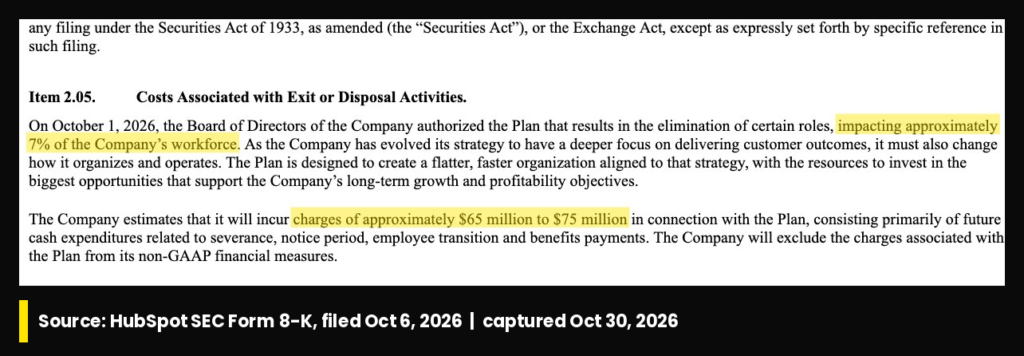
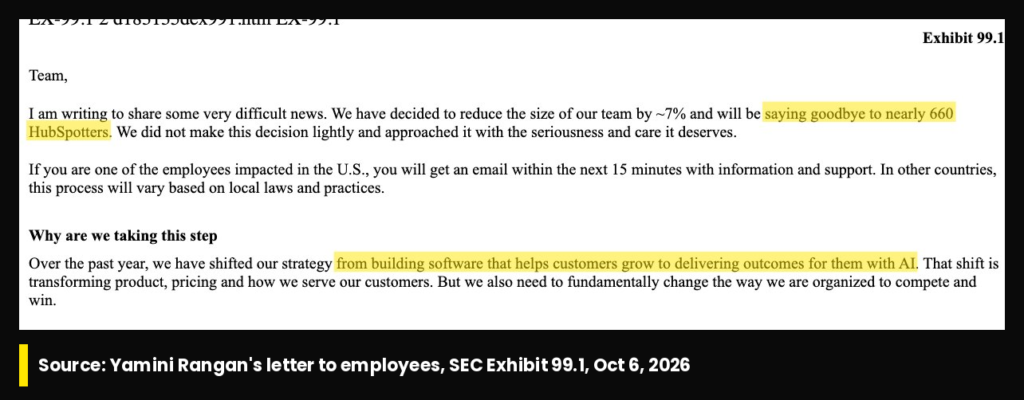
CEO Yamini Rangan’s letter to staff was filed as an exhibit. It puts the number at “nearly 660 HubSpotters.” The reason she gives is a strategy shift, not a slowdown.
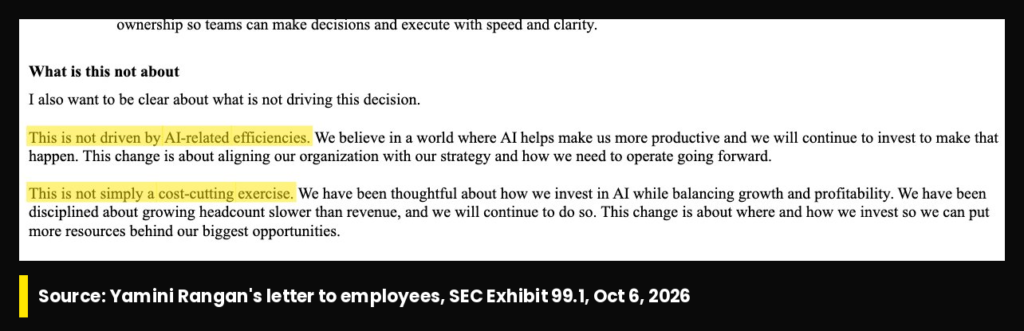
Then she rules two things out, in plain words.
The severance terms are generous. The letter offers 20 weeks of base pay plus a week per year of service, capped at 30 weeks. It also covers five months of health benefits, and staff keep their laptops. CBS Boston reported the same terms.
One gap remains. HubSpot has not said which teams were cut. Nothing public says how much of marketing was hit, so I won’t guess.
Two more filings followed. The same 8-K reaffirmed Q3 and full-year revenue guidance. Three days later, a second 8-K disclosed that Chief Legal Officer Erika Fisher is resigning, effective November 6.
Revenue still grew 20%
Here is the part that makes the layoff hard to read. HubSpot is not shrinking.
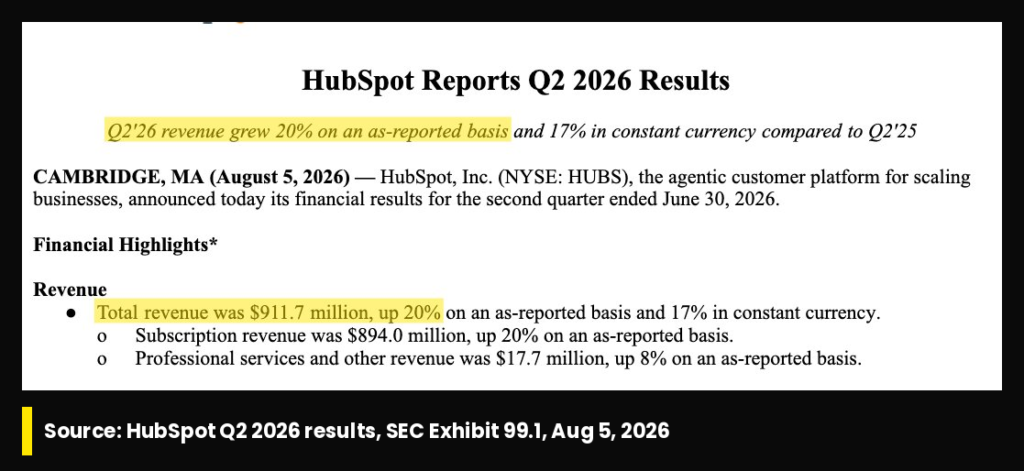
Q2 revenue was $911.7 million, up 20%. Customers grew 14% to 306,446, per the same filing.
The miss was underneath. The Q2 call summary puts net new customers near 7,000. The plan was 9,000 to 10,000. Hold onto that gap. It explains most of what follows.
The old HubSpot marketing strategy ran on Google
For 15 years, the engine was simple. Write blog posts that rank. Turn readers into leads. Turn leads into customers.
In 2021, HubSpot said 7 million people read its blogs every month. Then the traffic fell.
What the traffic tools saw
From late 2024, third-party tools estimated the blog lost 75% to 81% of its search traffic. Spin Sucks cites Semrush showing total organic visits falling from about 13.5 million a month to 8.6 million. Lynton cites a 76% year-over-year drop in Sistrix.
These are estimates, not HubSpot’s analytics. We broke down the dates in an earlier post: HubSpot lost most of its blog traffic. Its revenue went up 19%.
What HubSpot said back
SVP of Marketing Kieran Flanagan pushed back. He said they did not lose 80%. Informational traffic fell, but buying traffic held up.
Part of the drop was deliberate. HubSpot pruned more than 30,000 blog pages that did not convert. That is content pruning at a scale few companies will ever attempt.
By mid-2025, HubSpot told CX Today that only about 10% of its leads came from blog traffic.
The blog still says 4.5 million readers
The marketing blog’s meta description is the text Google shows under the link. It still claims more than 4.5 million monthly readers. It also promises to help you “master inbound marketing.” That is the word HubSpot just retired from its event.
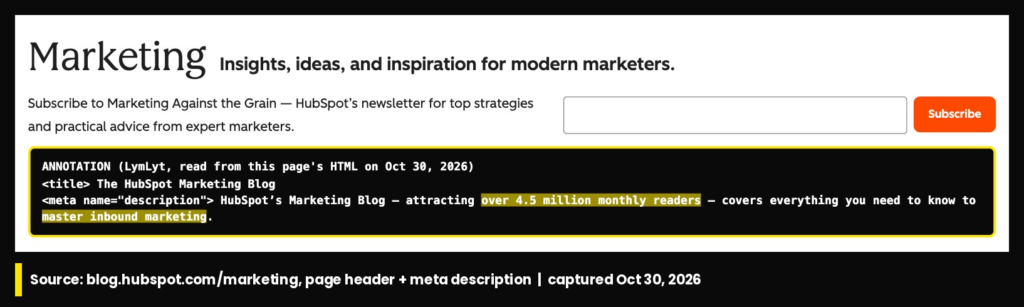
Neither number is current. The 4.5 million figure almost certainly predates the traffic collapse.
Plan B: buy the audience
HubSpot did not fight Google for the scraps. It went shopping.
- 2021: The Hustle, a business newsletter, for a reported $27 million. The My First Million podcast came with it.
- October 2024: Mindstream, an AI newsletter.
- February 2026: Starter Story, a YouTube channel about founders. Adweek reported a three-person, profitable team.
- April 2026: Futurepedia, an AI tools site, per Forbes Argentina.
HubSpot Media, by its own numbers
Stacker interviewed Jonathan Hunt, who runs HubSpot’s media business. The numbers are large.
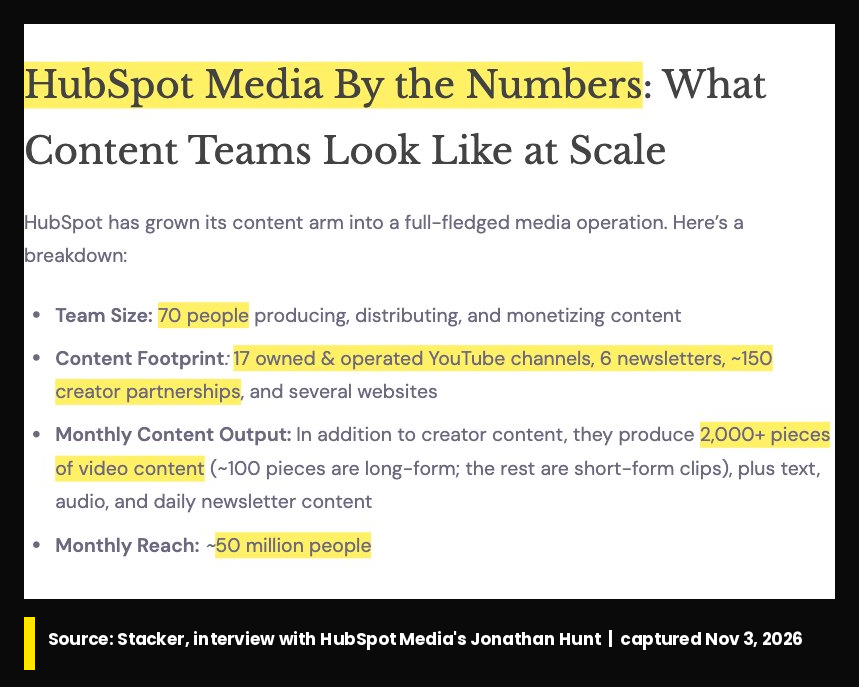
That is 70 people, 17 owned YouTube channels, six newsletters and about 150 creator partners. They ship more than 2,000 videos a month and claim a reach of about 50 million people.
The buying method is the clever part. Hunt describes it in the same interview. HubSpot sponsors a creator first. Then it co-creates. Then it watches conversion rates. Only then does it buy. He says the deals “never started from a place of acquisition.”
The channel it bought beats the channel it built
This is the stat from the video that people argued about most. Here is the fresh data.
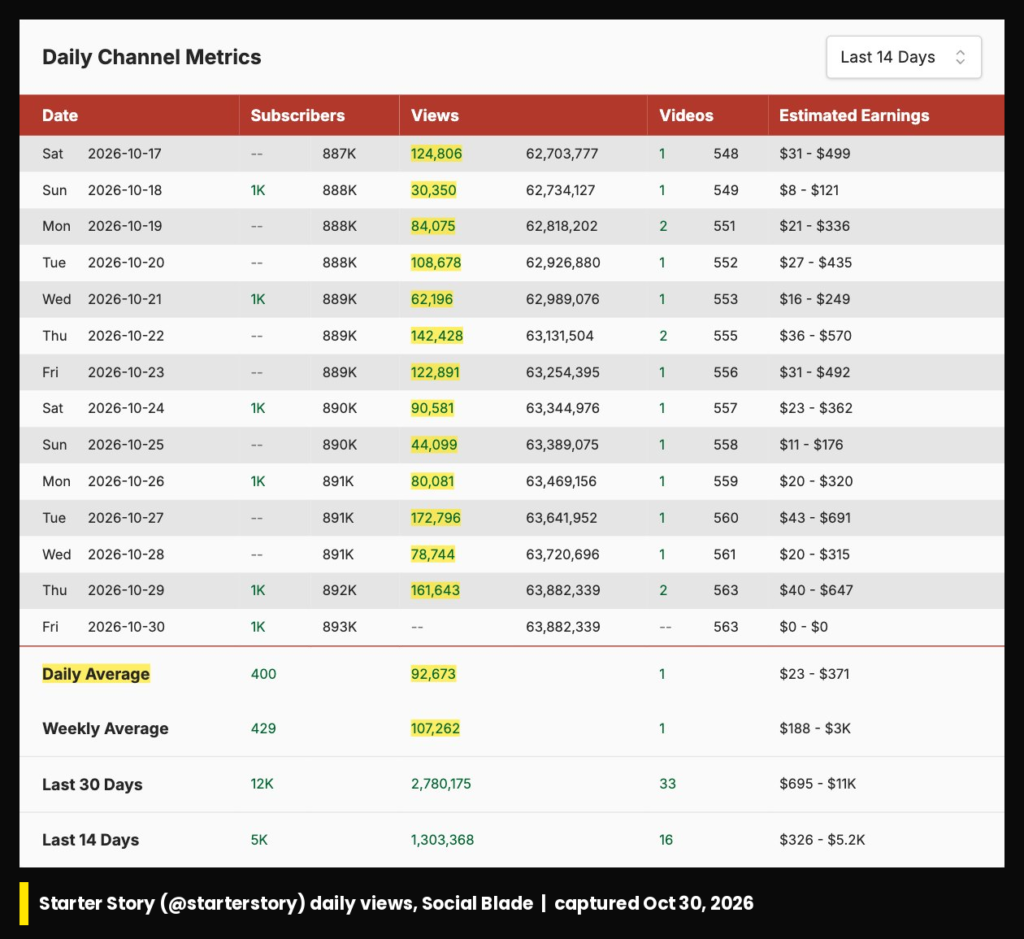
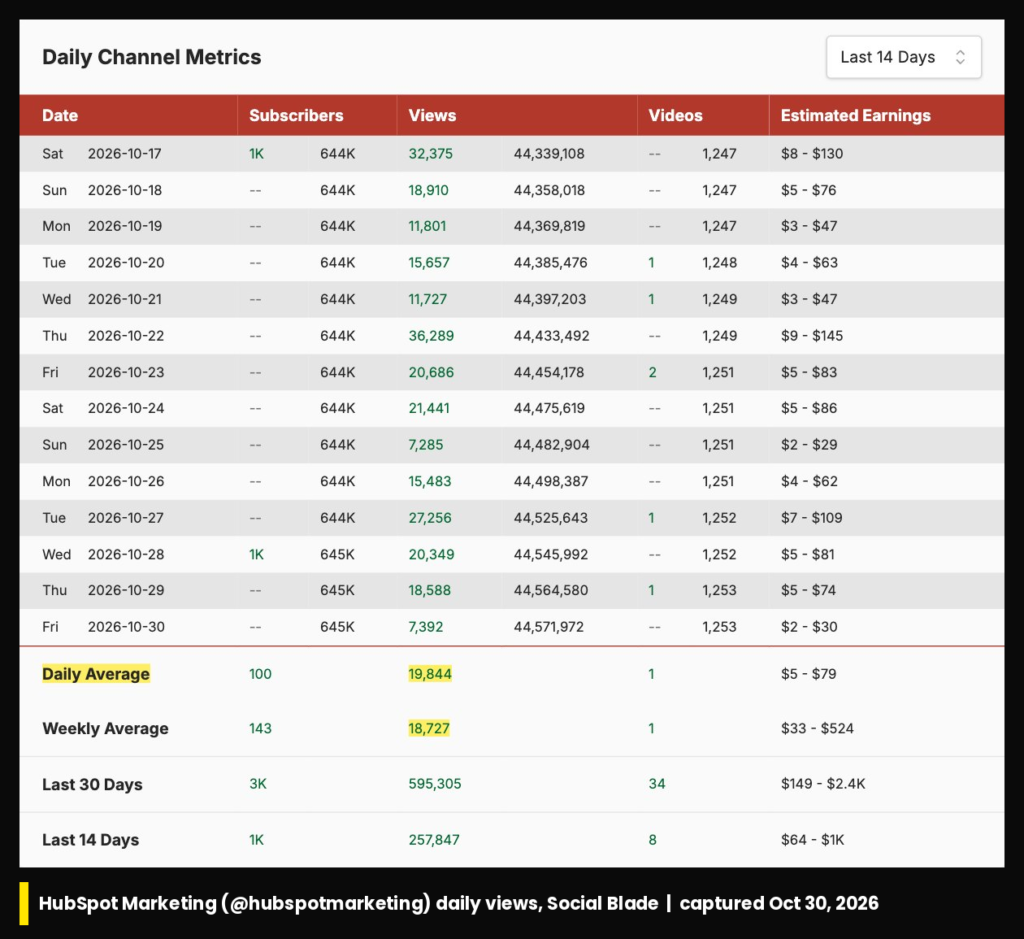
Over the same two weeks, Social Blade estimates Starter Story averaged 92,673 views a day. HubSpot’s own main channel averaged 19,844. That is about 4.7 times the daily views. When I recorded the video, the gap was closer to four times. It widened.
The podcast is a lead form with great hosts
How does a podcast turn into pipeline? Open any recent My First Million episode description.
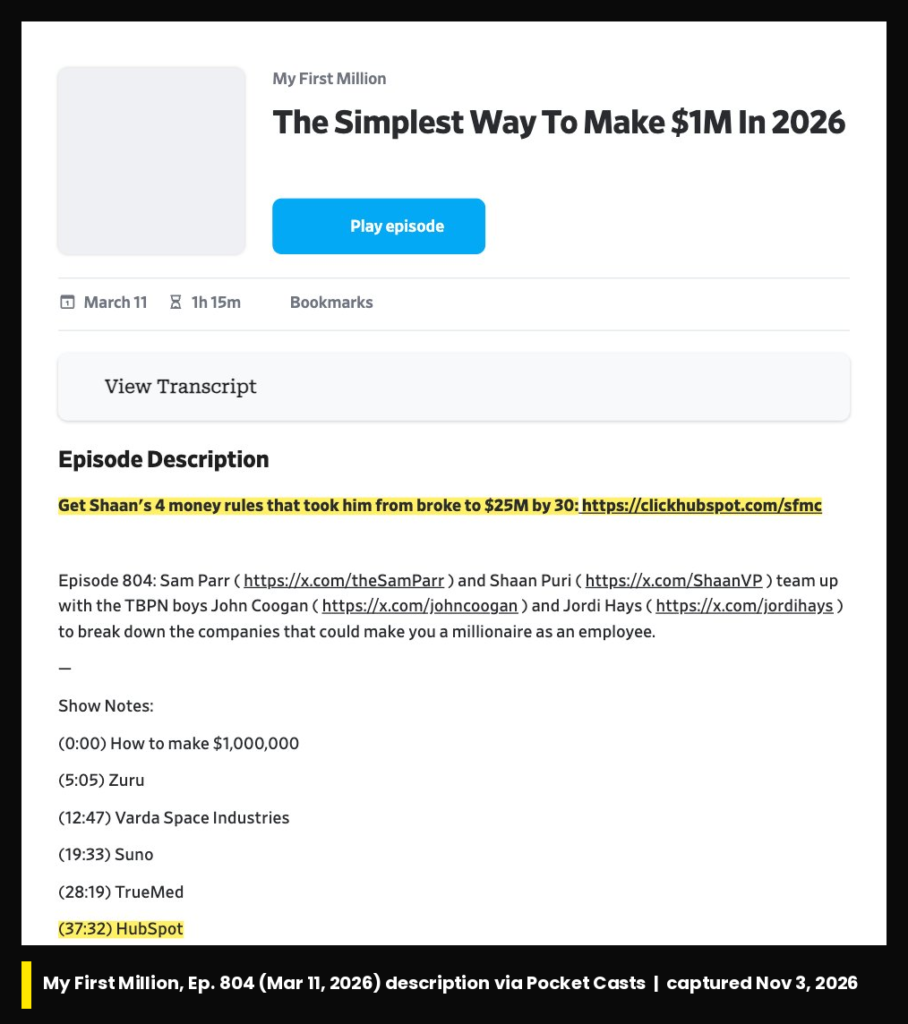
The first line is a free guide on clickhubspot.com. Click it, fill the form, and you are a HubSpot lead.
Look further down the same episode. The show lists the companies that “could make you a millionaire as an employee.” HubSpot is one of them, at 37:32. HubSpot owns the show.
That raises a fair question about trust. Analysts at eMarketer warned that the value disappears once a show starts to feel like an ad. If you run a newsletter yourself, our guide to B2B newsletters covers how to keep that line clean.
The scoreboard: faces beat logos
Every HubSpot channel with a logo is flat. Every channel with a person is growing.
Instagram: 662,588 followers, 0.03% engagement
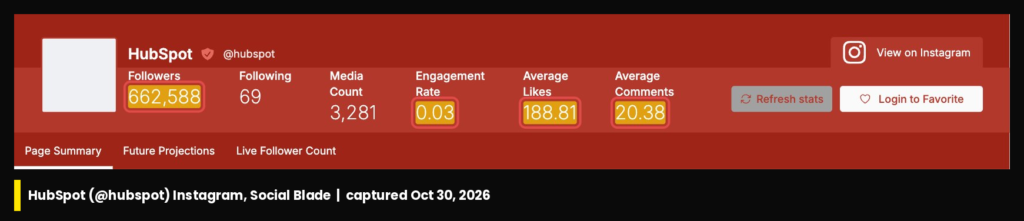
Social Blade shows about 189 likes and 20 comments per post on 662,588 followers. The engagement rate is 0.03%. In the video I said 0.04%. It slipped since.
Rival IQ’s benchmark, via SocialPilot, puts the media industry average at 0.48%. HubSpot sits at roughly a sixteenth of that.
The Hustle on YouTube: two views a day
HubSpot paid a reported $27 million for The Hustle. Its YouTube channel has 14 videos and 3,210 subscribers.
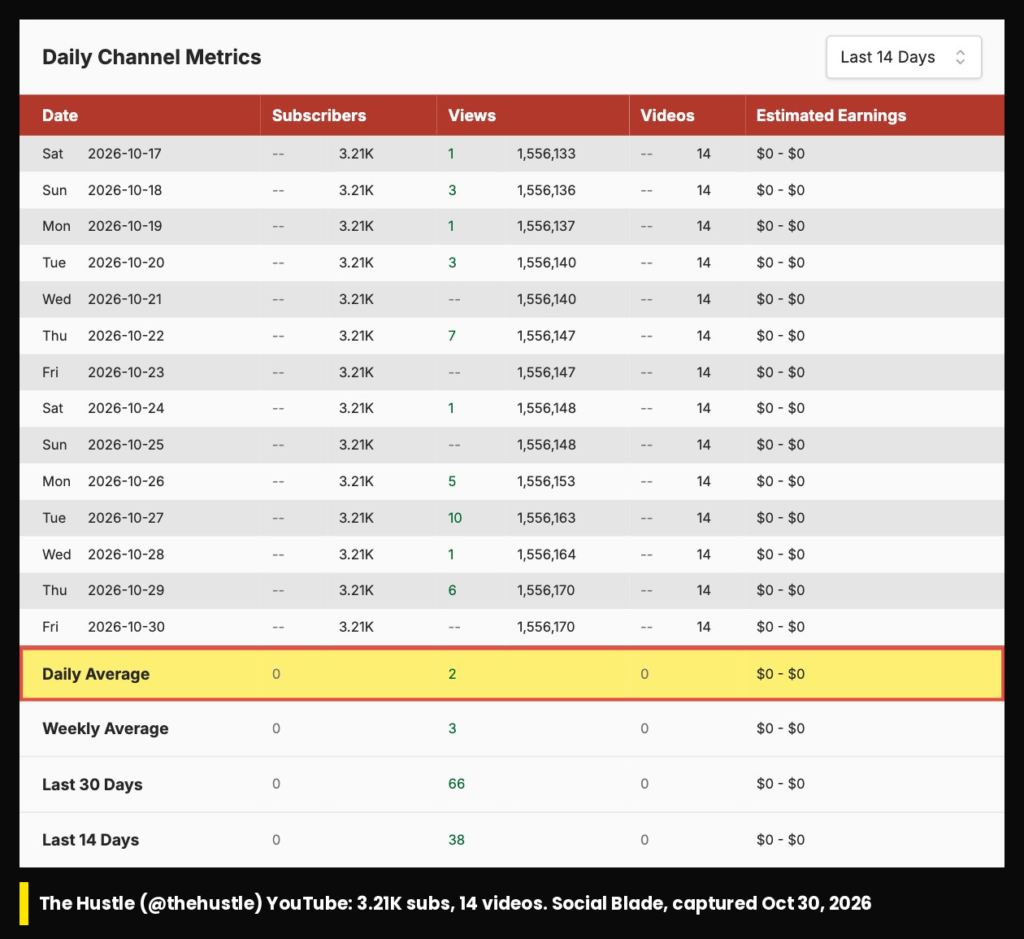
The daily average is two views. Over 30 days it got 66.
The people column
Compare that with the faces. My First Million has about 942,000 YouTube subscribers, per Developer Educators. Starter Story has 893,000, per Social Blade above.
The lesson is not new, but HubSpot just paid to prove it. Audiences follow people. We wrote about why this matters for B2B in why founder-led posts get marketer-led. The same pattern runs through Reddit, LinkedIn and YouTube as AI citation sources.
The new funnel: Loop, UNBOUND and AI answers
In September 2025, CMO Kipp Bodnar told Campaign Asia that “the funnel isn’t flowing.” HubSpot replaced it with “Loop Marketing.” Its four stages are Express, Tailor, Amplify and Evolve, per CMSWire.
Then, on April 6, 2026, it renamed the conference.
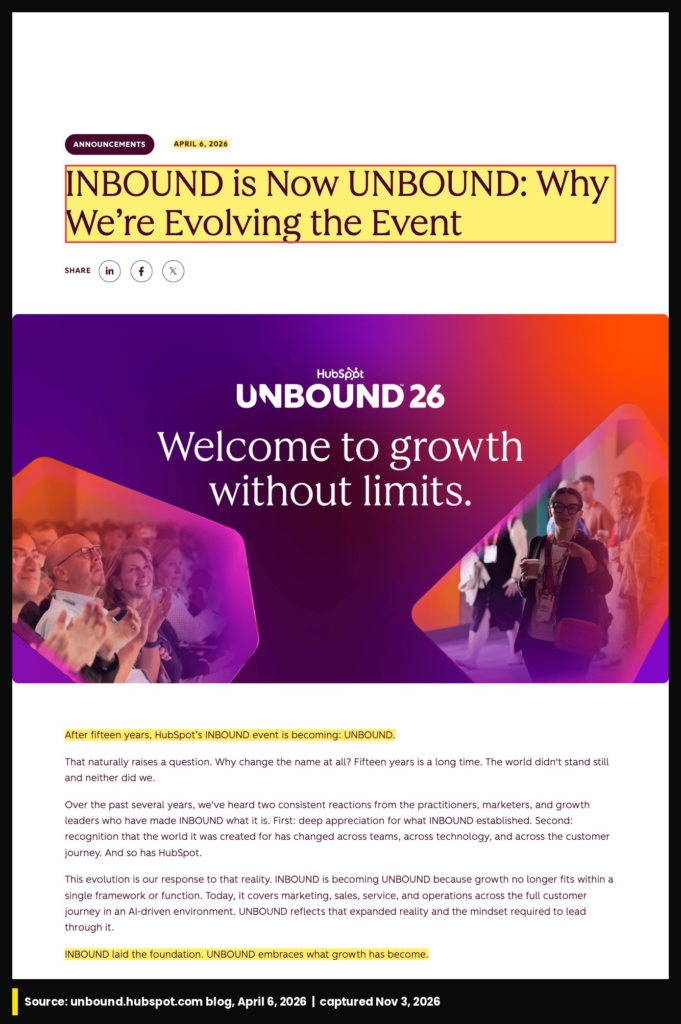
After 15 years, INBOUND became UNBOUND. The post says “Buyers now discover through AI before they click.”
Where HubSpot deserves real credit
HubSpot got very good at showing up inside AI answers. Goodie’s AI visibility index ranks it first in CRM, at 75.6 against Salesforce’s 72.9. Former marketing lead Aja Frost told Growth Unhinged that AI-qualified leads rose 1,850%.
It turned that into a product. HubSpot AEO costs $50 a month on the pricing page. It tracks whether ChatGPT, Gemini and Perplexity mention you.
There is a catch. Lynton noted that HubSpot launched AEO citing customers’ traffic losses. It did not mention its own blog’s drop. If you are comparing tools in this space, see our list of the best AEO tools for B2B SaaS.
Pricing: $7 at the door, $3,800 to grow up
Did HubSpot raise prices? At the entry level, the opposite.
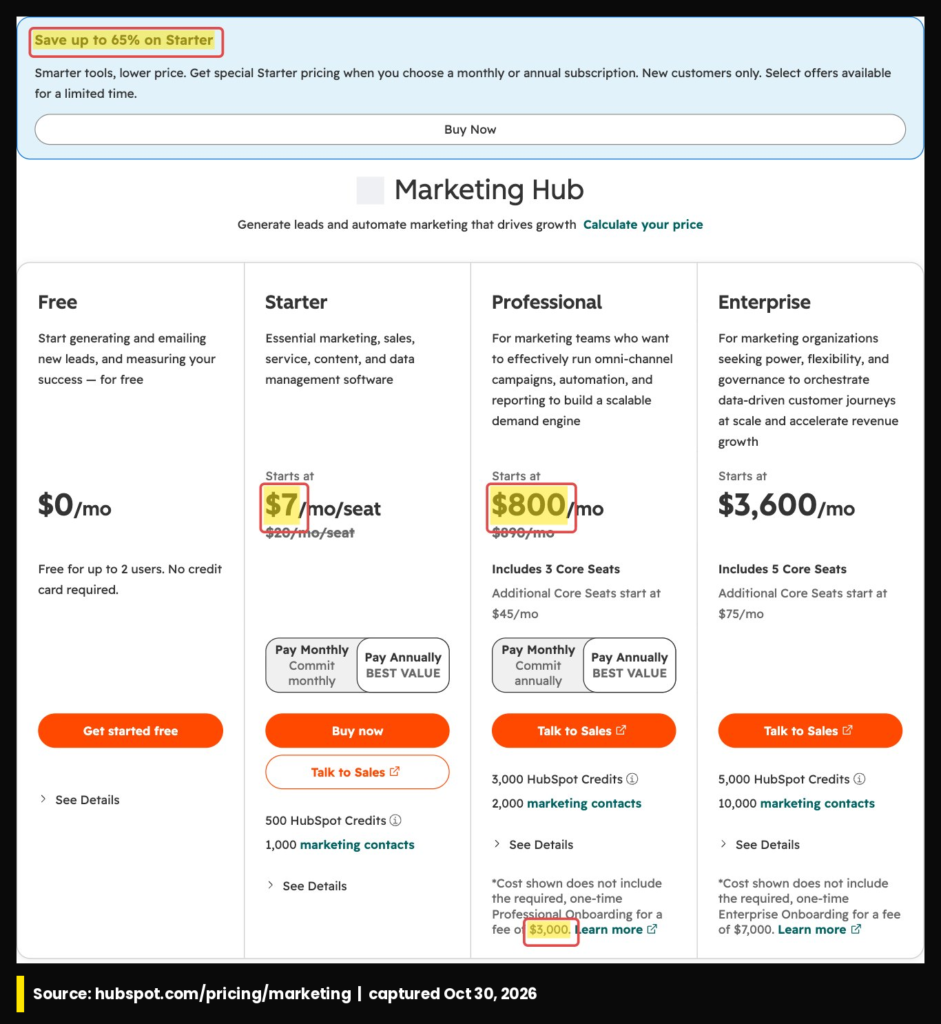
Starter now costs $7 per seat per month, billed annually. The banner says “Save up to 65% on Starter.” Marketing Hub Professional starts at $800 a month.
Read the asterisk. Professional also carries a required one-time onboarding fee of $3,000. So month one of Pro costs $3,800. Seven dollars gets you in. Growing up costs a lot more.
Why Wall Street did not cheer
On April 14, HubSpot moved its AI agents to pay-per-outcome pricing, per CX Today. Investors read the cut as weakness.
- May 8: the stock fell more than 20% in one day, per the Boston Globe.
- August 5: revenue beat, net adds missed, and the stock fell nearly 19%, per Börse Express.
- By mid-September: shares were down more than 60% over 12 months, per MarketBeat.
Cheap entry pricing grows the top of the funnel. It only pays if Starter users climb to Pro. That is the same trap we see in teams chasing more MQLs with less pipeline.
Trust: the data-sharing reversal
On July 1, HubSpot changed its terms of service. Contact enrichment data could be shared across customer accounts. The setting was opt-out by default.
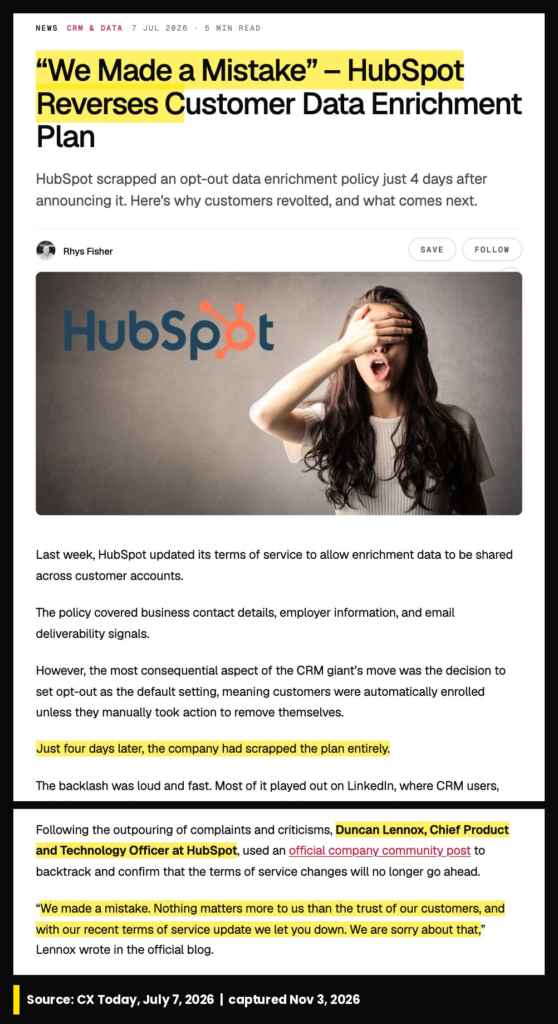
Marketers on LinkedIn revolted. Your prospect list could help your competitor. Four days later, the plan was scrapped. Chief Product and Technology Officer Duncan Lennox wrote: “We made a mistake.”
Credit where due: the reversal was fast and the apology was plain. The episode still matters. A company that built its brand on permission ended up on the wrong side of a consent argument.
Morale before the cut
HubSpot was Glassdoor’s best place to work in 2020. By July 2026 its rating had fallen to 3.4 out of 5, per Wikipedia’s summary. In April, one Glassdoor reviewer wrote that staff “now just push AI slop.” That is one person’s view, not proof. It is still a strange sentence to find about a company selling AI content tools. We define the term in our glossary entry on AI slop.
The audit: the marketing company’s messy attic
I did what HubSpot taught a generation of marketers to do. I audited its website.
Dead podcast links and two-year-old dates
The marketing blog has a podcast module. Every one of its 15 links routes through link.chtbl.com. That is Chartable, which Spotify shut down in December 2024, per Podcast News Daily. The cards still say “Updated 10/1/24.”
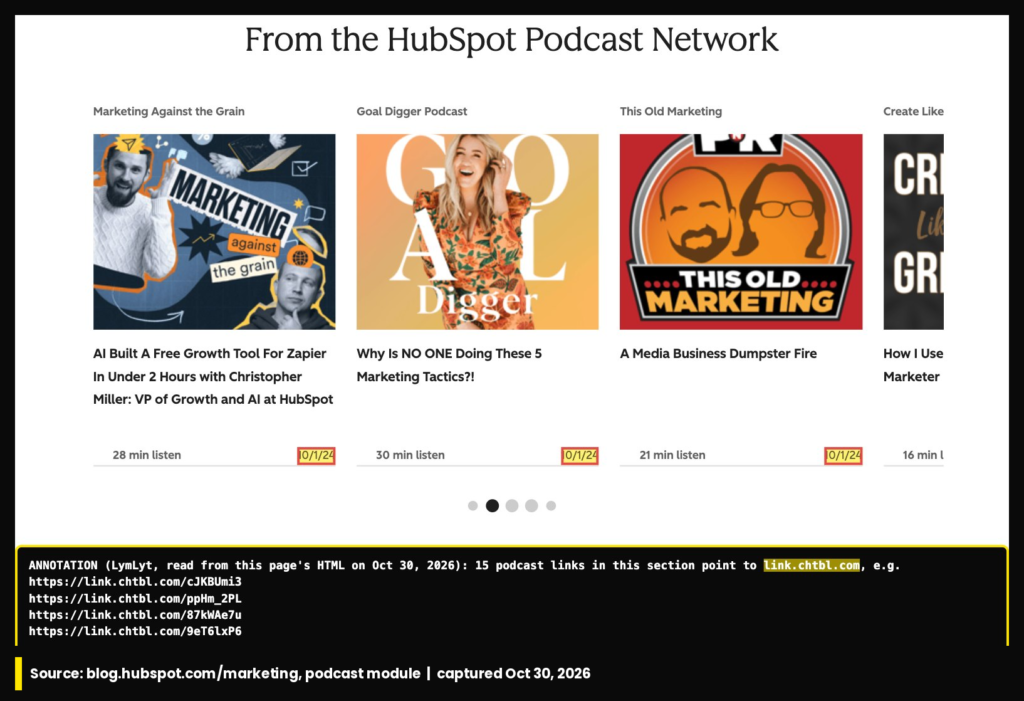
Some links may still redirect for shows hosted on Spotify’s Megaphone. Either way, the attribution service behind them is gone.
A folder called DO NOT USE
The homepage now calls HubSpot an “agentic customer platform.” Its logo images load from a folder whose name starts with “DO NOT USE.”
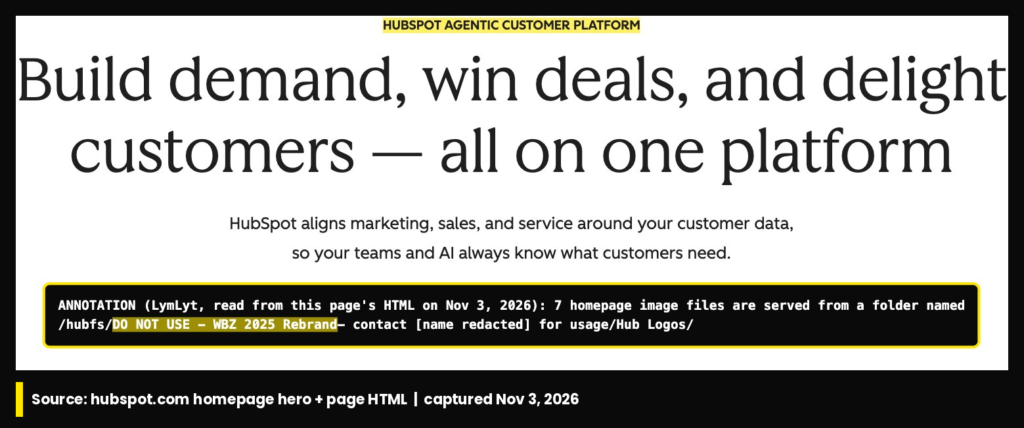
None of this is a scandal. Every company has a messy attic. But it shows where the attention went. It went to the creators, not the website.
One fix since the video: by Nov 3, the Data Agent card’s “content agent” link text was gone.
So, does the HubSpot marketing strategy work?
At the top of the funnel, yes. HubSpot reaches about 50 million people a month, by its own count. It leads its category in AI visibility. Its bought channels outgrow its built ones.
Below the funnel, it is unproven. New customers came in under plan. The stock lost more than half its value. About 660 people lost their jobs. The brand’s own channels barely move.
My verdict from the video stands. HubSpot proved you can buy an audience faster than you can rank for one. It has not yet proved that audience pays like Google traffic did.
HubSpot reports Q3 results on November 4, 2026. Net new customers is the number to watch.
Three things you can steal with a team of five
1. Put a face on it. Every HubSpot channel with a person grew. Every logo stalled. If your CEO has expertise, executive ghostwriting is the cheapest way to borrow that effect.
2. Sponsor before you build. HubSpot tests creators with sponsorships before buying them. Test new channels the same way. Our content distribution playbook covers how.
3. Give every piece of content a next step. My First Million ends in a gated guide. What does your content end in? Start with lead magnets that still work.

Rashmita is content marketer with 8 years of experience building and growing SaaS brands. Now she tests various AI tools for marketers and shares her feedback on this blog, LinkedIn, Instagram, and YouTube.