AI Has Entered the Buying Committee
Imagine a team choosing a project management tool.
Someone asks an AI assistant: “What should a 40-person agency use if we need client approvals, time tracking, and simple reporting?”
They ask for a comparison. They ask what each option does badly. Then they send the answer to a colleague.
No vendor has joined the conversation. Yet several vendors may already have been included or ruled out.
This is an illustrative example of a change that matters: your product can be discussed before anyone visits your website or speaks to your team.
AI is helping with the homework
“AI has entered the buying committee” is a useful way to describe its influence. It does not mean an AI tool has become the person approving every purchase.
For many buyers, it is a research assistant. It can explain a category, suggest options, summarize reviews, and prepare questions for a demo.
G2’s 2025 buyer research found that nearly eight in ten respondents said AI search had changed how they researched. Twenty-nine percent said they started research through platforms such as ChatGPT more often than Google.
That is substantial use within G2’s surveyed group. It is not proof that all B2B discovery now starts with AI.
Some buyers start with a colleague’s recommendation. Others start with a product they already know, a review site, a consultant, or a search engine. AI joins that mix.
The question has become more specific
A search might begin with “best project management software.” An AI conversation can quickly become more detailed:
- Which options suit our size and budget?
- What works with the tools we already use?
- What would make this a bad choice for us?
- What should we test before committing?
These are imagined questions, but they show why a vague product description is weak preparation.
“A powerful platform for modern teams” gives a buyer little to work with. “Client approval workflows for agencies that manage multiple accounts” gives them something specific to investigate.
LymLyt’s article on shortlist prompts explains the kinds of questions buyers ask when narrowing their options. Those questions are useful content briefs, whether the answer is read on your site or encountered through an AI-assisted search.
A confident answer still needs checking
An AI-generated comparison can sound complete while missing an important detail. A feature may be out of date. A limitation may belong to an older plan. A recommendation may overlook the buyer’s actual workflow.
Forrester’s January 2026 summary of business buying research describes buyers seeking trusted human validation because AI answers can be incomplete or unreliable.
The sensible response is to make verification easy.
Show current product facts. Link to supporting evidence. Explain which plan includes a feature. Describe how an integration works. Give buyers a clear way to ask a question that needs context.
The buyer should be able to move from “AI says this” to “I have checked this” without digging through five sales pages.
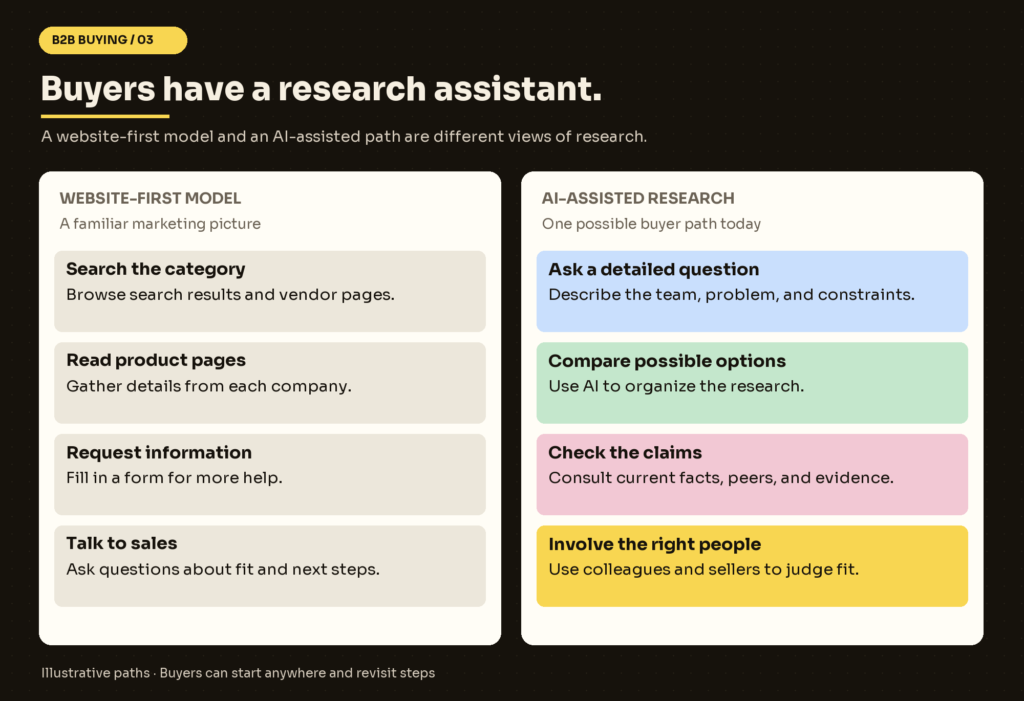
An explanatory comparison, not a fixed sequence. Buyers can start with a peer, a search, an AI tool, or an existing vendor and move between them.
People still help buyers judge fit
A summary can tell a buyer that your software has an integration. It may not tell them whether that integration will support their unusual approval process.
This is where a useful sales conversation matters.
Gartner’s research on buyer preferences found that buyers favored independent digital research for general information but preferred seller input for tasks such as judging whether a product fit their company’s needs.
The implication is practical: arrive with understanding. Ask what the team has learned, what they are comparing, and what still feels uncertain.
“sellers should offer unique guidance, acting as a sounding board for buyers”
— Alice Walmesley, Gartner, on helping buyers judge fit
A buyer who has done the homework may need a worked example, a trial plan, or a straight answer about limitations. Repeating a basic product introduction can waste the conversation.
Buyers are also using AI to examine brands they already know
In a Reddit discussion about research before a website visit, the original poster describes asking AI about brands they have already heard of and asks where initial discovery happens.
It is one person’s observation, not a survey. But it helps separate two questions that often get mixed together: “How did someone hear about us?” and “How did they investigate us?”
A LinkedIn post or a colleague may introduce your name. AI may help examine it. Your website may supply the evidence. A trial may settle the choice.
Giving the final tool all the credit would miss how the buyer got there.
Make your business easy to understand
Start with the questions a real buyer needs answered:
| Buyer question | Useful public information |
|---|---|
| Who is this for? | The team, problem, and circumstances where the product fits |
| What does it actually do? | Real workflows, examples, and product details |
| What are its limits? | Important trade-offs and unsuitable use cases |
| What will it take to use? | Setup, support, integrations, and meaningful pricing information |
| Why believe the claims? | Customer evidence with enough context to judge relevance |
LymLyt’s guide to honest comparison pages makes a useful point: admitting where another option fits better can help buyers trust the rest of the comparison.
Clear answers help humans evaluate you. They also give research tools better material to work with. They do not guarantee a recommendation in every AI answer.
Check the answers buyers may encounter
Build a small list of realistic questions from sales calls and customer interviews. Include category questions, comparisons, and questions about your own product.
Try them in the tools your buyers say they use. Record the tool, date, question, answer, and sources shown. Answers can change, so one test is only a snapshot.
Look for mistakes you can address with clearer public information. Check whether your important pages agree with product documentation and what sales says.
LymLyt’s AI visibility service can help structure this work. The objective should remain useful buyer information, rather than collecting mentions with no connection to real decisions.
Also ask new customers which tools helped them research. Their answers will keep the exercise grounded.
Measure AI visibility and buyer impact separately
A mention in an AI answer is a visibility signal. A visit from an AI tool is a traffic signal. Neither tells you, by itself, that AI created a customer.
Use a small scorecard that keeps those questions separate:
| Question | Evidence to record | Limit to remember |
|---|---|---|
| Do we appear for relevant questions? | Mentions across a fixed set of buyer questions, with tool and test date | A sample of answers is not market share |
| Are the answers accurate? | Correct and incorrect product claims, plus sources shown | Accuracy does not guarantee buyer preference |
| Does AI send suitable visitors? | Identifiable referrals and later qualified enquiries | Some buyers research without clicking a link |
| Does AI matter to real purchases? | Buyer accounts of using AI, linked to unique opportunities | Remembered use is evidence of involvement, not exact causal credit |
Keep the question set consistent enough to compare snapshots. Include genuinely unbranded questions; appearing when someone asks about your company is different from appearing when they ask for suitable options. Repeat checks because answers vary, and report the size of your sample.
For attribution, preserve the tracked source and add a separate field for the buyer’s reported AI use. If someone first heard of you through a peer and used AI to compare options, record both roles. Do not move the entire deal into an “AI-sourced” category just because AI was involved.
If visibility improves but no suitable enquiries or buyer mentions appear, investigate relevance and the next step. If buyer mentions increase without recorded referrals, the influence may be happening outside a click path. That is a reason to examine the accounts, not assign an invented percentage of revenue to AI.
Review results over your buying cycle, alongside costs and commercial outcomes. Avoid changing questions until the report looks good.
AI can speed up the research. Your job is to make the facts easy to find, the claims easy to check, and the next conversation worth having.
Frequently asked questions
Can we attribute every AI-assisted purchase?
No. Buyers may read an answer without clicking, and colleagues may share it privately. Combine identifiable referrals with buyer accounts and opportunity outcomes. Keep “AI-assisted” distinct from a tracked AI referral.
Is AI visibility a replacement for SEO and social?
Treat it as part of the same discovery and research work. Buyers can encounter a brand socially, investigate through AI, and verify on a website. The right mix depends on your audience.
What should a small team measure first?
Start with a fixed set of relevant questions, answer accuracy, identifiable referrals, and whether suitable buyers mention AI in their research. Those are useful signals without pretending to know the value of every AI mention.

Rashmita is content marketer with 8 years of experience building and growing SaaS brands. Now she tests various AI tools for marketers and shares her feedback on this blog, LinkedIn, Instagram, and YouTube.