
Thought Leadership Content: 9 Sources AI Can’t Copy
Most thought leadership content isn’t. It’s a summary of what everyone else already said, now written in about 30 seconds by a chatbot. In an Ahrefs study of 900,000 new web pages from April 2025, 74.2% contained AI-generated content (Ahrefs). If your post could have been written from the same public sources, it’s competing with all of those pages.
Real thought leadership starts with material only you have: your data, your customers, your mistakes, your decisions. AI can rewrite those things once they’re published. It can’t produce them in the first place.
This guide covers nine sources AI can’t copy, a five-step process to turn each one into a post and a quick test to run before you hit publish. For the short definition, see our thought leadership glossary entry.
What makes content “thought leadership”?
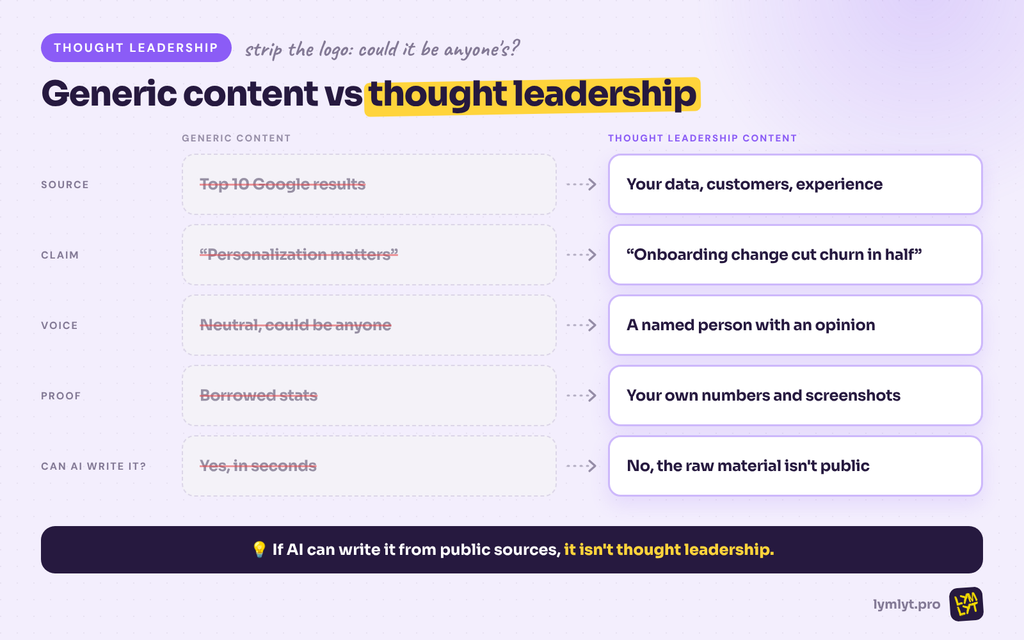
Thought leadership content gives the reader something new: a fact, a pattern, a point of view or a lesson they couldn’t get anywhere else. If you strip out the author’s name and the post could belong to any company in your category, it’s not thought leadership. It’s content marketing with a nicer byline.
| Generic content | Thought leadership content | |
|---|---|---|
| Source | Top 10 Google results | Your data, customers and experience |
| Claim | “Personalization matters” | “Personalized onboarding cut our churn in half; here’s the data” |
| Voice | Neutral, could be anyone | A named person with a clear opinion |
| Proof | Borrowed stats | Your own numbers, examples and screenshots |
| AI can write it? | Yes, in seconds | No, the raw material isn’t public |
Why thought leadership content matters more now
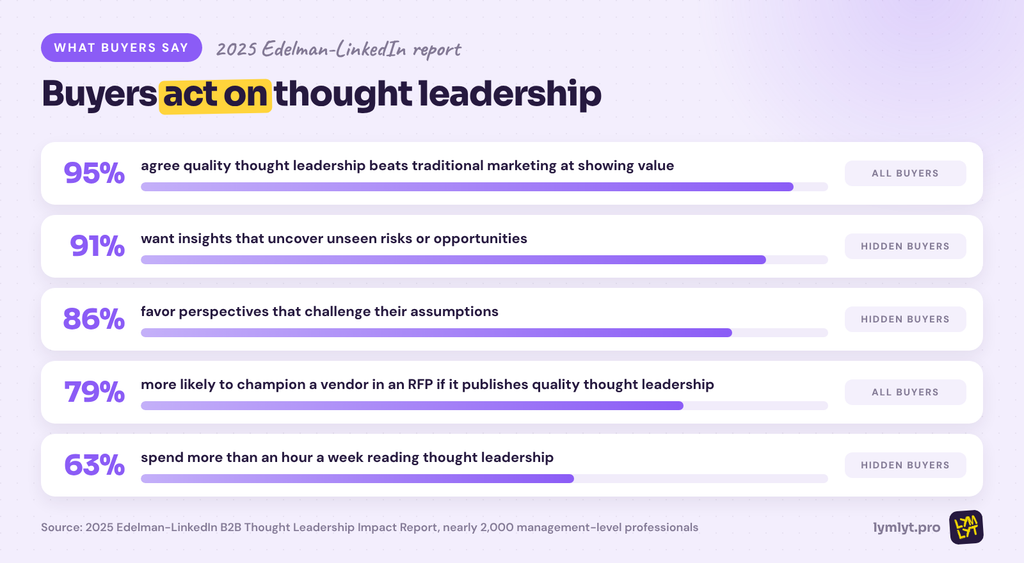
Buyers say they want it, and they act on it. The 2025 Edelman-LinkedIn B2B Thought Leadership Impact Report surveyed nearly 2,000 management-level professionals (Demand Gen Report). It found:
- 95% of buyers agree high-quality thought leadership conveys a supplier’s value better than traditional marketing or product information
- 91% of hidden buyers want insights that uncover unseen risks or opportunities
- 86% of hidden buyers favor perspectives that challenge their assumptions
- 79% are more likely to champion a vendor during an RFP if it consistently publishes quality thought leadership
- 63% of hidden buyers spend more than an hour a week reading it
“Hidden buyers” are the people in finance, procurement and IT who influence the deal but never talk to sales. Thought leadership is often the only way to reach them. More on that in our guide to the B2B buying committee.
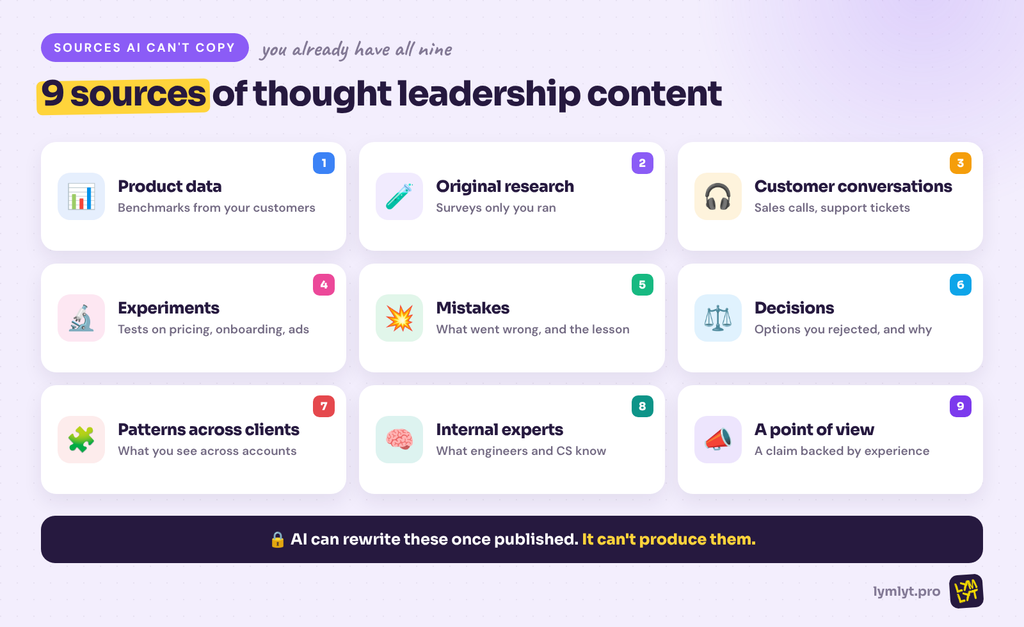
9 sources of thought leadership content AI can’t copy
Each source below is something your company already has. The work is capturing it, not inventing it.
1. Your product data
Aggregate, anonymized data from your product is the hardest thing for anyone to copy. Benchmarks, averages and trends across your customer base are original by definition.
- Example headline: “The median team takes 11 days to close a support ticket. The top 10% take two.”
- How to capture it: ask your data or product team for three numbers your customers would want to compare themselves against.
2. Original research and surveys
A survey of your audience gives you facts nobody else has. Keep it small and focused: 100 good answers beat 1,000 rushed ones.
- Example headline: “We asked 150 RevOps leaders how they forecast. Most still use spreadsheets.”
- How to capture it: state the sample, date and method with every number. Our post on original statistics and AI citations explains why that matters, and the AI citation telephone game shows what happens to numbers that don’t carry their source.
3. Customer and sales conversations
Your sales calls and support tickets are full of real problems in real words. They show what buyers actually worry about, not what a keyword tool says.
- Example headline: “The question we hear on every second demo, and the honest answer.”
- How to capture it: review call recordings monthly and tag repeated questions. Our case study interview guide has questions that get beyond polite answers.
4. Experiments you ran
Tests you ran on your own pricing, onboarding, ads or content are original evidence. Even a failed test is useful if you share what you learned.
- Example headline: “We removed the free trial for 60 days. Here’s what happened to signups and revenue.”
- How to capture it: keep a simple log of tests: what you changed, why and the result.
5. Mistakes and post-mortems
AI can describe best practices. It can’t tell the story of the time you got it wrong. Honest failure posts stand out because so few companies write them.
- Example headline: “We hired three SDRs before we had a repeatable message. It cost us six months.”
- How to capture it: after every project review, ask “What would we tell another company to avoid?”
6. Decisions and trade-offs
Every company makes choices: what to build, what to kill, how to price, who not to sell to. Explaining the reasoning shows how you think.
- Example headline: “Why we stopped selling to companies under 20 people.”
- How to capture it: when leadership makes a big call, write down the options you rejected and why.
7. Patterns across clients
If you work with many companies, you see patterns no single company can. That cross-account view is valuable and hard to fake.
- Example headline: “We reviewed 40 SaaS homepages this year. Here are the five claims every one of them made.”
- How to capture it: ask customer-facing teams for the one thing they see go wrong again and again.
8. Your internal experts
Your engineers, customer success managers and finance team know things your marketing team doesn’t. A 30-minute interview can produce a month of content.
- Example headline: “Our head of security on the five questions every vendor review actually asks.”
- How to capture it: run short recorded interviews, then turn the transcript into a post under the expert’s name. That’s what executive ghostwriting does well.
9. A point of view you can defend
An opinion becomes thought leadership when it’s specific, a little uncomfortable and backed by your experience. “AI is changing marketing” isn’t a point of view. “Most founder-led content is written by marketers, and buyers can tell” is. (We made that argument here.)
- How to capture it: finish the sentence “Most people in our industry believe X, but we’ve seen Y.”
How to turn a source into thought leadership content
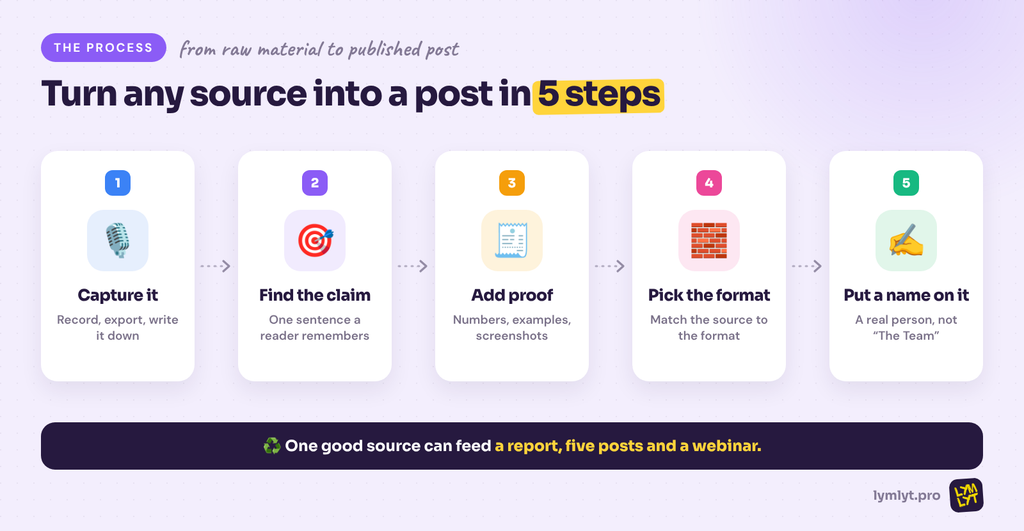
Having raw material isn’t enough. Here’s a simple five-step process to turn any source above into a finished piece.
- Capture it. Record the call, export the data, write down the decision. Don’t trust memory.
- Find the claim. What’s the single thing a reader should remember? Write it in one sentence.
- Add proof. Numbers, examples, screenshots or quotes that back the claim.
- Pick the format. Match the source to the format (see the table below).
- Put a name on it. Publish under a real person with real experience, not “The Team.”
Match the source to the format
| Source | Best formats |
|---|---|
| Product data | Benchmark report, chart-led LinkedIn post, annual index |
| Original research | Report, data story, press pitch |
| Customer conversations | FAQ post, objection-handling guide, newsletter |
| Experiments | Case study, “what we learned” post |
| Mistakes | Founder post, conference talk |
| Decisions | Founder letter, podcast episode |
| Patterns across clients | Teardown, list post, webinar |
| Internal experts | Bylined article, interview series |
| Point of view | Opinion essay, LinkedIn post, op-ed |
One good source can feed several formats. A single survey can become a report, five LinkedIn posts, a webinar and a newsletter issue (here are some B2B newsletter ideas that pair well with original data). Our list of the best content repurposing agencies covers teams that do this at scale.
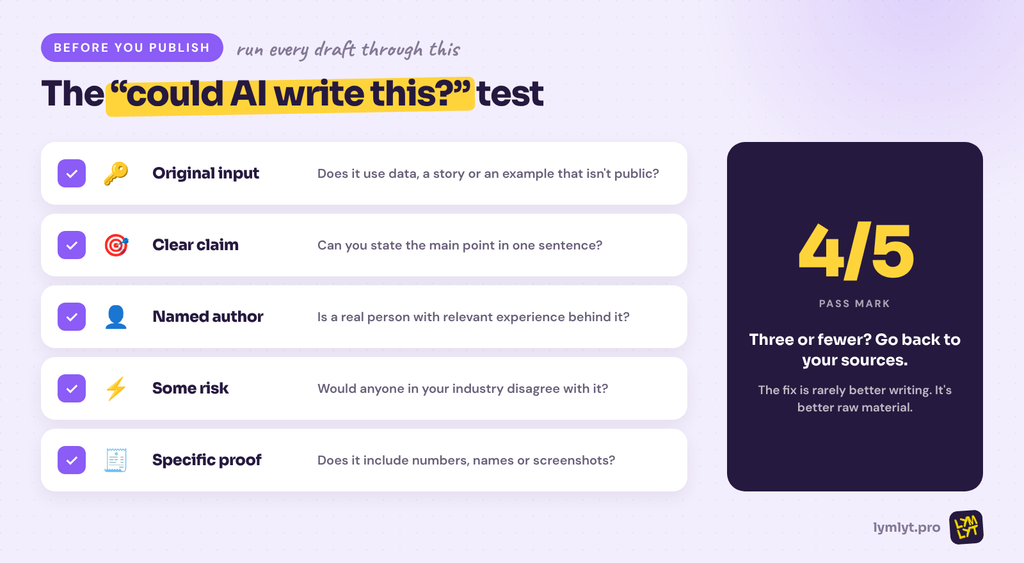
The “could AI write this?” test
Before you publish, check the draft against five questions. If you answer “no” to most of them, go back to the sources.
- Original input: Does it use data, a story or an example that isn’t public?
- Clear claim: Can you state the main point in one sentence?
- Named author: Is there a real person behind it with relevant experience?
- Some risk: Would anyone in your industry disagree with it?
- Specific proof: Does it include numbers, names or screenshots, not just adjectives?
Common thought leadership content mistakes
- Summarizing other people’s research. Commenting on a Gartner report isn’t original unless you add your own data or experience.
- Writing for everyone. If it doesn’t name a specific reader and problem, it won’t land with anyone. See why your ICP doesn’t read your blog.
- Hiding behind the company. People follow people. Put a face on it.
- Playing it safe. No one shares a post that everyone already agrees with.
- Publishing once. One great piece won’t build a reputation. A steady rhythm will.
How to measure thought leadership content
Pageviews tell you little here. Track signals of trust and influence instead:
| Signal | What to track |
|---|---|
| Sales use | How often reps share it in deals |
| Buyer mentions | “I read your post on X” in calls or forms |
| Inbound requests | Podcast, speaking and partnership invites |
| Citations | Links from other sites, mentions in AI answers |
| Pipeline | Opportunities where a contact engaged with it |
For the full reporting setup, see our guide to SaaS content marketing metrics that actually matter.
The bottom line
Thought leadership content works when it’s built on something only you have. Mine your product data, research, customer conversations, experiments, mistakes, decisions, client patterns, internal experts and points of view. Turn each one into a clear claim with proof and a real name attached, and test every draft before it goes live.
If you’d rather hire help, see our lists of the best thought leadership agencies for B2B and the best executive ghostwriting agencies, or talk to us about executive ghostwriting that turns your experts’ knowledge into published work.

Jay is the co-founder of LymLyt and an AI partnership consultant helping B2B SaaS companies grow through content strategy, SEO, and AI integration. He writes about content marketing, what makes B2B content convert, and how SaaS teams can build content systems that drive real pipeline.