Win-Loss Analysis: How to Run It (8 Reasons B2B Buyers Choose a Vendor)
Your CRM says you lost on price. The buyer says you lost because nobody showed them how implementation would work. Win-loss analysis is how you find out which one is true.
Done properly, it pays. In Clozd’s 2025 State of Win-Loss report, a survey of more than 1,000 professionals, 63% of companies said win-loss analysis increased their win rates, and half reported an increase of at least 10% (Clozd). Yet only 39% run an ongoing, cross-functional program.
This guide covers how to run win-loss analysis in six steps, the questions that get honest answers, and the eight reasons B2B buyers actually choose a vendor.
What is win-loss analysis?
Win-loss analysis is the practice of interviewing buyers after a deal closes, won or lost, to learn why they chose the vendor they did. It replaces guesses in the CRM with the buyer’s own words, then feeds those answers to product, sales and marketing.
It’s different from competitive intelligence. CI tracks what competitors do. Win-loss explains why buyers pick them. Our list of the best competitive intelligence tools covers the software side of both.
Why it’s worth the effort
- Win rates go up. 63% of companies report higher win rates from win-loss, rising to 84% for programs running more than two years (Clozd).
- Ongoing beats one-off. 85% of ongoing, cross-functional programs see positive ROI, compared with 55% of project-based ones.
- Leaders keep funding it. In Klue’s 2025 survey of 313 leaders involved in win-loss, 94% said they’re maintaining or increasing their program budget (Klue).
- Speed is the gap. 70% of programs analyze deals within a month of close, but only 3% collect feedback within 24 hours.
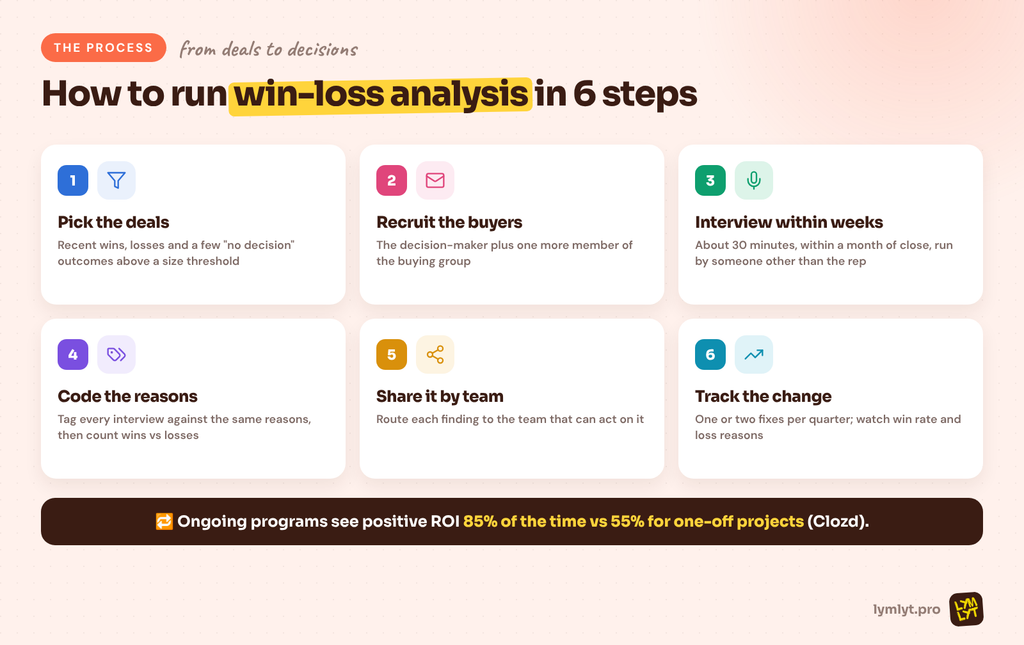
How to run win-loss analysis in 6 steps
1. Pick the deals
Start with recent, meaningful deals: wins and losses above a deal-size threshold, plus a few “no decision” outcomes. Aim for a balanced mix, because interviewing only losses tells you half the story.
2. Recruit the buyers
Ask the decision-maker and, where you can, one other member of the buying group. A short, neutral email works best: you want to learn, not resell. Many teams offer a small thank-you, such as a gift card or a charity donation.
3. Interview within weeks of the decision
Memory fades fast. Clozd’s research says the best time to collect feedback is within the first month after a deal closes. Keep interviews to about 30 minutes, and have someone other than the account’s rep run them so buyers speak freely. In Clozd’s data, companies using a third-party provider were more than twice as likely to be satisfied with the quality and depth of feedback.
4. Code the reasons
Tag every interview against a consistent set of reasons: product fit, price and value, implementation risk, sales experience, proof, brand and so on. Count how often each shows up in wins vs losses. One loud interview is an anecdote; ten that agree are a pattern.
5. Share it by team
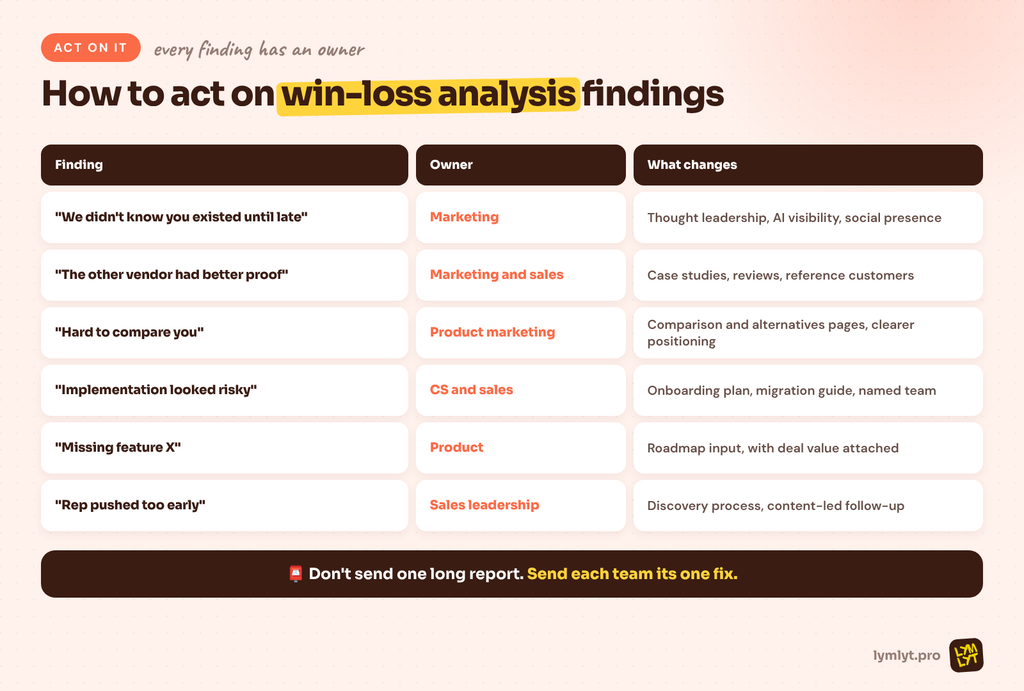
Don’t send one long report. Route each finding to the team that can act on it (see the table below). Clozd found companies that put win-loss insights into battlecards are 37% more likely to be satisfied with how accessible those insights are.
6. Track the change
Pick one or two fixes per quarter, then watch win rate, sales cycle length and loss reasons in the next round of interviews. That loop is what turns a research project into a program.
Win-loss interview questions that get honest answers
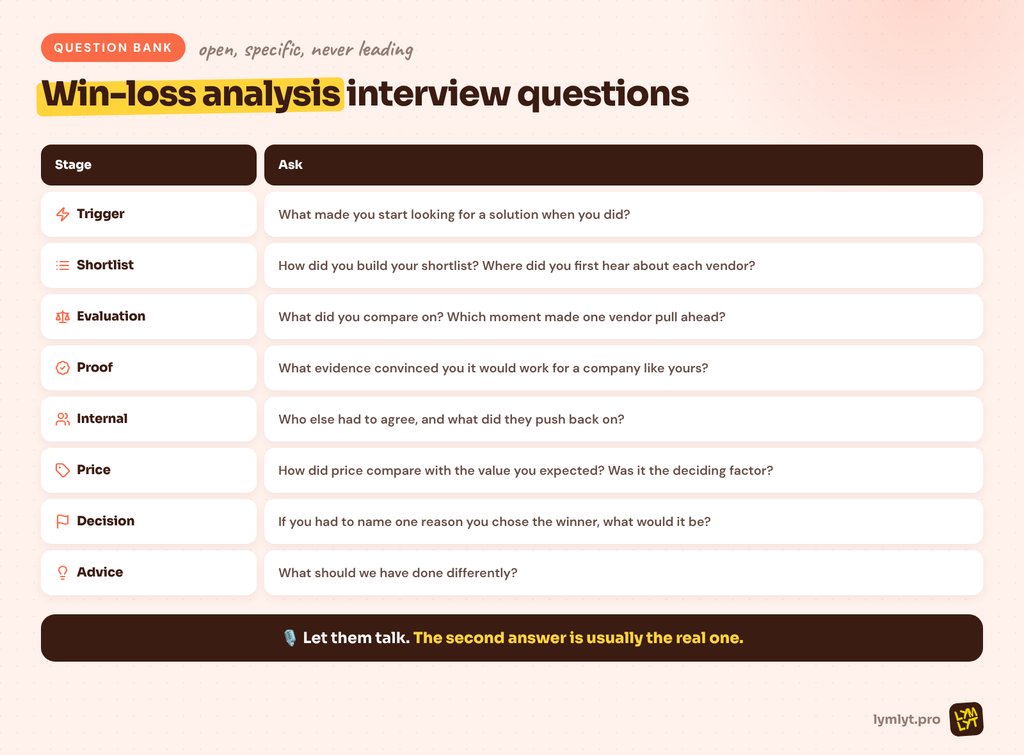
Open, specific questions work. Leading questions don’t.
| Stage | Ask |
|---|---|
| Trigger | What made you start looking for a solution when you did? |
| Shortlist | How did you build your shortlist? Where did you first hear about each vendor? |
| Evaluation | What did you compare on? Which moment made one vendor pull ahead? |
| Proof | What evidence convinced you it would work for a company like yours? |
| Internal | Who else had to agree, and what did they push back on? |
| Price | How did price compare with the value you expected? Was it the deciding factor? |
| Decision | If you had to name one reason you chose the winner, what would it be? |
| Advice | What should we have done differently? |
For more on getting buyers to open up, our guide to running a case study interview uses the same techniques.
8 reasons B2B buyers choose a vendor
These are the reasons that come up again and again in win-loss interviews, with the data behind each.
1. They already preferred you before talking to sales
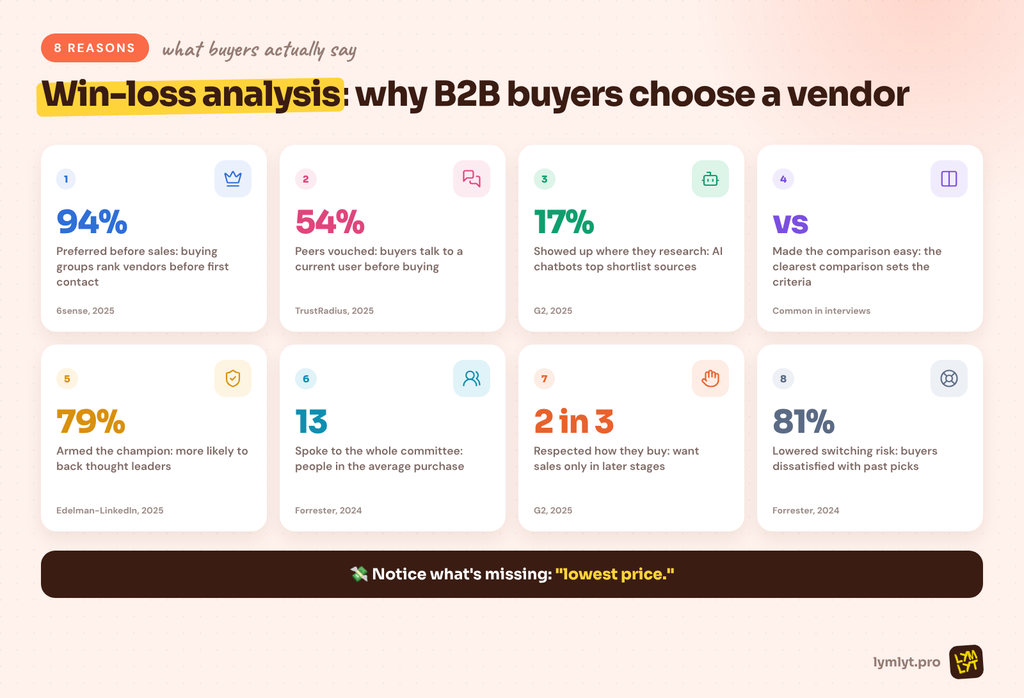
6sense’s 2025 Buyer Experience Report, based on more than 4,000 buyers, found 94% of buying groups ranked their preferred vendors before first contact, and 77% of purchases went to that early favorite (Business Wire). Many deals are won before the first call. Our guide to demand generation vs demand capture explains how to become that favorite.
2. Peers vouched for you
TrustRadius’s 2025 buyer research found 77% of buyers read user reviews and 54% speak with a current user before buying (TrustRadius). Proof from people like them beats your own claims. Strong B2B SaaS case studies do the same job at scale, and even an anonymous case study works when clients can’t be named. Employees count too: buyers trust people over brands, as these employee advocacy statistics show.
3. You showed up where they researched
G2’s 2025 Buyer Behavior Report found generative AI chatbots (17%) and review sites (15%) are the top two sources influencing vendor shortlists (Business Wire). If AI answers don’t mention you, you may never make the list. See what buyers ask in our shortlist prompts research and what AI cites for comparison queries.
4. You made the comparison easy
Buyers compare vendors whether you help or not. The vendor with the clearest, most honest comparison often controls the criteria. Our guides to B2B SaaS comparison pages and why losing a row wins the deal show how. Not sure where to start? Read alternatives page or vs page: which one to build first, and check who ranks for your vs keywords.
5. You armed the champion
The 2025 Edelman-LinkedIn B2B Thought Leadership Impact Report found more than 40% of B2B deals stall because buying groups can’t agree, and 79% of decision-makers are more likely to champion a vendor that consistently publishes quality thought leadership (Demand Gen Report). Winners give champions the business case to win internally.
6. You spoke to the whole committee
Forrester found the average purchase involves 13 people and 89% span two or more departments. Vendors that only sell to the main contact lose to vendors that answer finance, IT and procurement too. Our guide to the B2B buying committee maps each role.
7. You respected how they want to buy
Nearly two in three buyers prefer to engage salespeople only in later stages, up 17 points from 2024, per G2’s 2025 report (Business Wire). Transparent pricing helps too: TrustRadius found it’s the top change buyers want from vendors. See what AI tells buyers about cost in our pricing prompts study.
8. You lowered the risk of switching
Forrester found 81% of buyers are dissatisfied with the provider they chose (Forrester), so buyers fear repeating a bad decision. Winners make implementation, migration and support feel safe. Our research on migration prompts shows what AI tells buyers about leaving a vendor.
Notice what’s missing: “lowest price.” Price is a common CRM loss reason, but in interviews it’s often the polite answer that hides a bigger one, such as weak proof, unclear value or perceived risk. That’s exactly why win-loss analysis beats CRM loss reasons.
Turn findings into action
| Finding | Owner | What changes |
|---|---|---|
| “We didn’t know you existed until late” | Marketing | Thought leadership, AI visibility, social presence |
| “The other vendor had better proof” | Marketing and sales | Case studies, reviews, reference customers |
| “Hard to compare you” | Product marketing | Comparison and alternatives pages, clearer positioning |
| “Implementation looked risky” | Customer success and sales | Onboarding plan, migration guide, named team |
| “Missing feature X” | Product | Roadmap input, with deal value attached |
| “Rep pushed too early” | Sales leadership | Discovery process, content-led follow-up |
If positioning keeps coming up, start with our guide to B2B positioning. If you’re losing to the wrong-fit buyers, revisit your ideal customer profile.
Common win-loss analysis mistakes
- Only interviewing losses. Wins tell you what to double down on.
- Letting the rep run the interview. Buyers soften the truth for the person who sold to them.
- Waiting too long. Only 3% of programs collect feedback within 24 hours (Klue). After a month, memories blur.
- Trusting the CRM loss reason. “Price” is usually where the conversation stops, not where it started.
- Not closing the loop. If nothing changes, sales stops sharing deals and buyers stop agreeing to interviews.
- Not measuring the impact. Track win rate and cycle length by finding. Our guide to how to prove marketing ROI covers the metrics finance trusts.
The bottom line
Win-loss analysis turns “we lost on price” into a reason you can fix. Interview buyers within weeks, code their answers, route them to the team that can act, and track what changes. The data is clear that most deals are decided by proof, preference and risk long before price, and win-loss is how you see it.
When the findings point to missing proof or weak comparisons, LymLyt builds the case studies and comparison pages that close the gap. See our pricing, from $1,499/month.

Jay is the co-founder of LymLyt and an AI partnership consultant helping B2B SaaS companies grow through content strategy, SEO, and AI integration. He writes about content marketing, what makes B2B content convert, and how SaaS teams can build content systems that drive real pipeline.