HubSpot lost most of its blog traffic. Its revenue went up 19%.
Between early 2024 and January 2025, blog.hubspot.com is estimated to have lost around 80% of its organic search traffic. Over roughly the same stretch, HubSpot’s revenue went from $2.17bn to $3.13bn.
That is the whole story in two sentences. Everything below is why it happened, what HubSpot itself says about it, and the part where you check whether your own traffic is worth what you think it is.
The company that named the thing
In August 2007, HubSpot’s homepage described the product like this:
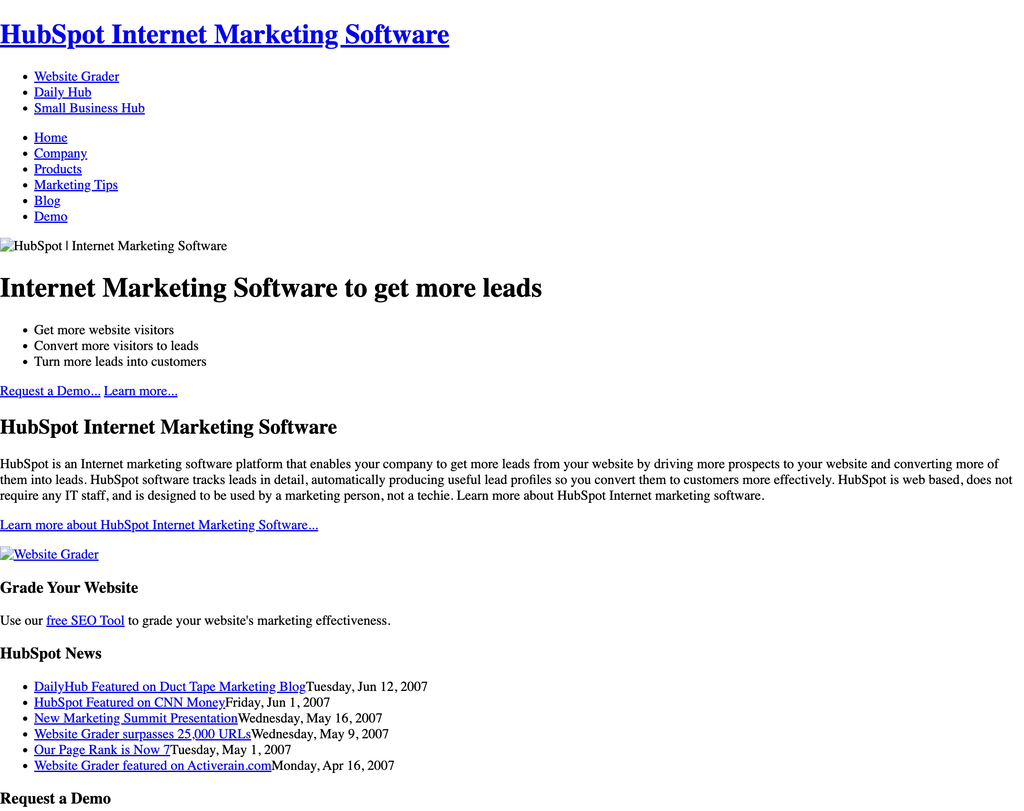
HubSpot Internet Marketing Software to get more leads
Internet marketing software. The word HubSpot would eventually own does not appear anywhere on its own homepage.
Among the items HubSpot considered worth announcing to the public:
Our Page Rank is Now 7 – Tuesday, May 1, 2007
A company posting its Google PageRank as a press item. Hold onto that, because the ending of this story is about Google.
Ten months later, in June 2008, the homepage looked like this:
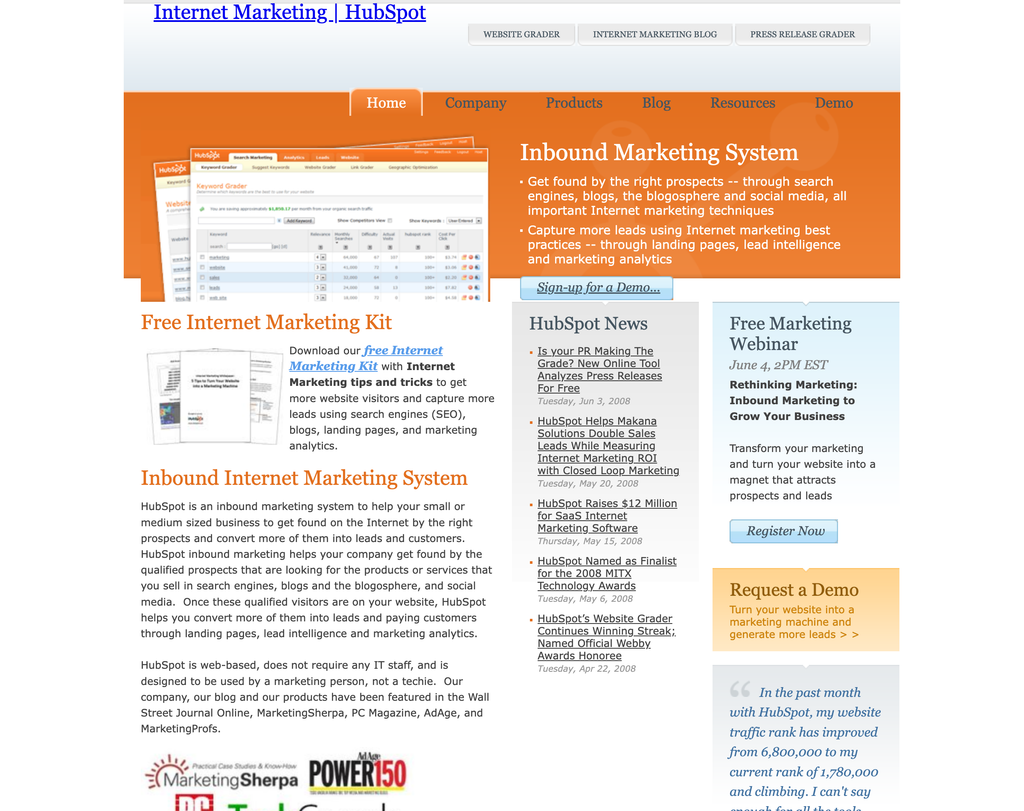
The headline is now “Inbound Marketing System.” Underneath: “Get found by the right prospects, through search engines, blogs, the blogosphere and social media.”
Between those two screenshots, HubSpot stopped selling software and started selling an idea. The rest of the page shows the machine that idea came with: a free Website Grader and a free Press Release Grader in the top navigation, a free Internet Marketing Kit to download, a free webinar called “Rethinking Marketing,” and a blog.
That is the inbound playbook, fully assembled, on one page in 2008. Free tool at the top, free content in the middle, demo request at the side. Every B2B SaaS company you can name has run some version of it since. It is the same move Salesforce made against Siebel in 2000.
It worked. HubSpot’s blog became one of the largest marketing publications on the internet. The company went public in 2014 and kept compounding.
Then they bought an audience
In February 2021, HubSpot acquired The Hustle, a daily business newsletter with more than 1.5 million subscribers, along with its Trends research product and the My First Million podcast.
Reported at roughly $27 million, with HubSpot’s SEC filing showing $17.2 million in cash plus equity. (Axios, TechCrunch)
Kieran Flanagan, then SVP of Marketing said:
“For many customers, their first introduction to HubSpot is through our educational blog, Academy, and YouTube content, not our software.”
(HubSpot announcement, 16 February 2021)
So HubSpot, the company whose entire brand was built on earning attention through search, spent eight figures buying an audience outright. A subscriber list, delivered by email, that nobody else controlled.
At the time this looked like an expensive luxury. Three years later it looked like a hedge.
What happened to the blog
Starting in 2024, blog.hubspot.com lost most of its organic search traffic.
Every figure in this section is a third-party estimate. HubSpot has not published its own traffic numbers, and the SEO tools that measure this are modelling from sampled clickstream data. They are not reading HubSpot’s analytics. The tools disagree with each other by millions of visits, which tells you how much precision to expect.
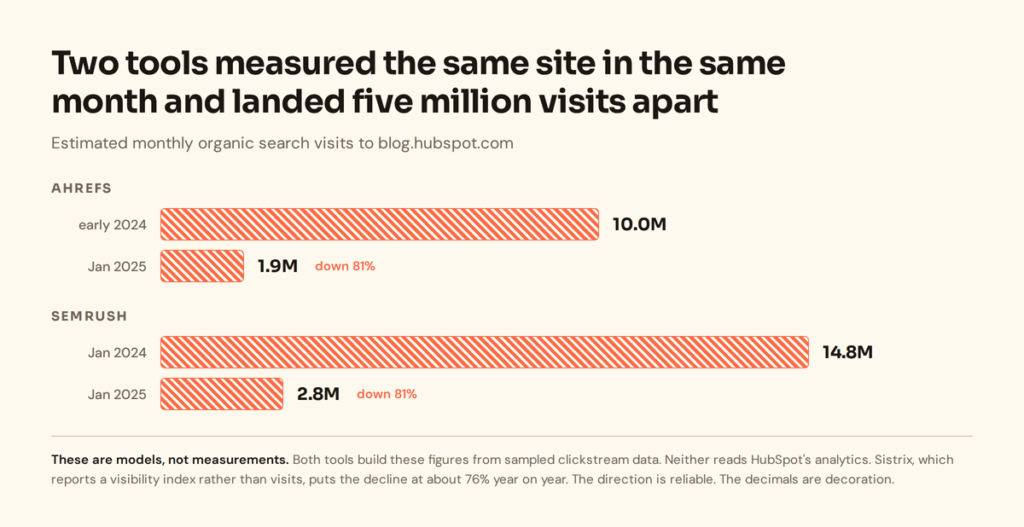
- Ahrefs: roughly 10 million monthly organic visits in early 2024, under 1.9 million by January 2025. About an 81% drop.
- Semrush: 14.8 million in January 2024, 2.8 million in January 2025. Also about 81%.
- Sistrix Visibility Index: about 76% down year on year.
Same direction, wildly different absolute numbers, all of them estimates. Ahrefs and Semrush differ by nearly 5 million visits on the same month for the same site. If you quote one of these in a deck, quote the range and name the tool. We do the same in our content marketing statistics roundup, and it is a habit worth copying.
But what about their product pages?
The popular version of this story is that AI search ate HubSpot’s traffic. It is a tidy narrative: the company that taught the world to rank on Google gets destroyed by chatbots answering the questions instead.
The declines cluster around Google’s core and spam updates in March 2024 and December 2024, with earlier damage in August and November 2023. None of those line up with an AI search milestone.
Aleyda Solis did the most careful public analysis of the drop. She traced it through those four core updates and found the pattern in the pages that lost. Among the biggest losers:
- “The 100+ Most Famous Quotes of All Time”
- “How to Type the Shrug Emoji”
- “Good Weaknesses to Say in an Interview”
Her read is that Google got better at rewarding demonstrated subject matter expertise, and worse for content built primarily to rank. She does not attribute the drop to AI Overviews.
The blog subdomain went from 77% of HubSpot’s site-wide organic traffic to 42% year on year, while the main www domain held its rankings on commercial keywords. The part of the site that sells software kept working. The part that ranked for shrug emoji did not.
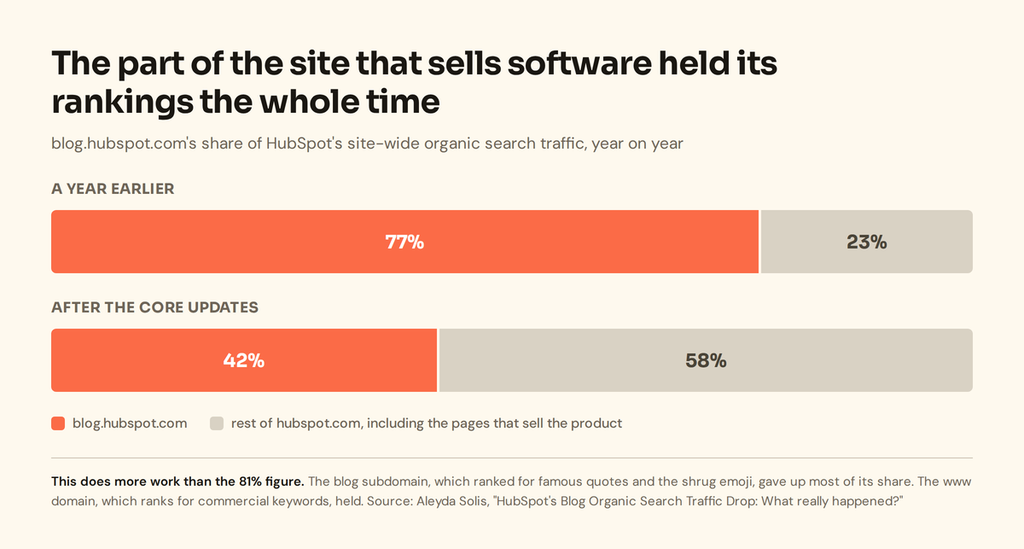
This matters for a practical reason. If AI killed HubSpot’s traffic, the lesson is “panic, the channel is gone.” If Google stopped rewarding a CRM company for ranking on shrug emoji, the lesson is: traffic from outside your topic was always borrowed.
What HubSpot actually says happened
HubSpot’s CMO Kipp Bodnar published a direct response on the HubSpot blog, and it is the most useful document in the whole story.
His account has three parts.
One, the shift was partly deliberate. Bodnar dates the change to early 2020, well before the core updates: “we became increasingly focused on cultivating influence rather than just providing information.” That is the money HubSpot moved into YouTube, podcasts, social, and the acquisitions.
Two, the informational traffic went away for everyone. “AI Overviews and no-click searches have cannibalized traditional informational search traffic across the board.” Bodnar’s counterpoint is that HubSpot content “actually performs really well within AI-generated responses,” so the visibility moved rather than vanished. That is a claim about citation share, which is measurable if you set it up properly, and it is the same argument we make in our AI visibility guide for B2B SaaS.
Three, the commercial half of search is fine. “Transactional search has remained relatively unchanged” and “it’s still well worth the investment.” This matches what Solis found on the www domain independently.
Read Bodnar with the appropriate amount of salt. He is the CMO defending his own numbers, he published no traffic figures of his own, and “it was partly on purpose” is what anyone says after a bad chart.
How about the overall company growth
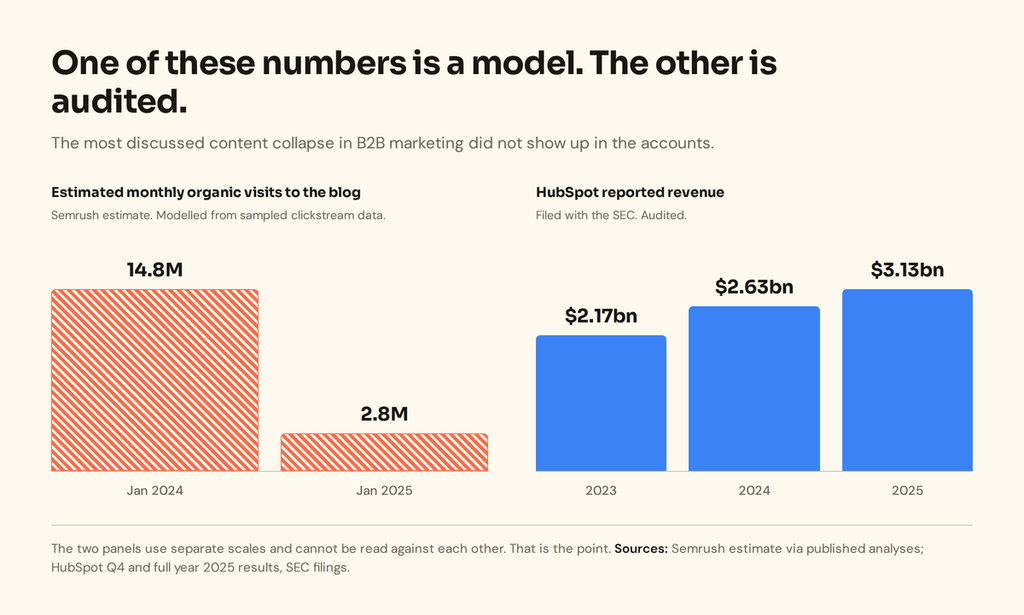
| Year | Revenue | Growth |
|---|---|---|
| 2023 | $2.17bn | |
| 2024 | $2.63bn | +21% |
| 2025 | $3.13bn | +19% |
HubSpot ended 2025 with 288,706 customers, up 16% year on year.
Source: HubSpot’s Q4 and full year 2025 results and SEC XBRL filings.
The traffic estimate fell through 2024. Revenue grew 21% that year and 19% the next. Customer count grew 16%. The most-discussed content collapse in B2B marketing did not produce a visible dent in the P&L.
Now the objection, because it is a good one. Revenue is a lagging indicator. HubSpot books multi-year contracts, expands inside existing accounts, and raises prices. A pipeline hole opened in 2024 would surface around 2026. Anyone waving the revenue chart as proof that blog traffic does not matter is moving faster than the evidence allows.
So look at 2026. Revenue growth went 21%, then 19%, then 20% as reported in Q2 2026 and 17% in constant currency. Customer growth slowed from 16% to 14%, and HubSpot cut its customer growth outlook for the year. Something is decelerating.
The honest reading is that HubSpot’s slowdown is modest, gradual, and happening two years after the traffic went. It looks like a large SaaS company getting larger with an AI pricing transition underway. It does not look like a company that lost 80% of the thing keeping it alive. If the blog had been load-bearing for revenue, the last two years would have looked considerably worse than this.
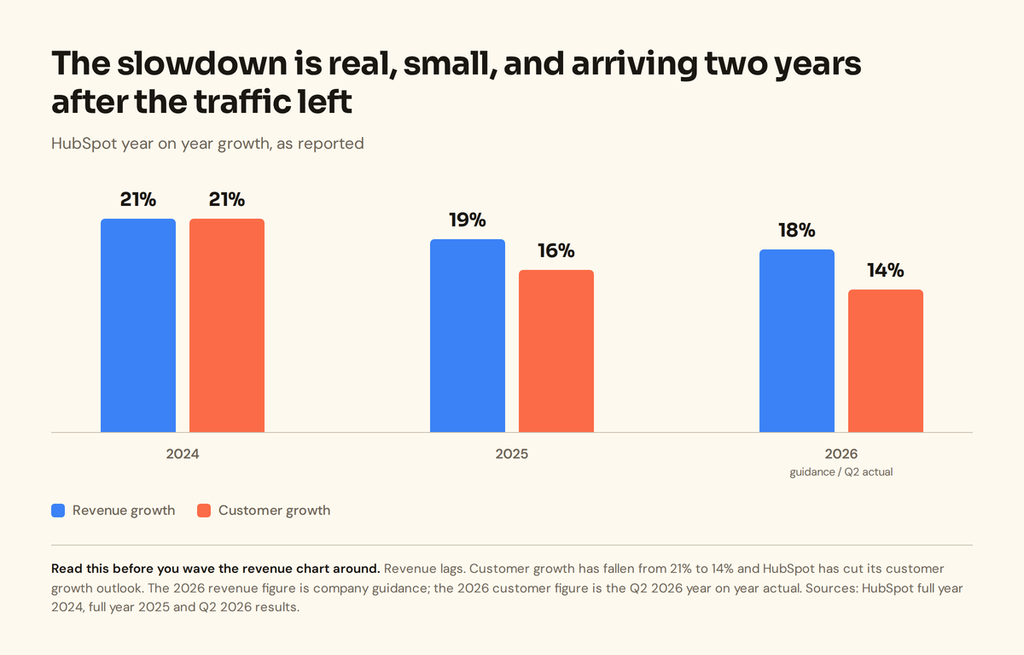
Which tells you what that traffic was worth. Nobody searching “how to type the shrug emoji” was ever going to buy a CRM. The blog was enormous, and a large part of it was measuring an audience with no relationship to the product.
Then they bought four more audiences
The clearest evidence for what HubSpot believes is what HubSpot spends money on. Since the traffic went:
- February 2026: Starter Story, roughly 1.6 million people across an 800,000-subscriber YouTube channel and a 275,000-person newsletter. (MarTech)
- April 2026: Futurepedia, a 280,000-subscriber AI tools newsletter, announced by Futurepedia itself, plus Mindstream in the same window.
List of channels they have acquired.
| Year | Property | Format | Marketing angle |
|---|---|---|---|
| 2021 | The Hustle | Newsletter + podcast + research | Buy an existing audience. Get access to entrepreneurs and business builders through media they already actively consume. HubSpot paid $17.2M net of cash. (HubSpot) |
| 2025 | Mindstream | AI newsletter | Own the AI conversation. Reach people actively learning about AI rather than waiting for them to search for HubSpot. |
| 2026 | Starter Story | YouTube + newsletter + website | Buy creator-led attention. Reach founders through stories, YouTube and email rather than traditional B2B content. HubSpot explicitly describes Starter Story as part of its strategy to acquire media that owns attention. (HubSpot Blog) |
| 2026 | Futurepedia | AI media + education + directory | Own AI discovery. Capture people researching AI tools, education and workflows before they become software buyers. HubSpot acquired Futurepedia on April 3, 2026 specifically to expand its media footprint. (HubSpot) |
List of channels they have built.
| Year | Property / initiative | Format | Marketing angle |
|---|---|---|---|
| 2007 | HubSpot Blog | Blog | SEO as distribution. Answer people’s problems before they know or care about HubSpot. |
| 2010 | HubSpot Academy | Courses + certifications | Teach → certify → create preference. Make HubSpot the platform people learn through, not just buy. |
| 2010s | HubSpot YouTube | YouTube | Turn education into video distribution. Reach audiences who prefer watching over reading. |
| 2010s | HubSpot Podcast / The Growth Show | Podcast | Build habitual attention. Get into people’s weekly business/media consumption. |
| 2021 | HubSpot Podcast Network | Podcast network | Become the infrastructure behind business podcasts. HubSpot announced the network alongside The Hustle acquisition and The Shake Up. (HubSpot) |
| 2021 | The Shake Up | Original podcast + video | Entertainment + education. Talk about how companies grow rather than constantly talking about HubSpot. |
| 2020s | HubSpot newsletters | Own the inbox. Build recurring direct distribution rather than depending entirely on Google/social algorithms. | |
| 2020s | HubSpot Media ecosystem | Blog + video + podcast + newsletter + education | One audience, many formats. Turn a content operation into a media distribution machine. |
List of channels they have partnered with / invested.
| Year | Initiative | Format | Marketing angle |
|---|---|---|---|
| 2021 | HubSpot Podcast Network partnerships | Podcasts | Borrow trusted audiences. Don’t build every audience yourself; partner with people who already have one. |
| 2021–present | Podcast Accelerator / creator investments | Podcasts | Fund the next generation of media. Get early access to creators before they become massive. |
| 2022–present | HubSpot Creators | YouTube + social + newsletters | Turn creators into distribution. Give creators resources/investment while HubSpot gets authentic reach. |
| 2023–present | Creator-led video collaborations | YouTube/video | Influence > impressions. Let trusted creators introduce HubSpot concepts to their audiences. |
| 2023–present | Creator newsletter partnerships | Email/newsletters | Rent attention without renting ads. Access niche audiences without having to acquire the entire publication. |
| 2020s | Podcast sponsorships / collaborations | Podcasts | Audience adjacency. Put HubSpot next to conversations its buyers already care about. |
HubSpot Media now works with around 150 creators generating more than 50 million monthly engagements. Jonathan Hunt, HubSpot’s VP of Media, told Forbes the company treats these as a build-or-buy decision and builds roughly nine times out of ten, buying when it wants to enter a market faster than it can build into it. His measure is plain: “If we can continue to see consistent ROI month over month in terms of qualified demand that they’re able to generate.”
These deals fail when the buyer starts dictating editorial direction, because the trust that took years to build is the asset.
So the company that invented ranking-first content marketing has spent the last five years buying newsletters, YouTube channels and podcasts. Every one of them reaches its audience without asking Google for permission. That is the case for owned channels.
Steal this
Own the distribution, do not rent it. The rankings were borrowed from Google and Google took them back. The Hustle still arrives in inboxes every morning, unaffected by any core update, because nobody has to rank to send an email. HubSpot has bought four more audiences since the traffic went.
Check what your traffic is actually worth before you mourn it. Pull your top 100 organic landing pages by sessions. Tag each one on-topic or off-topic, where on-topic means the query comes from someone with the problem your product solves. Sum the sessions in each bucket. If the off-topic bucket is most of your traffic, you already know what a core update would do to your chart, and you know what it would do to your pipeline, which is a different and smaller number. Our note on what to report instead of an AI visibility ROI figure covers the same discipline for the newer channels.
Stay inside your topic. The pages HubSpot lost were the ones a CRM company had no business ranking for. Volume outside your subject area is the easiest traffic to win and the first to be taken away. Build the topic map before the calendar.
Answer publicly when the estimates are wrong about you. Bodnar’s post is the only first-party account of this event, and it now shapes how the story gets told. It cost HubSpot one blog post. He still did not publish a single traffic figure, which is the opening for anyone confident enough to show real data.
Don’t steal this
Assuming the channel that built you will still be there. HubSpot’s 2007 homepage posted its PageRank as company news. The channel that made the company is the same one that repriced it 17 years later. Any channel you do not own can be changed by someone who is not you.
Reading this as proof that AI ended search. It is the most cited example, and the timeline does not support it. AI answers are a real and growing factor, and HubSpot’s own CMO says no-click search has cannibalised informational traffic across the board. But this particular collapse lines up with Google core updates and off-topic content. If you want to argue about AI and search, argue it with evidence that actually shows AI, or the people who check will find you out.
Treating estimates as facts. The 81% figure is repeated everywhere as though it were measured. It is modelled, and two reputable tools disagree by five million visits a month on the same site. Cite the range and say who produced it.
Waving the revenue chart as proof that content does not matter. Revenue lags. Customer growth has slowed from 16% to 14% and HubSpot has cut its outlook. The fair claim is narrower: this traffic was worth far less than its size suggested. The www domain that sells the software held its rankings the entire time.
Panicking about the wrong number. If HubSpot’s leadership had managed the blog’s traffic chart instead of the P&L, the last two years would have looked like a catastrophe. Pick the metric that pays.

Rashmita is content marketer with 8 years of experience building and growing SaaS brands. Now she tests various AI tools for marketers and shares her feedback on this blog, LinkedIn, Instagram, and YouTube.