Vs Page: Why Losing a Row Wins the Deal
Open ten vendor vs pages and you will find ten winners. Every table has one column of ticks and one column of crosses, and the ticks are always on the side of whoever published it. Buyers worked this out years ago, which is why an honest vs page converts better than a triumphant one, and why the vendor who concedes a row usually beats the vendor who concedes nothing.
This is the part of the page everyone argues about internally. Sales does not want a section admitting the competitor is better at anything. Nobody wants to hand a prospect a reason to leave.
The research says the opposite. Losing a row is what makes the rest of the page credible.
Perfect scores read as filtered
The clearest evidence comes from review data, where the pattern has been measured at scale.
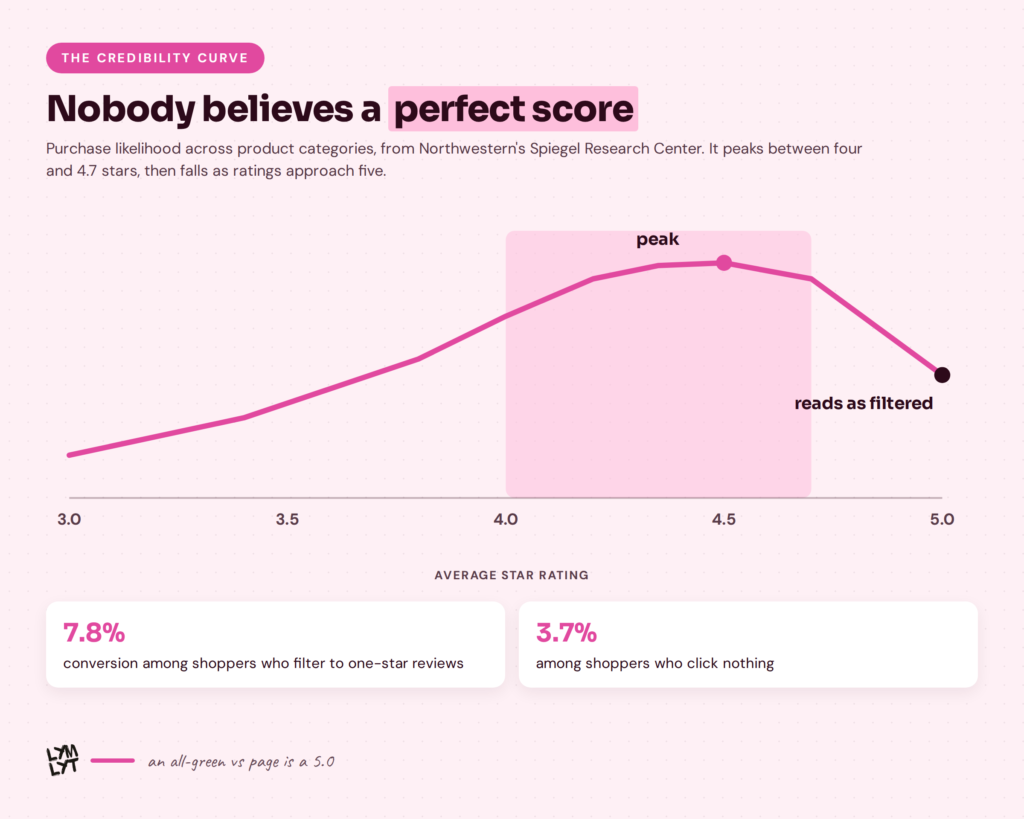
Northwestern’s Spiegel Research Center analysed ratings across dozens of product categories and found that purchase likelihood peaks between 4.0 and 4.7 stars, then falls as the average approaches 5.0. Products rated 4.7 to 5.0 were less likely to be bought than products rated lower. In no category was the optimal rating a perfect five.
Buyer behaviour around bad reviews says the same thing louder. PowerReviews found 82% of consumers specifically seek out negative reviews, and that among shoppers who click a star filter, 63% choose the one-star option. Those shoppers then converted at 7.8% against 3.7% for shoppers who clicked nothing. The people hunting for the worst thing about a product were more than twice as likely to buy it.
A vs page with no losses is the 5.0 rating of B2B content. It signals filtering, not quality. The buyer’s response is not “this product is better”, it is “I need a source that isn’t them”, and off they go to G2 or Capterra, or to Reddit and YouTube, none of which you control. Sometimes they do not even have to leave the search results: Google will show them your competitors on your own brand query.
The mechanism has a name
This is not just a trust heuristic. It is a documented persuasion effect.
Ein-Gar, Shiv and Tormala published four studies in the Journal of Consumer Research showing that a small dose of negative information added to an otherwise positive description can make people more favourably disposed to a product, not less. They called it the blemishing effect.
Two conditions matter, and both are worth knowing because they tell you exactly where to put the concession.
The negative has to be minor. A real flaw on a dimension that is not the buyer’s central concern. Admitting your product is slower than the competitor at the one job it exists to do is not blemishing, it is disqualifying.
And it has to come after the positives, not before. The Stanford summary of the work puts it plainly: the effect appears when the negative follows the positive, and disappears when it leads. What happens on reading the minor negative is a re-evaluation in which the negative gets discounted and the positive information gets bolstered.
So on a vs page, the “where they are the better choice” section belongs two thirds of the way down. After the table, after the real differences, before the CTA. Not in the hero, and not buried in a footnote nobody reaches.
The all-green table is the tell
You do not need a buyer to consciously reason about any of this. The table does the work in about four seconds.
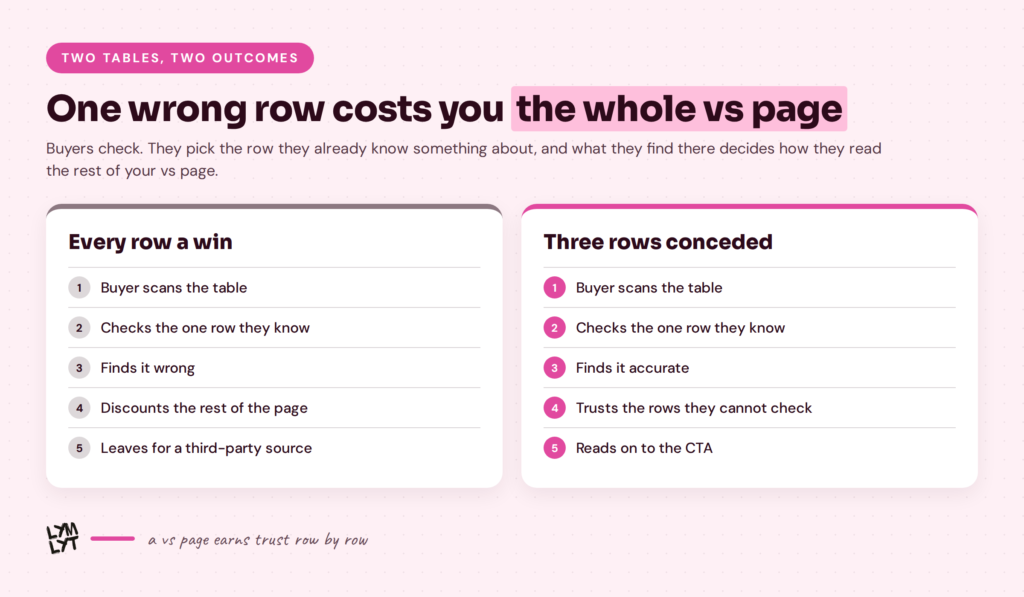
A column of ticks against a column of crosses is a claim about the world that a buyer with a trial account can disprove in an afternoon. When they do, they do not just discount that row. They discount everything else on the page, including the parts that were true.
The pillar’s table rules cover the mechanics: concede at least three rows, never mark a cross where the competitor supports something through an integration, match pricing tiers like for like, and date the thing. The logic behind all four is the same. Every row a buyer can check and find accurate buys credibility for the rows they cannot check.
The reverse is also true, and it is the expensive version. One provably wrong row costs you the whole page.
What to concede, and what not to
The instruction “be honest” is useless without a boundary, so here is one.
Concede where the competitor genuinely wins on a dimension your best-fit buyer does not lead with. On-premise deployment when you are cloud-only. Admin depth at 500 seats when you sell to teams of 30. A cheaper entry tier when you compete on time-to-value. Each of these is true, checkable, and sends away a buyer who would have churned in four months anyway.
Do not concede your core claim. If your entire positioning is implementation speed, a section conceding they implement faster is not honesty, it is a lost deal with extra steps. If they genuinely are faster, you have a positioning problem, not a copywriting one.
Do not manufacture a fake weakness. “We are so thorough that onboarding takes longer” is the cover-letter answer to what is your greatest weakness, and it reads exactly as badly. Buyers have seen it. It costs more credibility than saying nothing.
Name the buyer, not just the feature. “If you need on-premise, choose them” is fine. “If you are a regulated enterprise with an in-house security team that requires on-premise, choose them” is better, because the reader either recognises themselves or does not, and either outcome is useful to you.
Two or three concessions is the range. One reads as a token. Six reads as a page that cannot decide what it is for.
We hold our own alternatives posts to the same rule, opening by saying what the competitor is good at before saying anything else. It is the same instinct that makes a landing page work: name the buyer you are wrong for, and the buyer you are right for believes you.
What AI engines do with a balanced vs page
There is a second reader now, and it wants the same thing.
When we ran five comparison queries through ChatGPT, Claude and Google AI Mode, all three independently produced the same structure, and every one of them ended with an explicit “choose X if” and “choose Y if” split. Nobody prompted for that. Three systems decided a comparison answer is incomplete without naming who each product is wrong for.
A page that already contains that split is shaped like the answer. One that argues you win on every dimension has nothing an engine can slot into the half of the answer about the competitor, and it reads, to a retrieval system weighing candidate sources, like marketing copy rather than assessment.
The same study found vendor pages did get cited on two-brand queries, including both vendors’ own vs pages in one case, and our wider citation work points the same way. So the opportunity is real. The question is whether yours reads like something worth quoting rather than something to scroll past.
The objections you will hear
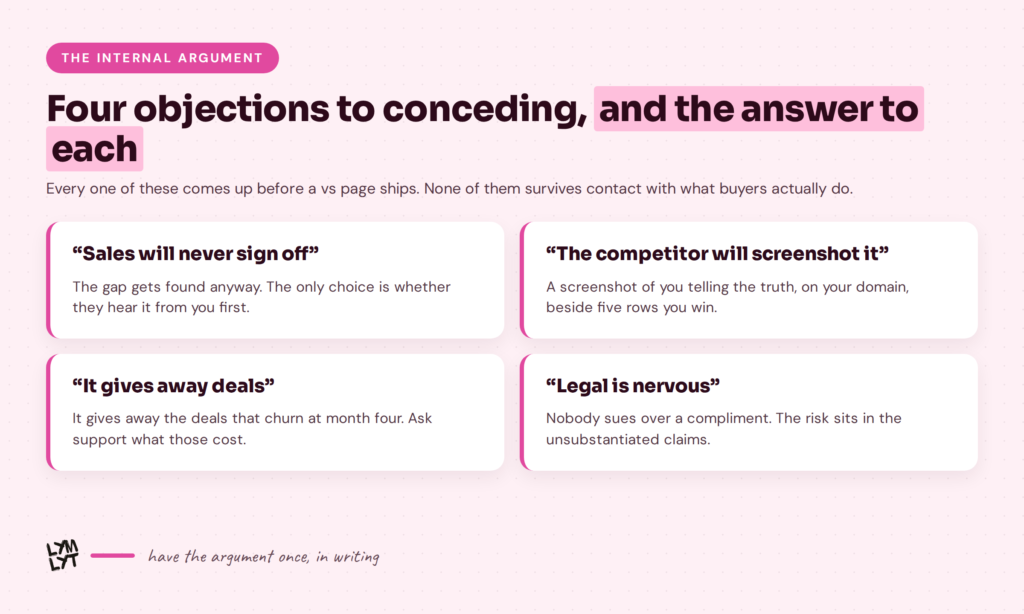
“Sales will never sign off.” Ask them what happens on the call when the prospect raises the gap anyway. The gap gets found, always, on a trial or a reference call or a Reddit thread. The only variable is whether the buyer hears it from you first, framed by you, or from someone else, framed by them.
“The competitor will screenshot it.” They will. It will be a screenshot of you telling the truth about their product, on your domain, next to five rows where you win. That is a bad asset for them and a fine one for you.
“It gives away deals.” It gives away deals you were going to lose at month four, when the buyer discovers the missing thing. Ask support and customer success what those churns cost. That number is usually larger than the pipeline number sales is protecting, and it never appears in the same meeting. The switchers who stayed are your best proof, and a case study interview is how you get their reasons on record.
“Legal is nervous.” Legal should be nervous about the unsubstantiated claims, not the concessions. Saying a competitor is good at something is the one part of a vs page nobody sues over. The pillar’s legal section covers what actually carries risk.
How to tell the vs page is working
Page conversion rate will not tell you much, because the traffic is small and pre-qualified.
Time on page and scroll depth are the first signals, since the concession section sits far enough down that reaching it tells you something on its own. Whether sales starts sending the page in follow-ups is the fastest read on credibility, because those are the people who talk to buyers daily and will not forward something that gets them argued with. Then win rate against that named competitor over two quarters. And finally churn at months three to six, because the buyers a good concession section turns away are the ones who would have shown up there. Sessions are the one number to ignore, for reasons HubSpot demonstrated at scale.
If the page gets traffic and no demos, that is usually a CTA or offer problem rather than an honesty problem, which is a different diagnosis entirely.
Philippe Lehoux of Missive has credited honest us-versus-them pages, including saying outright where a competitor is the better fit, among the things that took the company to $2.1M ARR. One founder’s account is not proof. It is a data point that lines up with the research, which is more than the all-green table has going for it.
FAQ
Will admitting a weakness cost us deals? Some, and they are mostly deals you would have lost later. Buyers who need the thing you do not have tend to discover that during a trial or in the first quarter of use.
How many rows should we concede? Two or three real ones. Fewer reads as a token gesture, more reads as a page that has lost its argument.
Where does the concession go on a vs page? After the table and the main differences, before the CTA. The persuasion research is specific that the effect depends on the negative following the positives rather than leading.
Should we name the competitor’s strengths in the table too, or only in prose? Both. A table with no losing rows is the fastest way to tell a buyer the page is filtered, and it is the element they scan first.
What if the competitor is genuinely better on the thing we sell on? Then you have a positioning problem rather than a content problem, and no vs page will fix it. Start with the pillar and work out which competitor deserves a page at all.
How do we brief a writer to do this well? Give them the three rows to concede before they start, agreed with sales, in writing. Our brief generator covers the rest of the structure.
A vs page that concedes nothing asks the buyer to take your word for it. One that concedes three rows gives them a way to check.
That is the job we do. See how we write comparison pages and how we handle case studies, look at our work, check pricing, or book a 30-minute call.

Jay is the co-founder of LymLyt and an AI partnership consultant helping B2B SaaS companies grow through content strategy, SEO, and AI integration. He writes about content marketing, what makes B2B content convert, and how SaaS teams can build content systems that drive real pipeline.