The Dark Funnel: Why B2B Marketing Attribution Misses Most of the Buying Journey
Your attribution report says the deal came from a demo request. The buyer would tell you it came from a podcast, a Slack thread and a recommendation from a former colleague. That gap is the dark funnel.
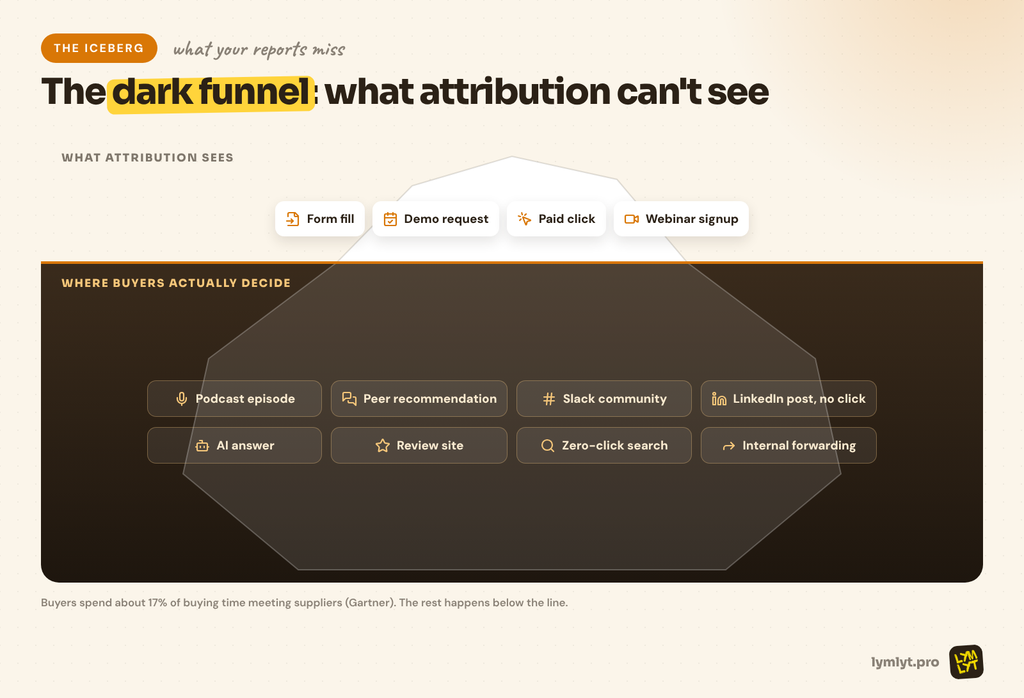
Gartner found B2B buyers spend about 17% of their buying time meeting potential suppliers (Gartner). The rest happens somewhere else: research, internal debate, peer advice, AI answers. Most of it never touches a tracked link.
This guide covers what the dark funnel is, why it’s growing, where it lives and six ways to measure what your attribution misses.
What is the dark funnel?
The dark funnel is the part of the B2B buying journey that your tracking can’t see: private conversations, communities, podcasts, social feeds, AI answers, review sites and searches that never end in a click. Buyers learn, shortlist and often decide there before they ever fill in a form.
It isn’t new. Word of mouth always mattered. What changed is how much of the journey now happens there, and how confidently attribution software reports on the visible slice. For the basics of how credit gets assigned, see our attribution glossary entry.
Why the dark funnel keeps growing
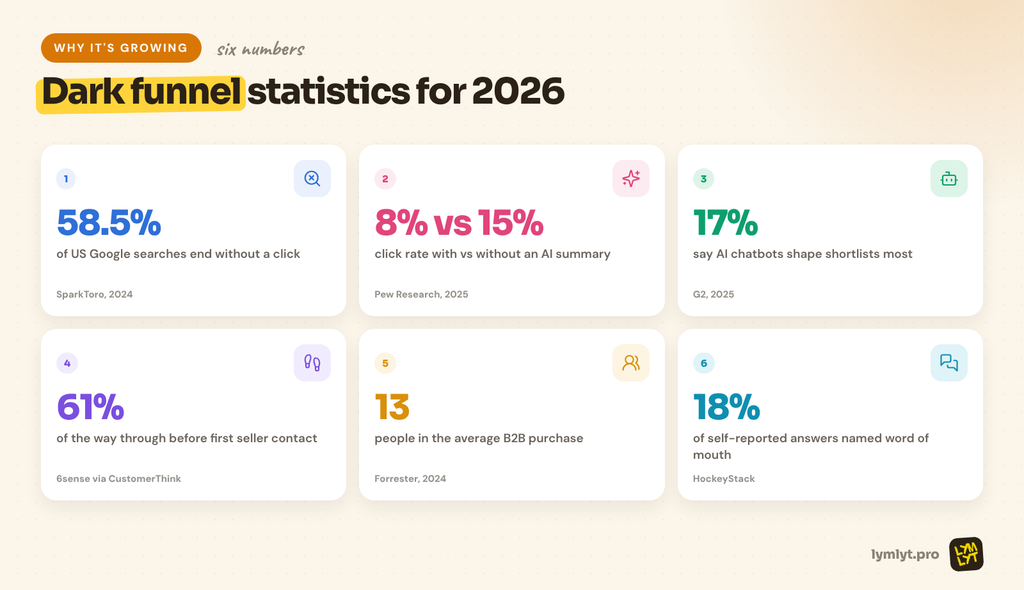
- Search clicks are shrinking. HubSpot is the loudest example: it lost most of its blog traffic while revenue still grew. SparkToro’s 2024 study, using Datos clickstream data, found 58.5% of US Google searches ended without a click (SparkToro).
- AI summaries cut clicks further. Pew Research found users clicked a traditional result on 8% of Google visits with an AI summary, versus 15% without one (Pew Research Center). Our roundup of how search behavior changed since AI arrived covers the rest.
- AI chatbots now shape shortlists. G2’s 2025 Buyer Behavior Report found AI chatbots were the top influence on vendor shortlists (17%), ahead of review sites (15%), and 29% of buyers start research in an LLM more often than in Google (Business Wire).
- Buyers decide before they show up. 6sense’s 2025 research put first contact with sellers 61% of the way through the buying process (CustomerThink).
- One form, thirteen buyers. Forrester found 13 people in the average purchase (Forrester). Attribution usually tracks the one who filled in the form. Meet the rest in our guide to the B2B buying committee.
- The tools got simpler. Google Analytics 4 removed its first click, linear, time decay and position-based attribution models in November 2023, leaving data-driven and last-click options (Google).
Where the dark funnel lives
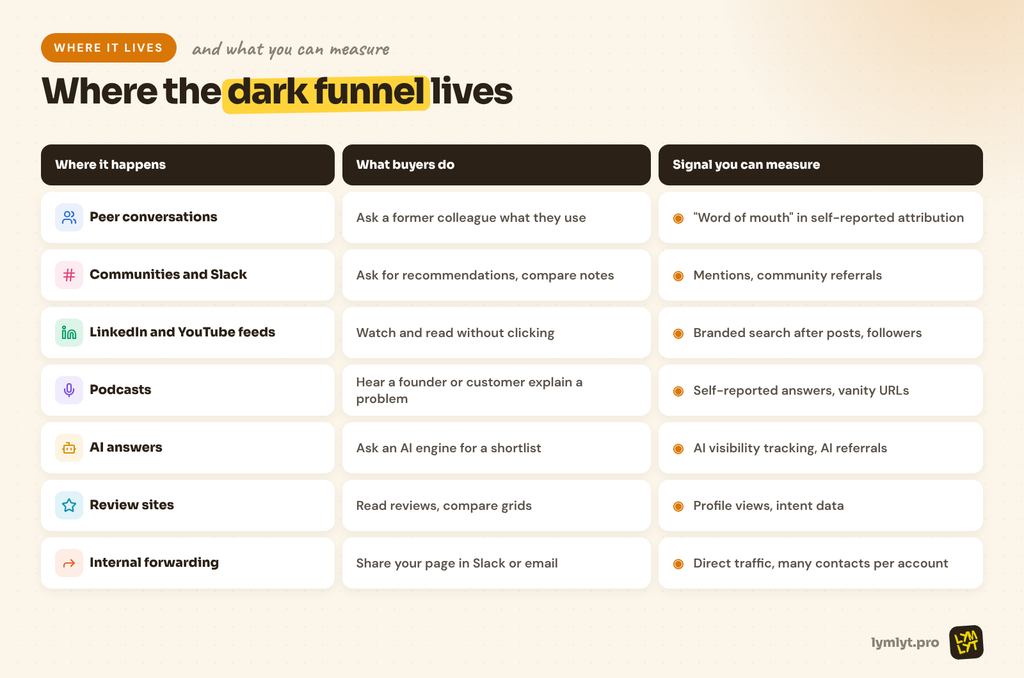
| Where it happens | What buyers do there | Signal you can measure |
|---|---|---|
| Peer conversations | Ask a former colleague what they use | “Word of mouth” in self-reported attribution |
| Communities and Slack groups | Ask for recommendations, compare notes | Mentions, community referrals, self-reported answers |
| LinkedIn and YouTube feeds | Watch and read without clicking | Profile views, followers, branded search after posts |
| Podcasts | Hear a founder or customer explain a problem | Self-reported attribution, promo-code or vanity URL use |
| AI answers | Ask ChatGPT, Perplexity or Google AI Mode for a shortlist | AI visibility tracking, AI referral traffic |
| Review sites | Read reviews and compare grids (how G2 and Capterra show up in AI) | Review site traffic, profile views, intent data |
| Internal forwarding | Share your page in an internal Slack or email | Direct traffic spikes, multiple contacts from one account |
The common thread: buyers trust people and neutral sources more than vendors. That’s why B2B marketing now lives across LinkedIn, YouTube and Instagram, why AI has entered the buying committee, and why the recommendation that never appears in your CRM is often the one that decided the deal.
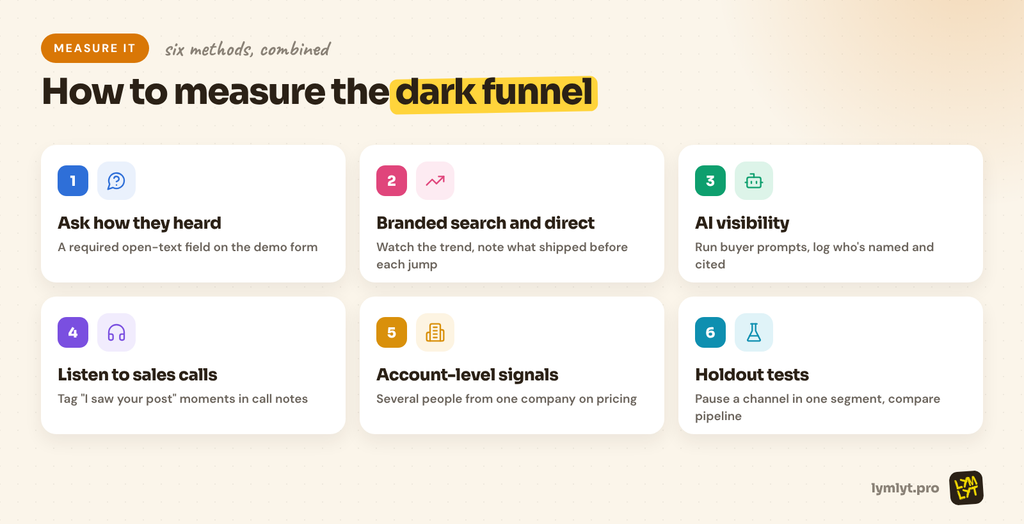
How to measure the dark funnel: 6 methods
No single method sees everything. Combine them.
1. Ask “How did you hear about us?”
Add a required, open-text field to your demo form. HockeyStack’s self-reported attribution report analyzed 8,528 responses from B2B demo bookers. Word of mouth made up 18% of answers, a channel most software attribution can’t see at all. Self-reported and last-touch sources overlapped 53% of the time for search, but only 21% for email (HockeyStack).
HockeyStack is clear that self-reported answers are “neither correlative or causal.” Use them to spot missing channels, not to replace your data.
2. Track branded search and direct traffic
When dark-funnel activity works, more people search your name or type your URL. Watch branded search volume and direct traffic as trend lines, and note what you shipped before each jump.
3. Track AI visibility
Run the prompts your buyers ask AI and record who gets named and cited. Our AI visibility audit shows how in an afternoon, and our list of AI visibility tracking tools covers ongoing tracking. Report AI referral traffic as its own channel, and know the difference between AI citations and AI mentions. Be careful with ROI claims here: most AI visibility ROI numbers are guesses.
4. Listen to sales calls
Discovery calls are full of dark-funnel evidence: “I saw your founder’s post,” “a friend at another company uses you.” Tag it in call notes. Better still, ask in win-loss interviews where the buyer first heard of the winner.
5. Watch account-level signals
When several people from one company visit your pricing page in a week, the buying group is talking. Intent data and account-level reporting catch what contact-level attribution misses. See our picks for B2B marketing attribution tools.
6. Run holdout tests
The only way to prove a channel causes pipeline is to turn it off somewhere and compare. Pause a channel in one region or segment for a quarter, keep it running elsewhere, and measure the difference in pipeline.
What not to do
- Don’t cut channels because last-touch says they don’t work. Podcasts, social and thought leadership rarely get the last click. They often create the search that does.
- Don’t treat any one method as the truth. Software attribution, self-reported answers and holdout tests each see a different slice.
- Don’t chase a single blended score. As our shortlist benchmark found with AI visibility, one number can average several different problems.
- Don’t try to track everything. Some of the dark funnel will stay dark. Build things buyers want to share, like thought leadership built on sources AI can’t copy and employee voices, and measure the trend.
How to report the dark funnel to leadership
Present three views side by side: what attribution software credits, what buyers say in self-reported fields, and the trend in branded search, direct traffic and AI visibility. Then show pipeline and win rate for the same period, and agree the definitions with sales first (see sales and marketing alignment). Counting MQLs won’t help: more MQLs can still mean less pipeline.
Our guide on how to prove marketing ROI covers the finance metrics, and the piece on demand generation vs demand capture explains why the work that fills the dark funnel needs its own budget line. Planning next year? Our guide to B2B marketing budget allocation shows how to fund it.
Frequently asked questions
What is the dark funnel in B2B marketing?
It’s the buying activity your tracking can’t see, such as peer conversations, communities, podcasts, social feeds, AI answers and zero-click searches, where buyers learn and shortlist before contacting you.
Is the dark funnel the same as dark social?
Dark social is one part of it: content shared in private channels like Slack, messaging apps and email. The dark funnel also includes AI answers, podcasts, review sites and zero-click search.
Can you track the dark funnel?
Not completely. You can measure its effects through self-reported attribution, branded search, AI visibility tracking, sales conversations, account-level signals and holdout tests.
Does the dark funnel mean attribution software is useless?
No. It’s useful for the visible, digital part of the journey. Just don’t treat it as the whole story.
The bottom line
The dark funnel isn’t a tracking bug you can fix. It’s where B2B buyers do most of their deciding. The teams that win stop asking attribution to explain everything, build the content and reputation buyers pass around, and measure the trend from several angles.
If you need the content that fills the dark funnel, LymLyt writes the thought leadership, original research and comparison pages buyers share. See our pricing, from $1,499/month.

Jay is the co-founder of LymLyt and an AI partnership consultant helping B2B SaaS companies grow through content strategy, SEO, and AI integration. He writes about content marketing, what makes B2B content convert, and how SaaS teams can build content systems that drive real pipeline.