Best AI Communities and Slack Groups for Marketers in 2026: 11 Rooms Worth Your Time
You start by joining one community, coz everyone’s talking about it. Then you end up with 50, with no idea about what to do and say in those.
That single fact explains most of what happened to marketing communities over the last two years. The good ones left Slack. The ones that stayed free on Slack turned into job boards with a #general channel attached.
So this is not a list of 11 communities to join. It is worth knowing about, with an honest note on what each one is actually for and who should skip it. Join two. Post in both. That is the whole strategy.
The 11 at a glance
| Community | Platform | Best for | Price | Size | Free option |
|---|---|---|---|---|---|
| SmarterX / Marketing AI Institute | Slack | Marketers starting on AI | Free; AI Mastery $999/yr | 10,000+ | Yes |
| AI Marketers Guild | Slack | Practical AI marketing tips | Free | Not disclosed | Yes |
| Learn Prompting | Discord | Getting better at prompting | Free | 40,000+ | Yes |
| r/ArtificialIntelligence and friends | Unfiltered opinion, AI visibility | Free | 1.5M+ | Yes | |
| Exit Five | Own platform | B2B SaaS marketers | $37/mo billed annually ($444/yr) | 5,700+ | 7-day trial |
| Superpath | Slack + Pro | Content marketers | Free; Pro $500/yr | 13,000+ (Pro ~325) | Yes |
| Traffic Think Tank | Slack | SEO and paid media | ~$119/mo | Not disclosed | No |
| Online Geniuses | Slack | Broad marketing questions | Free (vetted) | 25,000 to 53,000 | Yes |
| Lenny’s Community | Slack | Product and growth | Included with paid newsletter | 30,000+ | No |
| Pavilion | Own platform | Director and VP+ | $1,375 to $2,700/yr | Not disclosed | No |
| Women in Tech SEO | Own platform | SEO, women and marginalized genders | Free | 12,000+ | Yes |
AI-first rooms built for marketers
These are the communities where AI is the reason the room exists. They are useful when you are still building the habit, and they get thinner once you have. Nobody stays in a beginner room forever, and that is fine.
1. SmarterX / Marketing AI Institute Community: best for marketers just getting serious about AI
Quick facts
- Best for: marketers and business leaders who want structured AI education alongside peer conversation
- Price: free Slack community; AI Mastery Membership $999 per user per year, dropping to $399 per user at 5 to 99 licenses and $299 at 1,000+
- Platform: Slack
- Size: 10,000+ in the free community
- What you get: channels by tool and use case, plus free monthly Intro to AI classes, webinars, and AI Blueprints
- Free option: yes, the Slack community is free
Marketing AI Institute, now operating under the SmarterX brand, has been running AI-for-marketers education since before it was crowded. The free Slack is the largest room specifically for marketers using AI, and the education side is the most structured in this list. If your problem is that you do not know what you do not know, this is the right first stop.
The paid AI Mastery Membership at $999 a year is priced for companies rolling out AI training, not individuals. The honest complaint about the free Slack is the one you would expect from a 10,000-person free Slack: high signal in the tool-specific channels, low signal in #general, and the 90-day archive means the good threads evaporate.
Skip it if: you already run AI in your daily workflow and want senior-level debate rather than onboarding.
2. AI Marketers Guild: best for practical tips from people doing the work
Quick facts
- Best for: marketing strategists and practitioners swapping working tactics
- Price: free
- Platform: Slack
- Size: not publicly disclosed
- What you get: a working Slack plus community resources
- Free option: yes, entirely free
AI Marketers Guild is smaller and scrappier than the Institute, which is the appeal. The Slack is where people share what actually worked, including the parts that did not. Because it is free and does not publish a member count, treat it as a supplement rather than your main room.
The trade-off with any free, unvetted, undisclosed-size community is that quality depends on who happens to be active that month. Lurk for two weeks before deciding it is worth a channel in your sidebar.
Skip it if: you want depth, accountability, or a searchable archive you can rely on.
3. Learn Prompting Discord: best for getting genuinely better at prompting

Quick facts
- Best for: anyone whose output quality is currently limited by their prompting, which is most marketers
- Price: free
- Platform: Discord
- Size: 40,000+
- What you get: prompt critique, technique discussion, and a free course backing it
- Free option: yes
Learn Prompting sits alongside an open prompting curriculum, and the Discord is where people bring prompts that are not working and get them taken apart. That feedback loop is the thing most marketers never get. You write a prompt, the output is mediocre, you assume the model is limited, and you move on.
The room skews technical and hobbyist rather than marketing-specific, so you will be translating. Worth it. Prompting is the skill on this list with the biggest gap between effort and payoff, and the one people assume they already have.
Skip it if: you only use AI through marketing-specific tools with fixed interfaces where you never write a raw prompt.
4. Reddit’s AI and marketing subreddits: best for unfiltered opinion and AI visibility

Quick facts
- Best for: sentiment checks, honest tool reviews, and understanding what AI models are reading about your category
- Price: free
- Platform: Reddit
- Size: r/ArtificialInteligence alone is 1.5M+; add r/marketing, r/SEO, r/digital_marketing, r/SaaS
- What you get: the least polished, most honest opinion available
- Free option: yes
Reddit is not a community in the Slack sense, and it belongs on this list for a reason most roundups miss. Reddit content is heavily cited by AI answer engines. When someone asks ChatGPT for the best tool in your category, Reddit threads are a meaningful part of what shapes the answer. Reading the relevant subreddits tells you what the models are being trained and grounded on. That matters if you care about why your site does not show up in ChatGPT.
The current threads worth watching cover generative engine optimization, whether AI search is cutting organic traffic, and AI-driven headcount changes in marketing teams. Marketers on Reddit are broadly skeptical of dedicated AI marketing platforms and recommend general models like ChatGPT and Claude far more often, which is a useful counterweight to vendor content.
Skip it if: you want a room where people know your name and will answer a direct question. Reddit is a firehose with no relationship in it.
Marketing communities where AI became the main conversation
This is where most of you should spend your time. These are established marketing communities that now spend a large share of their oxygen on AI, which means you get the AI conversation with the context of your actual job attached.
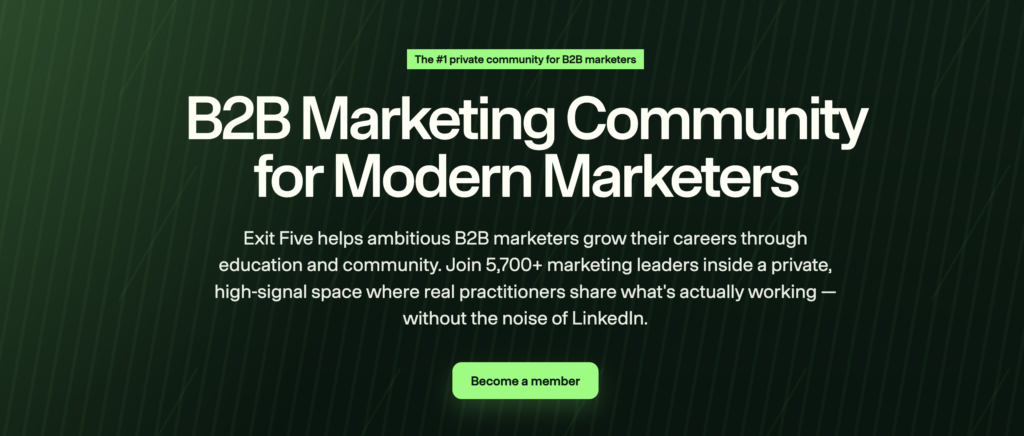
5. Exit Five: best for B2B SaaS marketers, full stop
Quick facts
- Best for: B2B marketers, especially at SaaS companies, from senior IC to VP
- Price: $37 per month billed annually, around $444 per year; 7-day free trial
- Platform: its own community platform
- Size: 5,700+ members, 8,000+ posts
- What you get: 30+ local chapters, industry subgroups (fintech, healthcare, HR tech, industrial), a 75+ template swipe file, monthly training, a jobs board, a mobile app, and DaveBot, an AI advisor trained on Exit Five content
- Free option: 7-day trial only
Exit Five is Dave Gerhardt’s community and it is the most consistently recommended paid room for B2B marketers. It runs as a bootstrapped business on track for around $3 million in revenue, which matters because the incentive is retention rather than growth at any cost. The paywall does the work: 5,700 paying members produce more useful conversation than 50,000 free ones.
The AI conversation here is grounded in real decisions, which is the point. People post about whether to cut a writer, how they are handling AI search traffic drops, what their CEO is demanding this quarter. Honest complaints center on the price for early-career marketers and the fact that a chunk of the value sits in events and chapters you have to show up for. If you never attend anything, you are paying for a forum.
Skip it if: you market to consumers, or you are in your first year and cannot expense $444.
6. Superpath: best for content marketers
Quick facts
- Best for: content marketers and content leads, especially in B2B and SaaS
- Price: free Slack; Superpath Pro $500 per year
- Platform: Slack, with Pro as a separate private space
- Size: 13,000+ across the network; Pro is roughly 325 people
- What you get: free tier is the Slack and job board; Pro adds courses, templates, off-the-record discussions, monthly peer meetings, and weekly founder calls
- Free option: yes, the main Slack is free
Superpath is the default room for content marketers and has been for years. Jimmy Daly built it and stepped back to an advisory role, with Alex Hilleary taking over as CEO. Pro is expanding in 2026.
The gap between free and Pro is unusually wide here, and worth understanding. The free Slack is large, useful for jobs and quick questions, and subject to the same 90-day archive problem as every free Slack. Pro at roughly 325 people is a genuinely different product: small enough that people know each other, expensive enough that they show up. The off-the-record channels are where senior content people say what they cannot say on LinkedIn about AI and headcount.
Skip it if: you do demand gen, paid, or product marketing. This is a content room and the advice is shaped for content problems.
7. Traffic Think Tank: best for SEO and paid media practitioners
Quick facts
- Best for: in-house SEO leads, agency SEOs, and paid media specialists
- Price: around $119 per month
- Platform: private Slack
- Size: not publicly disclosed
- What you get: private Slack, training library, and a member base of working practitioners
- Free option: no
Traffic Think Tank has been the reference paid SEO community for years, and in July 2026 it joined Search Engine Land’s community portfolio. The Slack covers SEO, paid media, AI, and adjacent marketing topics, and the paywall keeps the practitioner-to-vendor ratio healthy.
The acquisition is the thing to watch. Media-company ownership usually means more programming and more integration with the parent brand’s content. Whether that improves the room or dilutes it is not settled yet. At roughly $119 a month it is the most expensive per-month option on this list outside Pavilion, so give it a real month rather than a distracted one. If AI search is why you are looking, pair it with our take on SEO versus AI and Google AI Mode.
Skip it if: SEO is a small part of your job. The price only makes sense if search is most of what you do.
8. Online Geniuses: best for getting a fast answer to a broad question

Quick facts
- Best for: freelancers, consultants, agency owners, and generalists across SEO, PPC, email, and affiliate
- Price: free, with a paid Pro tier
- Platform: Slack
- Size: reported between 25,000 and 53,000 depending on the source
- What you get: high-volume channels, regular AMAs with names like Rand Fishkin, a marketplace and talent network
- Free option: yes, though every applicant is manually vetted
Online Geniuses is one of the biggest and oldest marketing Slacks going. Manual vetting on a free community is unusual and it helps. Post a specific question in the right channel and you will usually get an answer the same day, which is the main thing a large community is good for.
Two honest caveats. The published member count varies widely across sources, which tells you the number is not being maintained carefully. And it is free Slack, so treat it as a live room rather than a reference library. Ask, get your answer, save it somewhere else.
Skip it if: you want senior strategic discussion. Volume and seniority pull in opposite directions and this room chose volume.
9. Lenny’s Community: best if you already pay for the newsletter
Quick facts
- Best for: product managers, growth marketers, and founders in B2B SaaS
- Price: included with a paid Lenny’s Newsletter subscription, historically around $200 per year
- Platform: Slack
- Size: 30,000+
- What you get: the Slack, local meetups, plus the newsletter and its bundled tool perks
- Free option: no, it is gated behind the paid subscription
Lenny’s Community is the largest paid Slack on this list and it works because the paywall is incidental. People join for the newsletter and get the Slack, which means the room is full of people who are there to read and think rather than to network.
At 30,000+ members it has the scale problem, and the product skew is real: this is a product community that marketers are welcome in. The AI discussion is strong on how AI changes how software gets built and shipped, weaker on how it changes marketing specifically. The bundled tool credits on the annual plan cover a meaningful chunk of the cost for a lot of people, which makes the effective price of the community close to zero.
Skip it if: you want marketing-specific conversation. This is product-first and honest about it.
10. Pavilion: best for directors and VPs who need peers, not tactics
Quick facts
- Best for: director-level and above across marketing, sales, CS, and RevOps
- Price: $1,375 per year for Associate (manager and director), $2,700 per year for Executive (VP+)
- Platform: its own community platform
- Size: not publicly disclosed
- What you get: peer groups, structured courses, events, and a member base gated by seniority
- Free option: no
Pavilion is the most expensive room here and the most explicitly about career rather than craft. The seniority gate is the product. When you are the only marketing leader at your company, the value of a room full of people with your exact problem is high enough to justify four figures.
At $1,375 to $2,700 a year, the math only works if you use the peer groups and the courses. Members who treat it as another Slack to check do not renew. The AI conversation here is about org design, budget, and headcount rather than tools, which is the right altitude for the audience and useless if you wanted prompt tips.
Skip it if: you are an individual contributor, or your company will not expense it. Do not pay this out of pocket to lurk.
11. Women in Tech SEO: best free community with an actual culture
Quick facts
- Best for: women and marginalized genders working in SEO and technical marketing
- Price: free
- Platform: its own community platform, plus events and a mentorship program
- Size: 12,000+
- What you get: community access, a mentorship program, events, and a job board
- Free option: yes, entirely free
Women in Tech SEO, founded by Areej AbuAli in 2019, brings together 12,000+ people of marginalized genders in SEO and marketing. It is free, which usually predicts a dead room, and it is one of the more active communities on this list anyway. The reason is that it was built around a shared identity and a mentorship structure rather than around a topic feed.
The WTS mentorship program is the part worth flagging. Structured mentor matching is rare and it is the thing that changes careers rather than quarters. Coverage of AI here runs through the SEO lens: AI search, topical authority, and what generative results are doing to organic traffic.
Skip it if: you are not in the eligible group, or SEO is not part of your work.
The free tier reality
Free communities on this list fall into three groups and they are not equivalent.
Useful but shallow free: Online Geniuses, SmarterX, AI Marketers Guild, Learn Prompting. These are worth joining and worth checking weekly. None of them will be where your best conversation of the year happens. The 90-day Slack archive limit means anything you learn has to be saved elsewhere immediately.
Free as a funnel: Superpath’s free Slack is a real community and it is also the top of the funnel for Pro. That is fine, and it is worth naming so you know what you are looking at. The free tier is genuinely useful. The good stuff is behind the $500.
One rule that holds across all of them: a free community you check daily beats a paid one you check monthly. Prove you will show up before you pay.
The marketer’s playbook: which room for which problem
Pick by the problem you have this quarter, not by the list.
You are behind on AI and you know it. SmarterX for structure and Learn Prompting for skill. Give it 60 days of actual use. Then leave the beginner rooms, because staying in them is how you feel busy without getting better. Our top 100 AI tools guide covers the tool side of the same problem.
You market B2B SaaS and need one room. Exit Five. It is the closest match to the job and the paywall keeps it honest. $444 a year is one week of an agency retainer.
Content is your function. Superpath free to start, Pro if content is your career rather than your current title. The Pro room at ~325 people is where the conversation you actually want is happening.
SEO or paid is most of your job. Traffic Think Tank if you can expense it, Women in Tech SEO if you are eligible. Watch how Search Engine Land ownership changes TTT over the next two quarters before committing annually.
You are the only senior marketer at your company. Pavilion. This is the specific problem it solves and nothing else on this list solves it. Confirm your company will pay first.
You need to know what AI can really do before you plan around it. Reddit for the counterweight, because builders overestimate and marketers on Reddit underestimate, and the truth sits between them.
You want the AI answer engines to know your brand exists. Reddit, seriously. Read the subreddits where your category gets discussed, understand what is being said, and treat that as an input to your AI visibility work rather than a place to drop links.
Three rules that apply regardless of which you pick:
- Two communities, maximum. One where your job title is the majority, one where you are the least experienced person in the room. Anything past two and you lurk in all of them.
- Post in week one. Ask one specific question with real context. If nobody answers within 48 hours, you have your answer about the room.
- Save everything outside the community. Free Slack loses your archive in 90 days. Any answer worth having goes into your own notes the day you get it.
How to actually get value in your first month
Joining is not the work. Here is the sequence that works:
Week one. Read only. Scan the last week of posts in the three channels closest to your job. Note who answers questions well and follow them. Do not post an intro. Nobody reads intros.
Week two. Ask one specific question. Not “does anyone have thoughts on AI content?” but “we publish 8 posts a month, two writers, traffic down 30% since AI Overviews rolled out on our head terms. Has anyone measured whether their AI-assisted posts perform differently from human-only ones?” Specific questions get specific answers. Vague ones get vague ones.
Week three. Answer someone else’s question. This is the step everyone skips and it is the one that changes the community from a feed into a network. You know something. Say it.
Week four. Decide. If you got one answer that saved you a week of work, or one relationship worth having, stay. If not, leave and try another. There is no loyalty owed to a Slack workspace.
How to choose, in one line each
- B2B SaaS marketer, one pick: Exit Five
- Content marketer: Superpath, Pro if you can
- SEO or paid media: Traffic Think Tank
- Director or VP: Pavilion
- New to AI: SmarterX plus Learn Prompting
- Product-adjacent: Lenny’s Community
- Free and active: Women in Tech SEO
- Broad quick answers: Online Geniuses
Why the member count is the worst number to judge a community by
Every roundup leads with size. 53,000 members. 50,000 revenue creators. 1.5 million subscribers. Those numbers tell you almost nothing about whether you will get an answer when you ask a question.
The classic model of online participation is the 90-9-1 rule: 90% of a community lurks, 9% responds occasionally, 1% creates. Nielsen Norman Group popularized it and it held up well for open forums and wikis. Research from The Community Roundtable now argues it is outdated for professional communities, where the ratio looks closer to 55-25-20 or 70-20-10 depending on how tightly the room is vetted.
Both things are true, and the difference between them is the whole point. Big and free trends toward 90-9-1. Small and vetted trends toward 70-20-10. A 500-person paid community with 100 active posters is a more useful room than a 50,000-person free Slack with 200.
Judge a community by three things instead:
- How many people posted in the last seven days, not how many joined ever.
- Whether the archive is searchable. On free Slack, it is not.
- Whether the people you want to talk to are answering, or just listed in the member directory.
What changed for AI communities in last 2 years
Three shifts worth knowing before you pick.
AI stopped being its own room. In 2023 you joined an AI community to talk about AI. By 2026 the AI conversation moved into the general marketing communities, because AI stopped being a separate topic and became the thing everyone is arguing about inside content, SEO, demand gen, and ops. The most useful AI discussion for a B2B marketer is now happening in Exit Five and Superpath, not in a dedicated AI Slack.
Communities consolidated. Traffic Think Tank, one of the longest-running paid SEO Slack groups, joined Search Engine Land’s community portfolio in July 2026. Superpath brought in a new CEO, Alex Hilleary, with founder Jimmy Daly moving to an advisory seat. Independent communities are getting acquired by media companies, which changes what they optimize for.
The platform moved. Exit Five runs on its own platform. Buffer’s community moved to Discord. Plenty of others sit on Circle or Skool now. Slack is still where the free, high-volume, low-retention communities live, and the 90-day archive limit is the reason.
If you want the other half of this picture, our best AI newsletters guide covers the passive channel. Communities are the active one. Most marketers need one of each and pick two of neither.
What marketers should actually look for
Not every good community is a good community for you. Check these before joining anything:
- Searchable archive. Can you find the answer to a question asked eight months ago? Free Slack, no. Circle, Discord, forums, and paid Slack, yes. This is the single biggest quality difference and it is invisible until you need it.
- Vetting. An application or a paywall filters for people who show up. Open-door communities scale fast and go quiet faster.
- Practitioner density. Are the people posting doing the work, or selling to the people doing the work? Read a week of posts before you commit money.
- Your specific job is represented. A content marketer in a demand gen community gets generic advice. Pick the room where your title is the majority.
- Company stage match. Advice from someone running a 40-person marketing team does not port to a team of two. Some communities gate by seniority for this reason.
- Whether AI talk is grounded. There is a real difference between a channel where people paste prompts that worked and one where people share screenshots of ChatGPT being impressive.
- Real-time versus async. Slack and Discord reward being present. Forums and Circle reward being thorough. Pick the one that matches how you actually work.
- Exit cost. Annual-only pricing on a community you have not tested is a bad trade. Look for a trial or a monthly option first.
The bottom line
The communities on this list will not make you a better marketer. They will make you a faster one, which is a different thing and still worth paying for. You will find out sooner that a tool does not work, that a channel is dying, that everyone else’s organic traffic is down too. Faster feedback is a real advantage.
What none of them do is the part that matters. A room full of smart people will tell you what is working for them. It will not tell you what your buyer needs to hear, what your product is actually better at, or why the last six posts you published sank without a trace. That is still your job, and it is the job most marketing teams are quietly outsourcing to a Slack channel and a prompt.
We wrote about this in AI didn’t cause content blindness, marketers did. The tools and the communities both save you the doing. Neither one saves you the thinking. If the writing is generic, faster generic is worse, not better.
If you want that part handled by people who think about it full time, see what we do or book a call. And if you would rather read than talk, our best AI newsletters guide is the passive version of this list.

Rashmita is content marketer with 8 years of experience building and growing SaaS brands. Now she tests various AI tools for marketers and shares her feedback on this blog, LinkedIn, Instagram, and YouTube.