B2B Growth Strategies: 11 That Work in 2026 (How to Pick Yours)
Most lists of B2B growth strategies read like a menu. Try SEO. Try events. Try ABM. Try everything.
The companies actually growing don’t work that way. McKinsey’s 2026 B2B Pulse Survey of nearly 4,000 decision-makers found 60% of market leaders reported double-digit revenue growth in 2025, against 21% of laggards (McKinsey). The leaders weren’t doing more things. They were doing fewer things better, with clearer choices about where growth comes from.
Here are 11 B2B growth strategies that work in 2026, the data behind them, and how to pick the two or three that fit your stage.
Where B2B growth actually comes from
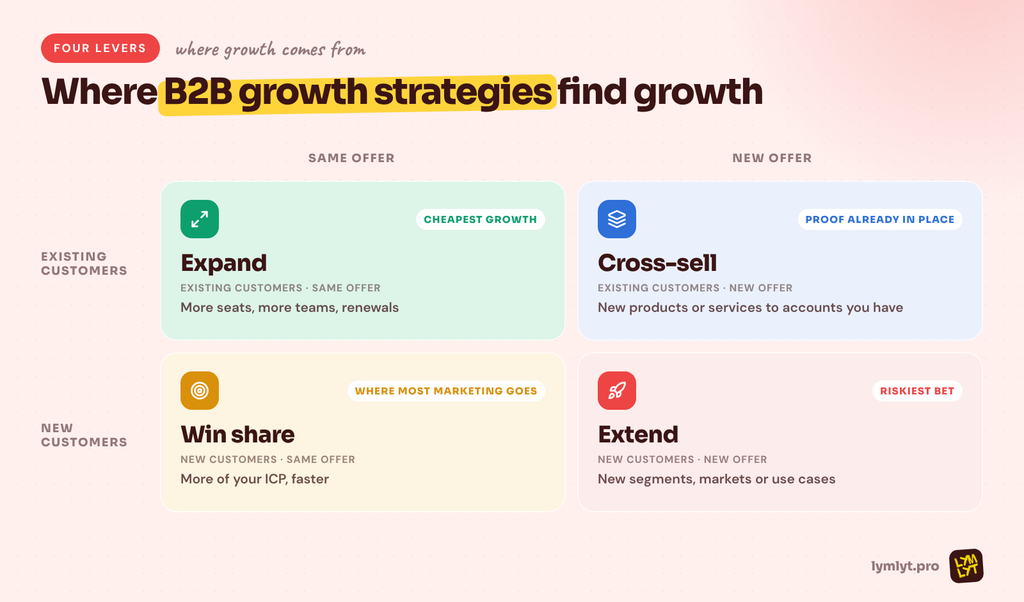
Every growth strategy pulls one of four levers:
| Same offer | New offer | |
|---|---|---|
| Existing customers | Expand: more seats, more teams, renewals | Cross-sell: new products or services to accounts you already have |
| New customers | Win share: more of your ICP, faster | Extend: new segments, new markets, new use cases |
The top-left box is the cheapest growth you’ll ever get, and the one most marketing teams ignore. The bottom-right is the riskiest and the one founders love most. Decide which box you’re playing in before you pick tactics.
The numbers behind B2B growth in 2026
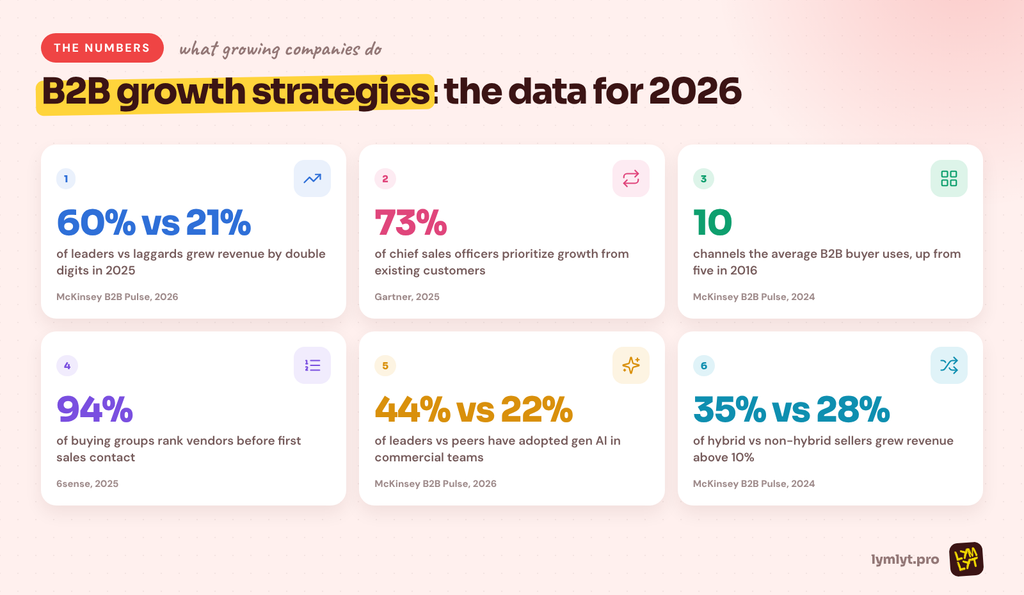
- Leaders grow twice as fast, or more. 60% of market leaders reported double-digit growth in 2025, versus 21% of laggards (McKinsey).
- Sales leaders are betting on customers they already have. 73% of chief sales officers said they’re prioritizing growth from existing customers in 2025, in a Gartner survey of 243 sales leaders (Gartner).
- Buyers use ten channels. B2B customers use an average of ten interaction channels in their buying journey, up from five in 2016, and over half say they’d likely switch suppliers without a smooth experience across them (McKinsey).
- The shortlist forms early. 94% of buying groups rank their preferred vendors before first contact with sales (Business Wire).
- AI separates leaders from laggards. 44% of market leaders have adopted generative AI in their commercial teams, versus 22% of peers (McKinsey).
11 B2B growth strategies that work in 2026
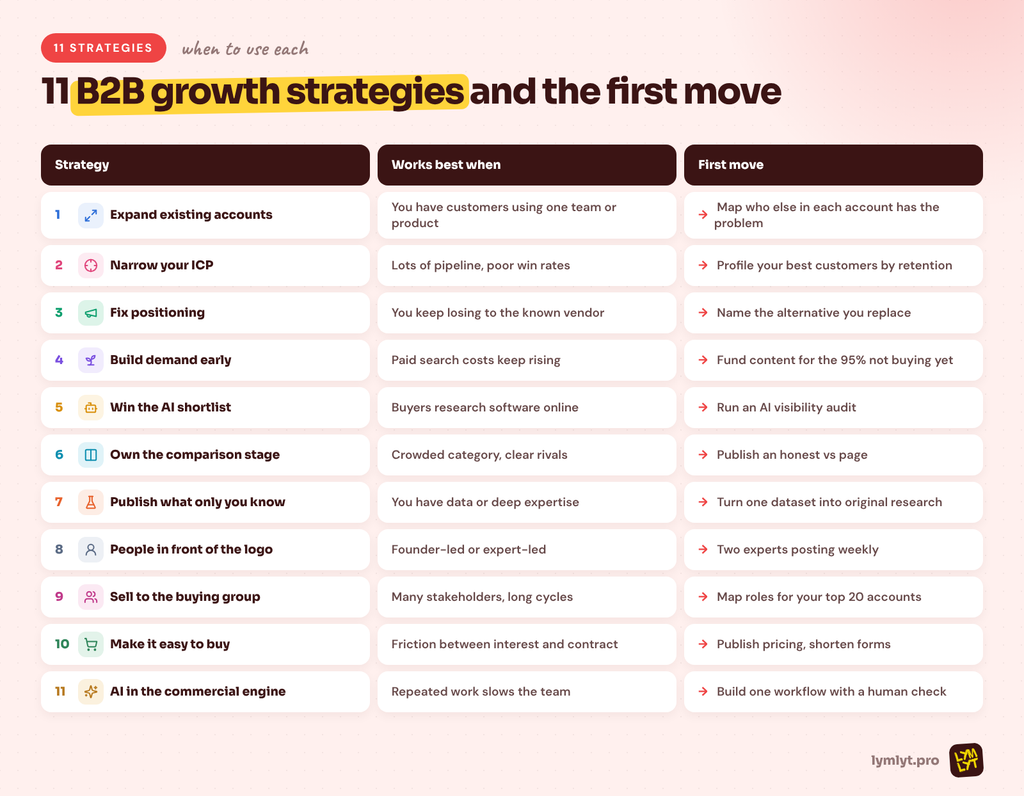
1. Expand the accounts you already have
Best for: any company with more than a handful of customers.
Expansion is cheaper than acquisition and easier to forecast. That’s why 73% of CSOs are prioritizing it. Map which accounts use one team or one product, find who else inside them has the same problem, and give customer success and marketing a shared expansion target. Your best proof is already in those accounts: turn it into case studies.
2. Narrow your ICP until it hurts
Best for: teams with lots of pipeline and poor win rates.
Growth often comes from saying no. Pull your best customers by retention, expansion and sales cycle, and find what they share. Then aim everything at that profile. Our guide to building an ideal customer profile lists the 7 data points to use.
3. Fix your positioning before you spend more
Best for: companies that keep losing to “the known vendor.”
If your homepage could belong to three competitors, more traffic won’t help. Pick the alternative you replace, the buyer you serve best and the one thing you do that they can’t. Our breakdown of B2B positioning lists 12 overused claims and what to say instead.
4. Build demand before you try to capture it
Best for: companies whose paid search costs rise every quarter.
Only about 5% of B2B buyers are in market at any time. If all your budget chases them, you’re competing for a shortlist that’s already formed. Fund content, social and thought leadership that builds memory with the other 95%. Our guide to demand generation vs demand capture has the data.
5. Win the AI shortlist
Best for: software and services buyers research online.
G2’s 2025 Buyer Behavior Report found AI chatbots were the top influence on vendor shortlists, ahead of review sites (Business Wire). Find out what ChatGPT, Perplexity and Google AI Mode say about your category with an AI visibility audit, then fix the pages AI cites. Our AI visibility guide for B2B SaaS covers how.
6. Own the comparison stage
Best for: crowded categories with clear alternatives.
Buyers comparing vendors are ready to decide. If you don’t publish an honest comparison, someone else will, and they’ll set the criteria. Start with our guides to B2B SaaS comparison pages, vs keywords and why losing a row wins the deal.
7. Publish what only you know
Best for: companies with proprietary data or deep expertise.
Original research and real opinions get quoted, cited and shared. Generic content gets summarized by AI and forgotten. See our guide to thought leadership content and what our research found about original statistics and AI citations.
8. Put people in front of the logo
Best for: founder-led and expert-led businesses.
Buyers trust people more than company pages. HubSpot went as far as buying audiences built by creators. You can start smaller: founders, experts and sales reps posting what they actually know. Our employee advocacy statistics show why it works.
9. Sell to the buying group, not the lead
Best for: deals with several stakeholders and long cycles.
The average purchase involves 13 people, according to Forrester. McKinsey found 43% of leaders using sales-led account-based marketing reached top revenue bands, against 31% without it (McKinsey). Map the roles with our guide to the B2B buying committee and get both teams on one plan with sales and marketing alignment.
10. Make it easy to buy
Best for: anyone with friction between interest and contract.
Buyers want to self-serve, compare prices and talk to sales when they choose. McKinsey found hybrid sellers were more likely to report revenue growth above 10% than non-hybrid ones, 35% versus 28% (McKinsey). Publish pricing where you can, shorten forms and replace gated PDFs with lead magnets that still work. Our pricing prompts research shows what AI tells buyers your product costs if you don’t.
11. Build AI into the commercial engine
Best for: teams with repeated work that slows growth.
Market leaders aren’t just using AI more. 71% increased AI investment by double digits year over year, versus 25% of peers (McKinsey). Start with workflows that have a clear input and a human check. Our guide to AI marketing workflows lists 9 worth building.
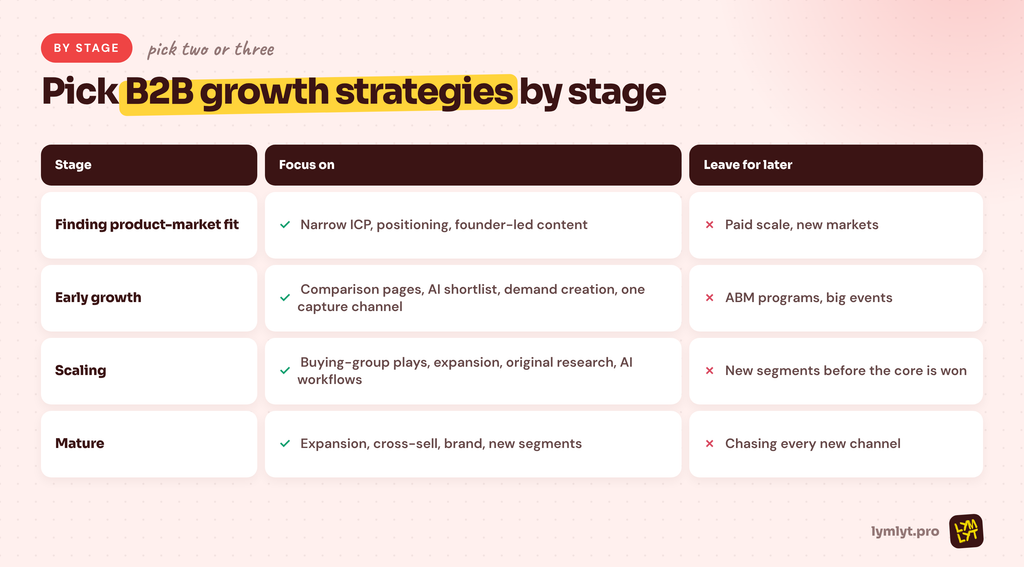
How to pick your B2B growth strategies by stage
| Stage | Focus on | Leave for later |
|---|---|---|
| Finding product-market fit | Narrow ICP, positioning, founder-led content | Paid scale, new markets |
| Early growth | Comparison pages, AI shortlist, demand creation, one capture channel | ABM programs, big events |
| Scaling | Buying-group plays, expansion, original research, AI workflows | New segments before the core is won |
| Mature | Expansion, cross-sell, brand, new segments | Chasing every new channel |
Pick two or three. Fund them properly, give each an owner and a metric, and review them every quarter. Before you commit, run your shortlist through our AI prompts for marketing strategy to find the weak assumptions. Plan the money with our guide to B2B marketing budget allocation.
5 mistakes that stall B2B growth
- Doing everything at once. Eleven half-funded strategies lose to three well-funded ones.
- Ignoring existing customers. New logos feel like growth. Expansion often is the growth.
- Measuring leads instead of revenue. More MQLs can still mean less pipeline.
- Cutting demand creation first. It’s slow to prove and fast to miss. Our guide to the dark funnel explains why attribution undercounts it.
- Copying a bigger company’s playbook. HubSpot’s moves make sense for HubSpot. Your stage needs different bets.
How to measure your B2B growth strategies
Give each strategy one leading and one lagging metric. Expansion: product usage and net revenue retention. Demand creation: branded search and self-reported attribution. Comparison pages: conversion and win rate on competitive deals. Then report it all in finance language. Our guide on how to prove marketing ROI lists the 11 metrics a CFO trusts, and win-loss analysis tells you which strategies buyers actually noticed.
Frequently asked questions
What are the best B2B growth strategies in 2026?
Expanding existing accounts, narrowing your ICP, sharper positioning, building demand early, winning AI shortlists, owning the comparison stage and selling to buying groups. Pick two or three that fit your stage.
What’s the fastest way to grow a B2B company?
Usually expansion. Existing customers already trust you, and 73% of CSOs are prioritizing that growth for a reason.
How do B2B growth strategies differ from B2C?
B2B purchases involve more people, longer cycles and higher stakes. Strategies have to reach the whole buying group, not one buyer, and prove value to finance.
How many growth strategies should a B2B company run at once?
Two or three, each with an owner, a budget and a metric. More than that and none get enough attention to work.
The bottom line
B2B growth strategies work when they’re choices, not a checklist. Know which box your growth comes from, pick the few strategies that fit your stage, and fund them like you mean it.
If content is one of your bets, LymLyt builds the comparison pages, original research and thought leadership that drive B2B growth. See our pricing, from $1,499/month.

Jay is the co-founder of LymLyt and an AI partnership consultant helping B2B SaaS companies grow through content strategy, SEO, and AI integration. He writes about content marketing, what makes B2B content convert, and how SaaS teams can build content systems that drive real pipeline.