AI Citations vs AI Mentions: The Difference, With Examples
You open ChatGPT, type the question your buyer would type, and hit enter. Your competitor’s name shows up in paragraph two. Yours doesn’t.
Then you check Perplexity. Your blog post is in the source list, footnote [4], link and all. The answer names three other vendors and uses your data to do it.
Same brand. Same week. Two different problems.
One is a citation problem. The other is a mention problem. Most teams treat them as one thing called “AI visibility,” build one plan, then wonder why six months of work moved one number and left the other flat.
Here’s the split, what causes each, and which to chase first.
Quick answer
An AI citation is when an AI answer links to your page as a source. Your URL appears in the footnotes, the source carousel, or the numbered list. It comes from retrieval, meaning the model searched the live web mid-answer and pulled your page in.
An AI mention is when an AI answer says your brand name inside the text. No link required. It comes from what the model already believes about your category, learned across training data and reinforced by everywhere your name appears on the web.
Citations are a page-level win. Mentions are a brand-level win. You need both, and they run on different clocks.
What an AI citation looks like
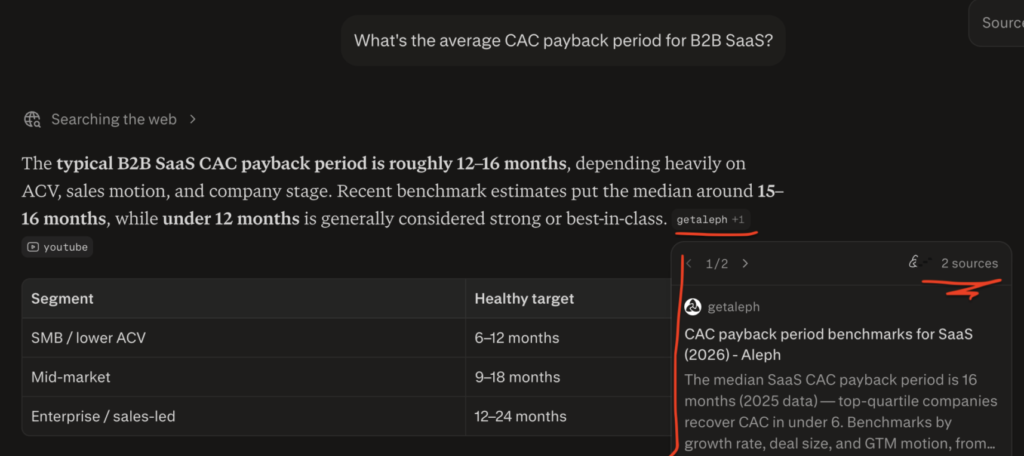
Ask Perplexity: “What’s the average CAC payback period for B2B SaaS?”
You get a synthesized answer with numbered markers through it. Click [2] and it opens your benchmark report. Your domain is listed in the sources rail.
That’s a citation. The model ran a live search, retrieved candidate pages, read them, and attributed a claim to yours.
Three things follow from that mechanism:
Citations are page-level. The model cited one URL, and that URL earned it. Your other 200 posts got nothing.
Citations are fast. Perplexity indexes in near real time. Google AI Overviews pulls from a continuously refreshed index. Publish something useful on a query with thin competition and you can show up in weeks.
Citations decay. AI engines favour recent content, and a page that stops getting updated drops out of the citation pool while still ranking on Google. That gap is why a client can say “we’re still position one” and be invisible in ChatGPT at the same time. More on that in 5 reasons your site doesn’t show up in ChatGPT.
What an AI mention looks like
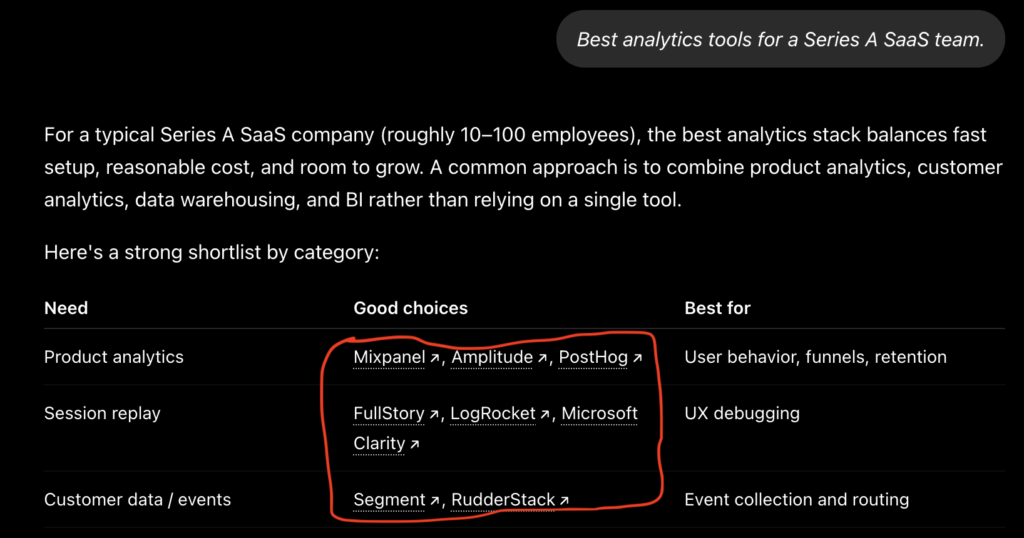
Ask ChatGPT: “Best analytics tools for a Series A SaaS team.”
You get a list. Six names, a line or two on each, often with links. If your product is on that list, you got a mention.
Nobody clicked anything. No page of yours was retrieved. The model knows your product belongs in that conversation, because it has seen your name next to that category thousands of times across G2 threads, Reddit posts, newsletters, YouTube transcripts, podcast show notes, and competitor comparison pages.
A mention is the model’s picture of your brand, formed from everywhere on the internet except your own website.
Which is why mentions are slow. You can’t publish your way into one. You have to get talked about, in enough places, often enough, that the association holds.
Ahrefs put numbers on this. In a study of 75,000 brands, branded web mentions came out as the strongest correlate with AI Overview visibility at 0.664. Backlinks landed at 0.218. A follow-up study extended the work to ChatGPT and Google AI Mode, where YouTube mentions scored 0.737. Ahrefs’ CMO summarized it in Search Engine Journal: get mentioned in a lot of places, get mentioned in a lot of AI answers.
Correlation isn’t causation, and the researchers said so.
Side by side
| AI citation | AI mention | |
|---|---|---|
| What appears | Your URL as a source | Your brand name in the text |
| Where it comes from | Live retrieval during the answer | Training data plus web-wide brand signals |
| What it proves | Your page is a trusted source | Your brand belongs in the category |
| Level | Single page | Whole brand |
| Sends traffic | Yes | Rarely |
| Buyer effect | “This company knows the topic” | “This company is an option” |
| Timeline | Weeks to 3 months | 6 months and up |
| Main lever | Publishing and refreshing pages | Earned coverage, community, third-party sources |
| Decays if ignored | Fast | Slow |
Examples you can run yourself
Open two tabs, ChatGPT and Perplexity, and run these. Screenshot each result.
Prompts that produce mentions
Turn search off in ChatGPT and ask:
- “Best content marketing agencies for B2B SaaS”
- “Who should I hire to write comparison pages for my SaaS?”
- “Best AI visibility tools for a small marketing team”
You get names in prose with no links. Highlight the brand names. That’s a mention.
Prompts that produce citations
In Perplexity, ask:
- “How much does content marketing cost for B2B SaaS?”
- “AI SEO statistics 2026”
- “What is Google AI Mode?”
Look at the source rail. Highlight the footnote numbers and domain chips. That’s a citation.
The one worth screenshotting
Run “AI SEO statistics for B2B marketers” in Perplexity. If your post appears as source [3] while the answer names Ahrefs and Semrush in the text, you have a citation with no mention. One image explains the whole difference.
Both in one answer
Ask Google AI Mode a comparison question like “ChatGPT vs Claude for marketing content.” Comparison queries tend to name brands and link sources in the same answer.
Mark your screenshots the same way each time: highlight over brand names for mentions, box around source chips for citations.
The four states your brand can be in
Run five of your buyer’s questions across ChatGPT, Perplexity, and Google AI Mode. You’ll land in one of four boxes.
Cited and mentioned. The answer names you and links you. You’re a category player and a knowledge source.
Cited, never mentioned. Your research gets used. Your name doesn’t. Perplexity links far more sources than it names brands. You pay for the content, someone else gets the shortlist spot.
Mentioned, never cited. The model recommends you but doesn’t treat your content as authoritative. Common for known products with thin content libraries. Works for awareness, does nothing for owning the explanation of your category.
Neither. Every question in this box goes to a competitor.
Most B2B SaaS teams sit in box two or box three without knowing which.
Which one to chase first
Citations.
Not because mentions matter less. Because citations are the half you can move fast enough to justify a budget, and because they feed the other half.
The sequence: you publish pages that answer the questions your buyers ask AI. Those pages get retrieved and cited. Publishers, newsletter writers, and Reddit commenters find them and reference your data. Those references become web mentions. The count climbs. The model’s picture of your brand sharpens. You start showing up in list answers where nobody linked anything.
Citations bought first. Mentions compound after.
Run it the other way and you’re doing brand PR with no asset for anyone to point at.
Where LymLyt fits
We run both at LymLyt, with different timelines, because agencies that promise the same speed for both are selling you something.
Citations: under 3 months. We map the questions your buyers put into ChatGPT and Perplexity, audit which of those you’re cited for, and build or rewrite the pages that can win them. Clear definitions, original numbers, clean structure, quotable sentences, a refresh cadence so the pages don’t decay out of the pool. Measurable inside a quarter.
Mentions: 6 months and up. Slower, because it isn’t fully in your control. Original research worth quoting, comparison pages that surface during vendor evaluations, community presence, and consistent entity signals so the model stops confusing you with the company that has a similar name. It builds quietly and then holds.
Same team, one plan, two clocks. See what it costs →
How to earn citations faster
Answer the question in the first two lines of the section. Retrieval systems lift self-contained passages. A paragraph that needs three paragraphs of context around it doesn’t get lifted.
Publish something only you have. Your own benchmark data, survey results, pricing teardown, or support-ticket analysis. There’s nowhere else to get those numbers.
Refresh on a schedule. Freshness is a strong signal across every major engine, and content untouched for a year fades out of the citation set. A real update with new data resets the clock. A changed date doesn’t.
Fix the technical layer. Schema, crawlability, whether your bot rules let AI crawlers through. Our AI visibility guide for B2B SaaS covers the setup.
How to earn mentions
Get on the sources AI engines already trust in your category. Find the domains that keep appearing in answers for your topics, then earn a place on them.
Show up in user-generated spaces. Reddit, Quora, community Slacks, and YouTube carry weight, and YouTube scored highest in the Ahrefs follow-up.
Say the same thing about yourself everywhere. Same category language on your site, G2 profile, LinkedIn page, and press. Inconsistent positioning gives the model a fuzzy picture, and fuzzy brands get left off lists.
Build comparison pages. They’re where buyers land during evaluation, and where your name gets placed next to the competitors you want to be grouped with. That’s the job of a comparison page.
How to measure each one
Two numbers. Don’t average them into one visibility score.
Citation rate: the share of AI answers for your target prompts that link to your domain. Track by page.
Mention rate: the share of AI answers that say your brand name, linked or not.
Run the same prompt set weekly across ChatGPT, Perplexity, Google AI Mode, and Gemini. Platforms disagree, so a brand can be strong in one and absent in another. For tooling, we compared the options in 10 best AI visibility tracking tools.
Start here
Find out which box you’re in before you buy anything. The checklist covers the technical setup, content structure, and brand signals that decide whether AI engines can cite you at all. Free, no email wall.
FAQ
Is an AI citation the same as a backlink? No. A backlink is a permanent link from another site. An AI citation is a temporary attribution inside one generated answer, and it can disappear the next time someone asks the same question.
Can you get cited without being mentioned? Yes. Perplexity links more sources than it names brands. Your page powers the answer while your name stays out of it.
Which one drives more revenue? Citations drive clicks and qualified traffic. Mentions get you onto the shortlist before anyone clicks. B2B SaaS deals need both, since the shortlist decides who gets evaluated and the content decides who gets trusted.
Do I need different content for each? The content overlaps. The distribution doesn’t. Citations come from what you publish. Mentions come from where you get talked about.
How fast can I see movement? Citations can shift inside a quarter on lower-competition queries. Mentions need six months or more, because they depend on signals accumulating across the web, not just your site.
Want to know where your B2B SaaS stands in AI answers? Book a 30-minute call and you’ll leave with a scoped plan, whether or not you work with us.

Rashmita is content marketer with 8 years of experience building and growing SaaS brands. Now she tests various AI tools for marketers and shares her feedback on this blog, LinkedIn, Instagram, and YouTube.