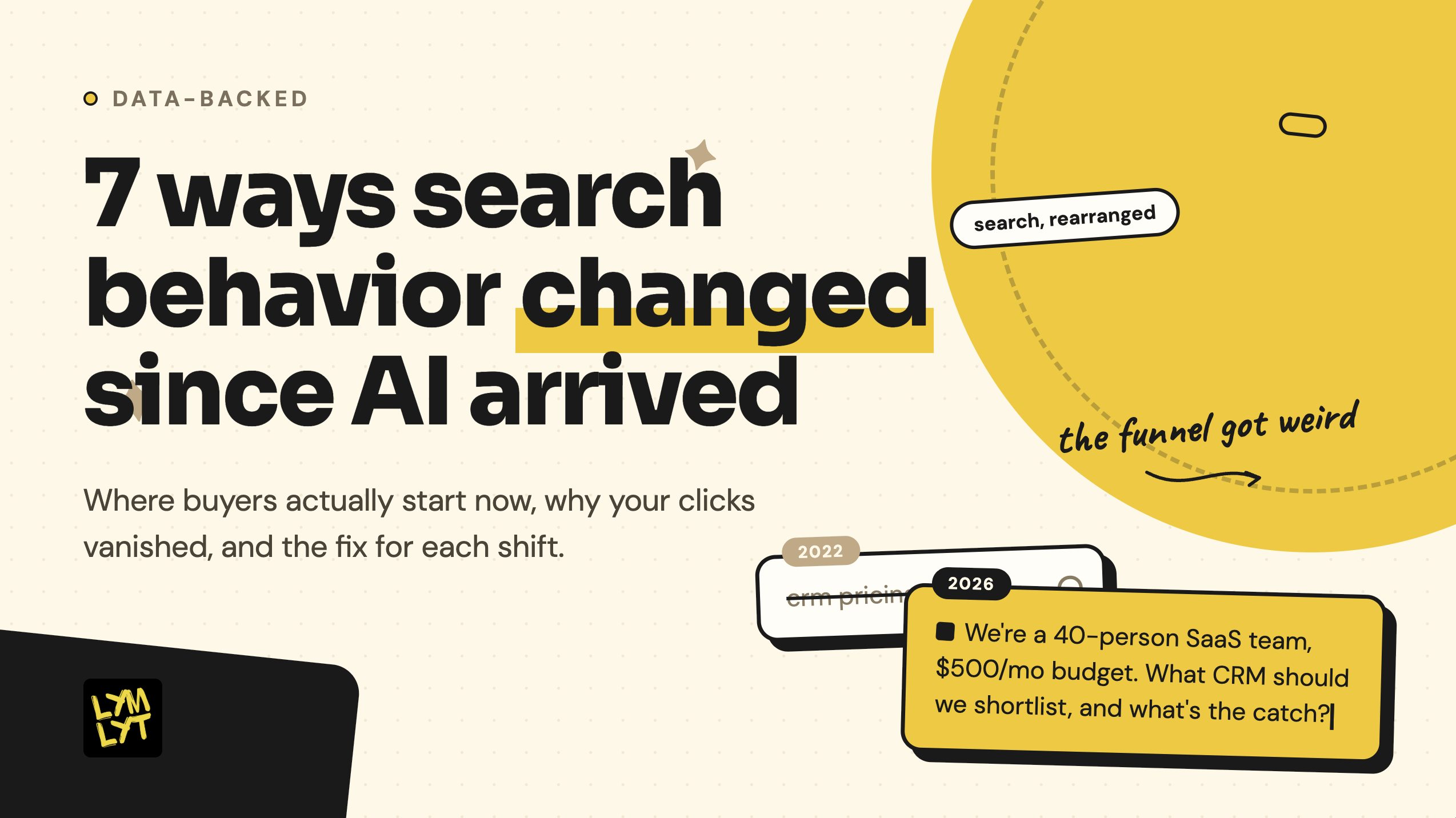
7 Ways Search Behavior has Changed since AI Arrived (and what to do about each one)
AI rearranged search. People still search plenty, and now they start in new places, ask longer questions, and trust different signals.
Somewhere between 2023 and now, the average buyer rewired how they find things. They started typing full questions into a chat box instead of three keywords into Google, and the entire discipline built around those three keywords started sweating.
If you run content or SEO for a B2B company, you have felt this. Traffic charts that used to climb now plateau. Rankings hold steady while clicks fall.
Below are 7 documented changes in how people search since AI arrived, each with the source behind it, a visual so you can see the shift instead of just reading about it, and a concrete adjustment. At the end, there’s a section on the conversation you’re dreading: explaining to leadership why your job still matters.
1: AI is now the starting point. Google is still the finish line.
A growing chunk of people no longer start at a search engine, even though they still end up at one. According to Eight Oh Two’s 2026 AI + Search Behavior Study, 37% of consumers now begin their search with AI tools instead of Google or Bing. And yet traditional search engines still command roughly 90% of global search traffic, as Ridge Marketing’s 2026 analysis points out.
Both numbers are true at the same time because search has split into two lanes. People use AI for exploratory research, comparisons, and “explain this to me” moments. They use traditional search for decision-making, navigation, and purchases.
The buyer who asks ChatGPT “what’s the best CRM for 40 person SaaS team” at 11am is the same buyer googling your brand name at 4pm to check you’re real.
explore · compare · learn
verify · navigate · buy
Sources: Eight Oh Two, 2026 AI + Search Behavior Study · Ridge Marketing, How People Search in 2026
The adjustment →
Treat “SEO” and “AI visibility” as one budget. They’re the same funnel now, entered from two doors. Your content needs to rank on Google and be understandable enough for an LLM to cite when someone asks the exploratory version of your keyword.
- Map your top 20 keywords to their conversational equivalents. “CRM software” becomes “what CRM should a small B2B team use and why.” Write for both.
- Audit whether AI assistants mention you at all. Our complete guide to AI visibility for B2B SaaS walks through exactly how to check.
- Keep investing in classic rankings. The finish line still runs through Google, and that’s where SEO content earns its keep.
2: Queries stopped being keywords. They became conversations.
For twenty years we optimized for people who typed like they were paying per word. Three to five terms, no grammar, no context: “crm pricing small business.” That era is fading fast.
Arc Intermedia’s 2026 case study found that queries on ChatGPT are often 20+ word prompts instead of the typical 3 to 5 word Google search, and users refine their requests across multiple turns instead of firing one query and scanning ten links.
This changes what “search intent” even means. A 4-word query forces you to guess intent. A 25-word prompt states it outright: budget, team size, constraints, deal-breakers, all in one message.
Buyers are handing over the exact context marketers used to pay analytics tools to infer. The question is whether your content is written to answer that level of specificity, or whether it’s still a 2,000-word essay that circles the point for six paragraphs.
Source: Arc Intermedia, Impact of AI Search on User Behavior & CTR in 2026
The adjustment →
Write for the paragraph-length question. That means content structured as direct answers: the recommendation first, the reasoning second, the caveats clearly labeled.
- Turn your FAQ section from an afterthought into a primary asset. Real questions, specific answers, no throat-clearing.
- Add “for whom” specificity everywhere. “Best for teams under 50,” “skip this if you need SOC 2,” and similar qualifiers are exactly what long conversational queries contain.
- Comparison content wins disproportionately here, because multi-turn AI conversations are essentially guided comparisons. That’s why we build dedicated competitor comparison pages for clients: they feed both Google’s “vs” searches and AI shortlists.
3: Zero-click became the default.
Pew Research Center tracked the real browsing behavior of 900 U.S. adults across nearly 69,000 Google searches. When an AI Overview appeared on the results page, users clicked a traditional result link on just 8% of visits. Without an AI Overview, that number was 15%. Nearly double.
Only 1% of users clicked a source cited inside the AI summary. And people were more likely to end their browsing session entirely after seeing an AI summary (26% of visits) than after a traditional results page (16%), per Search Engine Land’s breakdown of the Pew data. Separate large-scale research pointed the same direction: an Ahrefs study across 590 million searches observed roughly a 34.5% reduction in clicks when AI Overviews appeared, as summarized by Whole Whale.
The answer increasingly lives on the results page itself. Your content still gets read, but the reading happens inside Google’s summary while your analytics stay flat. The impression survives; the visit disappears.
Sources: Pew Research Center · Search Engine Land · Whole Whale on the Ahrefs study
The adjustment →
Accept that some queries will never send you a click again, and reallocate accordingly. The goal for informational queries shifts from “win the click” to “be the brand named in the answer.” The goal for commercial queries stays “win the click,” because those still convert.
- Segment your keyword list by click survival. Informational and definitional queries are AI-Overview food; bottom-funnel, transactional, and brand queries still deliver visits.
- Structure content so machines can lift it cleanly with your name attached: clear headings, direct answers in the first two sentences, entities spelled out. Google’s Knowledge Graph plays a bigger role here than most marketers realize; we broke down how to use the Knowledge Graph for SEO.
4: Google turned into the fact-checking layer.
AI made the buying journey longer and more deliberate. Research summarized by J. Arthur & Co. found consumers now take an average of 3.8 steps after interacting with AI, compared to 1.6 steps before. People ask AI to narrow their options, then head to search engines, websites, and marketplaces to verify the recommendations before committing.
Qualitative studies back this up: even experienced AI users keep traditional search in the loop throughout their research, often running AI and Google side by side to cross-check each other. Eight Oh Two’s study describes traditional search as having become the fact-checking and detail layer of the journey. Trust, meanwhile, remains the biggest thing holding people back from going all-in on AI answers, according to YouGov’s 2026 U.S. web search and AI report.
So the new journey works like a relay: AI hands the shortlist to Google, Google hands the verified pick to your website, and your website either closes or fumbles.
Sources: J. Arthur & Co., How AI Is Changing Consumer Search Behavior in 2026 · YouGov, U.S. Web Search and AI Report 2026 · Eight Oh Two
The adjustment →
Win the verification step. When a buyer googles you after an AI recommendation, what they find in those 90 seconds decides everything. That search needs to surface hard proof within seconds.
- Make customer proof impossible to miss. Real numbers, real names, real quotes. This is exactly the job case studies do, and why we treat them as sales assets first.
- Own your branded SERP: pricing page, comparison pages, reviews, and a case study should all appear when someone searches “[your brand] + anything.”
- Check what the verification layer currently says about you. Search your brand plus “reviews,” “pricing,” “alternatives.” If competitors own those results, that’s this quarter’s priority.
5: Brand trust now forms inside the AI answer.
In the old model, buyers formed first impressions on your website, which you controlled down to the pixel. In the new one, 47% of consumers say AI shapes which brands they trust, per Eight Oh Two’s 2026 study. The first impression increasingly happens inside a chat window, in a paragraph you never wrote, based on sources you may not know exist.
An AI-generated shortlist typically contains only a handful of brands. If you’re not in it, you never enter the consideration set at all. There’s no page two of a ChatGPT answer. You’re either named, or you’re invisible. This is the new definition of organic visibility, and it’s binary in a way rankings never were. Position 7 on Google still got scraps. Absence from an AI shortlist gets nothing.
Based on your requirements, three options stand out:
off the shortlist = out of the deal. that’s the whole game now.
Source: Eight Oh Two, 2026 AI + Search Behavior Study
The adjustment →
Treat AI answers as a channel you actively earn placement in, the way you once earned rankings. LLMs cite sources that are clear, consistent, and answer-ready, so the work is part content structure, part entity hygiene, part third-party presence.
- Get your positioning consistent everywhere AI models read: your site, directories, review platforms, LinkedIn. Contradictions between sources make models hedge or skip you.
- Publish content that answers the exact questions buyers ask AI, with your brand clearly attached as the source. This is the core of our AI visibility service, and it’s the fastest-growing thing clients ask us for.
- Earn mentions on the third-party pages AI trusts: comparison roundups, review sites, industry publications. Models weigh consensus across many sources far more than your own claims.
6: Traffic went down. Intent went up.
Now for the change that saves your quarterly review. Yes, AI search reduces organic traffic. But the visitors who do arrive from AI are dramatically more qualified. HubSpot reported 3x better conversion from AI-sourced leads versus other channels in 2025, and their State of AEO 2026 research found AI search was the number one predictor of purchase intent for CRM software buyers.
It makes sense once you think about the mechanics. A visitor from an AI answer has already been briefed. The AI explained the category, compared the options, and named you specifically for their situation. By the time they land on your site, the education phase is done. Their question has moved from “what is this” to “where do I sign up and what’s the catch.” Fewer visitors, further down the funnel, closer to money.
This reframes the traffic decline entirely. Losing 30% of your informational traffic while AI-sourced visitors convert at 3x is a trade you might have made on purpose if anyone had offered it.
The middle of the funnel moved inside the AI conversation. What’s left over converts better.
Source: HubSpot, AI Search Behavior & State of AEO 2026
The adjustment →
Rebuild your reporting around lead quality instead of session counts. And rebuild your site for visitors who arrive pre-educated.
- Tag and track AI-referred traffic separately (ChatGPT, Perplexity, Gemini, Copilot referrers). Compare its conversion rate to organic. That ratio is your new favorite slide.
- Shorten the path for warm visitors: pricing visible, demo bookable in two clicks, proof above the fold. Pre-educated buyers bounce off long-winded landing pages that re-explain what they already know.
- Feed the top of the funnel that AI now owns. The blog posts AI reads to form its answers still have to exist, and someone still has to write them well. That’s the quiet irony of this whole shift: AI answers are only as good as the human-made content underneath. (We wrote about the honest way to use AI in that process in can I use Claude for SEO blogs without getting penalized?)
Everyone sees the shift. Almost nobody measures it.
According to a Goodfirms 2026 survey cited by J. Arthur & Co., only 14% of marketers currently track their AI visibility, even though nearly all of them acknowledge the shift is happening. Meanwhile, Google Search Console has never once told you what ChatGPT says about your company. The tooling exists; almost nobody has adopted it yet.
That 86% gap between awareness and action is the closest thing to an arbitrage opportunity this industry has seen since early SEO. The brands that start tracking, testing, and optimizing for AI answers now will compound an advantage while everyone else is still forwarding each other think-pieces about it.
Source: Goodfirms 2026 survey, via J. Arthur & Co.
The adjustment →
Start measuring this month, even crudely.
- Run a monthly “AI audit”: ask ChatGPT, Claude, Gemini, and Perplexity the 10 questions your buyers ask. Log whether you’re mentioned, how you’re described, and who else appears. That’s your baseline.
- Graduate to proper tooling when it hurts. We compared the 10 best AI visibility tracking tools so you don’t have to demo all of them.
- Report it alongside rankings. One slide: “Google position” next to “AI citation rate.” Your leadership will understand the second column faster than you expect.
How to convince your boss your job still matters
Every marketer reading this has had, or will soon have, a version of the same conversation. It starts with “since AI can write content now” and ends somewhere uncomfortable. Here’s how to run that conversation with data instead of defensiveness, matched to each change above.
The core reframe
Skip the argument that everything is fine. AI obviously changed things, and pretending otherwise costs you credibility. Argue this instead: AI moved the battlefield, and the war carries on. Buyers still have to find you, trust you, and choose you. Every one of those steps now runs through content someone has to strategize, create, and maintain. The channel changed while the job stayed the same.
Seven talking points, one per change
When they say: “people just ask ChatGPT now, why do we need SEO?” “37% start with AI, yet 90% of traffic still flows through search engines, and buyers use Google to verify what AI tells them. We need both lanes covered. Cutting one is like closing the store’s front door because a side entrance opened.”
When they say: “can’t AI just write all this content?” “AI answers are assembled from content that already exists. If we stop feeding the machine well-researched, original material, the machine describes us using whatever’s left: outdated pages, competitor comparisons, Reddit threads. Someone has to author the version of us we want quoted.”
When they say: “traffic is down, so content isn’t working.” “Traffic is down industry-wide because AI Overviews cut clicks nearly in half. Pew measured it: 8% click-through with an AI summary versus 15% without. That’s a behavior shift happening to every website at once. Meanwhile HubSpot found AI-sourced leads convert at 3x. Fewer sessions, better pipeline. Judge me on pipeline.”
When they say: “so what are you optimizing for, if not clicks?” “Citations, mentions, and shortlist presence. 47% of buyers say AI shapes which brands they trust, and AI shortlists only include a few names. My job now includes making sure we’re one of them. That work looks like content strategy, entity consistency, and third-party proof. It doesn’t happen by itself.”
When they say: “how do we know any of this AI stuff is working?” “Only 14% of marketers track AI visibility right now. I want us in that 14%. Give me a quarter: I’ll baseline our AI citation rate, track it monthly next to rankings, and show you movement. If nothing moves, you’ll have the data to reallocate. Either way, we’ll know instead of guessing.”
When they say: “marketing feels less important now.” “It’s the opposite. When buyers arrive pre-educated by AI, the first human impression we control is smaller and higher-stakes: one landing page, one case study, one pricing page. Getting those exactly right is a marketing problem. And when AI describes our category, whose framing does it use? Whoever published the best content. I’d like that to be us.”
When they say: “should we just cut the content budget?” “The 86% of companies not tracking AI visibility yet? That’s our window. Cutting now means re-entering later at a premium, after competitors’ content has become the source material AI cites by default. This is the cheapest this advantage will ever be.”
Bring receipts
One page. Three columns: what changed (with the source linked), what we’re doing about it, what we’ll measure. What leadership really wants is for you to be the person in the room who understands this shift best. This article’s sources section is your bibliography; steal it.
And if the honest answer is “we don’t have the bandwidth to do all this on top of the day job,” treat that as a resourcing conversation rather than a confession. It’s also, full disclosure, the math we help teams run every week.
The through-line
Look at the seven changes together and a pattern shows up. Search got more honest. Keyword-stuffed filler is dying because machines summarize it into oblivion. What survives is content with an actual point of view, actual data, and an actual answer, published by brands consistent enough for a language model to trust. The marketers who lose this decade are the ones who keep producing content for an internet that no longer reads that way. The ones who win will be the ones who noticed, adjusted, and could prove it. You just read the noticing part. The adjusting starts whenever you do.
We’ve watched this play out in client work already: teams that invested in structured, citation-ready content are seeing it pay off in both lanes. Skrapp 4x’d organic traffic in 6 months and Recurly saw a 5.8x lift in conversion with exactly this kind of work. The playbook above is a regular Tuesday for us.
Related reading from our notebook: how AI changed marketing jobs, titles, and salaries in 2026, and the complete AI visibility guide for B2B SaaS.

Rashmita is content marketer with 8 years of experience building and growing SaaS brands. Now she tests various AI tools for marketers and shares her feedback on this blog, LinkedIn, Instagram, and YouTube.