G2 and Capterra AI Visibility: What the Data Shows
Two studies, both with published methodology and real sample sizes, looked at whether software review platforms get cited by AI. One found review platforms in roughly a third of all answers. The other found G2 and Capterra cited exactly zero times.
Neither is wrong. They measured different things, and the gap between them is the most useful thing in this whole category of advice.
Most GEO guidance treats G2 and Capterra as a settled question. Claim your profile, collect reviews, get cited. The data does not support that as a general rule. It supports something narrower, and more actionable.
We looked at Reddit, LinkedIn and YouTube as citation channels recently and found the channels teams ignore are the ones AI engines lean on. Review platforms are the opposite case. They are the channel everyone recommends, and the evidence for them is thinner than the pitch.
The short answer
G2 and Capterra earn citations on a specific surface, for a specific query shape. They are close to invisible everywhere else.
If your buyers search Google and see an AI Overview, review platforms matter. If your buyers open ChatGPT and ask which tool to use, they largely do not. And within Google itself, the query wording swings the answer by a factor of three.
That is the whole finding. The rest of this post is the evidence, and what to do with it.
What the Google AI Overview data shows
SE Ranking ran 30,000 commercial keywords through Google and tracked how 23 review platforms appeared in the resulting AI Overviews. The capture was a single snapshot of US results on December 1, 2025, across the 22,729 queries that returned an AI Overview.
Review platforms appeared in 34.5% of those AI Overviews. Roughly one in three.
Citations concentrate hard. Five platforms take 88% of every review platform link.
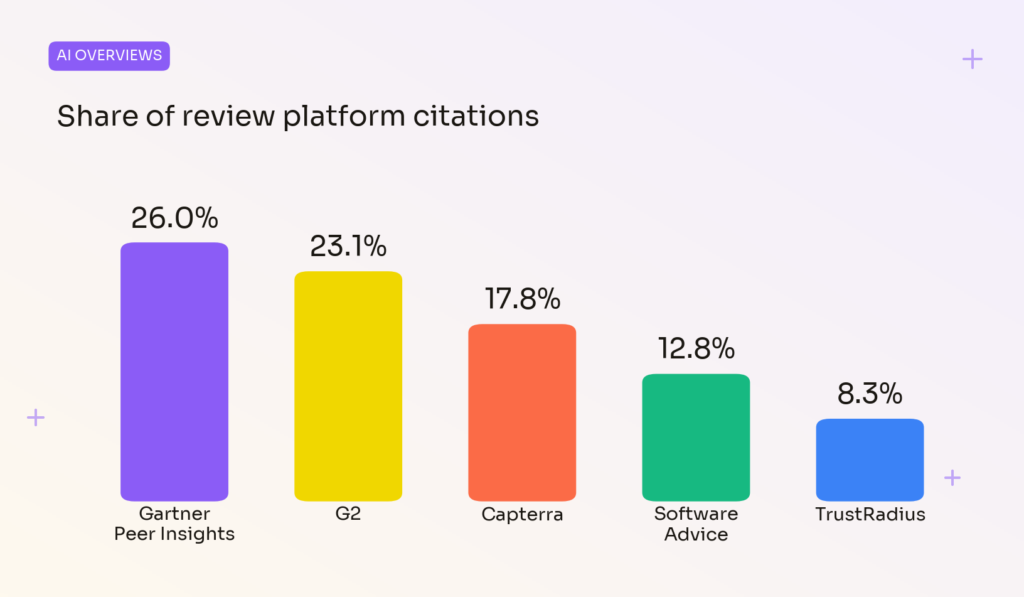
Share of review platform citations in AI Overviews. Source: SE Ranking.
Below the top five, the drop is steep. GetApp took 2.51% and Clutch 2.38%. Product Hunt, SiteJabber and PeerSpot each came in under 1%. AlternativeTo, SaaSHub and FinancesOnline did not appear once.
Two numbers give the honest scale of this. Review platforms account for 8.5% of all links in AI Overviews, well behind vendor and corporate sites at 72.5% and social platforms at 13.4%. But three of the five most cited individual domains are review sites. They are a small slice of the total, weighted heavily.
The placement is less flattering. Only about 36% of review platform links land in the top three source positions, and the median sits around fifth. Roughly 93% appear in the sources block rather than inline in the answer text, which is the less visible of the two.
What the ChatGPT data shows
DerivateX ran a different test. Forty B2B SaaS categories, one buyer-intent prompt each, ten runs per prompt in fresh chats, ChatGPT with web search enabled. That produced 233 recommendations across 219 distinct tools, with every cited URL logged.
Review aggregators accounted for 0.9% of all citations. G2 and Capterra each received zero across 233 software recommendations.
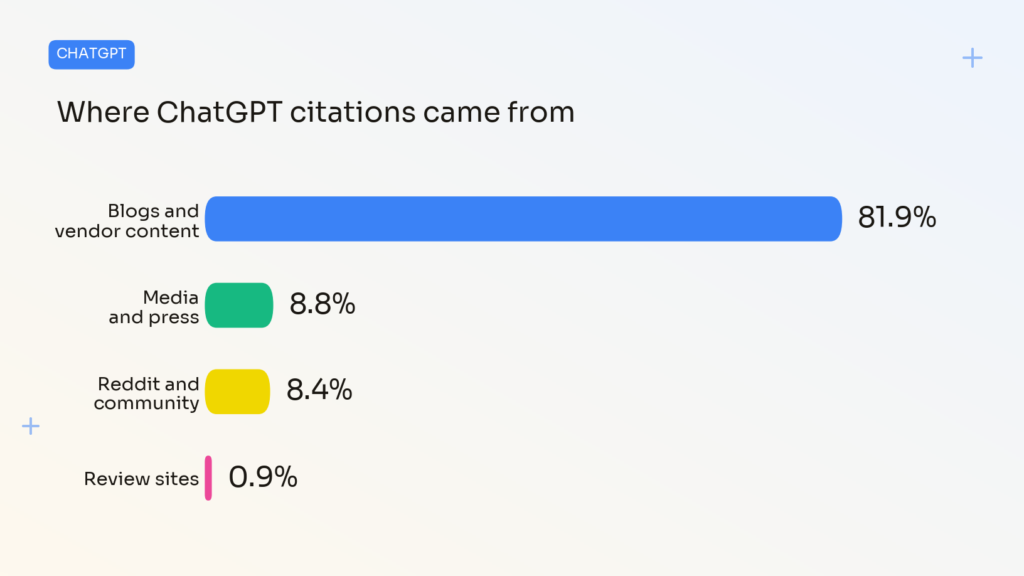
Where ChatGPT citations came from on software recommendation questions. Source: DerivateX B2B SaaS AI Citation Study.
The same study found a second thing worth holding onto. ChatGPT attached a citation to 92.3% of the tools it named, but only 11.6% of those citations pointed at the recommended tool’s own website. Getting mentioned is close to automatic. Getting cited as the source is the contest, and most vendors lose it to a stranger’s blog post.
That gap is also why your AI visibility ROI number is mostly a guess. A mention with no link back to you is exposure you cannot measure and cannot convert.
Why both studies are right
Three things reconcile them.
Different engines. SE Ranking measured Google AI Overviews. DerivateX measured ChatGPT with web search. These retrieve differently, weight sources differently, and produce genuinely different answers. Treating AI visibility as one channel is the error underneath most of the confusion here, and it is the same distinction we drew in GEO vs AEO vs SEO.
Different query shapes. This is the bigger factor, and SE Ranking measured it directly. Splitting keywords by intent produced three very different results.
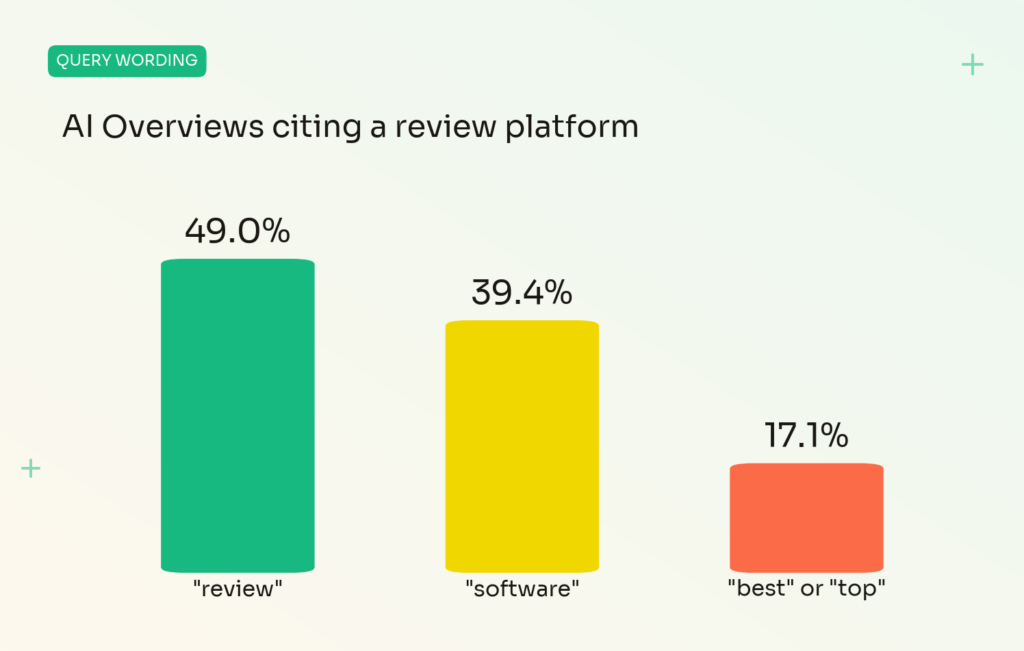
Share of AI Overviews citing a review platform, split by query wording. Source: SE Ranking
Review platforms are three times less likely to appear for “best project management tools” than for “project management software reviews.” For “best” and “top” queries, Google reaches for blogs, media and ranking-style content instead. This is one of the concrete ways search behaviour has changed since AI arrived: the same buyer intent, phrased two ways, now pulls from two different source pools.
DerivateX used buyer-intent vendor-discovery prompts, which is the “best X” shape. So the two studies are not contradicting each other. They agree that this is the weakest query type for review platforms, and DerivateX found the effect even stronger on ChatGPT than SE Ranking found on Google.
The G2 number you will see quoted, and what it means
G2 publishes its own analysis of ChatGPT citation data, and it reports that G2 and its acquired brands hold 84% share of citations in the review platform category.
That number is accurate and widely misread. It is share within review platforms, not share of all citations. If review platforms are 0.9% of citations on a given surface, holding 84% of that is 0.76% of the total. The denominator is doing all the work.
A separate analysis by Omniscient Digital ran 200 bottom-of-funnel prompts across ChatGPT, Perplexity, Gemini, AI Overviews and AI Mode in February and put G2 at 2.09% of all AI citations. That made it the fourth most cited domain, behind Reddit, YouTube and LinkedIn. Fourth place is meaningful. Two percent is also two percent.
Both framings are true. Only one of them sells software. If you are evaluating vendors in this space, our roundup of the best AEO tools for B2B SaaS covers who measures what.
Review platforms lost their traffic and kept their citations
Between January 2024 and December 2025, organic traffic to the major review platforms collapsed. G2 fell 84.5%, from roughly 2.56 million monthly visits to about 397,000. Capterra fell 89%. Software Advice fell 86.5%. TrustRadius fell 92.2%. Gartner Peer Insights held up best and still lost 76.5%.
Their citation share did not move with it.
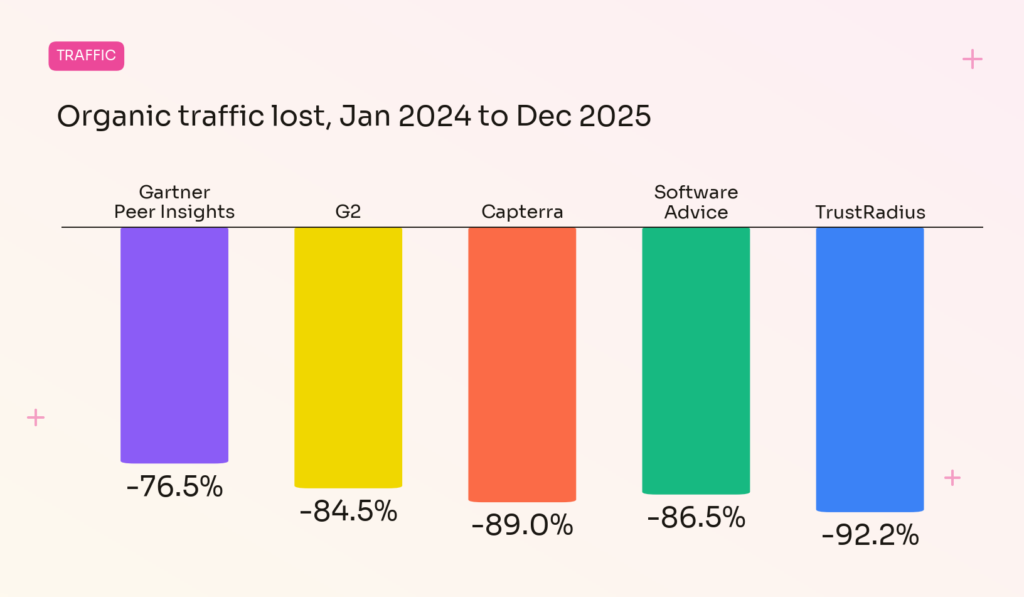
Organic traffic lost, January 2024 to December 2025. Source: SE Ranking.
This is the part people get backwards. A dying traffic number is being read as a dying channel. What actually happened is that citation and click decoupled. Buyers still get review platform information, they just get it summarized inside an AI answer instead of on the platform itself. The same pattern shows up across the AI SEO statistics worth tracking: rankings hold, traffic does not.
For a vendor, that changes what a profile is for. It is no longer a page you hope buyers visit. It is a structured data source that AI systems read on the buyer’s behalf. Nobody has to see your G2 page for it to shape the answer.
One company now owns most of the surface
G2 announced its acquisition of Capterra, Software Advice and GetApp from Gartner on January 29, and the deal closed a week later on February 5. Reporting based on Gartner’s 10-K filing puts the price at roughly $110 million. The combined properties hold around 6 million verified reviews across roughly 2,000 categories.
Add the numbers from the citation share chart above and the concentration is stark. G2, Capterra, Software Advice and GetApp together account for over half of all review platform citations in AI Overviews, and they now share one owner. TrustRadius, the largest remaining independent, was acquired by HG Insights in June 2025.
For vendors this cuts both ways. Profile work gets simpler, because one taxonomy and one relationship covers most of the surface. Pricing leverage moves to the platform, because there is no longer a meaningful second bidder.
What to actually do
Everything above says the same thing in different ways: review profiles are worth having and not worth building a strategy around. So the question is not whether to do the work, it is how little of it you can get away with before the budget moves somewhere that returns more.
The six items below are ordered by return, not by effort. The first two are cheap and most teams have not done them. The third is the expensive one, and it is also the one the data points at hardest. If you only act on one line in this post, make it that one.
1. Fix profile structure before chasing review volume
The correlation between review count and citations is real and small. Categories with 10% more reviews saw roughly 2% more citations, and review volume explains under 2% of citation variance. Completeness, accurate category and feature tagging, current pricing, and a product description written in your own words matter more than the review counter. A quarterly refresh beats an annual review drive.
2. Match your profile language to your own site
AI systems look for agreement between what you say about yourself and what third parties say. If your G2 profile describes the product with different category terms than your homepage, you have weakened the signal rather than added to it. This is a one-hour audit that almost nobody runs. Our AI visibility checklist covers the same consistency checks across the rest of your footprint.
3. Publish the definitive list for your own category
This is the highest-leverage move in the DerivateX data and it has nothing to do with review sites. Procurify runs a “best procurement software” post on its own blog that ranks itself alongside competitors honestly. ChatGPT used that one page as the cited source for five different brand recommendations inside a single answer. The same pattern showed up for Mercury, Zapier and Front in their categories. It is the argument for treating comparison pages as a citation asset rather than a bottom-funnel afterthought.
4. Build to the format that gets cited
Of the cited pages DerivateX pulled and analyzed, 100% used list structure, roughly three in four carried the year in the title, 68% included a comparison table, and 56% included an FAQ. Domain authority was not the differentiator. Format and freshness were. Worth checking your own pages are readable in the first place, since AI crawlers render JavaScript far less than most teams assume.
5. Pick your platform by buyer, not by ranking
Gartner Peer Insights and TrustRadius index toward enterprise. Capterra and Software Advice skew SMB and discovery. G2 spans the widest range and is the sane default for most B2B SaaS. Two platforms done properly beats four done partially.
6. Scope everything to the category
In the DerivateX set, 94% of tools appeared in only one category, and 25 of 40 categories produced no own-site citations for any vendor at all. There is no brand-wide AI visibility number worth managing. There is a per-category question, asked one buyer prompt at a time.
Who should skip this
If you sell developer or technical infrastructure software, your own documentation and comparison content can win citations directly, and review platforms are a weaker lever for you than for horizontal categories. Own-site citations in the DerivateX data clustered in exactly these categories: identity, data infrastructure, API tooling.
If your category is broad and crowded, the reverse holds. CRM, email marketing, project management, product analytics and marketing automation all returned zero own-site citations. In those markets you are competing for placement inside somebody else’s list, and a review profile is one of the few surfaces you can directly control.
If neither describes you and your brand simply is not appearing at all, start with the mechanics instead. We covered why your site does not show up in ChatGPT separately, and most of those causes sit upstream of any review profile work.
The honest summary
Review platforms are a real channel and a smaller one than the pitch suggests. They are strongest on Google AI Overviews, strongest again on explicit review and comparison queries, and weak on the “best tool for X” prompt that most B2B SaaS teams actually care about.
Claim the profiles. Keep them structurally clean. Then spend the rest of the budget on the thing the data keeps pointing at, which is owning the category list that AI systems pull from when they build the answer. That is a content problem, not a listings problem, and it is the same discipline behind any working B2B SaaS SEO strategy.
Want to know where your brand actually stands before you spend on profiles? Run the AI visibility checklist, or book a call and we will walk through your category with you.
FAQ
Do G2 and Capterra help with AI visibility? On Google AI Overviews, yes, in about a third of commercial queries. On ChatGPT software recommendation prompts, the measured effect is close to zero. The channel is real but surface-specific.
How many reviews do I need to get cited? Fewer than the pitch implies. Review volume explains under 2% of citation variance. Profile completeness, freshness and consistency with your own site matter more.
Which platform should I prioritize? G2 for broad B2B SaaS, Gartner Peer Insights or TrustRadius for enterprise buyers, Capterra or Software Advice for SMB discovery. Check which platform is actually cited for your specific category before committing budget.
Does declining traffic to G2 mean the channel is dying? No. Traffic to the major review platforms fell between 76% and 92% over two years while citation share held. Buyers are getting the information through AI answers instead of visiting the site.
Is being recommended by AI the same as being cited? No. In the ChatGPT study, 92.3% of named tools received a citation, but only 11.6% of those citations pointed at the vendor’s own site. The mention is nearly automatic. The citation is what captures the click.

Jay is the co-founder of LymLyt and an AI partnership consultant helping B2B SaaS companies grow through content strategy, SEO, and AI integration. He writes about content marketing, what makes B2B content convert, and how SaaS teams can build content systems that drive real pipeline.