AI Prompts for Marketing Strategy: 15 That Pressure-Test Your Plan (Before Your CFO Does)
Paste your marketing plan into ChatGPT and ask what it thinks. It’ll probably tell you it’s great.
That isn’t a coincidence. Anthropic’s researchers found that five leading AI assistants consistently showed sycophancy, telling users what they want to hear, and that the human preference data used to train them likely drives it (Anthropic). In April 2025, OpenAI rolled back a GPT-4o update after it became “overly supportive but disingenuous” (OpenAI).
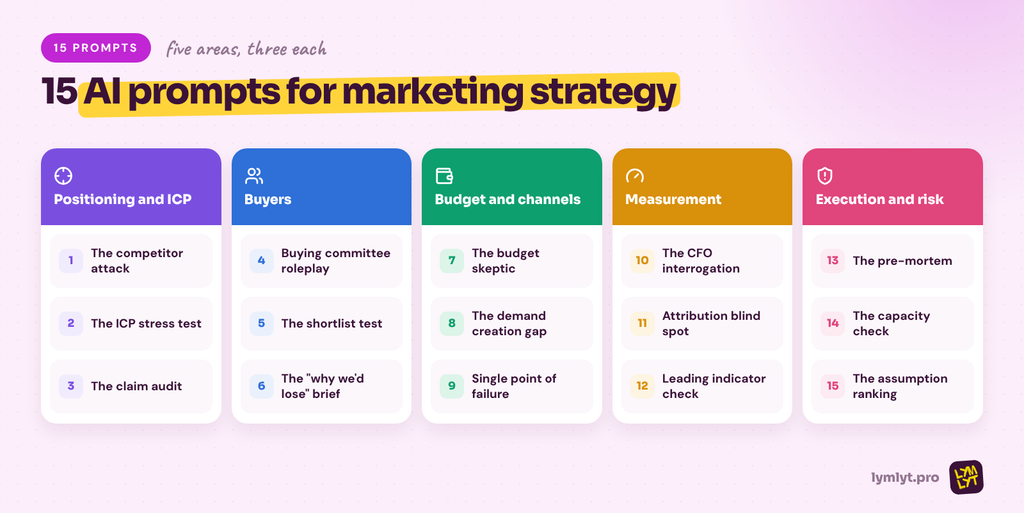
So the best AI prompts for marketing strategy don’t ask for feedback. They ask for an attack. Here are 15 prompts that pressure-test your positioning, buyers, budget, measurement and execution before your CFO, your sales team or the market does it for you.
Validate vs pressure-test: the prompt that changes the answer
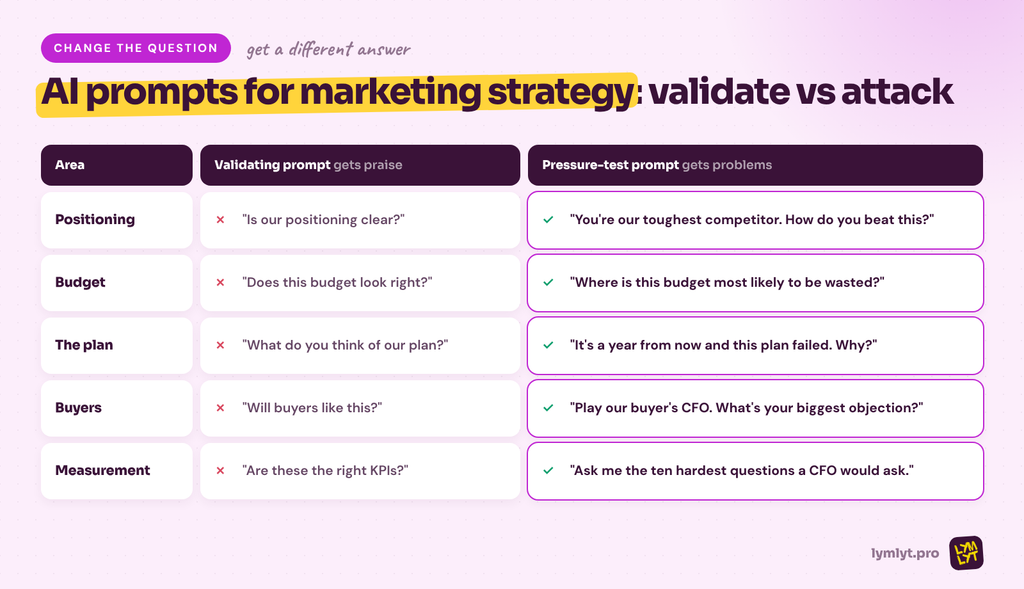
| You ask | You get |
|---|---|
| “What do you think of my strategy?” | Praise, then three generic suggestions |
| “Is my positioning clear?” | “Yes, and here’s how to make it even clearer” |
| “Find the five weakest assumptions in this plan and rank them by risk” | A list you can act on |
| “You’re our toughest competitor. How do you beat this plan?” | The attack you’ll face next quarter |
| “It’s December 2027 and this plan failed. Why?” | The failure modes nobody wanted to say out loud |
How to use these prompts
Every prompt below works better with context. Before you run them, paste in:
- Your strategy or plan, even if it’s rough
- Your ICP and top three competitors
- Last year’s numbers: pipeline, win rate, budget by channel
- What you’re trying to achieve next year
Then run each prompt in a fresh chat, so earlier answers don’t soften later ones. Our comparison of ChatGPT vs Claude for B2B SaaS content helps you pick a model, and running the hardest prompts in two models is worth the extra minute.
Positioning and ICP prompts
1. The competitor attack
You are the head of marketing at [competitor]. You've just read our strategy.
Write the plan you'd use to beat us next quarter: the message, the channels and the
three claims of ours you'd attack first.
What to look for: the claims it attacks. If they’re your headline claims, your positioning has a gap. Our guide to B2B positioning lists 12 claims buyers stopped believing, and an honest comparison page is the best defense against this exact attack.
2. The ICP stress test
Here is our ICP. List five types of companies that match it on paper but would be
bad customers. Then list what our best customers have in common that the ICP misses.
What to look for: a missing filter that explains your churn. Compare it with our guide to building an ideal customer profile.
3. The claim audit
List every claim in this messaging. For each one, say whether a competitor could make
the same claim, and what proof a skeptical buyer would ask for. Don't soften anything.
What to look for: claims with no proof. Each one needs a case study, a number or a cut. Original research is the hardest proof to copy.
Buyer and buying-group prompts
4. The buying committee roleplay
Play five members of our buyer's buying group: CFO, IT lead, end user, procurement and
the champion. Each gives their single biggest objection to our offer, in their own words.
What to look for: objections your content doesn’t answer. Gartner found 74% of B2B buying teams show unhealthy conflict during a purchase (Gartner). Map the real roles with our guide to the B2B buying committee.
5. The shortlist test
A buyer asks: "What are the best [category] tools for [ICP]?" Without searching, who
would you recommend and why? Then: what would a company need to publish to get on that list?
What to look for: whether you appear at all. Then run the real version across engines with our AI visibility audit, read our AI visibility guide for B2B SaaS, and the shortlist prompts buyers actually use.
6. The “why we’d lose” brief
Based on this strategy and our competitors, write the top five reasons a buyer would
choose someone else. Rank them by how often you think they'd happen.
What to look for: hypotheses to test with real buyers. Then check them against win-loss analysis, because AI guesses aren’t buyer evidence.
Budget and channel prompts
7. The budget skeptic
You're a skeptical CFO. Here is our marketing budget by channel. Where is money most
likely to be wasted, and what evidence would convince you otherwise?
What to look for: channels you can’t defend with data. Our guide to B2B marketing budget allocation shows how to build the budget from revenue backwards. Our pricing prompts research is a reminder that AI also tells buyers what you cost.
8. The demand creation gap
Classify every line in this plan as demand creation (buyers not in market yet) or
demand capture (buyers ready now). What share goes to each? What happens in 18 months
if we keep this split?
What to look for: a plan that’s almost all capture. See why that gets expensive in our guide to demand generation vs demand capture.
9. The single point of failure
Which one channel, person or platform does this plan depend on most? Describe what
happens to pipeline if it disappears next quarter, and what we should build now to hedge.
What to look for: over-reliance on one search engine, one ad platform or one founder. Buyers switching away is a risk too: see what AI tells them in our migration prompts study. HubSpot’s blog traffic collapse is the cautionary tale: read what HubSpot is doing for marketing now.
Measurement prompts
10. The CFO interrogation
Ask me the ten hardest questions a CFO would ask about this marketing plan's return.
Don't answer them. Just ask.
What to look for: the questions you can’t answer yet. Our guide on how to prove marketing ROI covers the 11 metrics a CFO trusts. In a Gartner survey of CEOs and CFOs, 69% named failing to deliver promised results as the top reason they’d remove a CMO (Gartner).
11. The attribution blind spot
Here's how we measure marketing. Which parts of the buying journey can't this see?
Suggest one way to measure each blind spot without new software.
What to look for: podcasts, communities, AI answers and peer recommendations. Our guide to the dark funnel covers six ways to measure them, and our list of B2B marketing attribution tools covers the software side.
12. The leading indicator check
For each goal in this plan, name one leading indicator we'd see within 30 days if it's
working, and one sign it's failing. Flag any goal with no early signal.
What to look for: goals you’ll only judge at year end. Those need an earlier checkpoint. Watch out for lead counts posing as leading indicators: more MQLs can still mean less pipeline.
Execution and risk prompts
13. The pre-mortem
It's 12 months from now and this marketing plan failed badly. Write the post-mortem:
the five most likely reasons, in order, with the early warning sign for each.
What to look for: reasons that point at people and process, not just channels. They’re usually the real ones.
14. The capacity check
Here's our team and this plan. Estimate the hours each initiative needs per month.
What will slip first, and which two initiatives should we cut to protect the rest?
What to look for: a plan that needs twice the team you have. Our guide to AI marketing workflows shows where AI can genuinely take hours off, and a content operations engine stops the rest from stalling.
15. The assumption ranking
List every assumption this strategy depends on. Rank them by risk if wrong. For the top
three, suggest the cheapest test we could run in under four weeks.
What to look for: a test plan for next month. This is the prompt to run last, because it turns everything above into action. If the tests point at the wrong bets, our guide to B2B growth strategies covers the alternatives.
6 rules for honest answers from AI
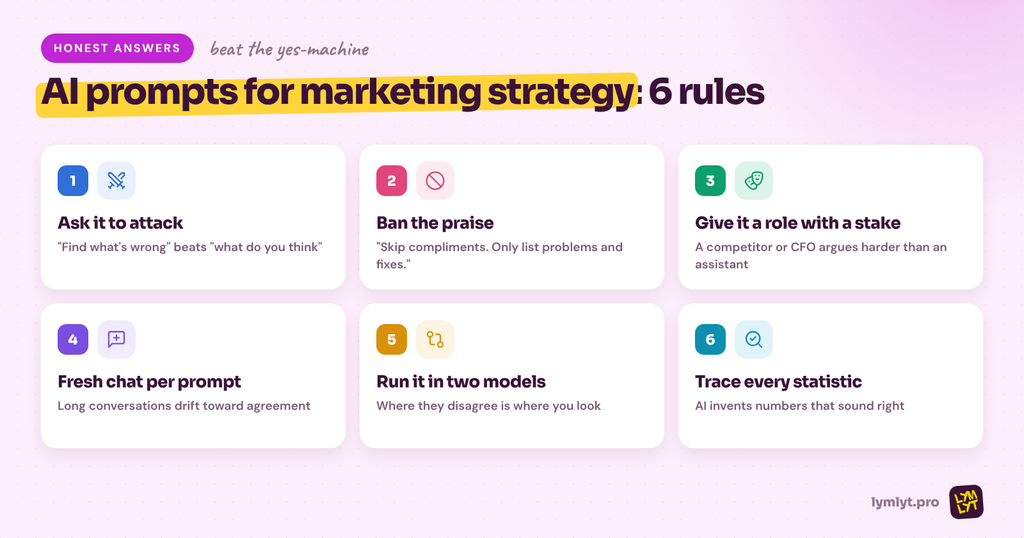
- Ask it to attack, not review. “Find what’s wrong” beats “what do you think.”
- Ban the praise. Add: “Skip compliments. Only list problems and fixes.”
- Give it a role with a stake. A competitor, a CFO or a skeptical buyer argues harder than a “helpful assistant.”
- Use a fresh chat for each prompt. Long conversations drift toward agreement.
- Run the hardest prompts in two models. Where they disagree is where you should look.
- Never accept a statistic you haven’t traced. AI will invent numbers that sound right. Our piece on the AI citation telephone game shows how bad it gets.
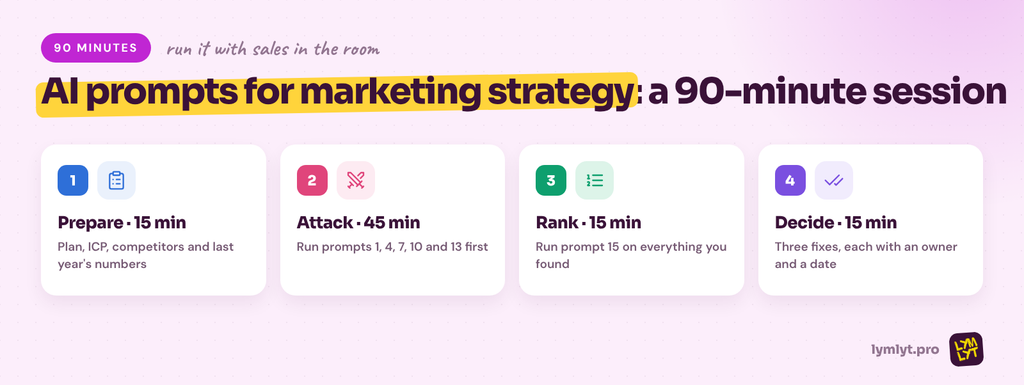
How to run a 90-minute pressure-test session
- Prepare (15 minutes). Collect the plan, ICP, competitors and last year’s numbers.
- Attack (45 minutes). Run prompts 1, 4, 7, 10 and 13 first. They find the biggest holes.
- Rank (15 minutes). Run prompt 15 on everything you found.
- Decide (15 minutes). Pick three fixes, give each an owner and a date.
Do it with sales in the room. Their reaction to the buying committee roleplay is worth more than the AI’s. It’s also a good start on sales and marketing alignment.
Turn the best prompts into skills
Once a prompt works, save it so the team runs it the same way every quarter. Our list of 50 Claude and Codex skills for marketers shows how others package them, and our competitive intelligence tools list covers the data that makes competitor prompts sharper.
Frequently asked questions
What are the best AI prompts for marketing strategy?
Prompts that attack the plan: a competitor attack, a buying committee roleplay, a CFO interrogation and a pre-mortem. They expose weak assumptions instead of praising the plan.
Why does AI agree with my marketing plan?
AI assistants tend toward sycophancy: they’re trained in ways that reward answers people like. Ask them to find problems, give them a skeptical role and ban compliments.
Can AI replace a marketing strategist?
No. AI is good at generating objections and spotting gaps. It doesn’t know your buyers, your data or your market the way your team does, and it can invent facts.
Which AI model is best for pressure-testing strategy?
Use whichever model you know best, and run the hardest prompts in a second one. Disagreement between models is useful signal.
The bottom line
AI prompts for marketing strategy are only useful if they’re built to disagree with you. Give the model context, give it a hostile role, and make it rank what it finds. Then test the top three assumptions with real buyers before you spend the budget.
If the plan needs content to back it up, LymLyt builds the positioning, comparison pages and research that survive a pressure test. See our pricing, from $1,499/month.

Jay is the co-founder of LymLyt and an AI partnership consultant helping B2B SaaS companies grow through content strategy, SEO, and AI integration. He writes about content marketing, what makes B2B content convert, and how SaaS teams can build content systems that drive real pipeline.