The 10 Best Competitive Intelligence Tools for Product Marketers in 2026
Your competitor changed its pricing page on Tuesday. Your sales team found out on Friday, from a prospect, on a call you lost. That gap is what competitive intelligence tools exist to close. They watch competitors so you do not have to, and they get what matters to the people who need it before the next deal, not after.
The category has grown up fast. Gartner published its first Magic Quadrant for Competitive and Market Intelligence in April 2026 (AlphaSense), a sign that buyers now treat it as its own software market. But “competitive intelligence” covers very different jobs. A tool that builds battlecards for sales cannot tell you why you lost a deal, and a traffic tool cannot tell you what a competitor announced last week.
So this list is sorted by the question each tool answers, not by brand size. Start with the question your team cannot answer today. If your competitors keep showing up in AI answers ahead of you, our shortlist prompts research is a good companion read.
What product marketers need from competitive intelligence
Product marketers own competitive intelligence in most B2B SaaS companies, and they use it for three things. Sales enablement: battlecards, objection handling and talk tracks. Positioning: knowing where you are genuinely different. And content: comparison pages, alternatives pages and launch messaging that answer the questions buyers are already asking.
Each of those needs different inputs. Battlecards need fresh, verified detail about competitor products and pricing. Positioning needs to know what buyers actually think, which usually comes from win-loss conversations. Content needs to know how competitors show up in search and AI answers. As we found in our vs keywords research, the pages that rank when buyers compare you are often not yours.
No single tool covers all of it. Most teams combine one platform with one or two specialist tools.
What to look for in competitive intelligence tools
Signal over noise. Every tool can collect thousands of updates. The good ones filter out the noise and flag what changed and why it matters.
Delivery where sales works. Intelligence that lives in a separate portal goes unread. Look for Slack, CRM and browser integrations.
Source of truth. Battlecards go stale fast. You need one place where the current answer lives, with an owner and a last-updated date.
Buyer evidence. Competitor websites tell you what they claim. Win-loss interviews and call recordings tell you what buyers believe.
Price that matches your program. Some competitive intelligence tools cost less than $100 a month. Others run to tens of thousands a year. Match spend to how many people will use the output.
The 10 competitive intelligence tools at a glance
| Tool | Question it answers | Best for | Price |
|---|---|---|---|
| Klue | What are competitors shipping and saying? | Battlecards plus win-loss in one platform | Custom; Vendr median $30,000/yr |
| Crayon | What are competitors shipping and saying? | Tracking and enablement for growing CI programs | Custom; Vendr median $30,000/yr |
| Kompyte | What are competitors shipping and saying? | Automated tracking on a small budget | From $22.50/mo per competitor |
| AlphaSense | Where is the market going? | Deep market research with expert calls and filings | Custom |
| Contify | Where is the market going? | News and market monitoring across many entities | Custom, 7-day trial |
| Similarweb | How are competitors growing? | Competitor traffic and channel mix | From $125/mo |
| SpyFu | How are competitors growing? | Competitor keywords and paid search history | From $59/mo |
| Visualping | What changed on their site? | Pricing and product page change alerts | Free plan; paid from $10/mo |
| Gong | Why do we win and lose? | Competitor mentions in your own sales calls | Custom |
| Clozd | Why do we win and lose? | Win-loss interviews with real buyers | Custom |
Prices checked in October 2026. Vendr figures are median annual contracts reported by Vendr. Confirm before you buy.
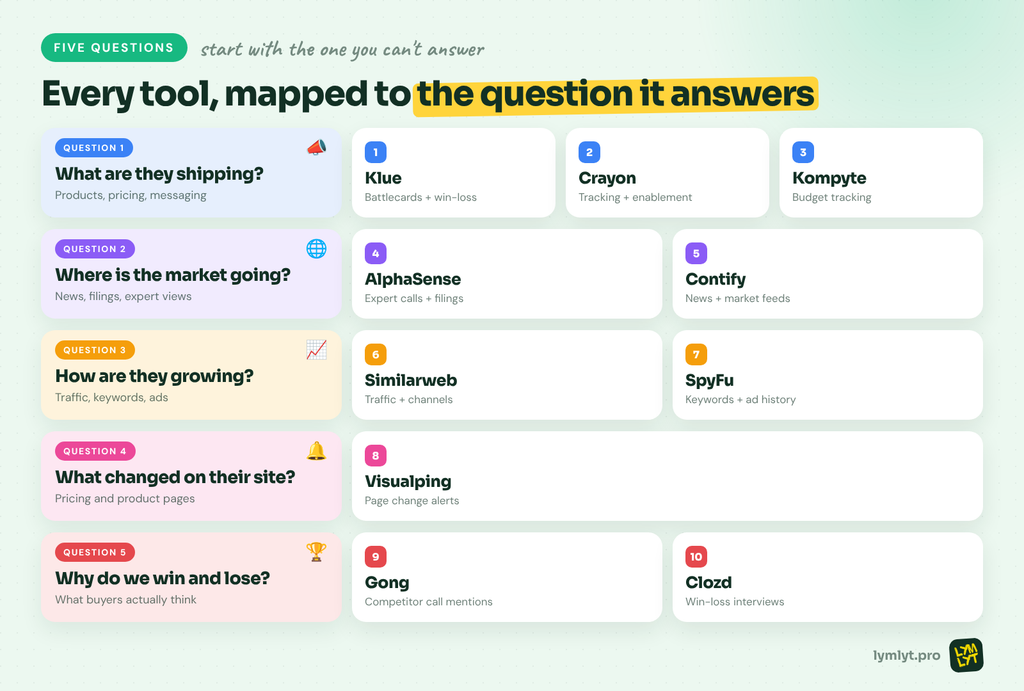
Question 1: What are competitors shipping and saying?
These are the core competitive intelligence platforms. They collect competitor updates, help you turn them into battlecards and push them to sales.
1. Klue
Klue combines competitive intelligence and win-loss in one platform. Its Compete Agent works as an AI research analyst that gathers intelligence and sends it to sellers during deals. Product marketers can create and update battlecards through conversation instead of editing them by hand.
The win-loss side is what sets it apart. Klue runs buyer interviews through human experts and an AI interviewer, and can interview buyers outside your own pipeline. It integrates with Slack and Glean, and lets teams ask Klue for cited answers on positioning and objections inside Claude, according to Klue.
Price: Not published. Vendr reports a median of $30,000 a year across 106 purchases, with a range of $16,000 to $60,000 (Vendr).
Best for: Product marketing teams that want battlecards and win-loss insight in the same place.
Skip it if: You have a handful of competitors and no dedicated CI owner. The platform pays off at program scale.
2. Crayon
Crayon tracks competitors across the web, organizes what it finds and pushes it to sales through battlecards and integrations. Its product is built around aggregating, organizing, publishing, enabling and measuring competitive intelligence, with AI throughout.
Crayon was named a Leader in Gartner’s first Magic Quadrant for Competitive and Market Intelligence Platforms, according to Crayon. Its pricing is not limited by the number of assets created or stakeholders with access, which helps when you want every rep to see the battlecards.
Price: Custom, tailored to your program (Crayon pricing). Vendr reports a median of $30,000 a year across 93 purchases, with a range of $12,700 to $46,000 (Vendr).
Best for: Growing CI programs that need to reach a large sales team without per-seat limits.
Skip it if: You need win-loss interviews built in. Crayon focuses on tracking and enablement.
3. Kompyte
Kompyte is the budget way into automated competitor tracking. It monitors competitor websites for changes to products, features, pricing and promotions, and its Time Machine shows before-and-after views of each change. Add-ons cover search marketing, email newsletters, blogs and social, and website traffic.
Basic plans monitor 10 web pages per competitor, with unlimited tracking history and PDF reports, according to Kompyte pricing. That is enough to cover pricing, product and homepage changes for your top rivals.
Price: Basic starts at $22.50/mo per competitor, and Startup plans start at $60/mo. Custom plans are quoted. 14-day free trial (Kompyte pricing).
Best for: Small product marketing teams that want automated tracking without an enterprise contract.
Skip it if: You need deep enablement workflows or win-loss.
Question 2: Where is the market going?
These tools look beyond direct competitors to the whole market: news, filings, analyst views and expert opinion.
4. AlphaSense
AlphaSense is a market intelligence platform built mainly for finance and corporate strategy teams, and useful to product marketers who need market-level research. It searches a library of over 500 million business documents, including earnings calls, filings and news, plus more than 250,000 expert interview transcripts from its Tegus library, according to its April 2026 announcement.
For product marketers, the expert transcripts are the draw. You can read what former employees, customers and partners of a competitor say about its product and strategy. AlphaSense reports more than 7,000 customers and was named a Leader in Gartner’s first Magic Quadrant for the category.
Price: Not published. Sales-quoted.
Best for: Product marketers at larger companies who need market-level research, not just competitor tracking.
Skip it if: You mainly need battlecards. AlphaSense is a research tool, not an enablement tool.
5. Contify
Contify is an AI-native market and competitive intelligence platform that monitors news and updates about your market, competitors, key accounts and other entities. Its Athena AI turns that feed into insights, and it delivers them through newsfeeds, newsletters and integrations.
Contify was named a Visionary in Gartner’s first Magic Quadrant for Competitive and Market Intelligence Platforms and is rated 4.5/5 on G2 from 100+ reviews, according to Contify. It suits teams that track many entities across several industries.
Price: Not published. Contify offers a 7-day free trial and a demo (Contify pricing).
Best for: Teams that need broad news and market monitoring delivered as a regular newsletter.
Skip it if: You want battlecards and sales enablement features.
Question 3: How are competitors growing?
These tools show where competitors get their traffic and which keywords and ads they invest in.
6. Similarweb
Similarweb estimates traffic for any website, broken down by channel, country and referring sites. Product marketers use it to see which competitors are growing, which channels they rely on and where their audience goes next. If you also run audience research, our list of audience research tools covers Similarweb from that angle.
Estimates are modelled, not exact, so use them for direction and comparison rather than precise numbers.
Price: Web intelligence plans from $125/mo, with business and enterprise plans quoted by sales (Similarweb pricing).
Best for: Benchmarking competitor traffic and channel mix.
Skip it if: You need product, pricing or messaging intelligence.
7. SpyFu
SpyFu shows the keywords competitors rank for and the keywords they buy in Google Ads, including historical ad copy. For product marketers, that history is a cheap way to see which messages a competitor has tested and kept, and which comparison terms it bids on.
That makes it useful for content too. If a competitor bids on your brand name, you need a strong alternatives or vs page to answer it. Our story on Basecamp’s Google Ads protest shows what happens when you do not.
Price: Free version with limited access. Basic is $59/mo, Pro + AI is $159/mo and Teams/Agency is $299/mo (Capterra).
Best for: Seeing which keywords and ad messages competitors invest in.
Skip it if: Your competitors do not rely on search.
Question 4: What changed on their site?
8. Visualping
Visualping watches any web page and alerts you when it changes. Point it at competitor pricing pages, feature pages, changelogs and careers pages, and you will know about a price increase or a new hire wave the day it happens.
It is the simplest competitive intelligence tool on this list and often the most useful per dollar. Business plans add reports, integrations and team workspaces, according to Visualping pricing.
Price: Free for 5 pages and 150 checks a month. Personal plans start at $10/mo billed annually ($14 monthly). Business plans start at $100/mo billed annually ($140 monthly) for 200 pages and 5 users (Visualping pricing).
Best for: Instant alerts on competitor pricing and product page changes.
Skip it if: You need analysis, not just alerts.
Question 5: Why do we win and lose?
Competitor websites show what rivals claim. These two tools show what buyers actually think.
9. Gong
Gong records and analyzes sales calls, and its trackers flag when words, phrases or concepts come up in calls and emails. Its built-in Competition tracker uses AI to find competitive discussions without a list of names, and win-loss analytics show how a deal’s win rate changes when a competitor is mentioned, according to Gong’s help center.
For product marketers, that turns every sales call into competitive research. You see which competitors come up most, which objections follow them and which talk tracks win.
Price: Not published. Sales-quoted.
Best for: Teams that already record sales calls and want competitor trends from real conversations.
Skip it if: Your sales team does not use Gong, since it is a revenue platform first.
10. Clozd
Clozd runs win-loss interviews with buyers after a decision. Live Interviews are 30-minute, human-led conversations with a Clozd interviewer. Flex Interviews use pre-recorded prompts with AI follow-ups. The output is a structured view of why you win, why you lose and which competitors cause it.
Clozd also covers churn analysis and customer experience feedback, and has an expert network of industry interviewers, according to Clozd. Our guide to running a case study interview covers similar interviewing skills if you start in-house first.
Price: Not published. You book a demo.
Best for: Teams that want honest buyer feedback without asking reps to interview their own lost deals.
Skip it if: You close only a few deals a quarter. There is not enough volume to find patterns.
What competitive intelligence actually costs
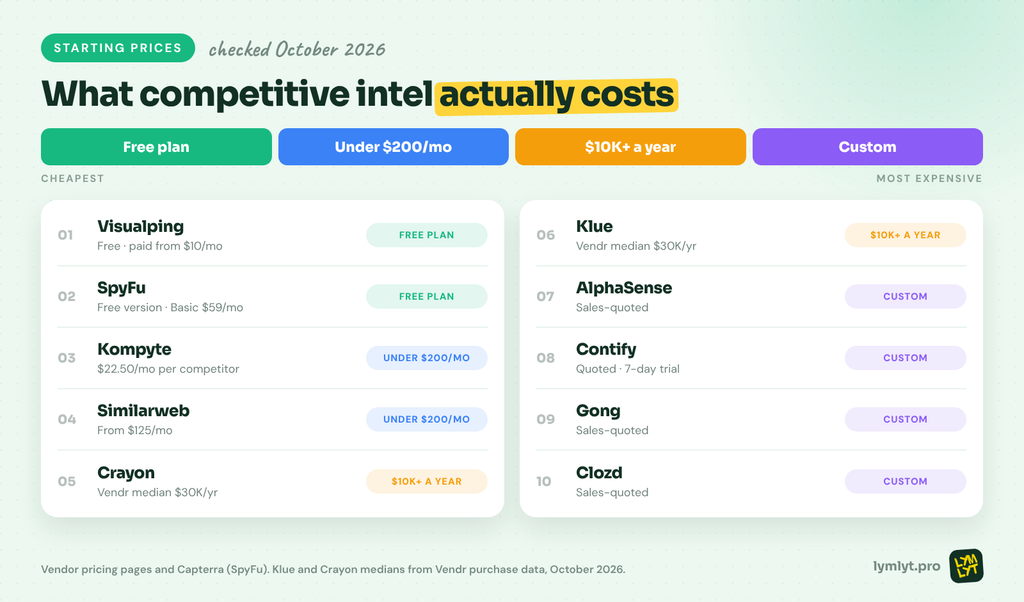
Most teams do not need a $30,000 platform on day one. A Visualping plan, a SpyFu or Similarweb subscription and a shared battlecard doc cover the basics for a few hundred dollars a month. Move to a platform like Klue or Crayon when you have a dedicated owner and enough reps to make enablement the bottleneck.
A weekly competitive intelligence routine
Tools collect signals. A routine turns them into decisions. Here is one product marketer’s week in 30 minutes a day.
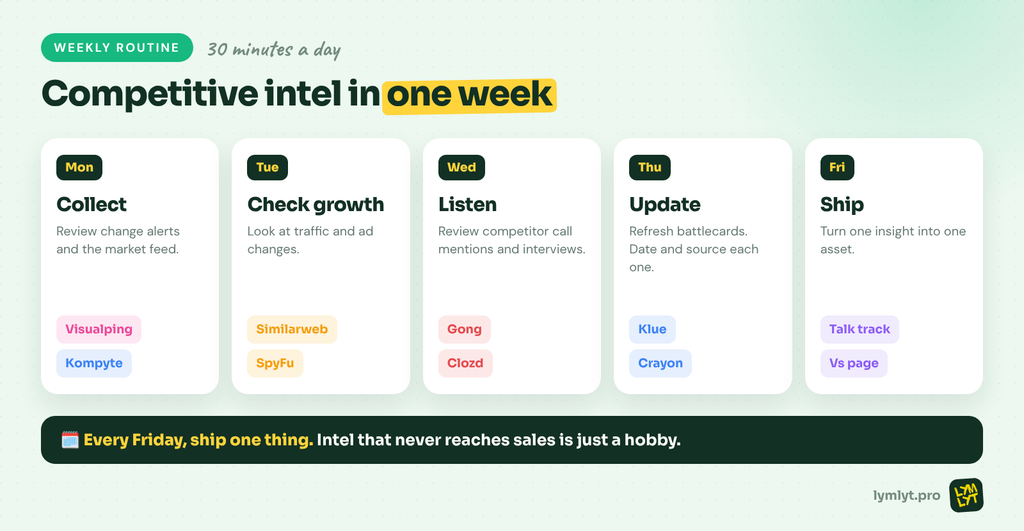
Monday: Collect. Review the week’s change alerts from Visualping or Kompyte and the market feed from your platform.
Tuesday: Check growth. Look at competitor traffic and ad changes in Similarweb or SpyFu.
Wednesday: Listen. Review Gong competitor mentions or the latest Clozd interviews.
Thursday: Update. Refresh the battlecards that changed and note the date and source on each.
Friday: Ship. Turn one insight into one asset: a talk track, a comparison page update or a launch note. Our honest vs page guide shows how to publish comparisons buyers trust.
How to choose
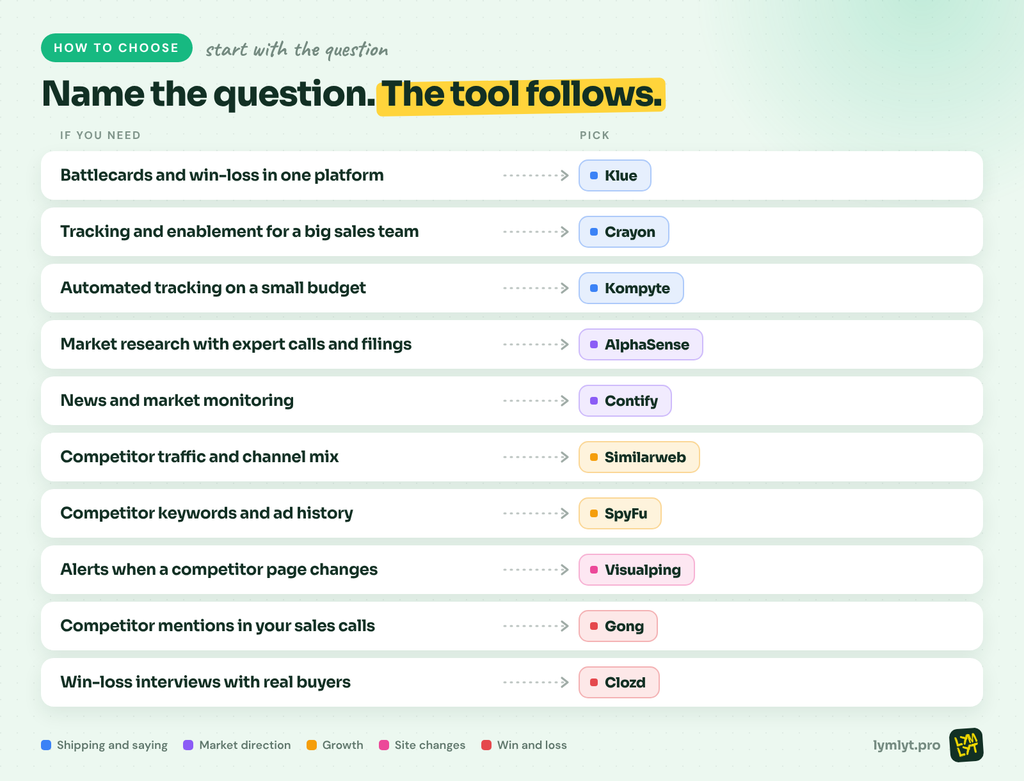
- Battlecards and win-loss in one platform: Klue
- Tracking and enablement for a large sales team: Crayon
- Automated tracking on a small budget: Kompyte
- Market research with expert calls and filings: AlphaSense
- News and market monitoring across many entities: Contify
- Competitor traffic and channel mix: Similarweb
- Competitor keywords and ad history: SpyFu
- Alerts when a competitor page changes: Visualping
- Competitor mentions in your sales calls: Gong
- Win-loss interviews with real buyers: Clozd
The bottom line
The best competitive intelligence tools do not just collect information. They get the right answer to the right person before the deal is decided. Start with the question that costs you most today. For most product marketers, that is “what changed?” or “why did we lose?”, and both can be answered for far less than a platform contract.
Then remember the newest competitive battleground. Buyers increasingly ask AI assistants to compare vendors, and the answers often cite pages you do not control. Our AI comparison queries study shows what ChatGPT and Google actually cite. If you want comparison and alternatives pages that win those answers, our competitor comparison page service builds them.

Jay is the co-founder of LymLyt and an AI partnership consultant helping B2B SaaS companies grow through content strategy, SEO, and AI integration. He writes about content marketing, what makes B2B content convert, and how SaaS teams can build content systems that drive real pipeline.