ChatGPT Ads for B2B SaaS: What the First Data Shows (2026)
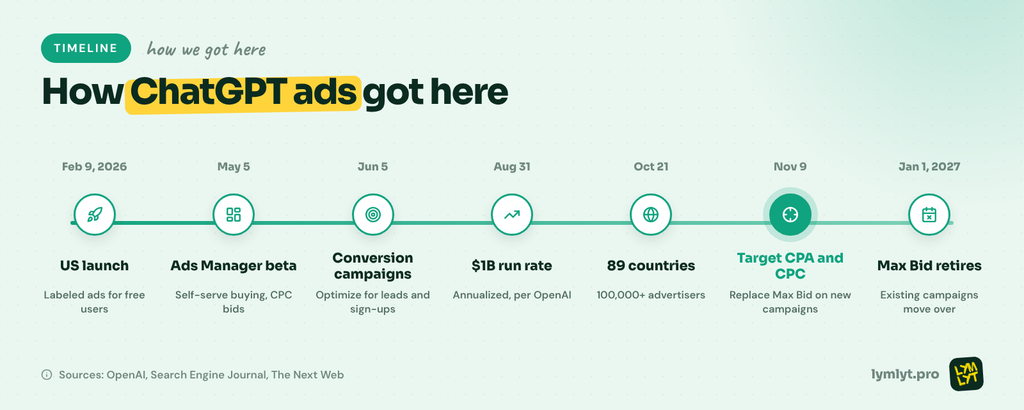
ChatGPT ads went from zero to a $1 billion annualized run rate in about seven months. OpenAI launched them in the US on February 9 and reported the $1 billion figure on August 31 (Search Engine Journal).
Software companies are the biggest buyers. In October, programming and developer software made up $27.9 million of the $110.6 million spent across the 24 countries AdClarity tracks (The Next Web).
Then the first real performance study landed. Across 102 websites, a paid ChatGPT visit earned $0.89. A paid Google Search visit earned $2.45 (PPC Land).
So should a B2B SaaS team put money into ChatGPT ads now? This guide covers how they work after the November bidding change, who’s buying, what the study and the first B2B tests actually show, and how to run a test that won’t waste your budget.
How ChatGPT ads work now
Where they show up. “Ads appear below ChatGPT responses,” according to OpenAI’s help center. They don’t sit inside the answer. Each ad has your brand name, logo, a headline, a description, an image and a landing page link.
Who sees them. Only free users. OpenAI says: “We do not show ads to users on Plus, Pro, or any Business plan.” Accounts identified as under 18 don’t see ads either (OpenAI).
How targeting works. There are no keywords. OpenAI matches ads to the context of the current conversation, your landing page and ad copy, and optional “context hints.” Those hints “are not exact-match keywords and do not guarantee delivery in specific conversations” (OpenAI). Qualifying advertisers can also block placements with Negative Phrases.
How you buy. Through agency partners like Dentsu, Omnicom, Publicis and WPP, or through the self-serve Ads Manager at ads.openai.com, which opened in beta on May 5 (OpenAI). The pilot started on CPM. CPC came with Ads Manager.
How bidding works since November 9. Target CPA replaced Max Bid for new conversion campaigns, and Target CPC replaced Max CPC for new click campaigns. Intelligent bidding (formerly Maximize Results) has no cost target. Max Bid and Max CPC retire for existing campaigns on January 1, 2027 (OpenAI).
One detail matters for budgeting: targets are averages, not caps. OpenAI says the winning auction bid sets the price, and your actual cost “may be higher or lower” than the target (OpenAI).
How you measure. OpenAI offers a Conversions API and a pixel, and advertisers get “aggregated performance insights” without access to conversations (OpenAI).
Who is buying ChatGPT ads
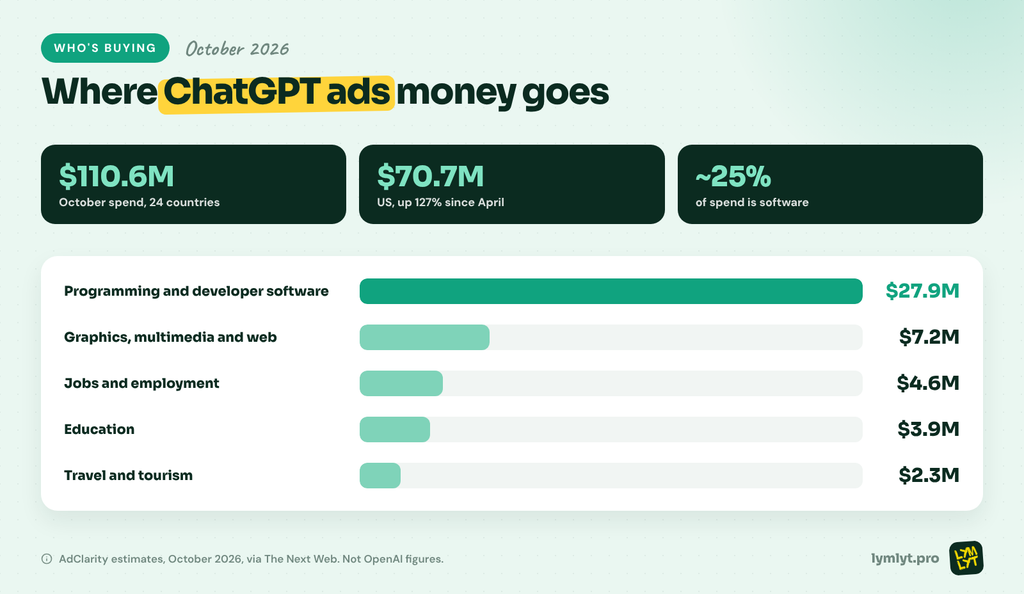
The money is moving fast, and a lot of it is ours. AdClarity’s October estimates, reported by The Next Web:
- US spend: $70.7 million, up 127% from $31.1 million in April
- Total across 24 countries: $110.6 million
- UK: $6.2 million, up 195% since June
- Japan: $5.9 million, up 103% since June
- Top category: programming and developer software at $27.9 million, about 25% of spend
MediaPost puts the total rise at 228% in seven months and reports that the US share fell from above 92% in April to below 64% in October. OpenAI said more than 100,000 advertisers had run ads by October 21 (Search Engine Journal).
Two caveats. These are AdClarity estimates, not OpenAI numbers. And The Next Web notes that AdClarity’s earlier figures included estimates for markets it wasn’t yet tracking, so the 127% isn’t a clean like-for-like comparison.
Still, the direction is clear. If you sell software, your competitors are probably already testing. That doesn’t mean it’s working for them.
What the first study found
The study is a working paper by Maximilian Kaiser (WU Vienna) and Christian Schulze (Frankfurt School of Finance and Management), titled “Can Advertising Fund Free AI?” It uses Google Analytics 4 data donated by Grips Intelligence and covers 60 weeks, up to August 22, 2026 (PPC Land).
Here’s what it found for US traffic, comparing paid ChatGPT visits with paid Google Search visits on the same sites:
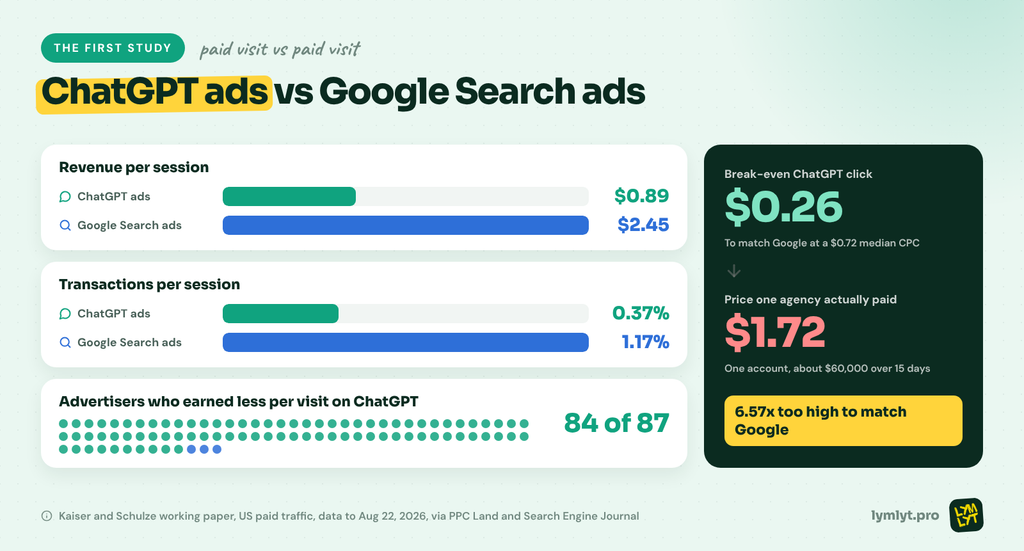
- Revenue per session: $0.89 vs $2.45
- Transactions per session: 0.37% vs 1.17%
- Advertisers who did worse on ChatGPT: 84 of the 87 that bought both channels (Search Engine Journal)
Then the authors worked out what a ChatGPT click should cost to match Google’s return. Using a $0.72 median Google CPC, the break-even ChatGPT click is about $0.26. The only real ChatGPT price they had was $1.72 per click, from one agency account. That’s 6.57 times the break-even price (PPC Land).
The paper’s verdict, as quoted by PPC Land: “ChatGPT ads offer more than six times worse value for money than Google Search ads.”
What the study doesn’t prove
Before you kill the line item, read the fine print. Most of it comes straight from Search Engine Journal’s breakdown:
- It’s descriptive, not causal. The authors say so themselves.
- Few sites actually converted. Only 18 of the 102 sites recorded a ChatGPT-driven transaction. One advertiser held 66% of all paid ChatGPT purchases (PPC Land).
- The data is old. It ends August 22, before Target CPA existed. OpenAI’s response: the study “captures an earlier period of ChatGPT Ads’ development and extrapolates platform performance from a small sample.”
- The price is thin. The $1.72 click came from one account, about $60,000 in spend over 15 days.
- It’s last-click. That matters more for B2B than for anyone else. More on that below.
What B2B tests show so far
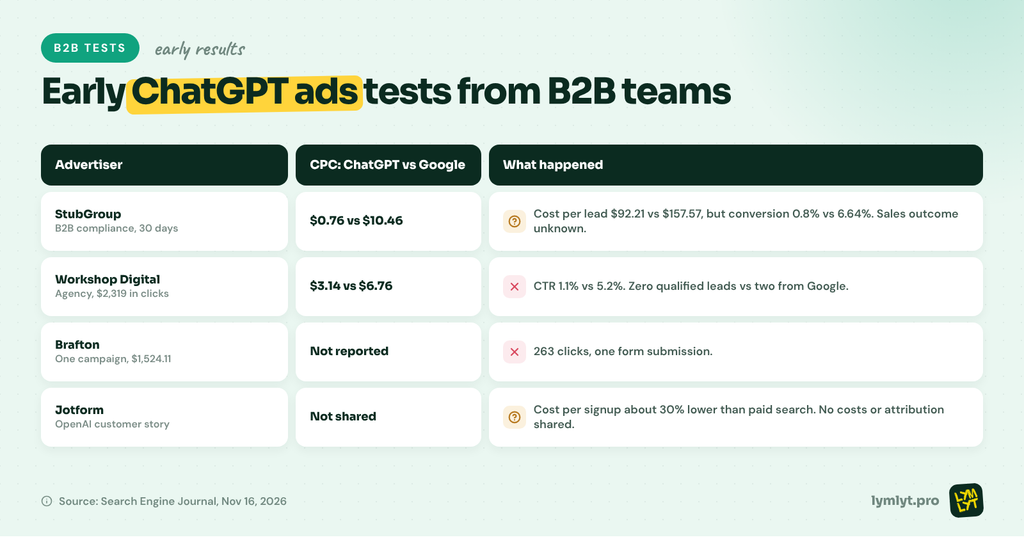
The study leans on ecommerce-style transactions. B2B buyers don’t check out in one session, so the more useful evidence is from B2B advertisers. Search Engine Journal collected four:
StubGroup (B2B compliance, 30 days). ChatGPT clicks cost $0.76 against $10.46 on Google. Cost per lead was $92.21 vs $157.57. But the conversion rate was 0.8% vs 6.64%, and with a long sales cycle, nobody knows yet whether those leads become customers.
Workshop Digital (agency, own money). It spent $2,319 on clicks. ChatGPT CPC was $3.14 vs $6.76 on Google, and CTR was 1.1% vs 5.2%. ChatGPT produced zero qualified leads. Google produced two. The agency itself called it “not a direct comparison.”
Brafton (content agency, one campaign). $1,524.11 spent, 263 clicks, one form fill. Director Zach Shah summed it up: ChatGPT ads are “priced like search, but seem to behave like paid social.”
Jotform (OpenAI customer story). Cost per signup came in about 30% lower than paid search. No costs or attribution method were shared, and as SEJ points out, “Sign-ups do not equal sales.”
The pattern: clicks can be cheaper than Google, but the people clicking aren’t ready to buy. That’s the paid social comparison in a sentence.
Why ChatGPT ads are hard to judge in B2B
Three things make ChatGPT ads look worse in B2B reporting than they might be, and one makes them look better.
Long cycles break last-click. A B2B buyer might click an ad today, read your comparison page next week and book a demo from a direct visit a month later. Last-click gives the ad nothing. The B2B buying journey rarely runs in a straight line. This is the dark funnel problem, now with a new channel in it.
The attribution windows are short. Ads Manager offers 7, 14 or 30-day click windows and a one-day view window, all last-touch (Search Engine Journal). Your sales cycle is probably longer than 30 days.
Lead definitions drift. If Google counts “demo booked” and ChatGPT counts “form fill,” you’re not comparing channels. You’re comparing definitions.
And the one that cuts the other way: cheap leads look great on a dashboard until sales rejects them. Judge on pipeline, not cost per lead. Our guide to proving marketing ROI covers which metrics a CFO will actually accept.
Paid ad vs being the answer
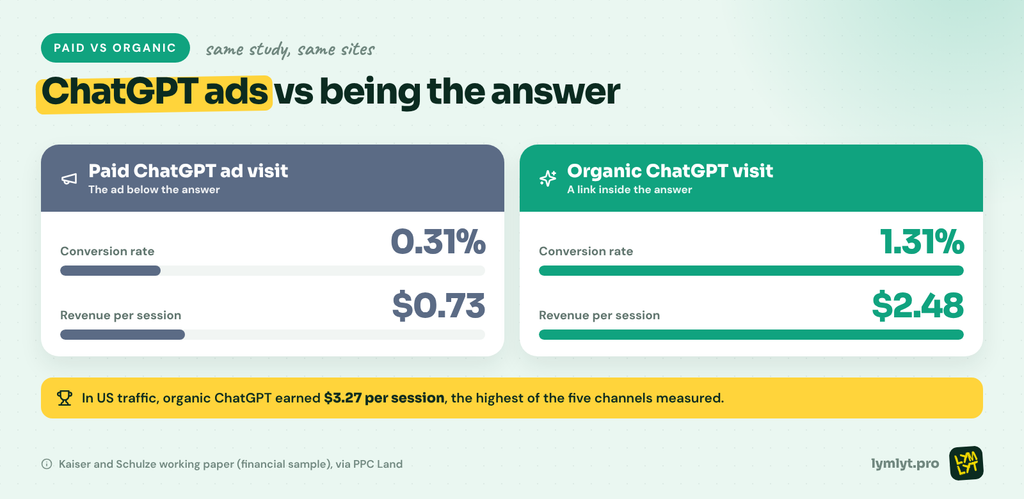
Here’s the number most coverage skipped. The same study measured organic ChatGPT traffic, meaning people who clicked a link inside the answer. In the financial sample, organic ChatGPT visits converted at 1.31% and earned $2.48 per session. Paid ChatGPT visits converted at 0.31% and earned $0.73. In US traffic, organic ChatGPT earned $3.27 per session, the highest of the five channels measured (PPC Land).
That’s the real story for B2B SaaS. The ad sits below the answer. The answer itself names vendors, compares them and links to sources. A buyer who asks “best SOC 2 tool for a 50-person startup” reads the shortlist first.
Being in that shortlist comes from organic work:
- Pages AI tools can cite: clear comparisons, pricing and original data. Our AI citation study shows what gets cited for B2B buying queries.
- Fixing the reasons you’re missing. Start with why your site doesn’t show up in ChatGPT.
- Answering the questions buyers ask AI before they shortlist, like what tools cost and how vendors compare.
- Tracking it. ChatGPT Business Hub now shows your mentions and clicks, and AI visibility tracking tools and AEO tools cover the other engines, including Perplexity.
Ads can sit next to a good answer. They can’t replace being in it. If you want help with the organic side, that’s what our AI visibility service does.
Should B2B SaaS buy ChatGPT ads yet?
Short answer: test, don’t scale.
Run a test if:
- Your buyers already use ChatGPT to research your category
- You have an offer that works on a first touch, like a free trial, a free tool or a template
- You can track conversions past the click and tie them to pipeline in your CRM
- You can afford to treat the budget as learning money
Wait if:
- Your only offer is “book a demo”
- Google Search isn’t profitable for you yet
- You can’t track leads past the first form fill
- You haven’t done the organic work to show up in the answer itself, or in the AI Overview above your own brand name
On budget, don’t take money from what already works. Our B2B marketing budget allocation guide covers how to fence off a test budget.
How to run a ChatGPT ads test
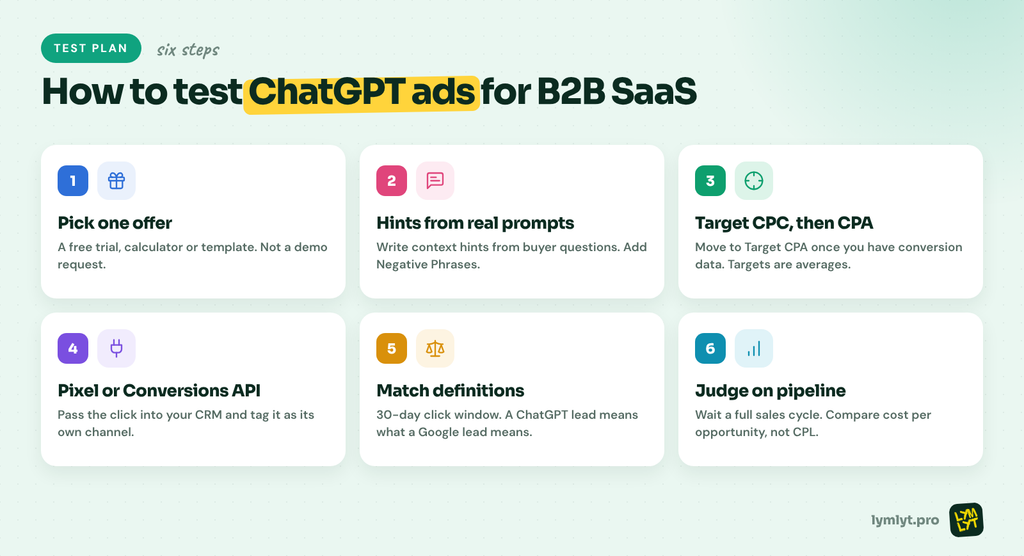
- Pick one offer. A free trial, a calculator or a template. Not a demo request.
- Write context hints from real prompts. Use the questions buyers type into ChatGPT, not your keyword list. Add Negative Phrases for support and job-seeker queries.
- Start on Target CPC, then move to Target CPA. Target CPA needs conversion data to work. Remember both are averages, so set a daily budget you’re happy to lose.
- Install the pixel or Conversions API and pass the click into your CRM. Tag the traffic so it shows as its own channel in GA4.
- Use the 30-day click window and match lead definitions. A ChatGPT lead should mean exactly what a Google lead means.
- Judge on pipeline, not CPL. Give it a full sales cycle before you decide. Compare cost per opportunity against Google Search and your attribution tool of choice.
If the test works, scale slowly. If it doesn’t, you’ve lost a test budget, not a quarter.
The bottom line
ChatGPT ads are real, growing fast and full of software companies. The first data says paid visits are worth far less than paid search visits, and the early B2B tests show cheap clicks from people who aren’t ready to buy.
That could change. The study’s data ends before Target CPA existed, and OpenAI keeps shipping. But today, the better return in ChatGPT is still being the brand the answer recommends. Fix that first, then test ads next to it.
FAQ
What are ChatGPT ads?
ChatGPT ads are sponsored units that appear below ChatGPT’s answers for free users. Each one shows your brand, a headline, a description, an image and a link. They’re matched to the conversation’s context, not to keywords (OpenAI).
How much do ChatGPT ads cost?
There’s no fixed price. It’s an auction. Reported CPCs range from $0.76 (StubGroup) to $3.14 (Workshop Digital), and OpenAI suggests a starting maximum bid of $3 to $5 (Search Engine Journal). With Target CPA and Target CPC, your target is an average, so actual costs can run higher.
Who sees ChatGPT ads?
Free users only. OpenAI doesn’t show ads on Plus, Pro or Business plans, or to accounts identified as under 18 (OpenAI).
Where are ChatGPT ads available?
By October 21, OpenAI’s rollout had reportedly reached 89 countries (The Next Web). The US is still the biggest market by spend.
Do ChatGPT ads change ChatGPT’s answers?
OpenAI says answers remain independent of advertising (OpenAI). Ads sit below the response. To show up inside the answer, you need organic visibility. See how AI search behavior has changed.
Are ChatGPT ads better than Google Ads for B2B?
Not on today’s data. Paid ChatGPT visits earned $0.89 per session against $2.45 for Google Search in the Kaiser and Schulze study (PPC Land), and no data yet shows B2B pipeline from ChatGPT ads beating search. Treat it as a test channel.
Will ChatGPT ads replace Google Ads?
There’s no evidence of that yet. Search Engine Journal found that no revenue figure, survey or Google disclosure shows how much spend has moved from Google Search to ChatGPT ads (Search Engine Journal). For now, it’s an extra line in the plan, not a swap. Our take on demand generation vs demand capture explains where each fits.
Conclusion
ChatGPT ads are growing fast, and software companies are the biggest buyers. The first data says a paid ChatGPT visit is worth about a third of a paid Google Search visit, and early B2B tests show cheap clicks from people who aren’t ready to buy.
That could change. The study’s data ends before Target CPA existed, and OpenAI keeps shipping. But today, the better return in ChatGPT is being the brand the answer recommends. Fix that first, then test ads next to it.
Want to know if ChatGPT recommends you, or your competitors? LymLyt checks where your brand shows up in ChatGPT, Perplexity, Gemini and Google’s AI Overviews, and builds the content that gets you into the answer. <p style=”text-align:center;margin:32px 0″><a href=”https://calendly.com/rashmita-lymlyt/30min” style=”display:inline-block;background:#10A37F;color:#ffffff;font-weight:700;font-size:18px;padding:16px 32px;border-radius:999px;text-decoration:none”>Book your free call</a></p>
No pitch deck, no contract. A 30-minute look at your AI visibility, plus our pricing if you want to go further.

Jay is the co-founder of LymLyt and an AI partnership consultant helping B2B SaaS companies grow through content strategy, SEO, and AI integration. He writes about content marketing, what makes B2B content convert, and how SaaS teams can build content systems that drive real pipeline.