AI Citation Study: What Gets Cited for B2B SaaS Buying Queries
We ran an AI citation study across 18 real B2B SaaS buying questions and logged every source that came back. G2 and Capterra, the review platforms most SaaS marketing teams have spent years building profiles on, surfaced in exactly two of them. What filled the gap instead is the part worth paying attention to.
The method
Six categories a B2B SaaS marketer genuinely searches. All of this was done on the free tier of Google Gemini, OpenAI’s ChatGPT, and Anthropic’s Claude. Four queries drafted per category, 18 run to completion with every source logged and categorised. The remaining six were near-duplicates of queries already covered, so they’re excluded rather than counted twice.
Each source was tagged by what it actually is:
| Tag | Source type | Example |
|---|---|---|
| REV | Review aggregator | G2, Capterra |
| VEN | Vendor citing its own blog | Zapier writing about Zapier alternatives |
| AGY | Agency ranking itself | An agency’s own “best agencies” post |
| IND | Independent or niche publication | A small SaaS or marketing blog |
| PUB | Recognised publication | TechRadar, Forbes Advisor |
| COM | Community source | Reddit, DEV Community |
The 18 queries, and what came back
Category 1: CRM (4 of 4 run)
| Query | Dominant source types | Review sites present? |
|---|---|---|
| Best CRM for B2B SaaS startups | VEN, IND | No |
| Best CRM for a 50-person sales team | VEN, IND, COM | No |
| HubSpot vs Salesforce for a growing SaaS company | VEN, IND | No |
| Best CRM alternatives to Salesforce | VEN, IND | No |
Category 2: Workflow automation (3 of 4 run)
| Query | Dominant source types | Review sites present? |
|---|---|---|
| Best workflow automation tools for tech teams | VEN, IND | No |
| Best Zapier alternatives | VEN, IND, REV | Yes — Capterra and G2 |
| Make vs Zapier for a SaaS marketing team | VEN, IND | No |
Category 3: AEO and AI visibility (2 of 4 run)
| Query | Dominant source types | Review sites present? |
|---|---|---|
| Best AEO tools for B2B SaaS | VEN (heavily) | No |
| How do I know if ChatGPT is citing my website | VEN, IND | No |
Category 4: Content marketing agencies (2 of 4 run)
| Query | Dominant source types | Review sites present? |
|---|---|---|
| Best B2B SaaS content marketing agencies | AGY (heavily) | No |
| Best SEO agency for B2B SaaS | AGY, IND | No |
Category 5: Keyword research tools (4 of 4 run)
| Query | Dominant source types | Review sites present? |
|---|---|---|
| Best keyword research tools for SEO | IND, PUB | No |
| Ahrefs vs Semrush for a small marketing team | VEN, IND, REV | Yes — G2 |
| Best free keyword research tools | IND, PUB | No |
| Best keyword research tools for B2B SaaS content | IND | No |
Category 6: AI writing tools (3 of 4 run)
| Query | Dominant source types | Review sites present? |
|---|---|---|
| Best AI tools for writing SEO content (small teams) | VEN, IND | No |
| Jasper vs Copy.ai for B2B content | IND, VEN | No* |
| Best AI content tools that don’t sound robotic | IND | No |
* One source quoted G2 star ratings inside its own article without G2 appearing as a cited source. More on that below.
Finding 1: review sites appeared twice, and only on one query shape
| Query type | Queries run | Review sites appeared |
|---|---|---|
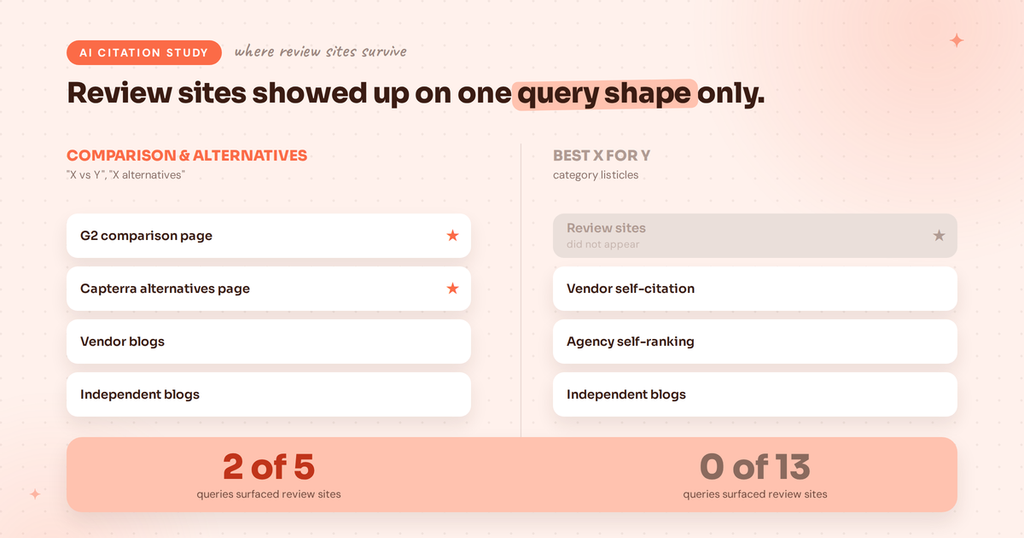
| Comparison and alternatives (“X vs Y”, “X alternatives”) | 5 | 2 |
| Category listicles (“best X for Y”) | 13 | 0 |
Both review-site appearances were the same shape of question: a direct comparison, or an alternatives search, inside a mature software category where G2 and Capterra have years of accumulated review data.
- “Best Zapier alternatives” returned Capterra’s Zapier alternatives page and a G2 competitors page.
- “Ahrefs vs Semrush for a small marketing team” returned G2’s head-to-head comparison page, complete with star ratings and review counts.
In all 13 category-listicle queries, review platforms didn’t appear at all. Not for “best CRM for B2B SaaS startups.” Not for “best B2B SaaS content marketing agencies.” Not for “best SEO agency for B2B SaaS.” These are exactly the categories where G2 and Capterra dominate traditional Google results.
The practical read: review-platform authority appears to transfer to AI answers on comparison and alternatives queries, and not on category listicles. If getting cited by a specific engine is the goal, our guide on how to get cited in Perplexity covers the structural side of this in more depth.
Finding 2: vendors and agencies are citing themselves, constantly
The sources filling those 13 listicle queries follow a clear pattern.
Content marketing agency queries were the most extreme case of self-ranking. Nearly every result was an agency publishing its own “best agencies” list:
| Agency | Publishes its own “best agencies” ranking | Appears on it |
|---|---|---|
| Animalz | Yes | Yes |
| Siege Media | Yes | Yes |
| Omniscient Digital | Yes | Yes |
| Grow and Convert | Yes | Yes |
| RevenueZen | Yes | Yes, ranked first |
| First Page Sage | Yes | Yes, ranked first |
A buyer reading these answers is largely reading agency marketing arranged in ranked order. Several disclose the conflict openly. Some don’t.
AEO and AI-visibility tool queries ran the same pattern even harder. Nearly every citation for “best AEO tools for B2B SaaS” pointed to an AEO vendor’s own blog ranking the category it competes in: Conductor, AirOps, Omnibound, Indexly, and others, each appearing in the list they published.
CRM and workflow automation mixed vendor-owned blogs (Zapier writing about Zapier alternatives, Close writing about the best CRMs for SaaS, folk writing about the best CRMs for sales teams) with a long tail of smaller independent publications.
Finding 3: G2’s data gets laundered through third-party blogs
One nuance worth separating out. On the Jasper vs Copy.ai query, a cited source included the line “G2 scores: Jasper 4.7/5, Copy.ai 4.6/5″ inside its own article.
G2’s data made it into the answer. G2’s domain did not get cited. The review platform did the work of collecting those scores and a third-party blog captured the citation.
That’s a meaningfully different failure mode from simple absence, and it suggests review data can still influence AI answers indirectly while the platform itself gets no visibility from it.
Finding 4: the citation pool is mostly small sites
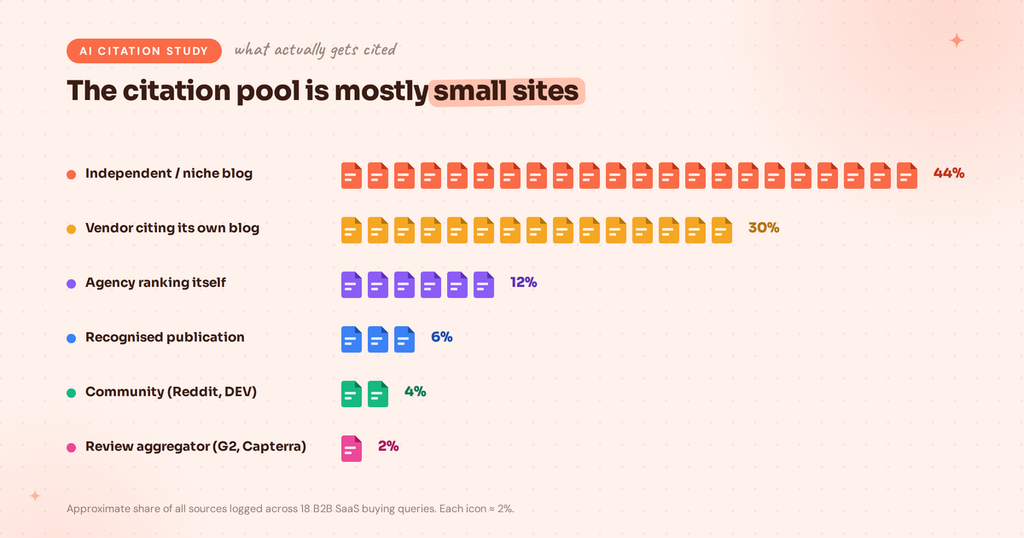
The most consistent characteristic across all 18 queries wasn’t a specific source. It was how thin the authority requirement appears to be.
Most cited sources weren’t major publications or established review platforms. They were small SaaS blogs, niche marketing sites, and tool vendors’ own content marketing, sites with modest domain authority publishing well-structured, current, specific comparison content.
Recognisable third-party publications appeared, but rarely: TechRadar, Forbes Advisor, a Gartner peer-review page, one Reddit thread, one DEV Community post. Real, but heavily outnumbered by the long tail.
That’s the encouraging finding for a smaller brand. The barrier to being a cited source here is not “outrank G2.” It’s closer to “publish something specific, current, and structured enough to be quoted.” That structural work is exactly what our AEO tools roundup evaluates tools against.
What this means for your AI visibility strategy
Comparison and alternatives pages are the highest-leverage format. They’re the query type where review platforms surface, which means they’re also where a strong owned comparison page competes directly against the aggregators rather than being buried under them. Our keyword research tools guide is one example of this format built deliberately.
Your own blog is a legitimate citation source, and your competitors already know it. The vendors dominating these results are cited because they published the category roundup. If you sell in a category and haven’t published a serious, honest roundup of it, someone else has.
Domain authority matters less here than structure and specificity. The citation pool is full of small sites. What they share is clear formatting, current information, and specific claims worth quoting.
Don’t abandon your review profiles, but don’t over-credit them. They earned their two appearances on genuine comparison intent, and their data reached a third answer indirectly. That’s a real slice of buyer research, just narrower than most teams assume.
Method notes and limits
- 18 of 24 planned queries were completed with full source logging. The other six were near-duplicates of covered queries.
- Category coverage is uneven. CRM and keyword research were fully covered at 4 queries each. AEO and agencies were covered at 2 each.
- Results reflect one collection window. AI search results shift; a re-run in three months would not produce an identical source list.
- This measures which sources get surfaced and cited, not whether being cited drives traffic or pipeline. Those are separate questions this dataset doesn’t answer.
- Categories were B2B SaaS marketing and sales tooling. Findings may not transfer to verticals where review platforms have deeper coverage.
Where to go from here
For the fuller picture on the categories tested here, our AEO tools roundup for B2B SaaS goes deeper on AI-visibility platforms, our workflow automation tools roundup and keyword research tools guide cover two of the categories above, and our B2B SaaS content marketing agencies roundup is our own entry in exactly the self-ranking category described in Finding 2, with that conflict disclosed in the piece itself.
Want this run for your category?
This is a repeatable method, not a one-time snapshot. If you want to know which sources AI engines surface for your buyers’ actual queries, and where your brand sits in that pool, we can run it.

Jay is the co-founder of LymLyt and an AI partnership consultant helping B2B SaaS companies grow through content strategy, SEO, and AI integration. He writes about content marketing, what makes B2B content convert, and how SaaS teams can build content systems that drive real pipeline.