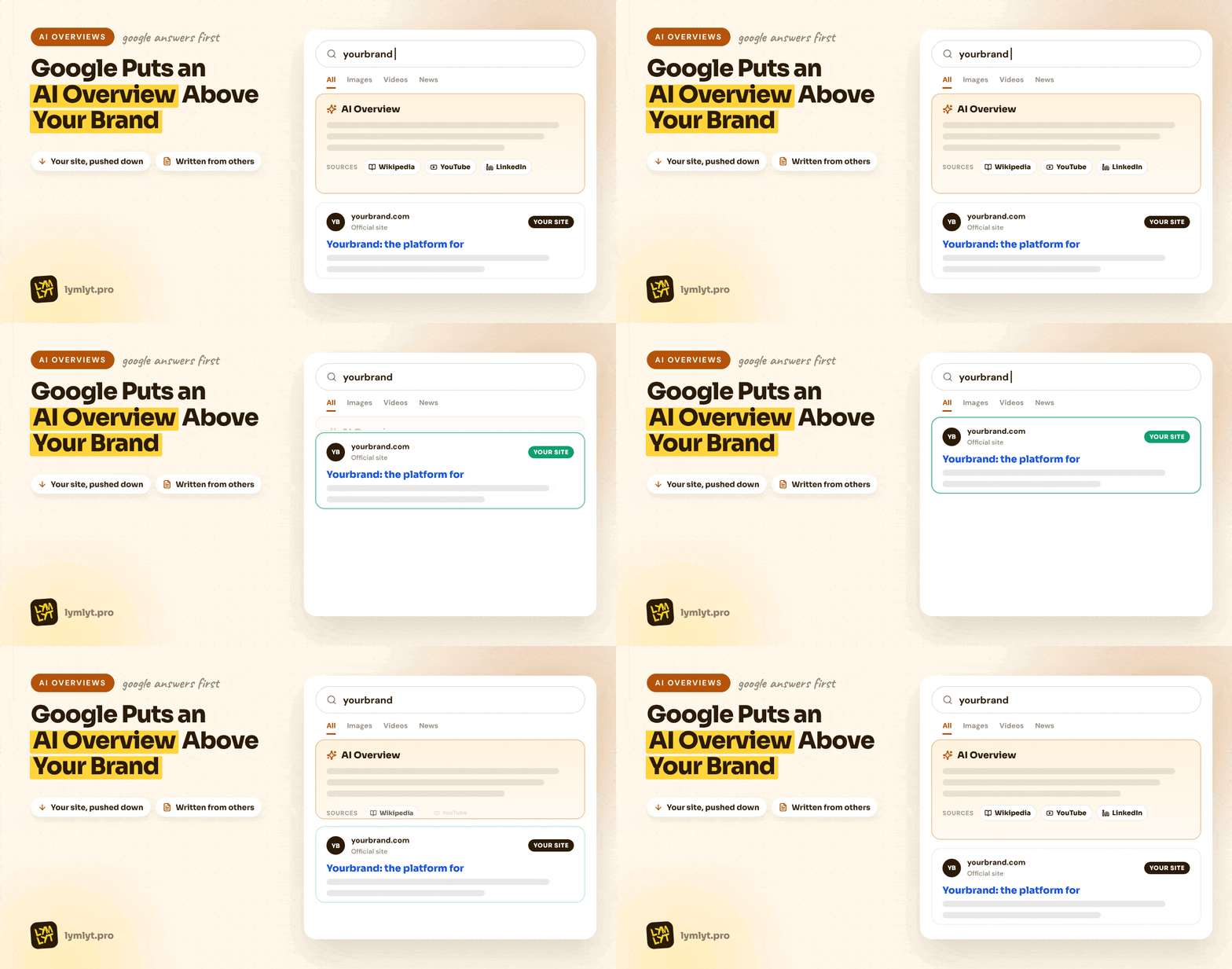
Google Now Puts an AI Overview Above Your Brand Name. Who Wrote it?
Search your company’s name on Google. There’s a good chance the first thing you see isn’t your website. It’s an AI Overview, written by Google, describing your company in its own words.
AI Overviews on branded searches went from rare to normal in a few weeks. Ahrefs found that “as of September 29th 2026, AI Overviews appeared in 82.91% of the US desktop search results for branded keywords” (Ahrefs).
That matters because a brand search is the moment a buyer is already looking for you. Here’s what changed, where Google gets its answer from, and what a B2B SaaS team can do about it.
What changed in September
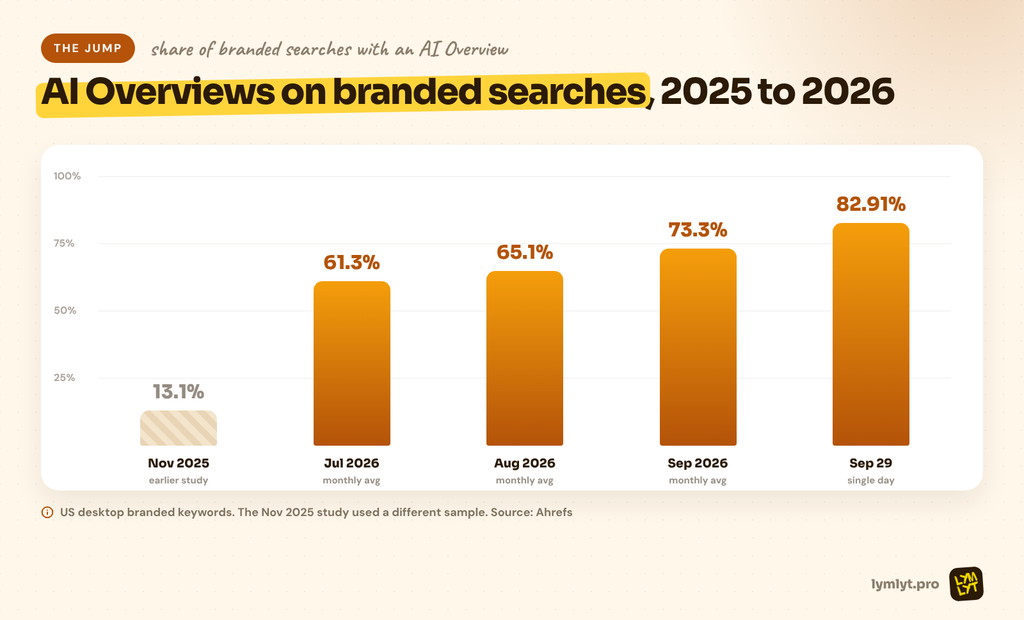
Google used to keep AI Overviews off most brand searches. That stopped in September.
Ahrefs’ numbers. Across 92.5 million branded-keyword crawls in the US, AI Overviews showed up 61.3% of the time in July, 65.1% in August and 73.3% in September, before reaching 82.91% on September 29 (Ahrefs). In Ahrefs’ earlier study, branded queries sat at 13.1%, though the two studies used different samples.
The 100-brand test. Ahrefs also searched the exact names of 100 global brands every week. On July 1, 5 of 98 usable results had an AI Overview. By September 30, 63 of 100 did (Search Engine Journal).
Other trackers saw the same jump. DemandSphere measured 26.12% of branded keywords with an AI Overview on September 1 and 82.06% on September 29. Chris Long of Nectiv found AI Overviews for 93 of 100 enterprise brands on September 30 (Search Engine Journal).
Each tracker uses its own sample and method, so the numbers don’t line up exactly. The direction does. And no announced update came with it, as GPO’s November roundup points out.
Where the overview sits on the page
The position is the problem. Of the 63 brand searches with an AI Overview, 48 showed it in position one, with an average position of 1.49 (Ahrefs).
So when a buyer searches your name, Google’s summary of you often sits above your own homepage. If you’ve watched Google AI Mode grow, this is the same idea moving into searches you used to own.
Who writes Google’s answer about you
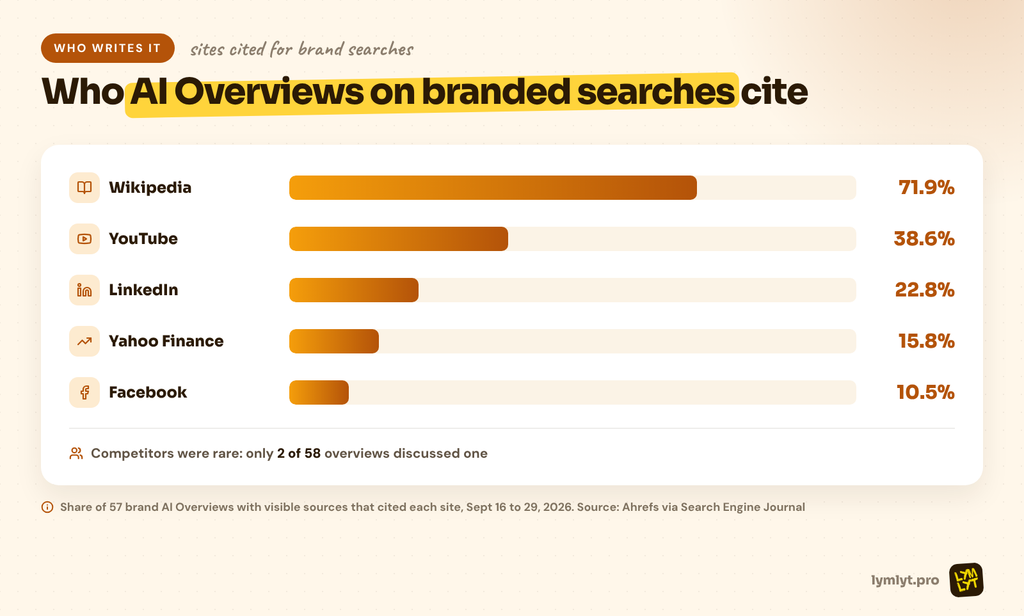
Mostly, other people. In the 57 brand AI Overviews with visible source lists, Ahrefs found (Search Engine Journal):
- Wikipedia cited in 71.9%
- YouTube in 38.6%
- LinkedIn in 22.8%
- Yahoo Finance in 15.8%
- Facebook in 10.5%
The good news: competitors rarely showed up. Only 2 of 58 overviews with full text talked about a competitor (Ahrefs).
The bad news is what Chris Long told Ahrefs: “competitors/external sources can now control the narrative of your brand directly in the search results.” Ahrefs also warned that unofficial videos can carry outdated product information.
Why this hits B2B SaaS harder
Those studies used big consumer brands. A SaaS company has a different set of sources. Your Wikipedia page may not exist, but your G2 reviews, Reddit threads, old YouTube demos and comparison pages written by competitors do. Our research on G2 and Capterra in AI answers and Reddit, LinkedIn and YouTube citations shows how often those platforms shape AI answers about software.
And SaaS buyers rarely search your name alone. They search “[your brand] pricing,” “[your brand] reviews” or “[your brand] vs [competitor].” Those are the searches where a stale review or a competitor’s comparison page can end up in Google’s summary. We’ve seen the same pattern in what AI tells buyers about pricing and about leaving a vendor.
Run a 20-minute brand AI Overview check
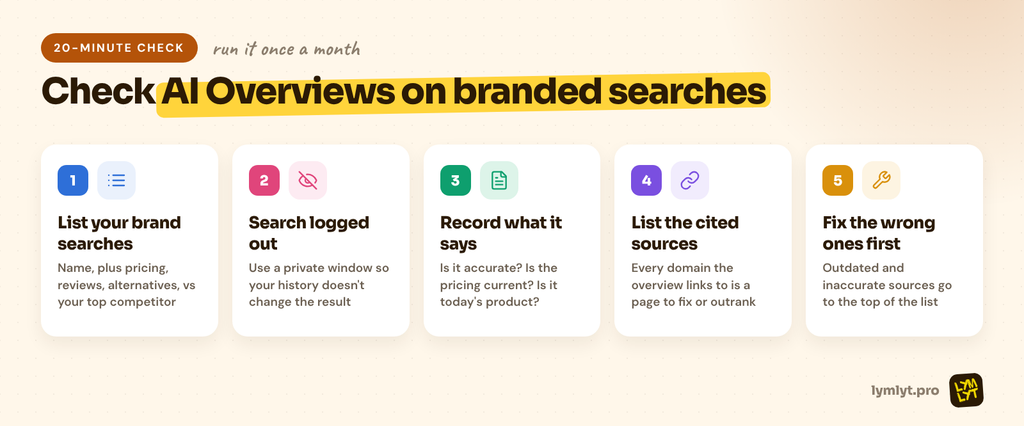
You don’t need a tool to start. Do this once a month.
- List your brand searches. Your brand name, plus “pricing,” “reviews,” “alternatives,” “vs [top competitor],” “login” and “integrations.”
- Search them logged out. Use a private window so your history doesn’t change what you see.
- Write down what the overview says. Is it accurate? Is the pricing current? Does it describe the product you sell today?
- List the cited sources. Note every domain linked in the overview. These are the pages you need to fix or outrank.
- Fix the wrong ones first. Anything outdated or inaccurate goes to the top of the list.
If you use Ahrefs, its Site Explorer can filter your branded keywords to the ones that show AI Overviews, and Brand Radar shows the text and cited domains (Ahrefs). For other options, see our list of AI visibility tracking tools.
How to change what Google says about you
You can’t edit an AI Overview. You can change the pages it reads.
Fix your third-party profiles. Update your G2, Capterra and LinkedIn company pages with current pricing, positioning and features. Ask happy customers for fresh reviews.
Own your YouTube results. Publish a short, current product overview video on your own channel. Since YouTube shows up in so many brand overviews, an up-to-date official video gives Google something better to cite than a three-year-old demo.
Strengthen your entity. Make sure Google understands who you are: consistent name, description and links everywhere, plus Organization schema on your site. Our guide to the Google Knowledge Graph and the entity SEO basics explain why this matters.
Publish the pages buyers search for. If someone searches “[your brand] pricing” and you don’t have a clear pricing page, Google will use someone else’s summary. Same for alternatives and comparison pages. Build those before your competitors build them for you.
Keep your content fresh. Old pages with old numbers get repeated. See whether content freshness affects AI citations before your next update cycle.
What to tell your CEO
Expect fewer clicks on brand searches, even when demand hasn’t changed. Search Engine Journal noted that these studies don’t measure click impact yet, so there’s no reliable number to quote (Search Engine Journal).
So don’t report a brand-click drop as falling interest without checking. Look at branded impressions in Search Console, demo requests and direct traffic together. If impressions are steady and clicks are down, the overview is answering the question before people reach your site. We saw a bigger version of this play out when HubSpot lost most of its blog traffic while revenue kept growing.
For the wider reporting picture, read how to prove marketing ROI and what to report for AI visibility.
FAQ
What percentage of branded searches show AI Overviews?
Ahrefs measured 82.91% of US desktop branded-keyword results on September 29, 2026, up from 61.3% in July. DemandSphere measured 82.06% the same day.
Can I turn off AI Overviews for my brand?
There’s no setting to remove an AI Overview from searches for your name. Google’s snippet controls, like nosnippet, can limit what it quotes from your own pages, but they also limit your normal search snippets. In practice, your best lever is the sources it reads.
Which sites does Google cite for brand searches?
In Ahrefs’ 100-brand study, Wikipedia, YouTube and LinkedIn were cited most. For SaaS brands, review sites like G2 and Capterra, Reddit and comparison pages often play the same role.
Do AI Overviews on branded searches reduce clicks to my site?
Probably, since the overview often sits above your homepage. But the studies so far haven’t measured the click impact, so check your own Search Console data before drawing conclusions.
The bottom line
AI Overviews on branded searches are now the default, not the exception. When a buyer looks you up, Google answers first, and it mostly uses other people’s pages to do it.
Check what it says about you this week. Fix the sources it reads. Then build the pricing, comparison and review content that gives Google a better answer.
If you want help mapping what Google and AI engines say about your brand, LymLyt’s AI visibility service audits it and builds the pages that fix it. Book a call.

Jay is the co-founder of LymLyt and an AI partnership consultant helping B2B SaaS companies grow through content strategy, SEO, and AI integration. He writes about content marketing, what makes B2B content convert, and how SaaS teams can build content systems that drive real pipeline.