How to Get Your B2B SaaS Brand Cited in Perplexity AI
Getting cited in Perplexity isn’t about “ranking” in the traditional SEO sense. It’s about becoming a source Perplexity’s retrieval system can confidently pull from and quote. For B2B SaaS brands, that means optimizing for relevance, freshness, authority, and structural clarity so your content survives Perplexity’s filtering process and earns a spot in the numbered source list.
A note before you read further. The AI citation tracking space is young and crowded with agencies publishing studies that use different sample sizes, different query sets, and different definitions of a citation. The disagreement is not marginal. On the most basic question anyone could ask about this engine, how many sources it cites in a single answer, published figures range from 3.5 to 21.9.
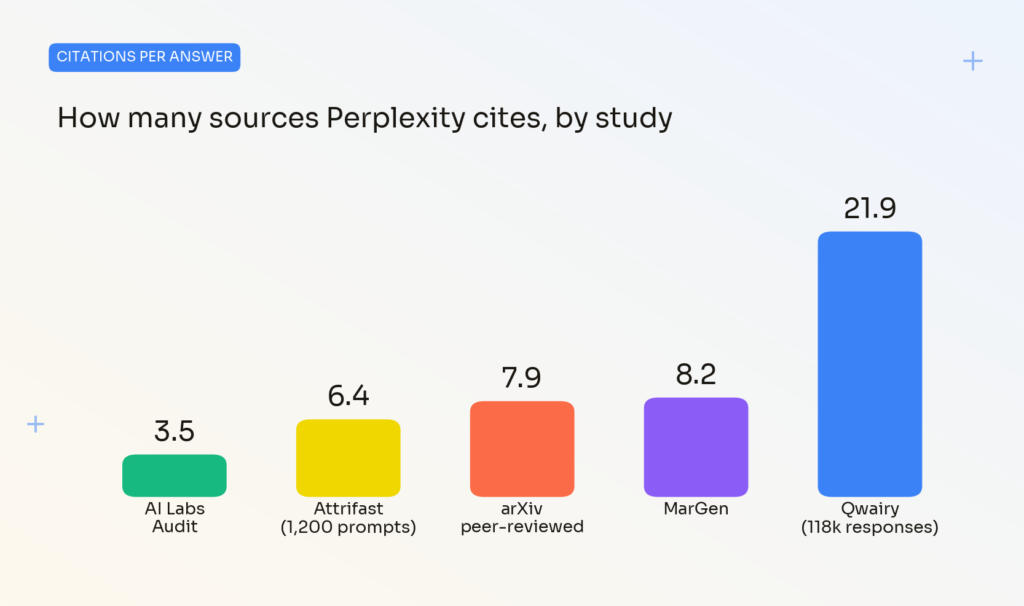
Five published estimates of how many sources Perplexity cites per answer. Sources: AI Labs Audit, Attrifast, arXiv, Qwairy via Whitehat SEO.
Some of that spread is methodology. The peer-reviewed figure of 7.9 counts unique cited sources. Qwairy’s 21.9 counts inline citation instances, so the same source cited three times counts three times. Attrifast’s 6.4 is a median of unique domains rather than a mean. They are measuring different things and calling them the same thing.
Treat every number in this article, including the ones we cite approvingly, as directional rather than settled. For a longer look at how far two credible studies can diverge on the same question, and why, see G2 and Capterra AI Visibility: What the Data Shows.
Why Perplexity Citations Matter for B2B SaaS
Perplexity is increasingly part of the B2B buyer’s research process, especially for category education, vendor comparisons, and “best tool for X” queries. Unlike a traditional search results page, Perplexity synthesizes an answer from a handful of candidate pages, which makes each citation meaningful visibility rather than one link among ten.
The buyer behaviour shift is well documented. G2 surveyed 1,076 B2B software buyers and decision-makers in March 2026 and found that 51% now begin their software research with an AI chatbot more often than with Google, up from 29% eleven months earlier. More striking: 69% said they chose a different vendor than they originally planned based on AI chatbot guidance, and roughly one in three purchased from a vendor they had never heard of before.
Worth flagging the source bias. That research comes from G2, which sells visibility on review platforms, and its headline finding is that review site citations are the number one signal making buyers trust an AI recommendation. That is a convenient conclusion for G2. The underlying buyer-behaviour numbers are still the best public dataset available, and G2’s own follow-up report in July put review sites at 38% and AI chatbots at 37% as shortlist influences, so even their framing moves between reports.
The practical takeaway does not depend on the exact percentage. If your brand isn’t appearing in Perplexity’s answers for your core category and comparison queries, you are invisible to a growing share of buyers who research this way. Whether that share is 51% or 40% does not change what you do about it.
Perplexity Is Not ChatGPT With Citations
The most useful thing to understand before optimising for Perplexity is how little it overlaps with the engine most teams have been optimising for.
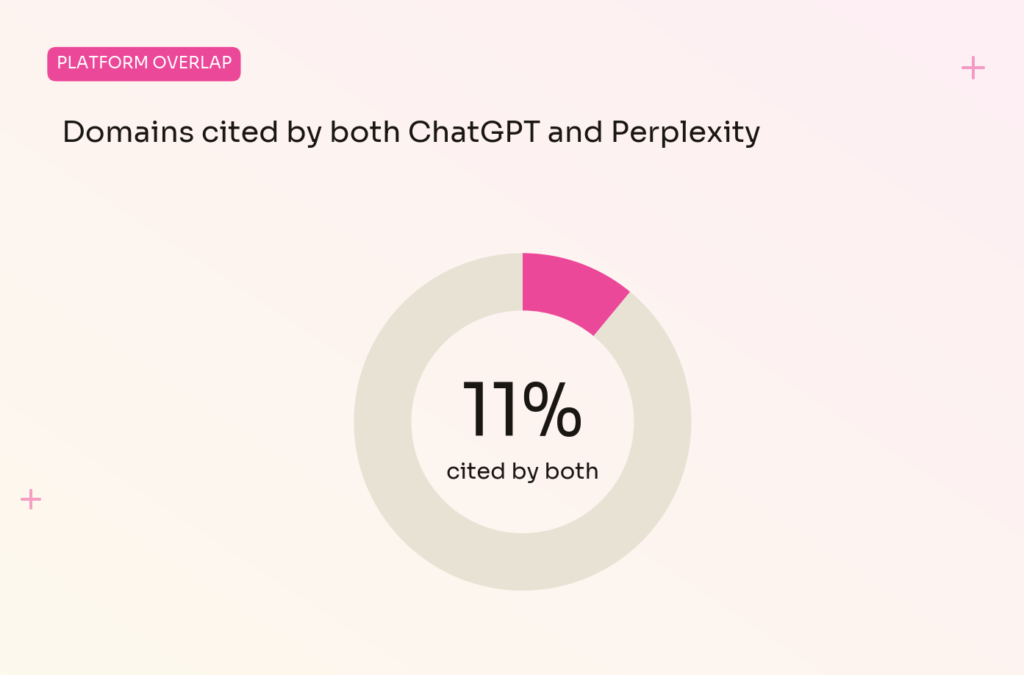
Share of domains cited by both engines. Sources: Averi (680 million citations) and Whitehat SEO (118,000 responses), which reached the same figure independently.
Two independent analyses, one across 680 million citations and one across 118,000 responses, both landed on roughly 11% of domains being cited by both ChatGPT and Perplexity. Two different methodologies, one conclusion: the source graph these engines see is close to disjoint.
That single number carries most of the strategic weight in this article. Work that earns ChatGPT citations does not reliably transfer. If the GEO, AEO, and SEO terminology in this space feels muddled, GEO vs AEO vs SEO: What Is Actually Different sorts out the distinctions. And if you want the wider numbers on how ranking and citation have come apart, our AI SEO statistics roundup collects what has actually been measured.
The mechanical differences that matter:
- Perplexity always searches. ChatGPT can answer from training data without retrieving anything. Perplexity runs a live search on every query, which is why freshness carries so much more weight here.
- Perplexity always cites. Citation is structural to the product, not an optional behaviour.
- Perplexity is selective. Reporting suggests it visits roughly ten pages per query and cites a fraction of them, though as the chart above shows, exactly what fraction is contested.
The Good News: Perplexity Has the Lowest Bar
The GEO-16 study is the most rigorous public analysis of AI citation behaviour. Researchers at UC Berkeley and Wrodium Research ran 70 industry-targeted prompts, harvested 1,702 citations across three engines, and audited 1,100 unique URLs against a 16-pillar quality framework.
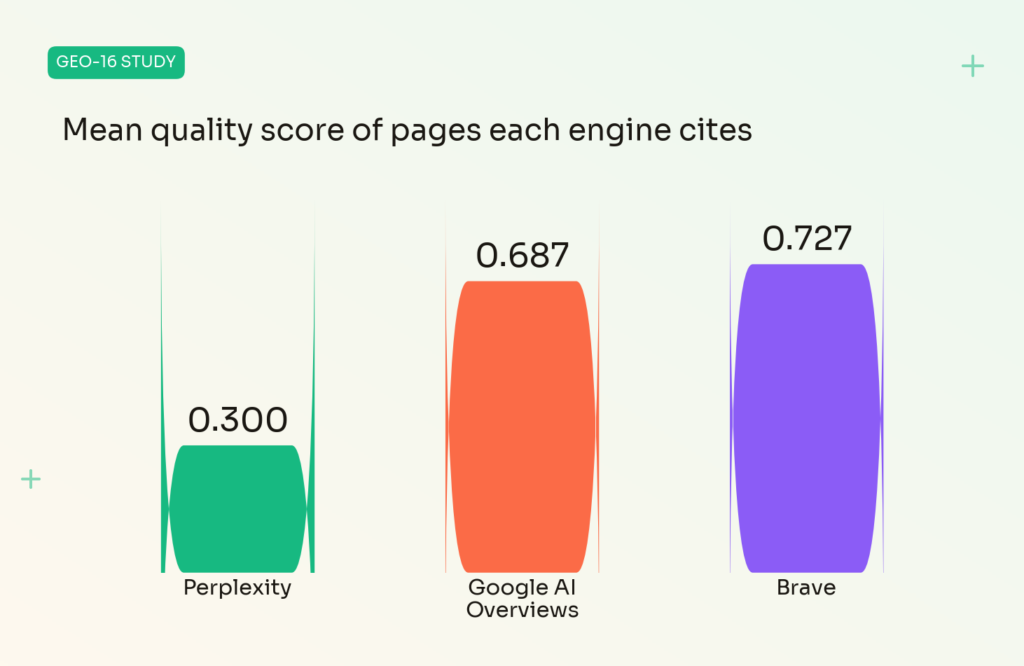
Mean quality score of pages each engine cites. Source: GEO-16 study
Perplexity does not demand technical perfection. Its mean cited-page quality score is 0.300, less than half of Google AI Overviews at 0.687 and Brave at 0.727. In plain terms, Perplexity will cite a well-structured, genuinely relevant, recently updated page from a site with modest authority. Google AI Overviews mostly will not.
For a small B2B SaaS team with no PR budget and a domain nobody has heard of, that makes Perplexity the most winnable surface in AI search. It is the reason we put this post ahead of a ChatGPT-specific one.
The study also found the three pillar categories most associated with citation across all engines were metadata and freshness, semantic HTML structure, and structured data. None of those require a large content team. All three are engineering and editorial hygiene.
How Perplexity Chooses and Ranks Sources
Perplexity works as a retrieval-augmented generation system: it retrieves candidate pages, ranks them, then generates an answer grounded in what it retrieved, attaching citations as it goes rather than bolting them on afterward.
The general shape of the pipeline
- Query interpretation. Perplexity classifies what kind of question you are asking and generates internal search sub-queries to match. One complex question can spawn several distinct searches.
- Retrieval. It pulls candidate pages using a mix of keyword and semantic search.
- Relevance ranking. Pages are scored on how directly they answer the specific question asked.
- Freshness and quality ranking. Recent, well-structured, fact-dense content is favoured over stale or thin pages.
- Authority and corroboration checks. Domain reputation and whether a claim is echoed across independent sources both factor in.
- Answer generation. The model writes the response using only what it retrieved.
Signals that consistently correlate with getting cited:
- Answering the question early. Content that states the direct answer in the first paragraph, rather than building to it, is easier to extract.
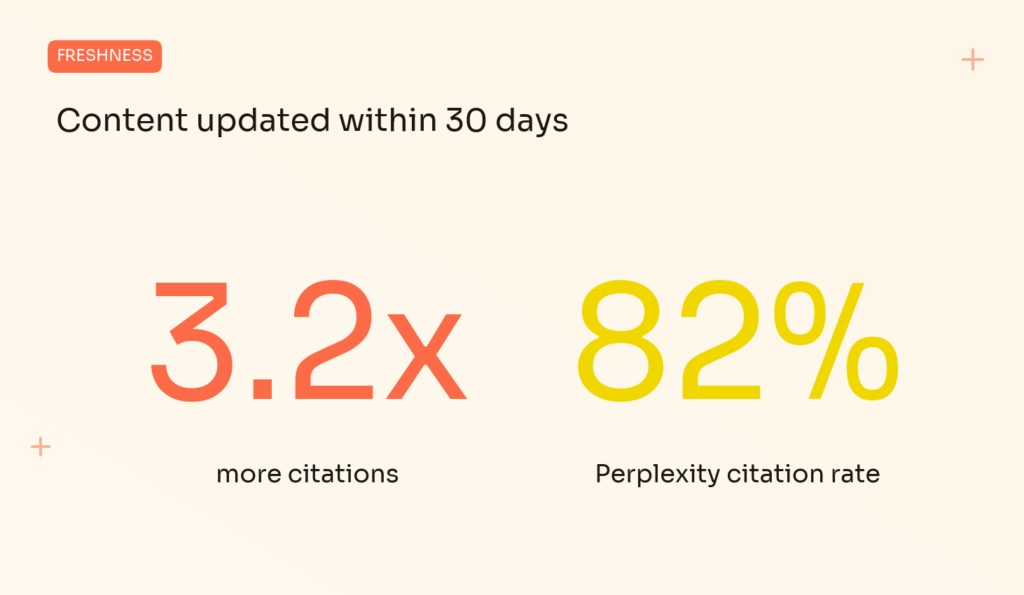
- Recency. Analysis of 118,000 responses found Perplexity cited content updated within 30 days at an 82% rate, and a separate Goodie AI study found content refreshed inside 30 days earned 3.2 times more citations across platforms.
- Structure. Clear headings, explicit question-and-answer formatting, and schema markup make a page easier to parse.
- Depth on a narrow topic. Focused, thorough coverage of one subject outperforms broad, shallow coverage of many.
- Corroboration. Claims that appear consistently across independent sources get picked up more readily than claims that live only on your own site.
Step-by-Step: Getting Your B2B SaaS Brand Cited
1. Make sure Perplexity’s crawler can actually reach your site
- Check robots.txt. Confirm you are not accidentally blocking PerplexityBot. Hosting and CDN defaults change without anyone being told.
- Render server-side where possible. Pages that depend on client-side JavaScript may not be retrieved at all. See Do AI Crawlers Render JavaScript? The Honest Answer for how wide the gap is between what Google sees and what AI crawlers see on the same page.
- Keep your sitemap current, since Perplexity’s retrieval leans partly on existing web indexes.
- Consider llms.txt, with realistic expectations. It costs little. Whether it does anything measurable is a separate question, covered in llms.txt: What It Is and Whether You Need One.
2. Map your pages to the queries you actually want to win
Identify the specific queries where you want to appear, then check whether existing content covers them or whether you need something new.
The highest-value query types for B2B SaaS:
- Category queries: “best [category] software for [use case]”
- Comparison queries: “[Your Brand] vs [Competitor]”, “alternatives to [Competitor]”
- Problem and solution queries: “how to solve [X] for [ICP]”
- Feature and benefit queries: “what is [feature] in [category]”
Build a tracking sheet mapping each target query to your primary URL, supporting content, and any third-party pages where you are already mentioned.
3. Structure content so it is easy to extract and cite
- Front-load the answer. Put a direct, concise answer in the opening paragraph, especially for definitional queries.
- Use headings that mirror how people actually ask the question.
- Add explicit question-and-answer blocks where they fit naturally.
- Use specific numbers and named frameworks instead of vague claims. “The market grew 23% in 2025” is citable. “The market grew strongly” is not.
- Implement schema markup via JSON-LD: Article, FAQPage, HowTo, Organization. Make sure datePublished and dateModified are in the schema, not just displayed for humans. A date visible on the page but absent from the markup reads as undated.
- Build internal topic clusters with a pillar page and supporting articles.
- Refresh priority pages quarterly. Given the freshness weighting above, this is the single highest-return maintenance habit for Perplexity specifically.
Most of this overlaps with what good SEO content writing already demands, and a proper content brief that specifies structure before drafting starts is how you make it repeatable rather than occasional.
4. Build entity signals across the wider web
Perplexity does not evaluate your brand only from your own site. It checks whether independent sources corroborate what you say about yourself.
- Keep naming consistent for your brand and products across your site, profiles, and press mentions. Fragmented naming weakens the entity signal even when coverage exists.
- Maintain detailed review profiles on G2, Capterra, TrustRadius and similar. Note that review count matters far less than profile structure and consistency with your own site copy. See G2 and Capterra AI Visibility for what actually moves the needle, and why the standard advice here overstates the return.
- Participate authentically in communities where your category is genuinely discussed.
- Pursue earned media. Independent coverage carries more weight than anything you publish about yourself, because it is corroboration rather than assertion.
5. Build out comparison and alternative content
Vendor comparison queries are one of the biggest citation opportunities in B2B SaaS, because they are exactly the kind of query where buyers want a synthesised, sourced answer.
- “[Your Brand] vs [Competitor]” pages: honest, structured, with clear tables and guidance on which use cases favour which tool.
- “Alternatives to [Competitor]” pages: position your brand as a genuine alternative with specific differentiators.
- Category “best of” posts: built around stated criteria, not thinly veiled self-promotion.
Owning the definitive list for your category, rather than only head-to-head pages, is one of the highest-leverage moves in this playbook. See how comparison pages work as a citation asset rather than a bottom-funnel afterthought.
6. Use Reddit and community threads, but treat the percentages with caution
Reddit appears as a heavily cited source across nearly every AI citation study published this year, and multiple independent studies agree it is top-tier for Perplexity specifically. Fewer agree on how large its share actually is, and reported figures vary enough by methodology and query category that we are not going to quote a single number here. Some B2B SaaS-specific analyses find Reddit’s share notably smaller than aggregate numbers suggest.
There is also a structural limit worth understanding. When Perplexity pulls from a Reddit thread, it cites the thread, not you. A positive mention in r/SaaS reinforces that the community rates your tool. It does not build your domain as a citable entity.
For more on Reddit alongside two other channels teams underrate, see Reddit ,LinkedIn, and YouTube: The Channels You Ignore.
Practical approach regardless of the exact percentage:
- Participate where your buyers actually are, not wherever traffic is highest.
- Answer with substance. Long, specific, experience-based answers get cited. Promotional one-liners do not.
- Link to your own content sparingly, and only when it genuinely helps the thread.
7. Track your Perplexity visibility and iterate
You cannot optimise what you are not measuring, and a mention with no link back to your site is exposure you cannot convert or report on. See Your AI Visibility ROI Number Is Mostly a Guess for what to report instead of a single invented score.
One methodological point that most guides skip. A 1,200-prompt study that ran every prompt three times per engine found AI citation behaviour is genuinely non-deterministic, which means a single check is a sample, not a measurement. Perplexity was the most reproducible engine tested, but “most reproducible” is not “deterministic”. Run each query more than once before drawing conclusions.
- Define a fixed set of 20 to 50 core queries across category, comparison, and use-case questions.
- Track two things separately: whether your brand name appears in the answer text, and whether your domain appears in the citation list. These are not the same thing.
- Log details per query: date, mention yes or no, citation URL, how prominently you are positioned, which competitors appeared, and whether the answer described you accurately.
- Check on a consistent cadence in a logged-out session, and run each query at least twice.
Useful metrics over time:
- Mention rate = queries where your brand appears anywhere in the answer, divided by total queries
- Citation rate = queries where your domain appears in the source list, divided by total queries
- Position quality = share of queries where you are the primary recommendation, not one option among several
If you would rather not build the tracking sheet yourself, our roundup of the best AEO tools for B2B SaaS covers which tools measure this properly and which just count mentions.
Common Mistakes B2B SaaS Brands Make
- Optimising only for Google and assuming rankings transfer. With roughly 11% domain overlap between ChatGPT and Perplexity, and Perplexity running its own retrieval, they do not. If your brand is missing across the board rather than on one engine, 5 Reasons Your Site Doesn’t Show Up in ChatGPT covers the causes that sit upstream of any single platform.
- Publishing thin, promotional content that lacks factual density or independent corroboration.
- Ignoring reviews and community presence while competitors build a real footprint.
- Treating a single citation check as data. Citation behaviour is stochastic. One run tells you very little.
- Not tracking at all, and finding out only when a sales rep mentions a competitor keeps coming up.
A Realistic 90-Day Plan
Weeks 1 to 2: Audit and baseline
- Confirm PerplexityBot can crawl your site and fix any blockers.
- Define your 30 to 50 target queries and run a baseline check, twice per query.
- Identify which competitors and third-party sources currently dominate those queries.
Weeks 3 to 6: Content and entity work
- Rewrite or build 5 to 10 priority pages with direct answers up front, clear headings, and valid schema including
dateModified. - Launch or refresh comparison and alternatives pages for your key competitors.
- Clean up your G2 and Capterra profiles for structure and naming consistency.
Weeks 7 to 12: Amplification and iteration
- Pursue coverage in a handful of industry publications or roundups.
- Participate genuinely in relevant community threads.
- Re-run your query set, compare against baseline, and prioritise the next round based on what actually moved.
Be sceptical of case studies promising precise before-and-after lifts. Claims like “0% to 60% in 90 days” are common in vendor marketing and rarely come with methodology. Results vary by category, competitive density, and how much entity presence you started with. Your own measurement is the only benchmark that means anything.
Final Thoughts
Perplexity citations are becoming a real form of brand equity in how B2B buyers discover and evaluate software. Winning them is not a single tactic. It is citation-friendly content on your own site, combined with a deliberate presence across review platforms, community discussion, and earned media, measured over time so you know what is actually working.
The one advantage worth holding onto: of the major AI surfaces, Perplexity has the lowest quality threshold and the strongest freshness weighting. That combination favours small teams who publish consistently over large teams who published something comprehensive two years ago. For most B2B SaaS companies reading this, that is the most winnable ground in AI search right now.
Start by understanding how the retrieval process selects sources, then build toward it systematically rather than chasing any single statistic from any single study.
Want to know where you currently stand? Run the AI visibility checklist, or book a call and we will walk through your category with you.

Jay is the co-founder of LymLyt and an AI partnership consultant helping B2B SaaS companies grow through content strategy, SEO, and AI integration. He writes about content marketing, what makes B2B content convert, and how SaaS teams can build content systems that drive real pipeline.