Sales and Marketing Alignment: 7 Fixes That Change Pipeline, Not Just Meetings
The most quoted sales and marketing alignment stat says aligned teams generate 208% more revenue. Nobody can find where it came from. One researcher who went looking found it isn’t in the LinkedIn guide it’s usually credited to, with no sample and no method behind it (Swotbee).
That tells you something. Alignment is the most agreed-on idea in B2B and the least measured one. In HubSpot’s 2025 State of Sales report, nearly 91% of sales professionals said their teams were strongly or somewhat aligned with marketing (HubSpot). Yet MQLs still get ignored, sales still builds its own decks, and pipeline still misses.
Sales and marketing alignment isn’t about getting along. It’s about one number, one set of definitions and one plan for the buying group. Here are 7 fixes that change pipeline, not just the meeting calendar.
What sales and marketing alignment actually means
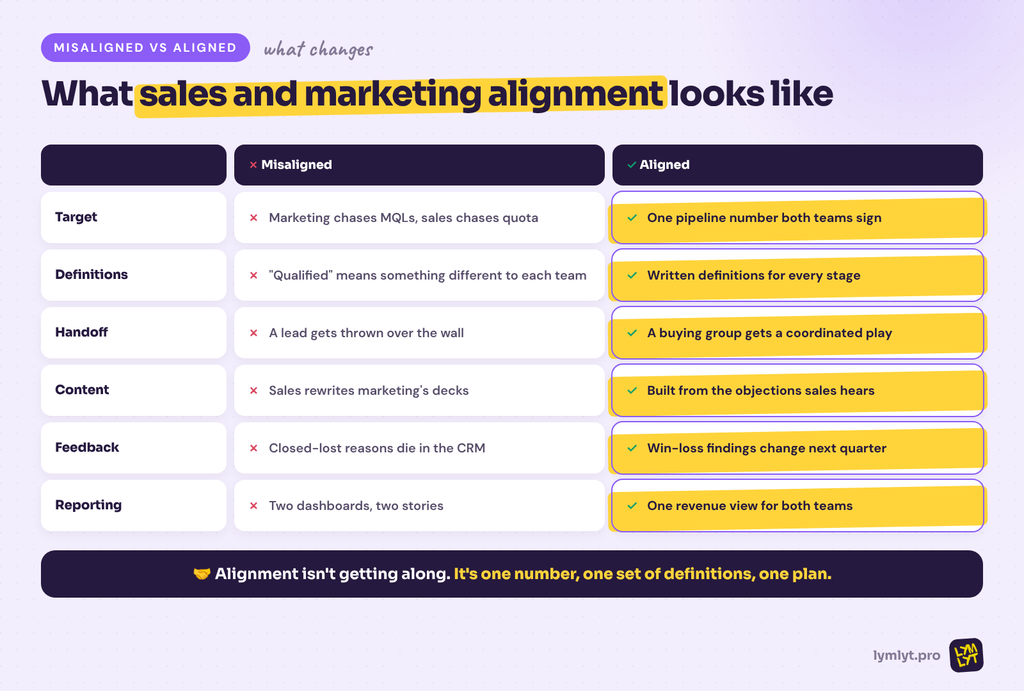
Sales and marketing alignment means both teams work toward the same revenue number, use the same definitions for every stage of the funnel, and share what they learn from buyers. It’s measured in pipeline and win rate, not in how many syncs are on the calendar.
| Misaligned | Aligned | |
|---|---|---|
| Target | Marketing chases MQLs, sales chases quota | One pipeline number both teams sign |
| Definitions | “Qualified” means something different to each team | Written definitions for every stage, with exit criteria |
| Handoff | A lead gets thrown over the wall | A buying group gets a coordinated play |
| Content | Sales rewrites marketing’s decks | Content is built from the objections sales hears |
| Feedback | Closed-lost reasons die in the CRM | Win-loss findings change next quarter’s plan |
| Reporting | Two dashboards, two stories | One revenue view: pipeline, conversion, win rate |
Why sales and marketing alignment matters more in 2026
The buyer changed. Your org chart didn’t.
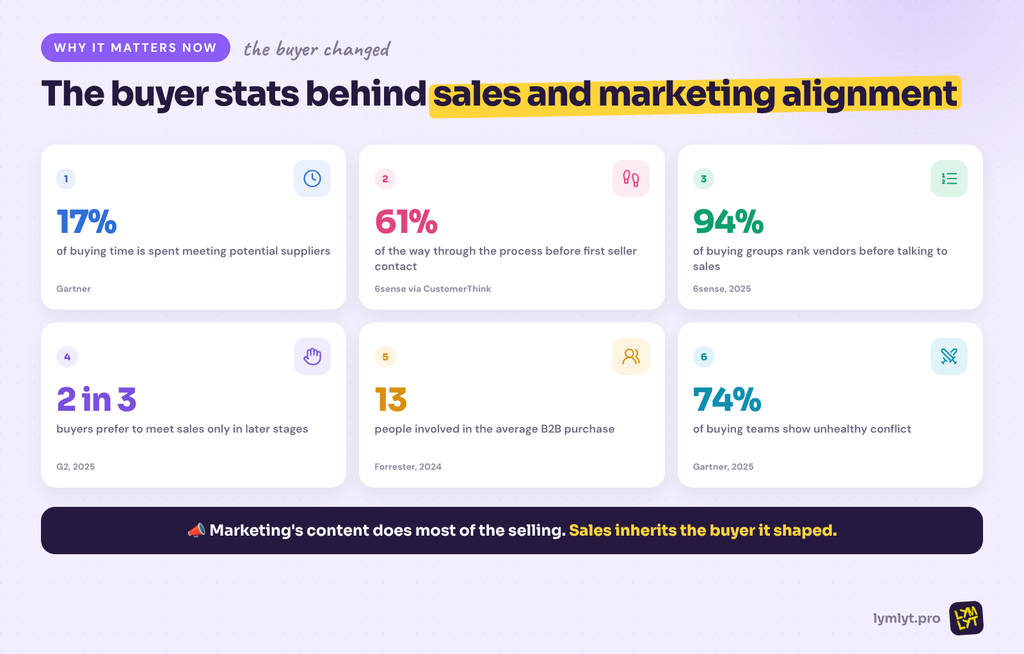
- Sales gets a sliver of the buyer’s time. Gartner found B2B buyers spend about 17% of their buying time meeting potential suppliers. Compare several vendors and any one rep gets about 5% to 6% (Gartner).
- The decision is mostly made before sales shows up. 6sense’s 2025 buyer research put first contact with sellers at 61% of the way through the buying process (CustomerThink), and 94% of buying groups had already ranked their preferred vendors (Business Wire).
- Buyers want sales later, not sooner. Nearly two in three B2B buyers prefer to engage vendor salespeople only in later stages, according to G2’s 2025 Buyer Behavior Report (Business Wire).
- There are 13 people to convince. Forrester’s 2024 research found an average of 13 people involved in a purchase (Forrester).
- The buying group fights. Gartner’s 2025 survey of 632 B2B buyers found 74% of buying teams showed unhealthy conflict during the decision. Groups that reached consensus were 2.5 times more likely to report a high-quality deal (Gartner).
Put those together and the split stops making sense. Marketing’s content does most of the selling. Sales inherits a buyer shaped by content it didn’t write. If the two teams tell different stories, the buying group hears both. Our guide to how the B2B buying journey starts before your funnel does covers the shift in detail.
7 fixes for sales and marketing alignment
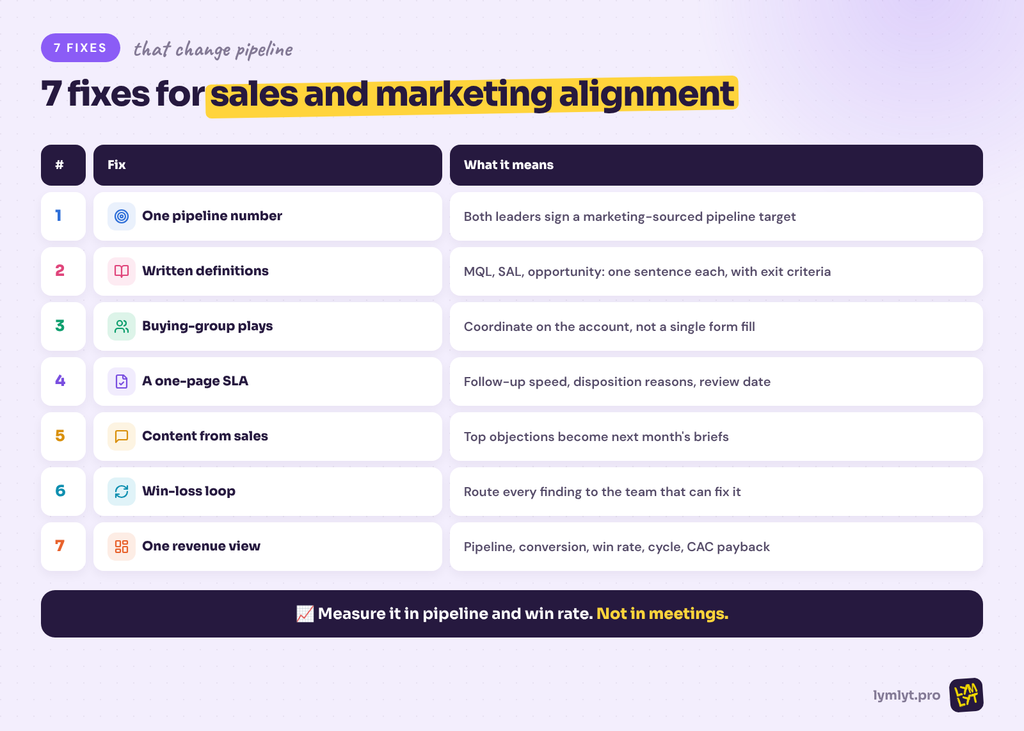
1. Agree on one pipeline number
Start with the target, not the relationship. Marketing and sales leaders sign one marketing-sourced pipeline number for the year, broken into quarters. Marketing owns hitting it. Sales owns working it.
If marketing is measured on MQLs and sales on bookings, you’ve built the conflict into the comp plan. Our guide on how to prove marketing ROI lists the pipeline metrics finance trusts.
2. Write down every definition
What’s a marketing-qualified lead? A sales-accepted lead? An opportunity? If you can’t answer in one sentence each, with exit criteria, neither can your teams.
Write them once, put them in the CRM and review them every quarter. Most “alignment problems” are definition problems. Our breakdown of why more MQLs can still mean less pipeline shows what happens when they drift.
3. Replace lead handoffs with buying-group plays
A single form fill isn’t a buying decision. Forrester’s 2025 marketing survey found 21% of marketing leaders rank the shift from leads to buying groups and opportunity management among their top priorities (Forrester). At Palo Alto Networks, win rates doubled during the pilot of that shift, though that’s one company’s result, not a benchmark (Forrester).
The play matters as much as the target. Gartner found content tailored to the whole buying group improved consensus by 20%, while content tailored to individuals reduced it by 59% (Gartner). Map who’s involved with our guide to the B2B buying committee, and build accounts from your ideal customer profile.
4. Put the handoff in a service-level agreement
An SLA turns good intentions into rules both teams can be held to. Keep it to one page:
- How fast sales follows up, and how many attempts it makes
- The disposition reasons sales must log: working, disqualified, recycled, converted
- What marketing commits to in volume and quality
- A review date, so the numbers get recalibrated instead of argued about
5. Build content from what sales hears
Sales hears the real objections every day. Marketing has the time and skills to answer them at scale. Connect the two.
Run a monthly 30-minute session where sales brings the top three objections and marketing leaves with three content briefs. AI marketing workflows can turn call notes into those briefs in minutes. That’s where the best comparison pages, case studies and thought leadership come from. It’s also how you stop sales from rewriting every deck: see our picks for the best AI presentation tools to make a shared library easy to keep current.
6. Close the loop with win-loss analysis
Your CRM says you lost on price. Your buyer might say something else. Interview buyers after the decision and route each finding to the team that can fix it. Keep battlecards current with one of the competitive intelligence tools for product marketers.
In Clozd’s 2025 report, 85% of ongoing, cross-functional win-loss programs saw positive ROI, compared with 55% of one-off projects (Clozd). Our guide to win-loss analysis has the question bank.
7. Report one revenue view
Kill the two-dashboard meeting. Build one view both teams present from:
- Marketing-sourced and influenced pipeline
- Stage conversion rates, from accepted lead to closed-won
- Win rate and sales cycle length by source
- Cost per opportunity and CAC payback
The SaaS content marketing metrics guide and our list of B2B marketing attribution tools help you build it. Expect it to miss things: our guide to the dark funnel covers what attribution can’t see.
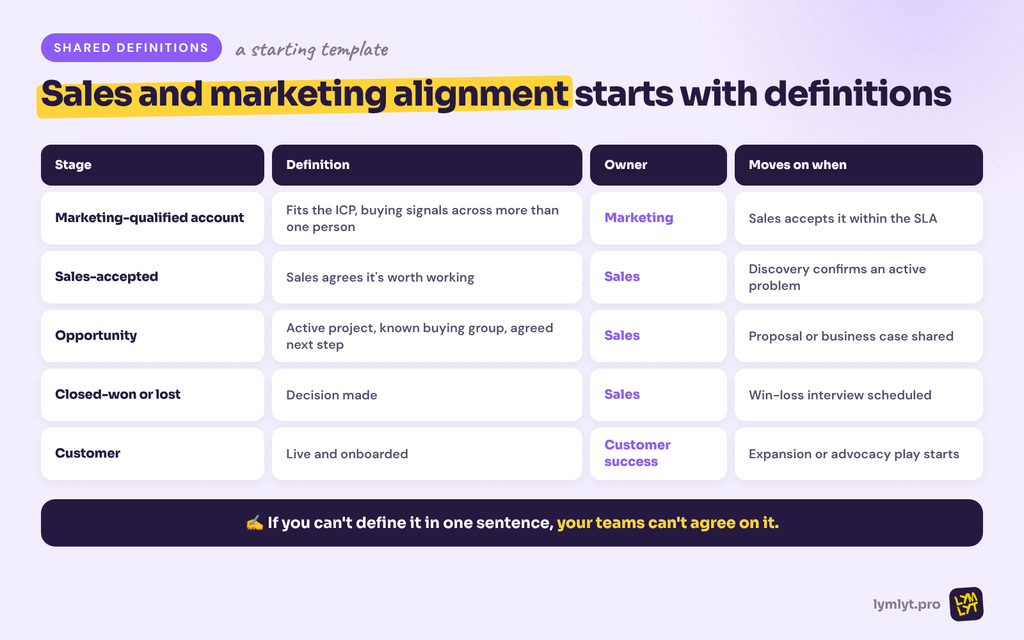
Shared funnel definitions: a starting template
Use this as a first draft, then adapt it to your sales motion.
| Stage | Definition | Owner | Moves on when |
|---|---|---|---|
| Marketing-qualified account | Fits the ICP and shows buying signals across more than one person | Marketing | Sales accepts it within the SLA window |
| Sales-accepted | Sales agrees it’s worth working | Sales | A discovery call confirms an active problem |
| Opportunity | Active project, known buying group, agreed next step | Sales | A proposal or business case is shared |
| Closed-won or lost | Decision made | Sales | Win-loss interview is scheduled |
| Customer | Live and onboarded | Customer success | Expansion or advocacy play starts |
Signs your sales and marketing alignment is broken
Tick three or more and you have a system problem, not a people problem:
- Sales says marketing’s leads are bad, and nobody can show the data
- Marketing doesn’t know the top reasons deals are lost
- Each team has its own pipeline number
- Sales builds its own decks and one-pagers
- Nobody owns the leads sales rejects
- Campaign plans are finished before sales sees them
- Customer stories come from marketing’s guesses, not sales calls
Three alignment myths to drop
“Aligned teams make 208% more revenue.” Possibly the most repeated stat in the category, and no one can trace it. Our piece on the AI citation telephone game shows how numbers like this spread.
“Alignment means more meetings.” It means fewer meetings with better inputs: one number, one dashboard and one objection review a month. Set the shared number when you plan the year’s B2B marketing budget allocation.
“Marketing’s job ends at the handoff.” Marketing content keeps working through the whole buying group, long after a rep is assigned, and AI has entered the buying committee too. That’s why employee advocacy from both teams and a clear B2B positioning matter after the first call too.
Frequently asked questions
What is sales and marketing alignment?
It’s when both teams share one revenue target, use the same funnel definitions and feed each other what they learn from buyers. You measure it in pipeline, conversion and win rate.
Who owns sales and marketing alignment?
Both team leaders, with revenue operations keeping the definitions, data and SLA honest. If you don’t have RevOps, see our list of marketing operations agencies, or B2B marketing agencies built for complex sales cycles.
How do you measure sales and marketing alignment?
Track sales acceptance rate, stage conversion, win rate and cycle length by source, plus SLA compliance on both sides. If those improve, alignment is working.
Is the 208% alignment stat real?
Nobody has traced it to a published study with a sample and method. Don’t put it in your board deck.
The bottom line
Sales and marketing alignment comes down to what you write down. One pipeline number. One set of definitions. One play for the buying group. One dashboard. The rest is calendar invites.
If the content half is what’s missing, LymLyt builds the comparison pages, case studies and thought leadership your sales team will actually send. See our pricing, from $1,499/month.

Jay is the co-founder of LymLyt and an AI partnership consultant helping B2B SaaS companies grow through content strategy, SEO, and AI integration. He writes about content marketing, what makes B2B content convert, and how SaaS teams can build content systems that drive real pipeline.