Best B2B Marketing Agencies for Complex Sales Cycles (2026)
A complex sales cycle is not just a long one. It is the kind of sale where six people need to say yes, procurement needs to sign off, legal wants to review the contract, and the original champion who loved your product has been quietly moved to a different team by the time you close.
Most marketing agencies are built for a different world. They optimize for click-through rates, lead volume, and top-of-funnel traffic. Those metrics mean something when a buyer can sign up with a credit card. They mean very little when your average deal takes seven months and involves a buying committee that your sales team has never fully mapped.
The agencies worth working with for complex sales cycles understand something different: that marketing’s job is not to hand leads to sales and walk away. It is to create content and touchpoints that keep buyers educated, confident, and convinced across an extended timeline, often long before they speak to anyone on your team.
This list covers the agencies that actually do that well, what each one does differently, and how to figure out which one fits where you are.
What makes a sales cycle “complex”
Before getting into the agencies, it helps to define the problem clearly, because “complex sales cycle” gets used loosely.
A genuinely complex sales cycle typically involves most of the following: multiple decision-makers with different priorities (a technical buyer, a financial approver, an end-user champion), deal values high enough that procurement and legal get involved, evaluation periods that run three to twelve months, and a constant risk that the deal stalls not because the buyer said no, but because internal momentum died.
In B2B SaaS, this shows up most frequently in adtech, martech, fintech, enterprise infrastructure, and compliance-heavy verticals. If your sales team regularly hears “we love it, we just need to get more people aligned,” you are in a complex sales cycle.
The marketing implication is significant. Content blindness becomes an acute problem when your buyers are receiving generic content at every stage of a long evaluation. The agencies below are selected specifically because they understand how to build content programs that stay useful and credible across that entire arc, from the moment a buyer first becomes aware of a problem to the moment they sign.
How we evaluated these agencies
Each agency on this list was assessed against four criteria:
Stage-aware content capability: Can they produce content that works at the awareness stage, the consideration stage, and the late-stage evaluation, or do they specialize in one layer and ignore the rest?
Multi-stakeholder thinking: Do they understand that the technical evaluator, the budget holder, and the end user need different messages from the same product?
Sales and marketing alignment: Do they treat content as something that feeds sales, not something that runs parallel to it?
Documented results: Do they have case studies with real numbers tied to pipeline or conversion, not just traffic?
Quick comparison
| Agency | Best for | Pricing | Core strength |
|---|---|---|---|
| LymLyt | Content-led growth across the full sales cycle | From $3,000/month | Stage-mapped content, conversion copy, sales enablement |
Holini | Paid acquisition and attribution for complex B2B sales cycles | Custom | Senior-led PPC, full-funnel measurement, CRM integration |
| Ironpaper | Demand gen and ABM for long sales cycles | Custom | Multi-stakeholder ABM, inbound, lead nurturing |
| Directive Consulting | Pipeline-tied paid media and SEO for SaaS | Custom | Customer Generation model, CAC and LTV focus |
| Refine Labs | Demand creation for mid-market and enterprise SaaS | Custom ($30M+ ARR) | Replacing MQL models with pipeline-first thinking |
| Velocity Partners | B2B messaging and thought leadership for tech companies | Custom | Copy strategy, narrative clarity for complex products |
| Powered by Search | Full-funnel demand gen for B2B SaaS with long cycles | Custom | SEO to demand gen pipeline, content tied to MRR |
| DemandLab | Revenue acceleration for complex B2B sales and marketing | Custom | Full-funnel orchestration, MarTech, nurture programs |
The agencies
1. LymLyt
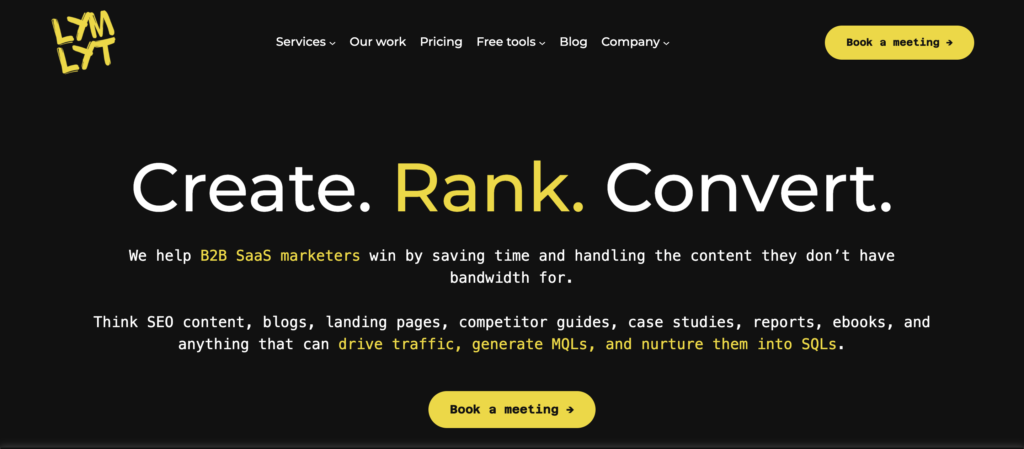
Best for: B2B SaaS companies in adtech, martech, salestech, and fintech that need content to do real work across a long sales cycle, not just sit at the top of the funnel.
LymLyt is an organic growth focused content marketing agency that works across the full sales cycle, from building awareness with top-of-funnel blog content to writing the comparison pages, sales enablement assets, and nurture sequences that close deals in the final stages of a seven-month evaluation.
Most content agencies produce content. LymLyt builds a content program with a specific commercial job to do at every stage of the buyer journey.
How LymLyt works within complex sales cycles
Complex sales cycles fail at predictable points. Buyers lose momentum between touchpoints. Procurement asks questions the sales team is not prepared for. A new stakeholder joins late and needs to get up to speed quickly. A competitor gets introduced and suddenly the deal is at risk.
LymLyt works to close those gaps through content that is built for each stage, not recycled across all of them.
At the awareness stage, the work focuses on SEO content and long-form blogs that put the brand in front of buyers before they know they have a problem to solve. The goal here is organic visibility and authority, not conversion.
At the consideration stage, the focus shifts to content that helps buyers build an internal case: in-depth guides, ROI frameworks, technical explainers, and content that speaks specifically to the concerns of different stakeholders within the same buying group. A CFO reading about your product needs different reassurance than a VP of Engineering evaluating the same product.
At the late stage, where most complex deals either close or stall, LymLyt produces the content that sales teams actually need in the room: competitor comparison pages written to address real objections rather than generic feature tables, case studies that make outcomes feel credible and specific, and landing pages that convert high-intent buyers who arrive already convinced but need a final reason to act.
Beyond the individual content types, LymLyt handles ideation, execution, distribution, and reporting across all of it, meaning the program runs as a connected system rather than a collection of one-off deliverables.
What LymLyt produces for complex sales cycles specifically:
- Buying-stage content maps that connect each content asset to a specific moment in the evaluation process
- Blog content targeting the search behavior of buyers in active research mode
- Nurture sequences for leads who are evaluating but not yet ready to commit
- Competitor comparison pages built around actual objections, not feature checklists
- Sales enablement assets that give your team something credible to share at every stage
- Case studies written to build confidence in the decision, not just describe the product
- ROI-framing content for financial stakeholders who need to justify the spend internally
- Social content for LinkedIn that keeps the brand visible during long evaluation periods
Results
Two published case studies illustrate what this looks like in practice.
For a B2B fintech company (~200 employees) with a long sales cycle and landing pages shared across both marketing and sales, the problem was not traffic. The pages had traffic. They were not converting. The sales team was sending prospects to comparison pages that read like internal documentation. LymLyt rewrote the copy without touching the design: tightened the message, addressed objections earlier, placed CTAs where intent peaked, and surfaced social proof where decisions actually happen. The result was a 5.8x increase in competitor page conversion rate and a 25% increase in leads from the same traffic, within three months.
For a bootstrapped email enrichment SaaS targeting sales teams and agencies, the challenge was that organic search was flat and the content that existed was not doing commercial work. LymLyt ran a full audit of 152 pages, rebuilt the content architecture around BOFU-first keywords tied to actual buyer intent, built authority through quality backlinks, and added case studies, glossaries, and social content to the distribution mix. Within six months: 4x organic traffic, 79% increase in organic leads, and domain authority climbing from 39 to 55.
Pricing: From $3,000/month retainer. Project-based work also available. No locked contracts or annual commitments.
Where LymLyt is not the right fit: If you need paid media management, ABM tooling, or CRM implementation alongside content, LymLyt handles the content side of the equation. You would combine it with a paid media or RevOps partner for a full-funnel program.
Book a 30-minute call to see how LymLyt fits into your sales cycle.
2. Holini
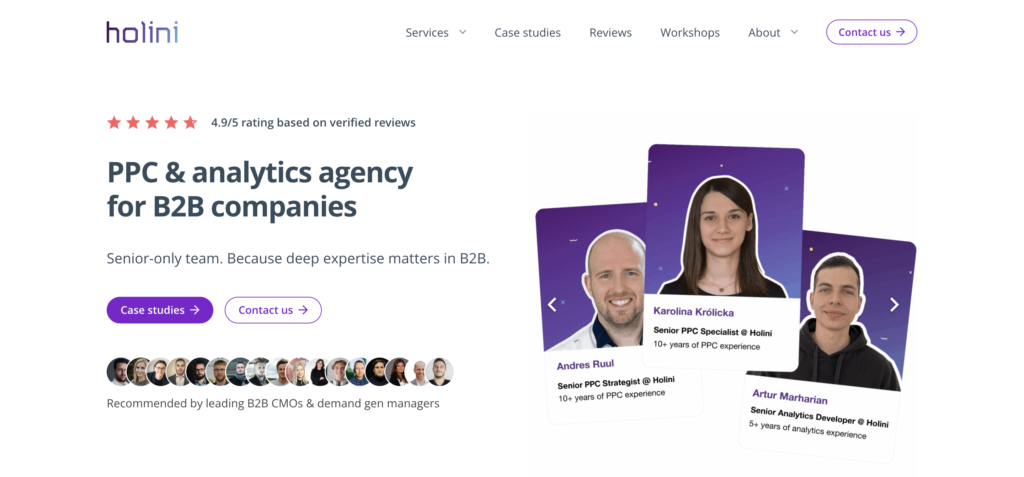
Best for: B2B SaaS and technology companies with complex sales cycles that need senior-led paid media and reliable measurement from advertising through pipeline and revenue.
Holini is a B2B PPC and analytics agency built around complex B2B buying journeys. Its senior-only team manages paid search and paid social while connecting advertising performance with CRM data, qualified pipeline, customer acquisition cost, and revenue.
This makes Holini particularly relevant when the problem is not simply generating more leads, but understanding which campaigns produce qualified opportunities and paying customers. Its services include Google Ads, Microsoft Ads, LinkedIn Ads, YouTube Ads, landing-page support, creative design, full-funnel measurement, analytics integrations, and custom reporting.
Holini builds its approach around each company’s ideal customer profile, buyer personas, positioning, and sales process. Campaigns can then be optimized using downstream sales outcomes rather than form submissions alone.
Results
For identity-verification company Veriff, Holini tripled opportunity pipeline value in three months and increased opportunity pipeline ROAS by 377%. The work included sending CRM opportunity, deal-value, and customer data to Google Ads through an API.
For HR technology company DeskTime, results from October 2024 compared with October 2022 included 86% more qualified leads, 106% more paying customers, and a 43% reduction in customer acquisition cost.
For CRM software company Livespace, Holini increased paid-search MQL volume by 37% and sales-accepted leads by 25% over six months. It also reduced MQL acquisition cost by 18%.
Pricing: Custom. Holini states that it is generally suited to growing B2B companies investing at least $10,000 per month in PPC ads.
Honest limitation: Holini specializes in paid acquisition and analytics rather than SEO, long-form content, lead nurturing, or sales-enablement production. If content gaps are the main reason deals are stalling, Holini would work better alongside a specialist content agency.
3. Ironpaper
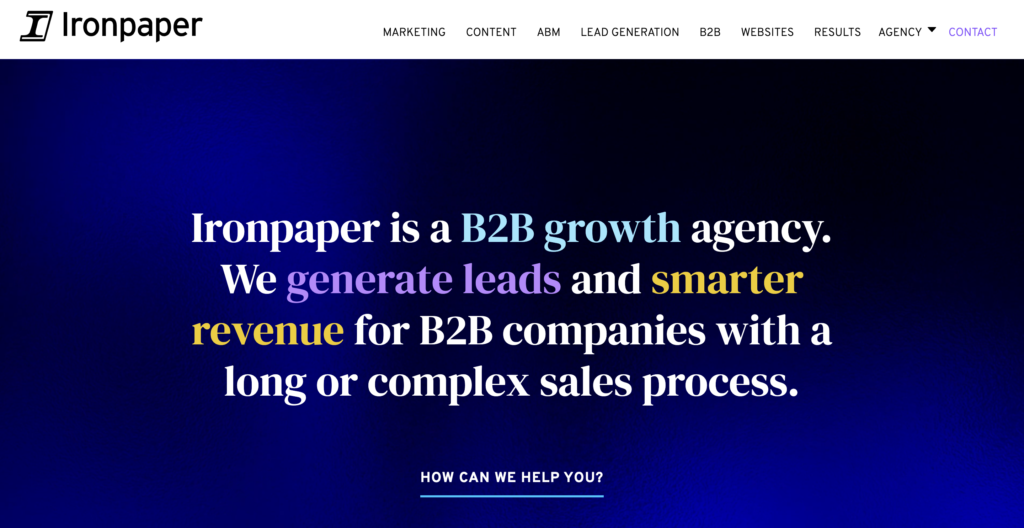
Best for: B2B companies with long or complex sales cycles that need demand generation, ABM, and content strategy working together rather than separately.
Ironpaper has operated with a single focus since 2003: marketing for companies where the buying process is inherently complex. They do not serve ecommerce brands or B2C companies. Every methodology they have built over two decades is shaped around multi-stakeholder buying committees, long evaluation windows, and the specific challenge of keeping prospects engaged and moving forward when deals can stall at any point.
Their approach combines ABM, inbound marketing, content, and sales enablement into integrated programs. The multi-stakeholder thinking is genuine: they build campaigns that address the different concerns of technical evaluators, financial approvers, and end-user champions within the same account, rather than targeting the single contact who filled out a form.
They work primarily with technology, SaaS, industrial, and professional services companies.
Pricing: Custom. No published rates.
Honest limitation: Results are not instantaneous and require sustained collaboration. Some clients report an alignment period at the start before the team finds its footing. The model works best when the client team is actively engaged, not looking for an agency to run everything autonomously.
4. Directive Consulting
Best for: SaaS and technology companies that need marketing performance tied directly to pipeline and customer acquisition cost, not lead volume.
Directive’s Customer Generation model is built around one argument: the right unit of measurement for B2B marketing is not leads, it is customers. They connect paid media, SEO, and content marketing directly to CAC and LTV, which makes them a natural fit for companies where the sales cycle is long enough that lead volume means nothing without knowing what percentage of those leads actually close.
Their client roster includes Cisco, ZoomInfo, and Gong. They are also investing seriously in Generative Engine Optimization, which matters for complex-cycle companies because buyers in long evaluations increasingly use AI search to build their shortlists before engaging any vendor.
Pricing: Custom. Mid-market to enterprise positioning.
Honest limitation: Directive is a paid-media-first agency that layers in content. If content-led organic growth is your primary acquisition channel, they are less the right fit than if you need paid and organic working as one system.
5. Refine Labs
Best for: Mid-market and enterprise SaaS companies ready to move away from MQL-driven lead generation toward a demand creation model.
Refine Labs built their reputation on a pointed argument: the standard B2B marketing playbook of gating content, chasing MQLs, and reporting on lead volume is actively counterproductive for complex sales cycles. Buyers in long evaluations do not fill out forms to get a PDF. They consume content, talk to peers, and form opinions before they ever talk to a vendor. Refine Labs rebuilds marketing programs around how buyers actually behave rather than how marketing teams prefer to measure.
Their Revenue Engine Optimization framework and Brand, Demand, Expand methodology produce clients who consistently describe a shift from chasing MQLs to tracking pipeline contribution.
Pricing: Custom. Their published sweet spot is mid-market and enterprise SaaS with at least $30M ARR, ACVs around $25K or higher, and existing paid media spend of $50K or more per month.
Honest limitation: This is explicitly not an early-stage agency. The pricing, the change-management intensity, and the strategic scope are sized for organizations with mature marketing operations. If you are pre-Series B, Refine Labs is not the right fit yet.
6. Velocity Partners
Best for: B2B technology companies that need sharper messaging and thought leadership to differentiate a complex product to a sophisticated audience.
Velocity Partners has been producing B2B content for technology companies for long enough that they predate the term “content marketing.” Their specific strength is narrative: helping companies that sell genuinely complex products articulate what they do and why it matters to buyers who are smart, skeptical, and tired of vendor noise.
For companies in complex sales cycles, this matters because the content that fails most often is not bad content. It is content that is accurate but not persuasive, detailed but not clear, and thorough but not differentiated. Velocity Partners fixes that problem at the messaging level, which then flows through to every content asset downstream.
Notable clients include Salesforce, DocuSign, and Alteryx.
Pricing: Custom.
Honest limitation: Velocity Partners leads with strategy and messaging rather than SEO or demand generation. If your primary need is organic traffic and pipeline, they work best combined with a content execution partner.
7. Powered by Search
Best for: B2B SaaS companies that need to move from lead generation to demand generation and want organic content connected directly to revenue metrics.
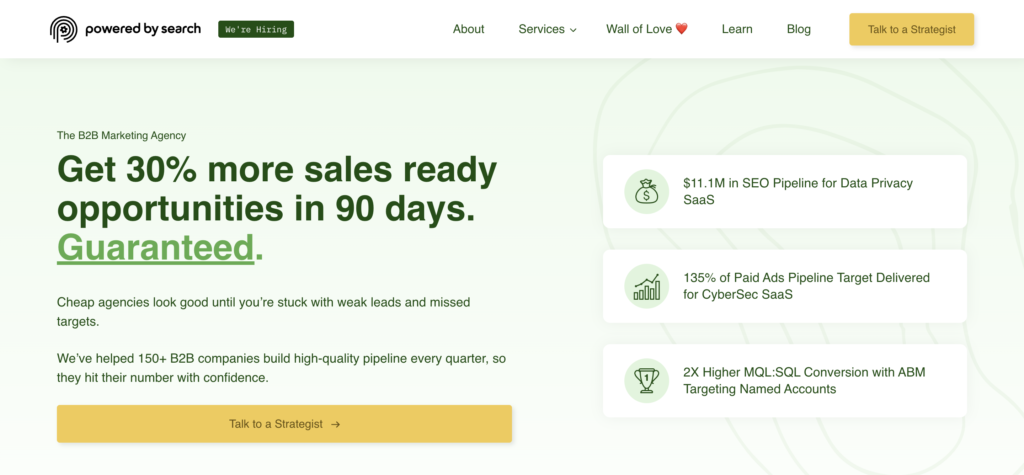
Powered by Search positions itself as a B2B SaaS growth marketing agency focused on helping companies shift from lead gen to demand gen. Their model integrates SEO-driven content with paid media and demand generation strategy, treating organic search as a revenue channel rather than a traffic channel. For companies with complex sales cycles, that framing matters: they report against MRR impact and pipeline contribution, not keyword rankings or session counts.
Their approach starts with identifying where deals are actually stalling and working backward to build content that addresses those friction points. They have published work covering how to connect content activity to CRM pipeline data, which is a practical capability for companies with multi-month sales cycles where attribution is otherwise messy.
They work primarily with B2B SaaS companies at the growth stage.
Pricing: Custom. No published rates.
Honest limitation: Powered by Search works best when you have at least some existing pipeline data to work with. If you are pre-revenue or very early stage, the demand-gen model requires more groundwork before it produces results.
8. DemandLab
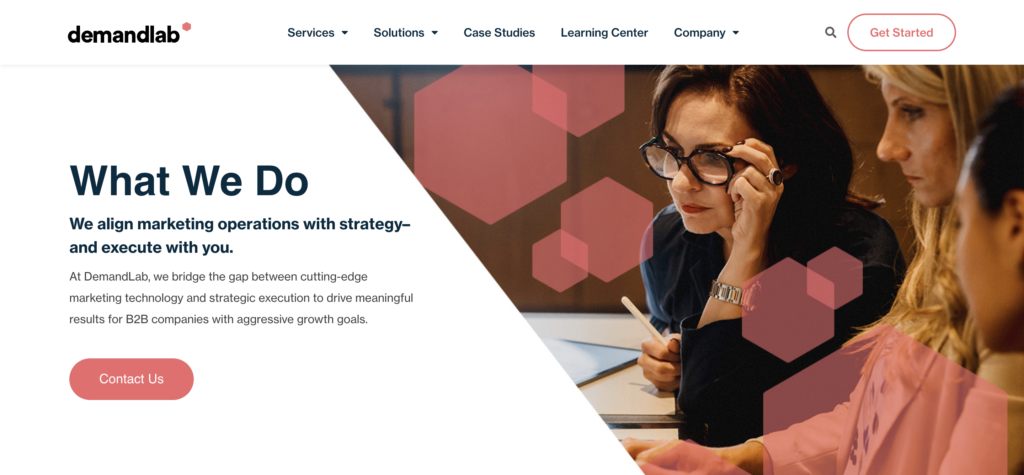
Best for: B2B companies with complex sales and marketing operations that need content, nurture programs, and MarTech working together as one connected system.
DemandLab specializes in revenue acceleration for B2B organizations where the sales cycle is long, the buying committee is large, and marketing automation is already in place but not producing the results it should. Their work sits at the intersection of content strategy, demand generation, and MarTech implementation, which makes them relevant for companies where the problem is not that content does not exist, but that it is not reaching the right stakeholders at the right moment.
For complex sales cycles specifically, DemandLab builds nurture programs that account for the different roles involved in a purchase decision and the different questions each of those roles needs answered before they will advocate internally. They connect that content architecture to marketing automation platforms so that the right asset reaches the right person based on where they are in the evaluation, rather than blasting the same sequence to everyone.
They work across B2B technology, financial services, healthcare technology, and professional services.
Pricing: Custom.
Honest limitation: DemandLab’s value scales with the maturity of your MarTech stack. If you are not already running marketing automation, you would need to invest in that infrastructure alongside the agency engagement, which adds cost and timeline.
How to think about agency fit for your sales cycle
The mistake most companies make is choosing an agency based on channel (content, paid, ABM) rather than based on where their sales cycle is actually breaking down.
If deals are stalling at the awareness stage because buyers do not know you exist, the priority is organic content and SEO. LymLyt and Powered by Search are the right starting point.
If deals are stalling at the consideration stage because buyers know you exist but cannot build internal consensus, the priority is multi-stakeholder content: technical explainers, ROI guides, case studies, and nurture sequences. LymLyt, Ironpaper, and DemandLab all address this directly.
If deals are stalling at the late stage because buyers are comparing you against competitors and your content is not helping them decide, the priority is conversion copy: comparison pages, sales enablement assets, and case studies that make outcomes feel real. The fintech case study above is exactly this scenario.
If deals are stalling because marketing and sales are working from different playbooks and leads are disappearing into a pipeline that nobody trusts, the priority is demand generation strategy and attribution. Refine Labs and Directive are built for that problem.
Most companies in complex sales cycles have more than one of these problems simultaneously. The practical answer is to pick the agency that addresses the most urgent one, get that working, and then layer in what else you need.
What does complex-cycle content actually cost?
The honest answer is that content for complex sales cycles costs more than generic content, because it requires more thought, more research, and more coordination with your sales team to produce something that actually helps in the room.
At the low end, a focused content retainer covering blog content, one or two sales enablement assets, and a nurture sequence starts around $3,000/month. That covers the essentials for an early-stage company.
At the mid tier, $5,000–$10,000/month gets you a fuller program: stage-mapped content across the full funnel, regular competitor comparison page updates, case studies, and distribution through owned channels.
At the top of the range, $10,000–$20,000+/month is where full-service organic growth programs with strategy, production, link-building, and attribution reporting live.
One thing worth being clear about: none of this is a substitute for sales enablement investment. The best content program in the world does not close deals if your sales team does not know the content exists or does not use it. The agencies that work best in complex sales cycles are the ones that treat the sales team as a distribution channel for content, not as a separate function.
Frequently asked questions
How does content marketing actually help a long sales cycle?
It works at three levels. First, it puts you in front of buyers during the awareness phase, before they have a vendor shortlist. Second, it gives buyers the information they need to build internal consensus during the evaluation phase, which is where most complex deals stall. Third, it gives your sales team something credible to share at each stage rather than relying on custom decks and one-off emails. Content that is built with the sales cycle in mind reduces the amount of manual work sales has to do and keeps deals moving forward between conversations.
Should we gate our content or leave it ungated?
For complex sales cycles, the gating question is usually the wrong question. Buyers in long evaluations are not going to give you their contact information to read a PDF. They will read whatever is publicly available and form an opinion before they ever fill out a form. The more useful question is: is this content good enough that someone in active evaluation would find it genuinely useful? If yes, publish it without a gate and let it do its work. If it is only worth reading if you force people to trade contact details for it, the content is the problem.
How do we measure ROI when the sales cycle is seven months long?
Measure what you can attribute: organic leads from content, time spent on key pages by accounts in your CRM, content assets shared by sales, influence on deals that closed. The right metrics are not traffic or lead volume. They are: did a prospect engage with our content before signing? Did the sales team use our content in a late-stage conversation? Did the deal close faster than average for accounts that consumed content versus those that did not? Those questions take time to answer, but they are the right ones to track.
How do we align marketing content with what sales actually needs?
Start by asking your sales team what questions they get asked most often in late-stage conversations, what objections kill deals, and what competitor comparisons come up most frequently. Then build content that answers those questions before the conversation happens. A piece of content that saves a sales rep from having to write a custom email for the fifteenth time is content that is earning its keep.
The bottom line
Complex sales cycles do not get fixed by publishing more content. They get fixed by publishing content that is built for specific moments in the evaluation, distributed to the right people at the right stage, and connected to what the sales team is doing in the room.
If you are a B2B SaaS company in adtech, martech, or fintech and want to talk through what that looks like in practice, book a 30-minute call with LymLyt. We will tell you honestly what we would focus on and whether we are the right fit.
Disclaimer: Pricing and services are subject to change. All figures are sourced from publicly available information as of mid-2026. Always verify directly with agencies before making a decision.

Rashmita is content marketer with 8 years of experience building and growing SaaS brands. Now she tests various AI tools for marketers and shares her feedback on this blog, LinkedIn, Instagram, and YouTube.