Pricing Prompts: We Asked 4 AI Engines What Tools Cost
We ran 48 pricing prompts through four AI engines expecting to catch wrong prices. Our working hypothesis, written down before the run, was that more than half the answers would carry a stale or incorrect figure, and that the bad numbers would trace back to third-party roundups.
That is not what happened. On pricing prompts for a well-documented tool, all four engines returned the correct tier ladder. The hypothesis was wrong, and saying so is more useful than quietly rewriting it.
The failures were real, they were just somewhere else. Here is what we ran, what we found, and what broke in our own method.
What we ran
Twelve pricing prompts across four brands, in four engines. Three prompts per brand: “how much does X cost”, “what’s included in X pricing”, and “is X worth the money”.
The brands were Ahrefs, Semrush, HubSpot and LymLyt, three of which also appear in our comparison query study. We included ourselves deliberately. A study that only tests other people is easy to dismiss, and we publish a price where most agencies do not.
The engines were ChatGPT, Claude, Google AI Mode and Perplexity, on the free tier of each, default model, no deep research mode. They retrieve and cite very differently, which is why a single-engine run is close to useless. That is what a buyer doing quick research actually sees.
This is the pricing run of the shortlist prompts framework, the evaluation half of AI visibility: the four question types buyers ask once they already know your name. The comparison run is published here, and the method is written up as a repeatable audit.
Ground truth came from the live vendor pricing pages, checked the same week. Every pricing prompt was typed bare, with no context about company size or use case, because that is how buyers ask.
What went wrong with our own run
Three things, stated before any findings.
ChatGPT was contaminated by account memory. The prompts were generic. The answers were not. ChatGPT repeatedly wrote things like “for LymLyt, the interesting ones are probably Starter vs Lite” and offered to work out “what you’d actually need to pay for 10 to 20 clients”. Nobody mentioned LymLyt in those prompts. Its memory did. Every ChatGPT row in this run describes an answer shaped for one agency owner rather than a generic buyer, so we are reporting them as directional only.
Four rows were recorded wrong, then re-run. Four of the twelve Google AI Mode captures were ChatGPT answers filed in the wrong column. We caught it because every link carried a ChatGPT tracking parameter. The whole AI Mode set was re-captured, and the figures below use the corrected data.
Ground truth is same-day for four brands, partial on one. We checked the live pricing pages for Ahrefs, Semrush, HubSpot and LymLyt the same week. The Ahrefs capture covers Lite, Standard and Advanced but not Starter or Enterprise, so those two figures are verified against published sources rather than our own screenshot. We have marked them as such rather than claiming more than we checked.
So this is a smaller study than we planned. The honest version of a research post includes the parts that did not work.
Finding one: pricing prompts returned the right numbers
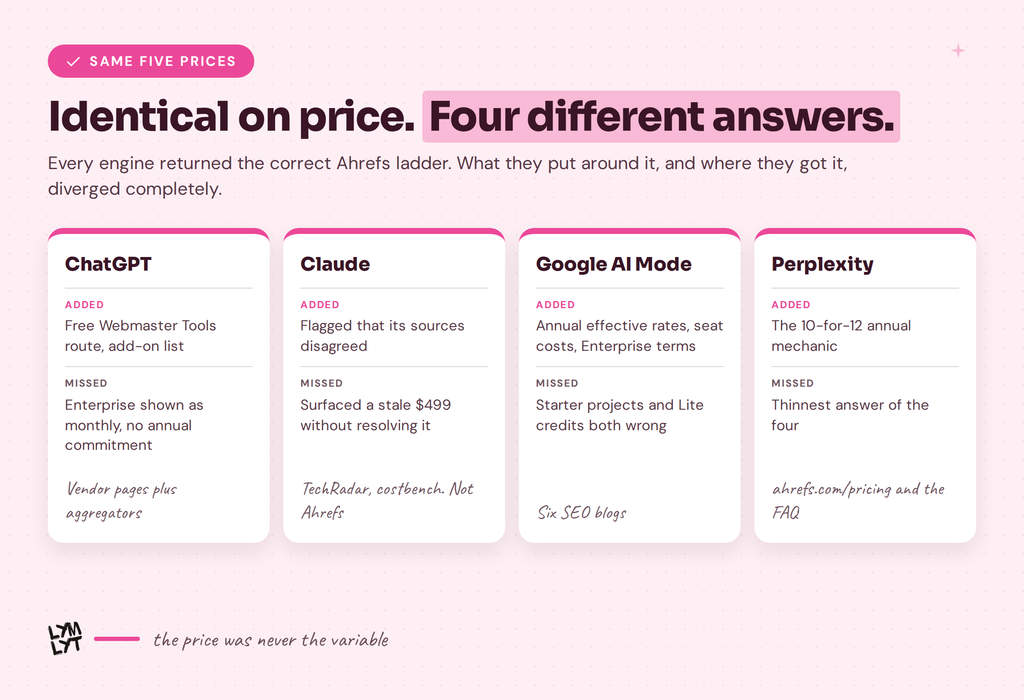
On Ahrefs, every engine returned the correct ladder. Starter $29, Lite $129, Standard $249, Advanced $449, Enterprise $1,499. Verified against the vendor’s own page.
That surprised us. Pricing is the most volatile thing on a software site and the most commonly wrong figure in third-party content. Our outreach tools roundup found four of ten prices wrong across the roundups that publish them, which is where the hypothesis came from.
The difference is coverage. Ahrefs pricing is documented across dozens of pages that are updated constantly because pricing posts earn traffic. The engines had plenty of consistent material to draw on.
What did vary was everything around the number. One engine gave annual effective rates and seat costs, another gave neither. One cited the vendor, another cited TechRadar. The tier prices were the only thing all four agreed on.
The obvious implication is the uncomfortable one. If your pricing is thinly covered, or only appears on pages nobody updates, you do not get this result. Accuracy here is a by-product of somebody else’s content volume, not of your own pricing page. That is the same dependency our citation study found across buying questions generally.
Finding two: pricing prompts cited everyone except the vendor
Correct answers, built from other people’s pages.
Google AI Mode’s pricing answer cited maintouch.com, searchatlas.com, checkthat.ai, tuningdigital.com, saleshive.com and clarorank.com. SEO blogs writing about pricing, not the company that sets it. No review platform appeared, and neither did the forums and video that carry so much of the load on other question types.
Claude cited TechRadar and costbench, and surfaced a claim that the median Ahrefs contract runs about $1,199 a year based on 171 verified purchases. We could not verify that anywhere, and it reads with more authority than it has earned.
Perplexity was the exception. It cited ahrefs.com/pricing and the Ahrefs FAQ directly, which is consistent with what we found about getting cited in Perplexity.
This matches the wider pattern from our citation study and from what the organic results look like on comparison queries: third parties carry the answer even when the vendor has published the same facts more clearly.
That dependency is the thing that has changed, and it is part of a wider shift in how buyers research. Your pricing page being correct is necessary and not sufficient. The pages quoting you need to be correct too, and that is an outreach problem.
Finding three: the errors are in the fine print
The headline numbers were right. The qualifications around them were not.
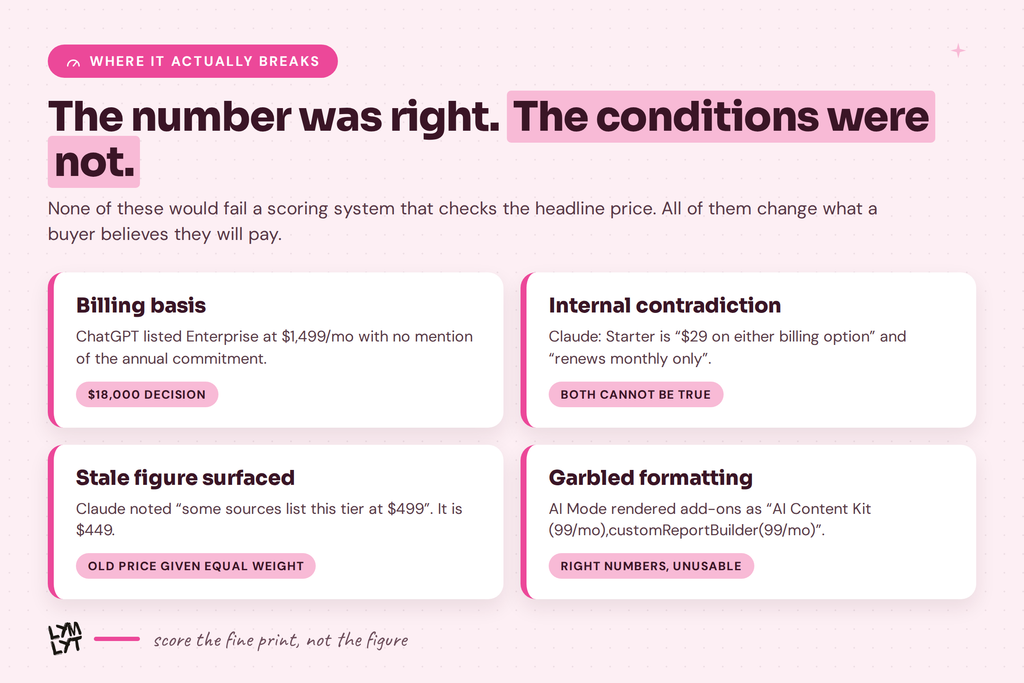
Billing basis. ChatGPT listed Enterprise at $1,499 a month with no mention of the annual commitment. Google AI Mode correctly recorded that Enterprise is annual-only. For a $1,499 line item, the difference between a monthly option and an $18,000 commitment is the entire decision.
Internal contradiction. Claude wrote that Starter is “$29 on either billing option” and then, in the same bullet, that it “renews monthly only”. Both cannot be true. The second is correct.
A stale figure presented as disagreement. Claude noted that “some sources list this tier at $499” for Advanced. The current price is $449. Rather than resolving the conflict, it surfaced the old number alongside the new one.
Garbled add-ons. Google AI Mode rendered the add-on list as “AI Content Kit (99/mo),customReportBuilder(99/mo)”, dropping the dollar signs and the spacing. The figures were right. The presentation was unusable.
None of these would show up in a scoring system that checks whether the headline price is correct. All of them change what a buyer believes they will pay.
Finding four: three engines found us, one had never heard of us
The most useful result in the run was the one about our own brand.
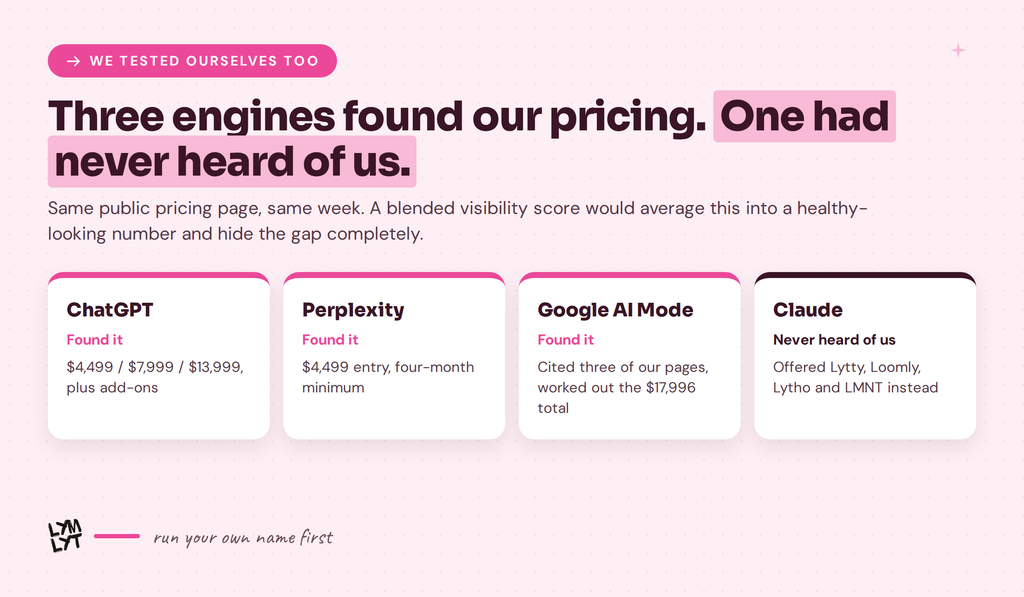
ChatGPT, Perplexity and Google AI Mode all pulled LymLyt’s live pricing page and returned the correct tiers: $4,499, $7,999 and $13,999, with the add-on list attached. AI Mode went further than the others, citing three separate LymLyt pages including one of our own blog posts, and working out that the four-month minimum on the entry plan means a total commitment of $17,996.
Claude returned: “I couldn’t find any product called LymLyt.” It then offered Lytty, Loomly, Lytho and LMNT as possible matches, and asked for the correct spelling.
That is not caution. Three other engines read the same public pricing page in the same week. It is a retrieval gap, and it is the single most relevant finding here for any company that is not Ahrefs or HubSpot.
The lesson generalizes. A brand with thin third-party coverage can be entirely invisible to one engine while appearing correctly in three others. A single blended AI visibility score would average this into a healthy-looking number and tell you nothing about the fact that a quarter of the engines has never heard of you.
If you are a smaller brand, run pricing prompts on your own name before you run anything else, and run them in every engine rather than the one you use. The answer might be that there is no answer.
Finding five: a superseded price list, presented as current
Google AI Mode’s Semrush answer was two answers stitched together.
Its “Semrush One” figures were perfect. SEO $139, Starter $199, Pro+ $299, Advanced $549, with annual rates of $117.33, $165.17, $248.17 and $455.67. Every one matches the live pricing page to the cent, annual included. That is the most accurate single block in the entire run.
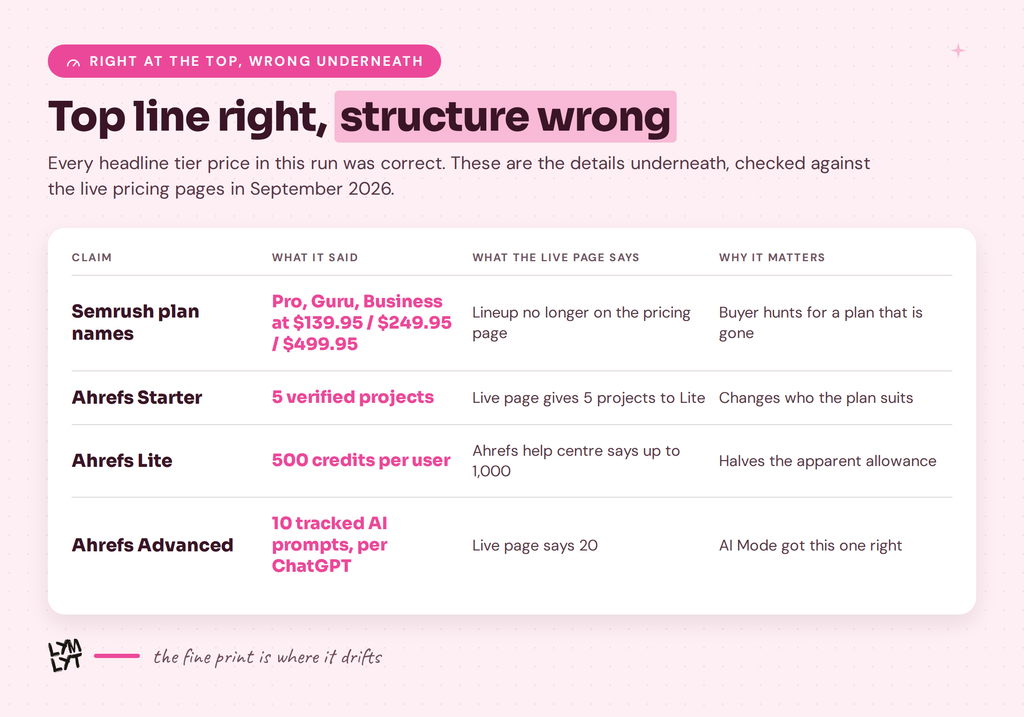
In the same answer it also presented a “SEO Classic” lineup of Pro at $139.95, Guru at $249.95 and Business at $499.95. That lineup does not appear on Semrush’s current pricing page. Semrush has restructured, and the engine served the old plan names alongside the new ones as though both were on sale.
A buyer reading that answer would go looking for a Guru plan that no longer exists.
The Ahrefs answers had smaller versions of the same problem. AI Mode said Starter allows 5 verified projects, where the live page gives 5 projects to Lite and Starter far fewer. It gave Lite 500 credits per user where Ahrefs’ help centre says up to 1,000.
ChatGPT was not immune. It listed Advanced at 10 tracked AI prompts. The live page says 20, which AI Mode got right.
The pattern holds across all of it: headline tier prices correct, the structure around them drifting. Plan names, allowances and seat counts are what a buyer uses to work out whether a plan fits, and those are the parts that decay first.
Finding six: it coached the buyer on how to pay less
This is the one vendors will care about most.
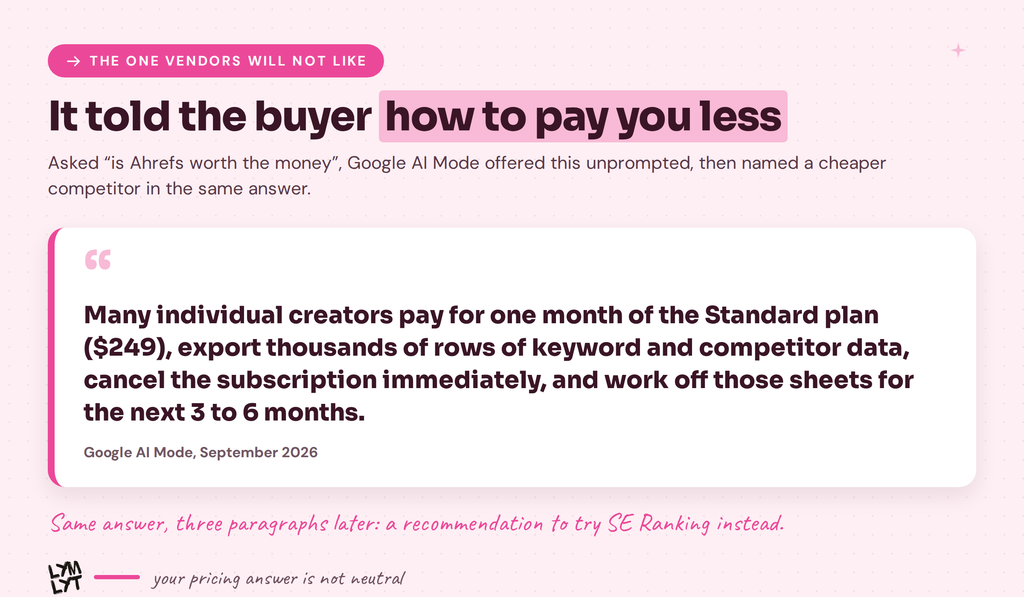
Asked whether Ahrefs was worth the money, Google AI Mode offered the “subscribe and cancel” method unprompted: buy one month of the $249 Standard plan, export thousands of rows of keyword and competitor data, cancel immediately, and work off those spreadsheets for the next three to six months.
Three paragraphs later, in the same answer, it recommended SE Ranking as a cheaper alternative.
Neither of those is an error. Both are defensible advice to a buyer. That is exactly what makes it worth knowing: your pricing answer is not a neutral restatement of your pricing page. It can explain how to extract most of your product’s value for one month’s fee, and name a competitor while doing it.
We saw the same third-competitor pattern in the organic results for comparison queries, where a rival’s page frequently outranks both vendors. The AI version is more direct, because it arrives as advice rather than a link.
Finding seven: nobody quoted the price we would actually pay
We ran these prompts from India. HubSpot serves localized pricing there: hubspot.in lists Starter at 585 rupees per seat, Professional at 66,697 rupees a month and Enterprise at 300,000 rupees.
All four engines answered in US dollars. ChatGPT, Claude, AI Mode and Perplexity all described HubSpot Professional in the $450 to $890 range. HubSpot is a useful test case for this, being the company whose own inbound traffic collapse made the case that visibility and outcome are separate problems. The rupee figure works out around $750 a month, so the dollar answers are not wildly wrong, but none of them is the number on the page a buyer in this market actually sees.
Perplexity came closest to acknowledging it, noting on another brand that prices are listed in USD and will vary with exchange rate, taxes and payment fees. Everyone else presented a dollar figure as the price.
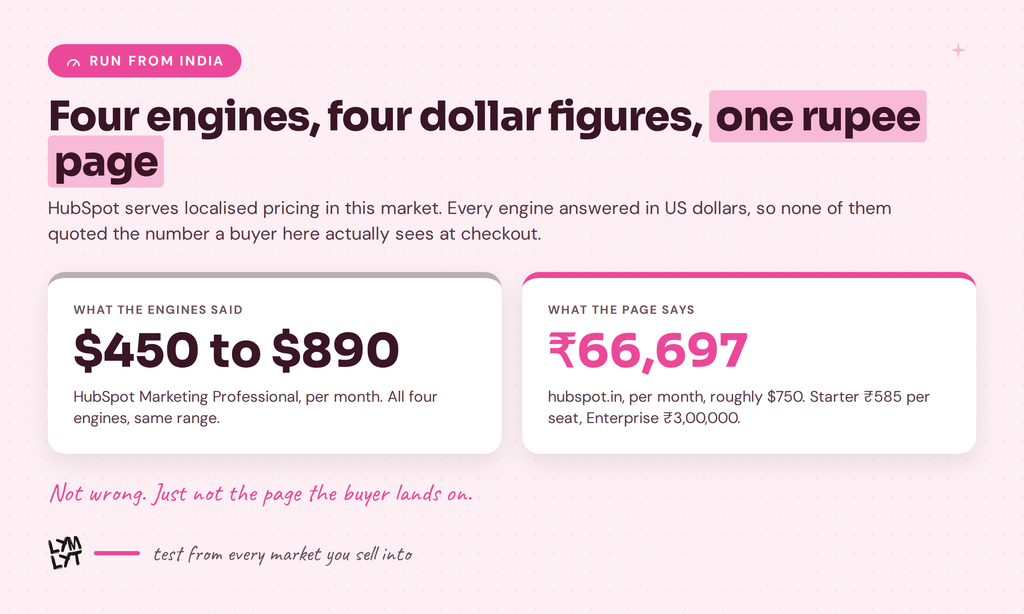
If you sell into multiple markets with localized pricing pages, this is worth testing from each one. The answer a buyer gets may be technically accurate and still not match the page they land on, and a mismatch between the AI answer and your checkout is a conversion problem before it is a visibility problem.
Finding eight: memory changed the answer
The ChatGPT contamination is a limitation of our run. It is also a finding.
Asked a generic pricing question, ChatGPT produced an answer tailored to a specific business it remembered, complete with recommendations about which tier that business should buy and offers to model the cost across its client base.
For buyers, this means the answer your prospect sees may be shaped by their own history rather than by your pricing page. Two buyers asking the same question get different answers, and neither one is the generic answer you optimized for.
For anyone running an audit, it means logged-out runs are not optional. We said so in the audit method and then failed to follow it ourselves, which is how this ended up documented rather than theorized.
What this means for your pricing page
Put the numbers in text. Not in an image, not behind a JavaScript toggle. Every engine that got Ahrefs right was reading text, which is the same reason pages fail to show up in ChatGPT at all.
Answer the question on the page. Engines lifted the tier tables almost verbatim where they existed, which is the structure argument in its simplest form.
State the billing basis next to every figure. The most common error in this run was a correct number attached to the wrong commitment. Write “annual commitment” beside the annual-only tier.
Date the page. A visible “updated September 2026” gives a retrieval system a recency signal and gives a buyer a reason to trust the number. It is one of the cheapest wins in generative engine optimisation.
List the add-ons as text too. The add-on line items were the most mangled part of every answer. Seats, credits, overages and optional modules are where the real bill is decided.
Check whether anyone is searching this way at all. Most pricing queries show negligible volume in a keyword tool, which is a reporting floor rather than evidence nobody asks.
Then go fix the third-party pages. Your page being right does not help if the engines are reading six SEO blogs. That is what comparison and alternatives pages are for on your own domain, and earned mentions for everyone else’s.
Run it yourself
Three prompts per brand: how much does X cost, what’s included in X pricing, is X worth the money. Your brand plus your two closest competitors, chosen from closed-lost data rather than the positioning deck, the same way the comparison pillar prioritizes pages.
Four engines, logged out, one prompt per fresh conversation, whole set in one sitting. Screenshot every answer including the expanded sources panel.
Then open the live pricing pages the same day and record every tier. Without same-day ground truth you have opinions, not data. We learned that the hard way on three of our four brands.
Log the price stated, the billing basis, the tiers named, the sources cited and any hedge language. The full audit method covers the rest, the AI visibility checklist covers the on-site half, and a tracking tool takes over once you pass fifteen prompts a run.
FAQ
What are pricing prompts? One of the four shortlist prompts: the questions a buyer asks once they know your name and are working out whether they can afford you. The other three are comparison, alternatives and migration.
Is this an SEO problem or an AI problem? Both, and they behave differently, which is the SEO versus AI search distinction. A pricing page can rank well and still be ignored by an engine reading six SEO blogs instead.
Are AI engines reliable on software pricing? On well-documented products, the headline numbers were accurate in this run. The qualifications around them, billing basis and add-ons, were not. Treat the number as probably right and the conditions as probably wrong.
Why did Claude fail to find a company with a public pricing page? We do not know. Three other engines found it the same week. Thin third-party coverage plus a different retrieval approach is the likeliest explanation, but that is a hypothesis, not a finding.
How does this fit with the rest of the work? Pricing is one of four shortlist prompts. The others are comparison, alternatives and migration, and each is answered by a different page, from a vs page to an alternatives page.
We expected to catch engines getting prices wrong. Instead we caught one that had never heard of us, one selling a plan that no longer exists, one that coached buyers on how to pay us less, and four that quoted prices in the wrong currency for the market we ran them from.
That is the job we do. See how we approach AI visibility and how we write comparison pages, look at our work, check pricing.

Jay is the co-founder of LymLyt and an AI partnership consultant helping B2B SaaS companies grow through content strategy, SEO, and AI integration. He writes about content marketing, what makes B2B content convert, and how SaaS teams can build content systems that drive real pipeline.