Reddit, LinkedIn, and YouTube: The Channels You Ignore
The AI citation channels most B2B SaaS teams treat as an afterthought are, according to multiple independent studies, the ones AI engines cite most. Reddit, LinkedIn, and YouTube rank among the top five most-cited domains across ChatGPT, Perplexity, Gemini, and Google’s AI Overviews.
Most content strategies still route budget toward the owned blog first and treat these three AI citation channels as an afterthought, or a place to repost a link. The data says that’s backwards.
Unlike the tactic covered in our llms.txt explainer, which turned out to show no measurable citation lift at all, the data behind these three channels is real and repeatedly verified. Here’s what’s actually confirmed, platform by platform.
Reddit: The Most-Cited AI Citation Channel, With a Real Caveat
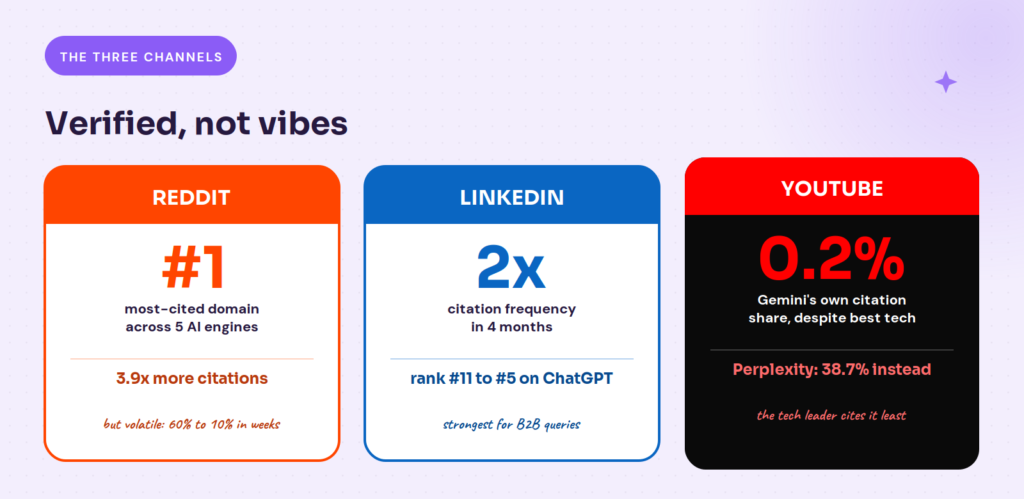
Peec AI’s analysis of 30 million directly-cited sources across ChatGPT, Google AI Mode, Gemini, Perplexity, and AI Overviews, published May 2026, ranked Reddit the single most-cited domain across all five engines combined. SE Ranking’s separate 129,000-domain study found brands with a substantial Reddit presence averaged 7 ChatGPT citations, against 1.8 for brands with minimal presence, a 3.9x difference.
The mechanism is different from traditional authority. AI engines treat Reddit threads as community-validated, experience-based answers rather than marketing copy. The signal isn’t backlinks. It’s discussion depth and the appearance of an unfiltered opinion.
Here’s the caveat most roundups skip. Semrush’s 13-week study of over 230,000 prompts found ChatGPT’s citation rate for Reddit collapsed from close to 60% of relevant prompt responses in early August 2025 to around 10% by mid-September, in a matter of weeks.
Reddit and Wikipedia remain among ChatGPT’s most-cited domains even after that drop, but the swing itself is the point: Reddit is not a stable, set-and-forget AI citation channel. Share can move sharply on a single platform update.
What to actually do: Build a genuine presence in the two or three subreddits that map directly to your category, not a broad spray. Answer real questions with specific product experience rather than link drops, since generic promotional replies get downvoted and buried, which removes them from what a model would ever surface.
LinkedIn: Built for the Queries You Actually Care About
Profound’s research covering 1.4 million citations from November 2025 to February 2026 found LinkedIn is the most-cited domain for professional queries specifically, across ChatGPT, Google AI Mode, AI Overviews, Microsoft Copilot, and Perplexity.
LinkedIn’s citation frequency doubled over that four-month window, with its rank on ChatGPT moving from roughly 11th to roughly 5th, the largest shift Profound tracked for any AI citation channel in the period.
That matters more for B2B SaaS than the Reddit numbers do, since LinkedIn’s citation strength concentrates specifically in professional and category-comparison queries, the exact shape of question a B2B buyer asks.
The credibility signal is implicit: a claim posted under a named professional identity, tied to a real company page, reads differently to a model than the same claim on an anonymous blog.
What to actually do: Prioritize your LinkedIn Company Page as a citable entity, not just individual founder posts. Publish comparison and framework content there directly rather than only linking out to your blog, since this AI citation channel favors LinkedIn-native content over posts that just point elsewhere. If founder voice is the bottleneck, our guide to executive ghostwriting covers how to scale that without the founder writing every post personally.
YouTube: Where the Tech Leader Cites the Least
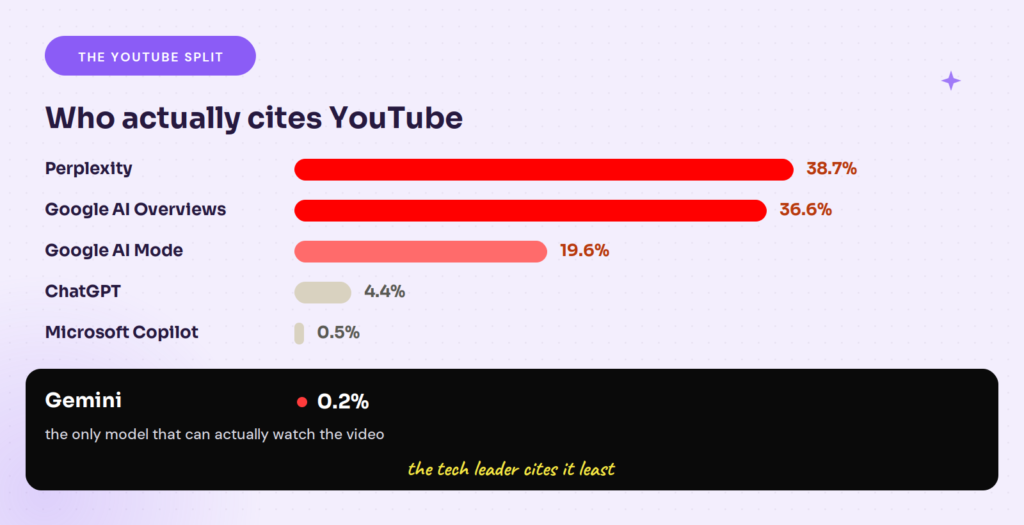
This is the most counterintuitive of the three AI citation channels. OtterlyAI’s YouTube Citation Study 2026, based on more than 100 million citation instances, found Perplexity drives 38.7% of all YouTube citations and Google AI Overviews another 36.6%.
ChatGPT accounts for just 4.4%. Gemini, the one model with genuine video-understanding technology that samples actual audio and visual frames, accounts for only 0.2%.
The reason is mechanical, not a preference. ChatGPT and Perplexity can’t watch a video. They read the transcript, title, and description, the same text-extraction limitation covered in our guide to whether AI crawlers render JavaScript.
These systems work from what’s in the raw, readable content, not from anything that requires processing a richer format first. Claude has no direct YouTube access at all. Only Gemini can actually see the video, and despite that capability, it cites YouTube the least of any major engine.
The same study found popularity barely matters. Views, likes, subscriber count, and video duration all showed near-zero correlation with getting cited. 40.8% of cited videos had under 1,000 views, and 94% of citations went to long-form explainers and comparisons rather than Shorts. A small channel with a structured, reference-quality video can out-cite a viral one that has none.
One more specific finding worth building around: 78% of timestamped videos get cited more than once, often across two to five separate chapters, which multiplies the citable surface area of a single upload.
But that benefit is Google-specific. Of timestamped citations, 73% appear in AI Overviews and 27% in AI Mode, with close to zero appearing in ChatGPT, Perplexity, Copilot, or Gemini.
What to actually do: Treat the transcript as the actual content, not a side effect of publishing. State the direct answer in the first 45 seconds and name your product on screen and in the transcript text. Add timestamps and chapters if Google surfaces are your priority; skip the effort if your audience concentrates on Perplexity or ChatGPT, since chapters don’t move citation there.
Why All Three AI Citation Channels Work the Same Way
Reddit, LinkedIn, and YouTube share one property that a brand’s own blog does not have by default: a built-in, third-party trust signal that does not depend on the AI model taking your word for it. A forum thread carries community validation. A LinkedIn post carries a named professional identity. A YouTube transcript carries a spoken, first-person account.
That is consistent with the broader mechanics covered in our breakdown of how Google AI Mode works: a synthesis system weighs sources by confidence and corroboration, not by domain authority alone. Third-party platforms where real people are visibly saying the same thing your marketing says carry more of that corroboration than your own site can generate by itself. Review platforms feel like the obvious next move, but the citation data on G2 and Capterra tells a more complicated story than most advice in this space acknowledges.
Frequently Asked Questions
Common questions on building out these AI citation channels, answered directly.
Should I stop investing in owned blog content in favor of these three channels?
No. The evidence supports adding these channels alongside owned content, not replacing it. Our complete guide to AI visibility for B2B SaaS covers how the owned and third-party layers work together.
Which of the three AI citation channels should a small B2B SaaS team prioritize first?
LinkedIn, generally, since its citation strength concentrates in exactly the professional and comparison queries a B2B buyer asks, and a Company Page requires less ongoing content production than a Reddit presence or a video channel.
Does posting once on Reddit or LinkedIn create a lasting citation?
Unlikely on its own. The volatility data on Reddit specifically shows citation share can shift sharply within weeks. Treat presence on these platforms as an ongoing program, not a one-time checklist item. Our best AI visibility tracking tools roundup covers how to monitor whether it’s actually working.
Can I just repost my blog content to LinkedIn and YouTube?
Not effectively. The citation data favors platform-native content, a LinkedIn post written for LinkedIn, a video with its own transcript, over a link-out to the original article. Models cite what they can read directly on the platform.
Do these findings apply the same way to Google’s AI Mode as to ChatGPT and Perplexity?
Mostly, with one exception: YouTube. Google’s AI Mode and AI Overviews cite YouTube heavily and are the only surfaces where timestamps and chapters meaningfully help. For Reddit and LinkedIn, the pattern holds fairly consistently across all major engines.
If you want help figuring out which of these AI citation channels actually matters for your specific buyer, let’s connect. Or see our roundup of best AEO tools for B2B SaaS if you want to start tracking citation performance across all three yourself.

Jay is the co-founder of LymLyt and an AI partnership consultant helping B2B SaaS companies grow through content strategy, SEO, and AI integration. He writes about content marketing, what makes B2B content convert, and how SaaS teams can build content systems that drive real pipeline.