How to Write an Anonymous Case Study That Buyers Still Trust
The customer had a great result. They are happy to talk about it. Then legal comes back and says no logo, no revenue figures, nothing that identifies us. That is the moment an anonymous case study stops being a compromise and starts being the only version you can actually publish.
Most teams treat that as the end of the story and quietly drop the case study. That is the wrong call, and there is a number that explains why.
UserEvidence’s Evidence Gap research asked buyers how much they trusted different kinds of proof. Named testimonials scored 64%. Blind but verified testimonials, where the customer’s identity is confirmed but not published, scored 60%.
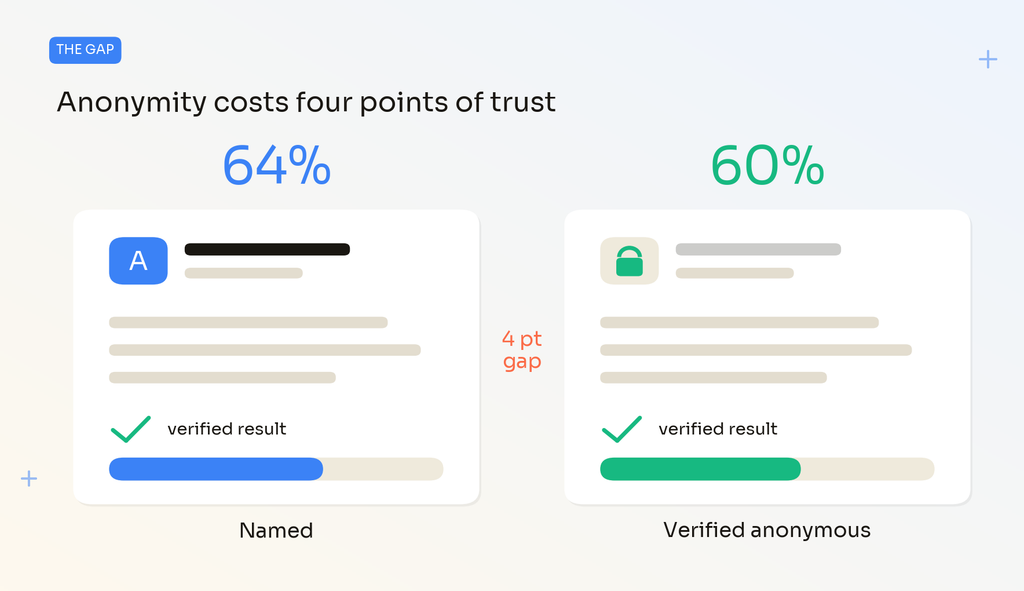
Buyer trust in named versus verified anonymous proof. Source: UserEvidence Evidence Gap research.
Four points. That is the entire cost of anonymity.
Set that against what anonymity buys you: a case study that ships in days instead of months, in categories where named stories are frequently impossible, with permission to tell the honest version rather than the sanitised one. Traded against four points of buyer trust, that is not a close call.
This post covers what to do at each level of restriction, what you can safely include, what you cannot, and the one situation where you should genuinely walk away. It is a companion to our complete guide to B2B SaaS case studies, which covers the full format.
First, find out what is actually being blocked
“We can’t do a case study” is almost never the real answer. It is shorthand for one of four much narrower objections, and they have different solutions.
The logo. Often a policy rather than a legal position. Many enterprises prohibit endorsements as a blanket rule, because a named case study reads as a public endorsement of a vendor.
The numbers. Usually competitive rather than legal. The customer does not want rivals knowing their conversion rate, their headcount, or what they spend. Worth checking which figures you actually need first, since the metrics that carry weight are narrower than most teams assume.
The identification. Common in regulated categories. In cybersecurity, financial services, and healthcare, naming a vendor can itself disclose something about your security posture or infrastructure.
The time. Not an objection at all, just a stalled approval chain, and the reason case study production so often stalls without a documented content calendar holding it to a cadence. A small company might need one marketing director’s sign-off. A large enterprise can require marketing, legal, product, and the account team, and reported approval times range from a single day to over a month.
Ask which one it is before you concede anything. Teams routinely anonymise a whole story when the only real blocker was one revenue figure.
The ladder: what to do at each level
Work down this list. Stop at the first rung the customer will accept.
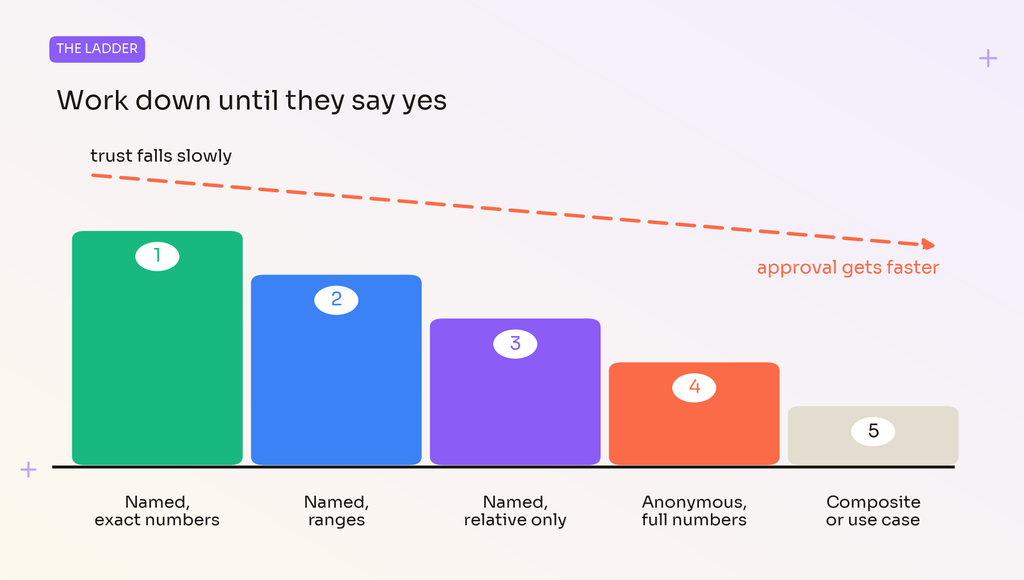
Work down until the customer says yes. Trust falls slowly. Approval speed rises fast.
1. Named, with exact numbers. The strongest version and the one worth asking for first. Ask plainly, and ask early, before anyone has said no to anything.
2. Named, with ranges. “Reduced onboarding time by 40 to 50%” clears most legal reviews that block a precise figure, and reads as nearly as credible. This single substitution rescues more case studies than any other move on this list.
3. Named, with relative figures only. “Tripled qualified pipeline” without disclosing the base. Weaker than a baseline, still far stronger than nothing.
4. Anonymous, with full numbers. Here is the trade most teams miss. Customers who will not attach their logo are frequently happy to share exact figures once the name is off. You lose the logo and keep the proof, which is usually the better half of the deal.
5. Composite or use case. Several customer situations combined into one representative account, or the methodology told without a specific customer. Useful filler for a comparison page where you need illustrative proof rather than a headline story. Weakest form, and it must be labelled as such. Never present a composite as a single real customer.
The pattern to notice: trust declines gently down this ladder while approval speed rises sharply. Rung four often ships in a week when rung one would have taken two months.
What you can safely include
Anonymity works when the description is specific enough for the right reader to recognise themselves. “A leading enterprise” describes nobody and persuades nobody. This is the same recognition problem behind why your ICP doesn’t read your blog: specificity is what makes a reader stop.
Generally safe:
- Industry vertical
- Company size as a range, such as 200 to 500 employees
- Funding stage or rough revenue band
- Team structure and who was involved
- The business challenge in detail
- Your solution approach and implementation timeline
- Percentage-based results
Generally not safe:
- Exact revenue or headcount figures that narrow identification to one company
- Geographic detail beyond a broad region
- Proprietary process or product names belonging to the customer
- Anything about their security posture, in regulated categories
- Named individuals, including in quotes
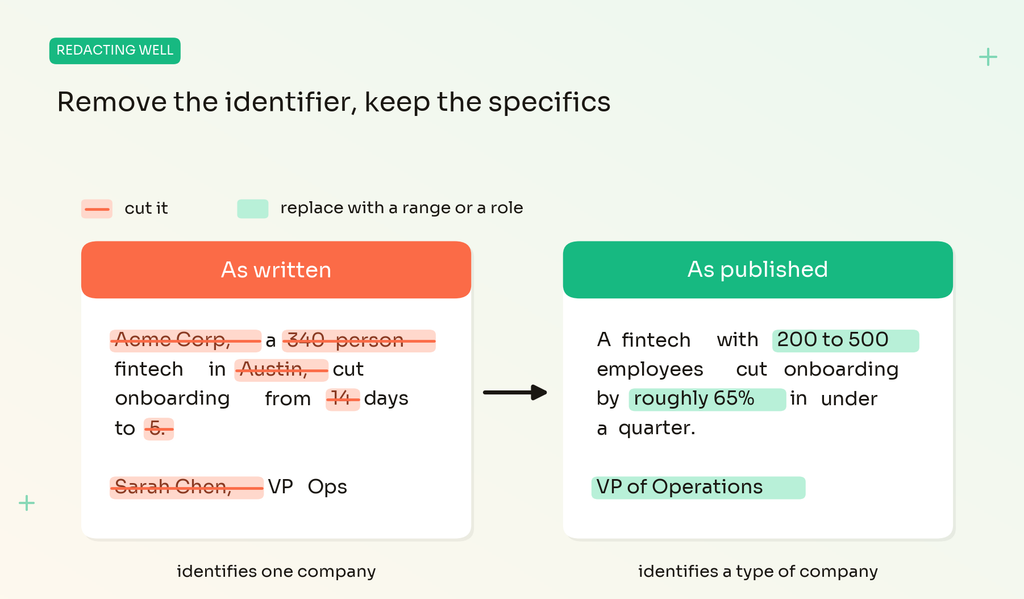
The judgment call is cumulative. Industry, size band, region, and funding stage are each harmless alone. Together they can identify exactly one company. Read the finished draft and ask whether a competitor in that market could name the customer in under a minute. If so, remove one identifier, usually the geography.
When in doubt, let the customer redline the draft. They know their own sensitivity thresholds better than you do, and handing them the pen converts an approval fight into a collaboration.
The upside nobody mentions
Anonymity is usually framed as damage control. It has a genuine advantage that named case studies structurally cannot offer.
When a customer’s logo is attached, they will approve only the flattering version. The rollout was smooth, the team loved it, the numbers went up. Every real implementation has friction, and every buyer reading your case study knows it, which is precisely why the polished version persuades so weakly.
Remove the name and that constraint largely disappears. You can write about the two departments that resisted the change, the month where adoption stalled, the feature that turned out not to matter. That honesty is more convincing than any logo, because it sounds like something that actually happened.
It also happens to be the trait that AI answer engines reward. Specific, verifiable, non-promotional detail gets retrieved and cited far more readily than marketing language, which is one reason the format connects to AI visibility for B2B SaaS more directly than most teams expect. It matters most on Perplexity, which weights freshness and relevance over domain authority.
So the ordering is not simply named good, anonymous bad. An honest anonymous story frequently outperforms a sanitised named one.
Making it credible without a name
Four things carry an anonymous case study.
Verification language. State plainly that the customer is real and the results are confirmed, and say why the name is withheld. One line does it: “The customer has verified these results. Their name is withheld under their vendor disclosure policy.” Silence about the omission invites the reader to assume you made it up.
Specificity everywhere else. Every identifier you remove should be replaced with two details that do not identify. Not “a large company” but “a compliance team of nine, running quarterly audits across four regulated markets.” The same discipline that separates good SEO content writing from filler applies here.
Named quotes by role. “Head of Revenue Operations” carries most of the weight a personal name would, and is usually approvable when a name is not.
A traceable number. Every figure should trace to a real record you could produce if challenged. If you cannot verify it, cut it. Fabricated outcomes are both a trust problem and a legal one.
When to walk away
There is one situation where the answer is genuinely no.
If the customer will not share the name, will not share any numbers, will not approve ranges, and will not let you describe the situation in specific terms, you do not have a case study. You have a testimonial. Publish it as one, on a quotes page, and move on to the next customer. Third-party proof on G2 or Capterra can carry some of that weight in the meantime.
The failure mode to avoid is publishing a vague story and hoping nobody notices. A page describing how an unnamed company in an unspecified industry improved unspecified metrics damages credibility rather than building it. Readers have seen that page a hundred times and know exactly what it means.
Fix this upstream
Everything above is remediation. The structural fix is a case study clause in the contract.
A standard clause covering participation, usage rights, and the approval process, agreed at signature when goodwill is highest and the stakes feel abstract, removes most of this negotiation before it starts. It costs one conversation with your legal team and it converts a recurring monthly obstacle into a checkbox.
This is one of the few content problems that a B2B SaaS SEO strategy cannot solve on its own, because the blocker sits in contracts rather than in search.
Ask for the case study shortly after a measurable win, not months later. Name a specific time commitment, offer full approval rights, and do all the work yourself. Most refusals come from customers assuming they will have to write something.
If you are choosing which customers to approach in the first place, our complete guide to B2B SaaS case studies covers how to score candidate wins, and the wider content engine piece covers making it a standing workflow rather than an annual scramble.
Want help turning a customer win into proof your sales team will actually send? Look through our own case studies, see how we build them, or book a 30-minute call.
Frequently asked questions
Are anonymous case studies worth publishing? Yes. Buyers trust verified anonymous proof at 60% against 64% for named proof, a four-point gap. Given that anonymity often cuts approval time from months to days and unlocks stories in regulated categories, the trade usually favours publishing.
What can I include in an anonymous case study? Industry, company size as a range, team structure, the challenge in detail, your approach, and percentage results. Avoid exact headcount or revenue, tight geography, proprietary names, and anything about a customer’s security posture.
How do I stop an anonymous case study reading as fake? Say explicitly that the customer is verified and why the name is withheld, replace every removed identifier with two non-identifying details, quote people by role, and only publish numbers you could evidence if challenged.
Can I combine several customers into one story? Yes, but label it a composite or a use case, never a case study. Presenting merged accounts as one real customer is a credibility risk that outweighs any benefit.
What if the customer will not share any numbers at all? Try ranges, relative figures, and operational metrics such as hours saved or steps removed first. If none of those are available and the situation cannot be described specifically either, publish it as a testimonial rather than a case study.

Jay is the co-founder of LymLyt and an AI partnership consultant helping B2B SaaS companies grow through content strategy, SEO, and AI integration. He writes about content marketing, what makes B2B content convert, and how SaaS teams can build content systems that drive real pipeline.