How to Run a Case Study Interview That Gets Real Answers
Search for help running a case study interview and you will find lists. One hundred case study questions. Sixty questions. Twenty-six questions plus nineteen bonus questions.
The lists are not wrong. They are just not the problem.
A case study interview fails for one of three reasons: you walked in without knowing what the story is, you asked good questions and accepted the first answer, or you spent the hour talking about your product instead of their situation. None of those is fixed by adding more questions to the list.
What actually separates a usable transcript from an unusable one is what happens in the ten seconds after the customer stops talking.
This is a companion to our complete guide to B2B SaaS case studies, which covers the format the interview feeds.
Before you get on the call
Most of the work happens here, and most teams skip all of it.
Interview your own salesperson first. They know the deal history, what nearly killed it, which stakeholder pushed back, and roughly what the numbers looked like. Thirty minutes with them means you arrive knowing what story you are looking for instead of fishing for one in front of the customer. The technique is the same voice extraction the better executive ghostwriting agencies run before writing a word.
Confirm the numbers exist before you ask for them. If nobody on your team knows what changed, the customer probably has not calculated it either. Walking into an interview hoping a result materialises is how you end up with an hour of pleasant conversation and nothing publishable.
Send three or four questions ahead, not twenty. Enough that they can pull a figure or check with a colleague. Not so many that they write out answers in advance and read them to you, which produces the flattest possible transcript. Decide what the finished piece needs before the call, the same way a content brief settles the decisions before drafting starts.
Set the ask properly. Name the time commitment, offer full approval rights, and say plainly that you will do all the writing. Most refusals come from customers assuming they have to produce something. If you can, send an example of a finished case study so they can picture the output.
Decide what to do about recording. Record if you can, because writing from a transcript beats writing from notes every time. Ask permission first regardless of where you are. Several US states, including California, Connecticut, Massachusetts, Pennsylvania and Washington, require consent from all parties to a recorded call.
Where the hour actually goes
The single biggest structural mistake is spending the interview on your product.
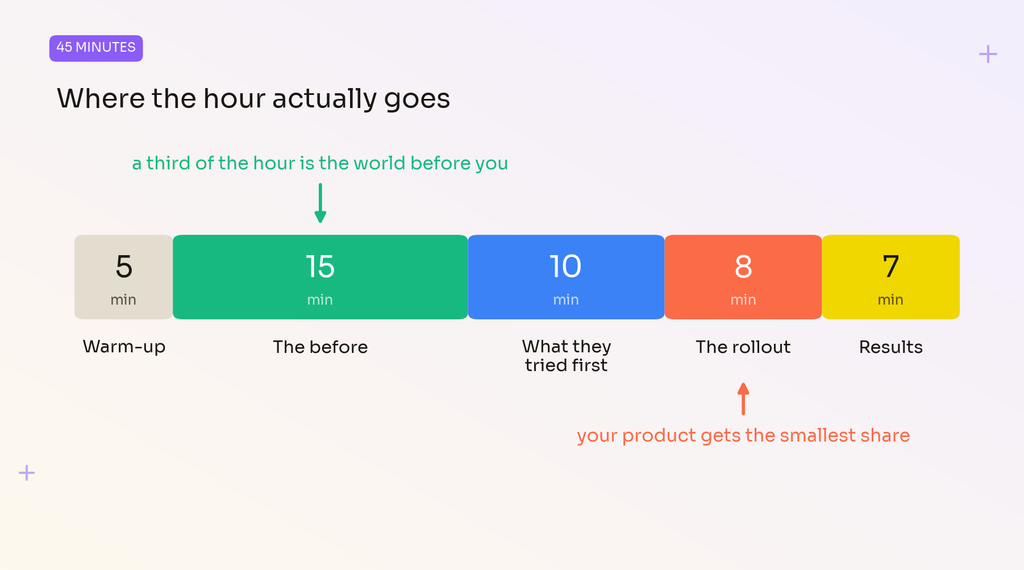
Where the hour goes. Your product gets the smallest share.
Roughly a third of the conversation belongs to the world before you existed. That is the section a prospect uses to recognise themselves, and it is the part customers find easiest and most enjoyable to talk about. It is the same recognition problem behind why your ICP doesn’t read your blog: specificity is what makes a reader stop.
The rollout of your product gets less time than either the before or the failed attempt. That feels wrong to most marketers and it is correct. Nobody reading a case study is persuaded by your implementation timeline. They are persuaded by recognising their own situation in the opening paragraphs.
Fewer questions, asked better
Eight questions is plenty for forty-five minutes if you follow up properly.
- Walk me through your role and what the team looked like then. Warm-up, and it gives you the specifics that make an anonymous version possible later.
- What was going on that made you start looking? The trigger, not the pain in general.
- What did you try first? The most valuable question on the list. See below.
- What made you keep looking? Why the first attempt failed, in their words.
- What nearly stopped you choosing us? The objection your prospects share, and useful material for your comparison pages as well as the case study.
- What did the first month actually look like? Where you get honest detail about friction.
- What changed, and how do you know? The results question, asked so it requires evidence.
- What would you tell someone in your old position? Usually produces the best quote of the call.
That is the whole list. The skill is not in the eight questions. It is in what you ask after each one.
The follow-up is the interview
First answers are almost always summaries. People compress. The usable material is one or two layers below.
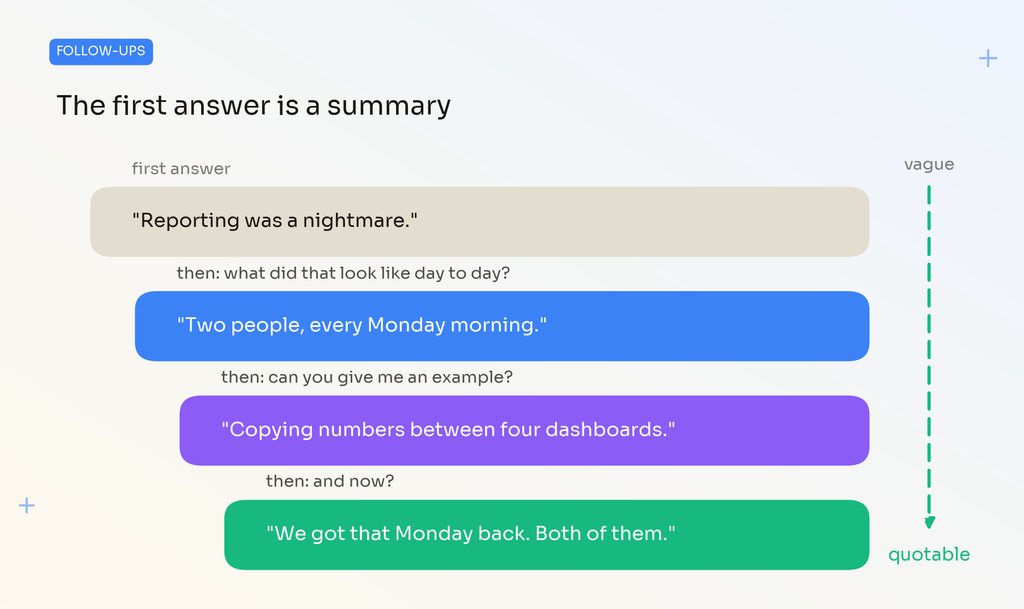
The first answer is a summary. The fourth is the quote.
Four follow-ups worth memorising:
“What did that look like day to day?” Converts an abstraction into a scene. “Reporting was a nightmare” becomes “every Monday two people spent the morning copying numbers between four dashboards.”
“How did you know?” Forces evidence behind a claim. Ask it whenever someone says something improved.
“Can you give me an example?” The most reliable question in the set. Examples are where quotes live.
Silence. Count to five before filling the gap. Most people keep going, and what they add is more specific than what they just said, because they have moved past the prepared answer.
Ask for numbers twice
Ask directly once. Later, ask obliquely: “what did that look like in the numbers?” or “how did your CFO see it?” The second phrasing regularly produces a figure the first did not, because it moves the question from metrics reporting into storytelling.
If nothing comes back either time, drop to operational measures. Hours per week. Steps removed. People no longer needed on a task. Those are countable, they are usually not commercially sensitive, and they persuade. The metrics that carry weight are narrower than most teams assume, so knowing which ones you are hunting for before the call matters.
If the customer cannot share figures at all, that is a solvable problem rather than a dead end. We covered the options in how to write an anonymous case study.
When they go flat
Some interviews stall. Short answers, polite agreement, nothing usable. Three things that restart them:
Go backwards. Return to the before. It is the safest territory and it warms people up again.
Ask about a specific person. “Who on your team pushed back hardest?” Concrete beats abstract every time.
Give them something to disagree with. “Sounds like the rollout was pretty smooth?” A customer who corrects you gives you a far better answer than one who agrees with you.
When they say something unflattering
They will. A feature did not work, onboarding dragged, support was slow.
Do not defend it in the room. Do not explain. Write it down, thank them, and move on.
Two reasons. Defending makes the rest of the interview cautious and you lose everything after that point. And the criticism is frequently the most valuable material you collect, because a case study that admits friction is far more believable than one that does not. Whether it survives approval is a separate question, but you cannot use what you never captured.
After the call
Write from the transcript, not from memory. The customer’s phrasing is the raw material. Your paraphrase of it will sound like your product marketing, which is exactly what makes most case studies unreadable. Buyer language over product language is the same discipline that separates useful SEO content writing from filler.
Pull quotes before you draft. Read the transcript once and mark every sentence you would publish verbatim. Then build around them. Drafting first and hunting for supporting quotes afterwards produces a story shaped by your assumptions rather than theirs. Specific, verifiable sentences are also what AI answer engines cite, so the quotes you keep do double duty.
Send the draft with the parts you need confirmed marked. Reviewing a whole document is a chore. Confirming four highlighted figures is a five-minute task, and it gets returned faster.
Log what you could not use. Numbers withheld, quotes rejected, sections cut. That record tells you what to ask differently next time, and it is what turns interviewing into a repeatable process rather than a talent. Booking interviews as a standing item in your content calendar, rather than when someone remembers, is what keeps the pipeline full. Building it into a documented content engine is how it survives the person who currently does it leaving.
The interview is the whole job
Everything downstream is transcription and craft. A strong transcript produces a good case study almost regardless of who writes it. A weak one cannot be rescued by good writing, and the usual symptom is a finished draft that reads well and says nothing. What you do with the transcript afterwards is covered in the complete guide.
The questions are not the hard part. Sitting with a five-second silence, asking “how did you know” for the third time, and letting a customer criticise your product without flinching are the hard parts.
Want the interviews run for you? See how we build case studies, look through our own.
Frequently asked questions
How long should a case study interview be? Forty-five minutes is the right target. Long enough for follow-ups, short enough that customers agree to it. Naming a specific length in the ask removes most of the hesitation about committing.
Should I send the questions in advance? Send three or four, not the full list. Enough that they can look up a figure. Any more and they prepare answers, which produces a polished, useless transcript.
Can I record the interview? Ask permission first, always. Several US states including California, Massachusetts and Washington require consent from every party on the call. Recording is worth the ask, since writing from a transcript is substantially better than writing from notes.
What if the customer criticises our product during the call? Capture it and do not defend it. Defending makes the rest of the interview guarded. The friction is often the most persuasive material in the finished piece, and you can decide later whether it survives approval.
Who should I interview if several people were involved? The person who felt the problem daily, not the one who signed the contract. Executives describe outcomes, which you can get from your own content marketing metrics. Practitioners describe the before, which you cannot get anywhere else.

Jay is the co-founder of LymLyt and an AI partnership consultant helping B2B SaaS companies grow through content strategy, SEO, and AI integration. He writes about content marketing, what makes B2B content convert, and how SaaS teams can build content systems that drive real pipeline.