What Is Google AI Mode? A Complete Guide for B2B SaaS
Google AI Mode is a conversational search experience built into Google Search that uses Gemini to generate synthesized, cited answers instead of a list of ten blue links. It launched in March 2025 inside Search Labs, expanded to all signed-in US users by May 2025, and crossed one billion monthly active users by May 2026. For B2B SaaS marketers, that growth curve is not a side note. It is the reason a buyer can now research, compare, and shortlist your product without ever landing on your website.
This guide walks through what AI Mode actually is, how it works under the hood, how it differs from AI Overviews, and what a B2B SaaS content team needs to do differently to get cited inside it. For the broader picture of how your brand shows up across every AI surface, our AI Visibility for B2B SaaS complete guide is the pillar this article sits under.
What Is Google AI Mode, Exactly?
AI Mode is a dedicated, opt-in search interface. Rather than scanning a results page, a user asks a question and receives a synthesized answer built from multiple sources, each with an inline citation. Afterward, they can ask a follow-up question in the same thread, much like a conversation with ChatGPT or Claude. If you’re weighing how these underlying models actually compare for content work, we’ve covered that separately in ChatGPT vs Claude for B2B SaaS Content and the wider Claude vs ChatGPT vs Gemini vs Perplexity vs Grok comparison.
Two things separate it from the search experience most marketers grew up optimizing for. First, the query itself can be long and layered. A user might type something closer to “compare the top three CRM tools for a 20-person sales team that already uses HubSpot” than a three-word keyword. Second, the answer is not a summary bolted onto existing results. It is the entire experience.
Google built AI Mode on Gemini, its family of large language models. Gemini 3 powered the feature from January 2026 until Gemini 3.5 Flash took over as the default model in May 2026, bringing faster multimodal handling and deeper multi-step reasoning. Since then, Google has kept expanding what the feature can do. Personal Intelligence, announced earlier in 2026, lets AI Mode draw on a signed-in user’s Gmail and Photos for more individualized answers. In July 2026, Google added the ability to link and interact with select apps, starting with Instacart, Canva, and YouTube, which pushes AI Mode from answering questions toward completing tasks.
How Google AI Mode Works
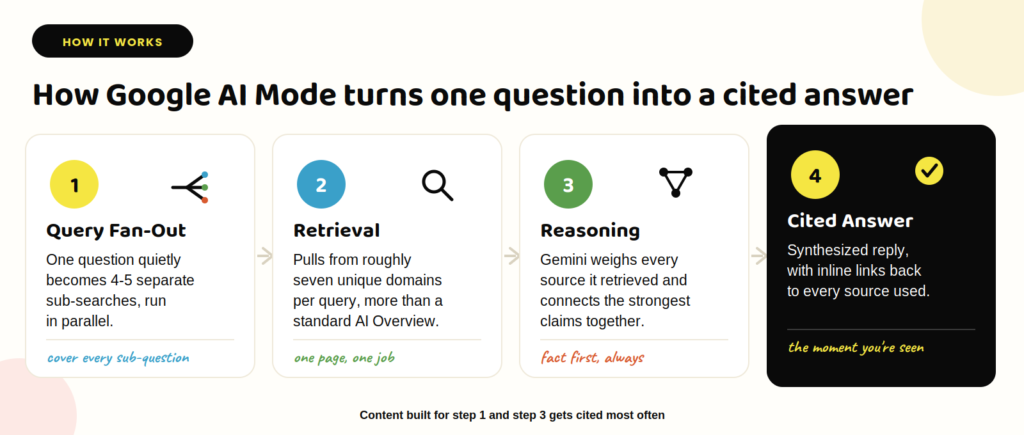
Underneath the conversational interface sits a three-stage process: retrieval, reasoning, and synthesis. Understanding each stage matters because it explains exactly what your content needs to do to get pulled in.
Query Fan-Out
When a question arrives, AI Mode rarely treats it as one search. Instead, it breaks a complex query into smaller sub-questions and runs each one separately against Google’s index. A single prompt about “best project management tools for remote teams” might quietly become four or five parallel searches covering pricing, integrations, team size fit, and specific tool comparisons. This is called query fan-out, and it is the single biggest reason AI Mode surfaces different sources than a standard search for the same topic.
Retrieval Across Multiple Sources
Once the sub-queries return results, the system pulls from a wider spread of pages than a typical search. Research from Ahrefs, cited by Search Atlas, found that AI Mode references an average of roughly seven unique domains per query, notably more than a standard AI Overview pulls for the same topic. That is good news for smaller, specific sources: a page does not need to outrank every competitor to get cited. It needs to answer one sub-question better than anything else Google finds.
Reasoning and Response Synthesis
Finally, Gemini reasons across everything retrieved and writes a single coherent answer, attaching inline citations to the claims it pulls from each source. This is where content structure starts to matter as much as content quality. A page that states a clear fact and follows it with a specific, well-supported insight is easier for the model to extract and attribute than a page that buries its answer under three paragraphs of preamble. This is also where entity clarity does its work behind the scenes; our guide to the Google Knowledge Graph breaks down how Google structures that entity data in the first place.
Google AI Mode vs. AI Overviews vs. Traditional Search
These three terms get used interchangeably, and that confusion costs marketing teams real visibility. Here is the actual distinction.
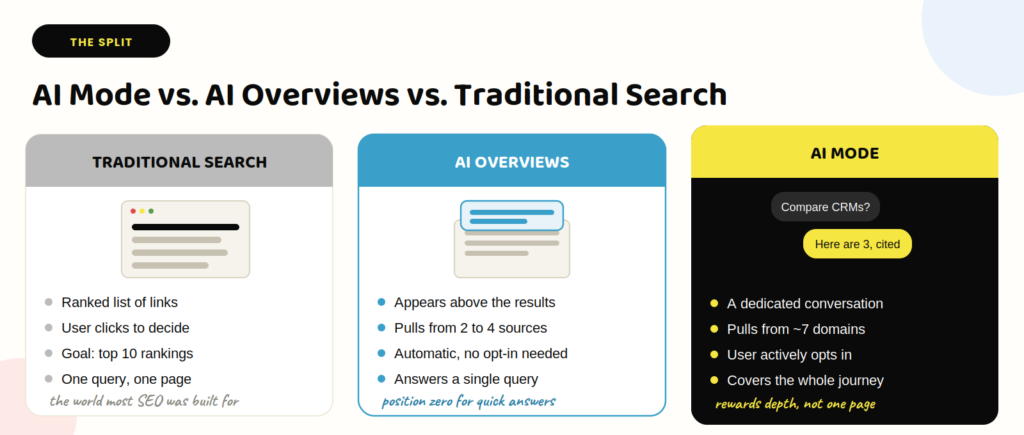
Traditional search returns a ranked list of links. The searcher decides what to click, and your job is to earn one of the top positions.
AI Overviews appear automatically inside standard search results for many informational queries. They sit above the traditional listings, pulling a short synthesized summary from two to four sources. A searcher who gets what they need often never scrolls further, which is part of why zero-click searches have climbed sharply since AI Overviews rolled out broadly.
AI Mode is a separate, self-contained experience. A user actively switches into it, either through the “Ask anything” prompt or a dedicated tab, and stays inside a running conversation rather than bouncing back to a results page. Because the experience supports the entire research journey rather than a single query, it rewards brands with depth across a topic, not just one well-optimized page.
The overlap between the two AI-driven surfaces is smaller than most teams assume. Ahrefs found that AI Mode and AI Overviews cite the exact same URL for the exact same query only 13.7% of the time, even though roughly 88% of the domains they draw from overlap at the domain level. In practice, that means a brand can dominate AI Overviews and still be invisible inside AI Mode conversations, or the reverse. Both surfaces need their own optimization attention. Neither is a proxy for the other. Our earlier piece on how search behavior has changed since AI arrived covers seven of these shifts in more depth, and SEO vs AI looks at what this means for the discipline overall.
Google AI Mode by the Numbers
The scale here is worth sitting with, because it changes the size of the opportunity and the cost of ignoring it.
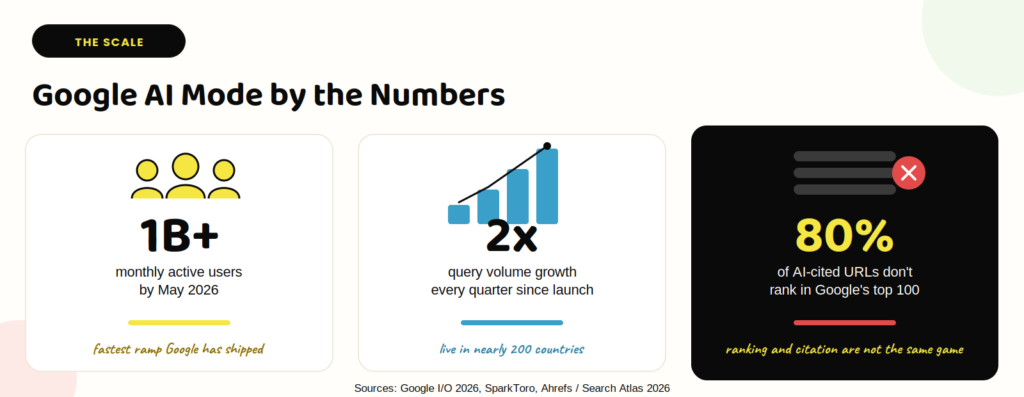
AI Mode reached one billion monthly active users by May 2026, roughly a year after Google opened it to all signed-in US users. Query volume has doubled every quarter since that launch, which Google itself flagged at I/O 2026 as one of the fastest ramp rates of any consumer product it has shipped. The feature is now live in close to 200 countries.
On the traditional search side, SparkToro’s 2026 research puts the zero-click rate at 68% of all US Google searches in the first four months of the year, up from 60.45% in 2024. AI Mode itself is still a small slice of that traffic: SparkToro found only 0.34% of searches transitioned into AI Mode over that same period, though Google reported at I/O 2026 that AI Mode’s query volume was doubling every quarter, so that share is likely climbing fast. Meanwhile, G2’s April 2026 report found that 51% of B2B software buyers now start their vendor research inside an AI chatbot rather than a traditional search bar, up from 29% eleven months earlier.
Perhaps the most important number for a content strategist comes from Ahrefs’ 2025 citation-overlap study: roughly 80% of the URLs cited by AI assistants such as ChatGPT, Gemini, and Perplexity do not rank anywhere in Google’s top 100 for the matching query. That research covered AI assistants broadly rather than Google AI Mode specifically, but the underlying point holds across surfaces: traditional rankings and AI citations are correlated but they are not the same contest, and a page can lose the first while winning the second. That gap is also why AI didn’t cause content blindness, marketers did argues the real problem was never AI itself.
How to Optimize Content for Google AI Mode
Since AI Mode rewards depth across an entire question journey rather than a single ranked page, the optimization playbook looks less like classic keyword targeting and more like building a small, thorough knowledge base around each topic you want to own.
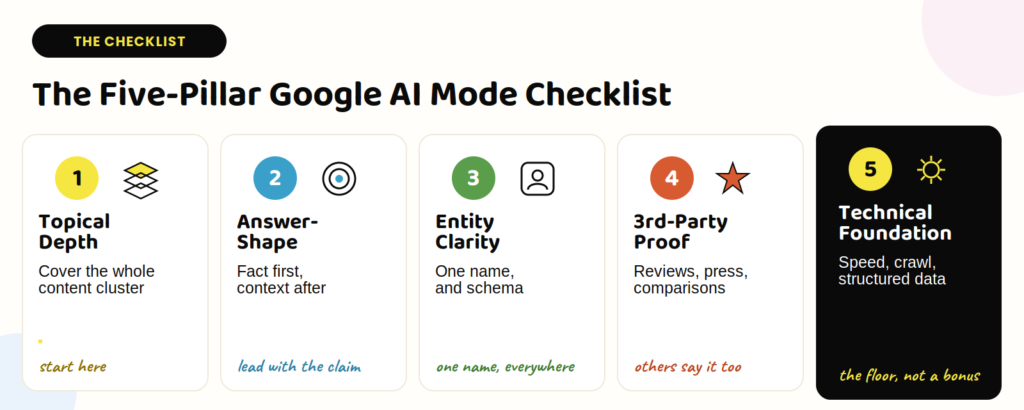
Build Topical Depth, Not Just Keyword Coverage
Because AI Mode fans a single query out into several sub-questions, a page that only answers the headline question misses most of the citation opportunities. Cover the definition, the comparison, the pricing, and the decision criteria within the same content cluster, and link them together so Google can trace the full picture. Our guides to topical authority for B2B SaaS and topic clusters vs. keyword lists both go deeper on how to structure this.
Write in Answer-Shape
State the direct answer to a specific question early in a section, in plain language, before adding supporting detail. A sentence that leads with the fact and follows immediately with a concrete, well-sourced insight is far easier for Gemini to extract and cite accurately than a paragraph that opens with three sentences of throat-clearing.
Strengthen Entity Clarity
AI Mode needs to know exactly what your brand is and does before it will cite you confidently. That means consistent naming across your site, a clear “About” page, structured data that defines your product category, and accurate, up-to-date facts everywhere your brand appears, including third-party listings. This is the same entity work covered in our Google Knowledge Graph guide.
Earn Third-Party Corroboration
Because the model weighs whether other trusted sources say the same thing about you, brand mentions on review platforms, comparison articles, and industry publications compound the credibility of your own site. A single strong page rarely wins alone. Consistent, accurate mentions elsewhere are usually what pushes a brand from occasionally cited to reliably cited. If you’re tracking whether this is actually working, see our roundup of 10 best AI visibility tracking tools. If you’d rather have a team build this system for you, our guide to the best AI SEO agencies covers who actually does this work well.
Fix the Technical Foundation
None of the above matters if the page loads slowly, buries content behind heavy JavaScript rendering, or lacks basic schema markup. Google has been explicit that page experience remains a filter before content quality is even considered, so a fast, crawlable, well-structured page is the floor, not a bonus. Our B2B SaaS SEO strategy guide covers the foundational work most teams skip.
What This Means for B2B SaaS Marketers
The buyer research journey has quietly split into two paths, and most B2B SaaS content strategies were built for only one of them. A prospect comparing project management tools no longer necessarily opens five browser tabs. Instead, they might ask AI Mode to compare pricing, read the synthesized answer, then ask a follow-up about integrations, all without your homepage ever appearing in their browser history.
That shift changes what “ranking well” is worth. A page that ranks on page one of Google but never gets pulled into an AI Mode conversation is increasingly invisible to a growing share of your buyers. If that sounds familiar, our piece on 5 reasons your site doesn’t show up in ChatGPT walks through the same failure pattern on a different AI surface. Meanwhile, a page that ranks modestly but answers a specific sub-question with real precision can end up cited in front of a buyer who never saw your domain in a traditional results page at all.
The practical response is not to abandon traditional SEO. It is to treat AI Mode and AI Overviews as parallel surfaces that share a foundation, structured, specific, well-corroborated content, but require separate tracking and separate attention, since citation on one does not guarantee citation on the other. If your content operation isn’t built for that yet, our guide on how to build a SaaS content engine is a useful next read.
Not sure where your brand stands inside Google AI Mode right now?
Frequently Asked Questions
Is Google AI Mode the same as Gemini? No. Gemini is Google’s underlying family of large language models. AI Mode is the search interface and experience that uses Gemini as its reasoning engine, fine-tuned specifically for retrieval-grounded, cited search answers rather than open-ended conversation.
Does Google AI Mode replace AI Overviews? No, they run in parallel. AI Overviews appear automatically inside standard search results. AI Mode is a separate experience a user opts into. A brand needs visibility in both, since the two surfaces cite the same URL for the same query only about 14% of the time.
Can I opt my site out of Google AI Mode? There is no dedicated opt-out for AI Mode specifically. Blocking Google’s AI crawlers or using a nosnippet tag will reduce your presence, but it also removes you from featured snippets and other visibility that most sites still want. Run the traffic math before opting out of anything.
How is success in AI Mode measured? Standard rank trackers do not capture AI Mode citations. Google Search Console shows some signal, but most teams pair it with a dedicated AI visibility tool that tracks citation rate and share of voice across ChatGPT, Perplexity, Gemini, and AI Mode specifically. See our AI visibility tracking tools roundup for current options.
How long does it take to get cited in Google AI Mode? There is no fixed timeline, since citation depends on the model’s confidence in a source rather than a ranking algorithm with a known refresh cycle. Teams that build out full topical clusters with strong entity signals tend to see citation activity emerge faster than teams publishing single, isolated pages.
Keep Exploring
More from LymLyt on AI search, GEO, and B2B SaaS visibility:

Jay is the co-founder of LymLyt and an AI partnership consultant helping B2B SaaS companies grow through content strategy, SEO, and AI integration. He writes about content marketing, what makes B2B content convert, and how SaaS teams can build content systems that drive real pipeline.