Schema Markup and AI Citations: Does It Actually Help?
If you have asked anyone how to get cited by ChatGPT or Google’s AI Overviews, someone has probably told you to add schema markup. Schema is the hidden code (usually JSON-LD) that labels what a page is about: this is a product, this is its price, this is the author. The pitch is simple. Label your pages for machines, and AI will understand and cite them more.
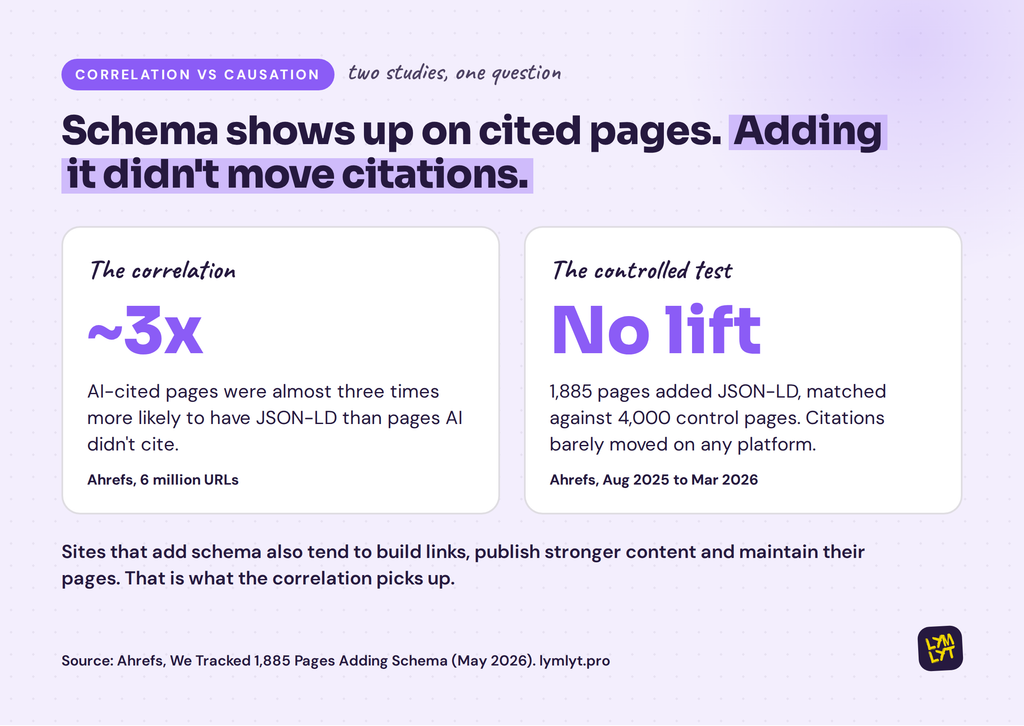
The evidence behind that pitch is one correlation: pages AI cites are almost three times more likely to have schema than pages it ignores. In 2026, Ahrefs ran the controlled test. They tracked 1,885 pages that added schema and compared them with similar pages that did not. Citations barely moved in ChatGPT or Google AI Mode, and dipped slightly in AI Overviews.
So what is the real link between schema markup and AI citations? Below is what the data shows, what AI engines actually read on your page, where schema still earns its place, and how to test it on your own site.
The short answer:
| Question | What the evidence says |
|---|---|
| Do AI-cited pages use more schema? | Yes, about 3x more often, in a 6 million URL analysis |
| Does adding schema increase AI citations? | No measurable lift on already-cited pages |
| Do AI chatbots read JSON-LD when they fetch a page? | No. In a 2025 test, none of five systems used facts that existed only in schema |
| Does schema help search engines understand your site? | Yes. Bing says it helps Copilot’s models understand content, and Google uses it for rich results and entities |
| Is special schema needed for Google’s AI features? | No, per Google’s own documentation |
Where “schema boosts AI citations” came from
The claim starts with a real correlation. Ahrefs analysed 6 million URLs and found AI-cited pages were almost three times more likely to have JSON-LD than pages AI did not cite, with 53% of cited pages carrying schema (Ahrefs).
That number travelled. It is easy to share and points to a task any team can finish in an afternoon. But it describes the kind of site that gets cited, not what got it cited. Sites that add structured data also tend to invest in technical SEO, publish stronger content, build links and maintain their pages. Ahrefs says exactly that in the same study.
Citera’s 2026 analysis of about 350,000 B2B SaaS articles points the same way. Schema appeared on 69% to 72% of articles in every group it measured, with no gradient between pages AI cited and pages it ignored (Citera). When nearly everyone has it, it cannot be what separates the winners.
This is the correlation-to-causation drift we traced in the AI citation telephone game: “cited pages have schema” quietly becomes “add schema to get cited”.
The controlled test: 1,885 pages, no lift
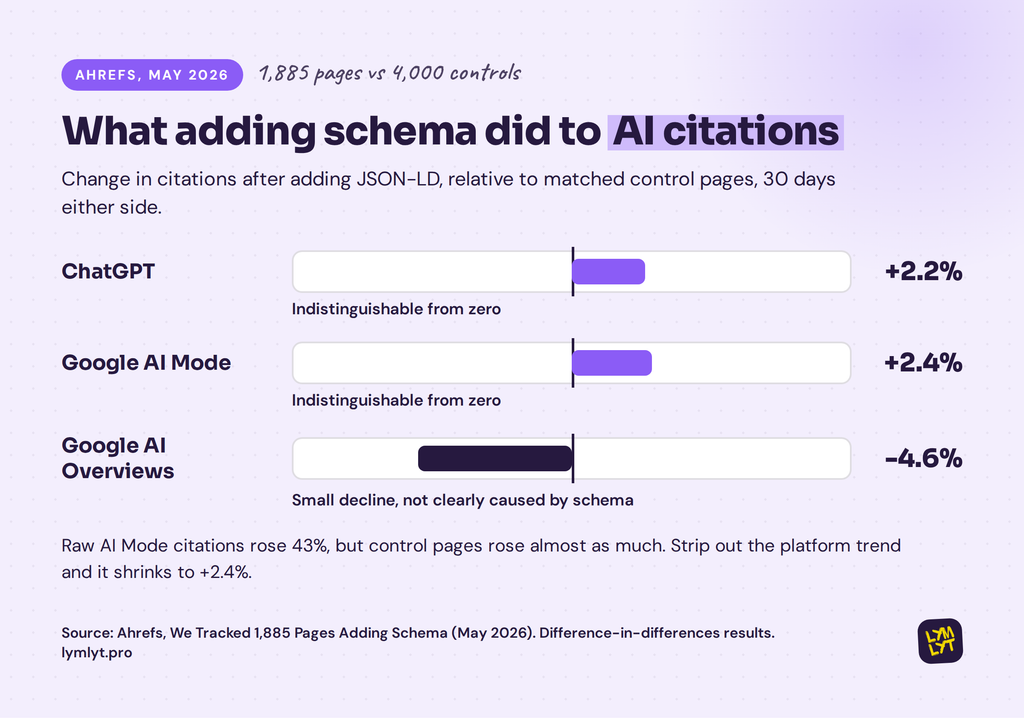
To separate schema from everything that travels with it, Ahrefs tracked 1,885 pages that added JSON-LD between August 2025 and March 2026. Each was matched with three control pages from other domains with similar citation levels that never added schema. Citations were measured 30 days before and after the change, and the headline numbers come from a difference-in-differences test, which strips out platform-wide trends (Ahrefs).
| AI surface | Effect of adding schema | What it means |
|---|---|---|
| ChatGPT | +2.2% | Statistically indistinguishable from zero |
| Google AI Mode | +2.4% | Statistically indistinguishable from zero |
| Google AI Overviews | −4.6% | Small, statistically significant decline that Ahrefs could not attribute to schema |
The trend correction mattered. Raw AI Mode citations on treated pages rose 43%, but the control pages rose almost as much, because AI Mode was growing for everyone. Strip that out and the effect falls to 2.4%.
What the test did not cover
The limits are worth reading before you quote it:
- Every page was already heavily cited. Each had 100+ AI Overview citations before schema was added. The study cannot say whether schema helps an invisible page get its first citation.
- 30 days only. A slower effect over 60 or 90 days is untested.
- All schema types pooled. Article, FAQ, Product and Organization were measured together.
- JSON-LD in the HTML only. Schema injected with JavaScript was not studied.
What AI engines read when they fetch your page
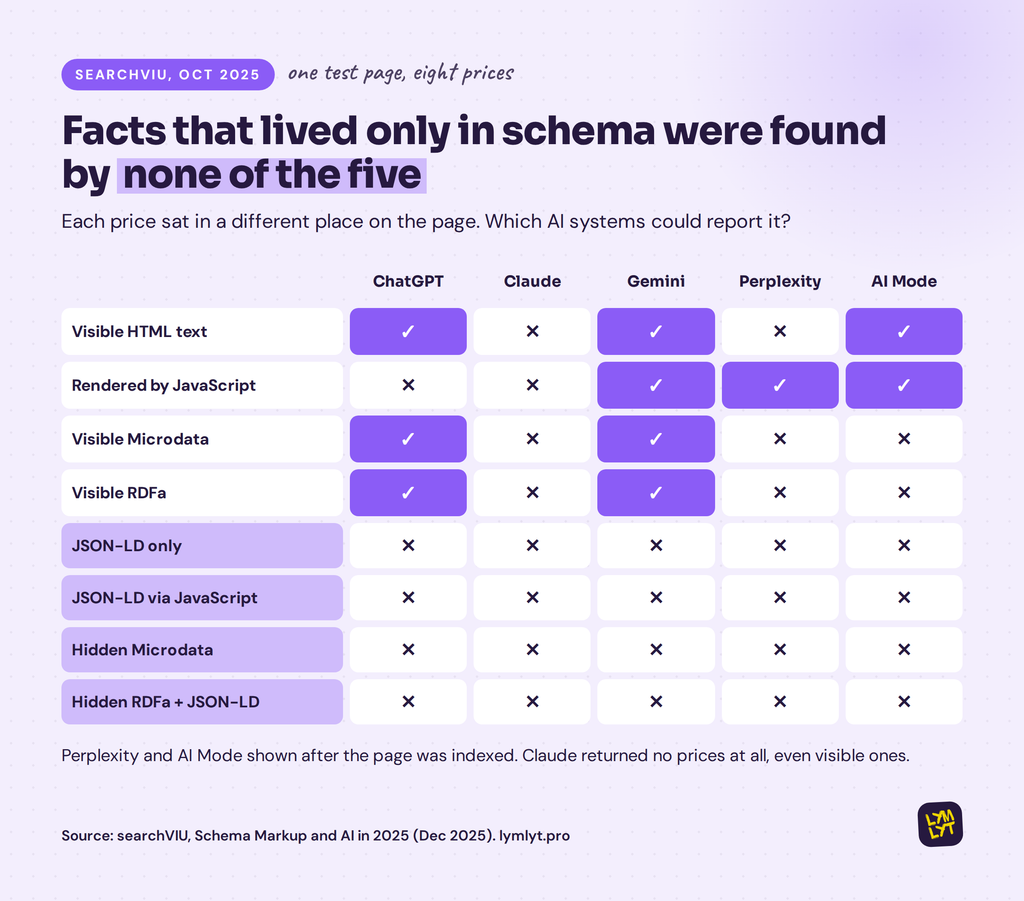
A separate experiment explains why the lift is missing. In October 2025, searchVIU built a test page for a fictional product with eight prices, each placed somewhere different: visible text, JavaScript, JSON-LD only, hidden Microdata, hidden RDFa and visible markup. They then asked ChatGPT, Claude, Gemini, Perplexity and Google AI Mode for the prices, repeating each query (searchVIU).
| Where the price lived | Systems that found it (of 5) |
|---|---|
| Visible HTML text | 3 |
| Rendered by JavaScript | 3 |
| Visible Microdata or RDFa | 2 |
| JSON-LD only | 0 |
| JSON-LD injected by JavaScript | 0 |
| Hidden Microdata or RDFa | 0 |
A price that existed only in JSON-LD was found by none of the five systems. The chat-bots that fetched the page live, like ChatGPT and Gemini, worked from visible content. Perplexity and AI Mode answered from their indexes and captured only part of the page, one reason getting cited in Perplexity depends on what its index holds, not what your page declares.
It is one page and one fictional product, so treat it as a demonstration, not a benchmark. The lesson is still direct: if a fact matters, it has to be visible on the page. It is the same fix that came out of our pricing prompts study: put prices and their billing basis in plain text, not just in markup or images.
Where schema still plausibly matters
Schema is not dead. It works at a different stage than most AI advice assumes.
- Inside search indexes. searchVIU’s own caveat is that schema may still be used when pages are indexed, which matters for systems that answer from an index. Microsoft’s Fabrice Canel said at SMX Munich in March 2025 that schema markup helps Microsoft’s LLMs understand content for Copilot (Search Engine Roundtable). That is a statement about understanding, not citation counts.
- Entity clarity. Organization and author markup help search engines connect your pages to your brand, which is the job we covered in our Google Knowledge Graph guide.
- Rich results and Google’s rules. Google says no special schema is needed for AI Overviews or AI Mode, and asks that structured data match the visible text on the page (Google Search Central).
Watch how this gets retold. Canel’s “helps understand content” already appears in at least one 2026 guide as a confirmed citation lift. That is the telephone game again, and the reason to quote the original words.
What we would do on a B2B SaaS site
Keep schema as infrastructure, not as an AI citation tactic:
| Schema type | Keep it? | Why |
|---|---|---|
| Organization | Yes | Brand and entity clarity, knowledge panel eligibility |
| Article with author | Yes | Ties content to a named person and your company |
| SoftwareApplication or Product with pricing | Yes, with the price also in visible text | Markup alone is invisible to live-fetching chatbots |
| FAQPage | Only if the FAQ is visible on the page | Do not expect an AI citation lift from the markup |
| Anything carrying facts not shown on the page | No | AI chatbots will not see them, and Google asks markup to match visible text |
The rule underneath all five rows: never let schema be the only place a fact lives. If your pricing, plan names or integrations exist only in markup, the answer engines reading your page live will not see them. It is the same logic that made an llms.txt file a weak bet: machine-only files and tags are not what these systems read when they answer.
Test schema on your own pages
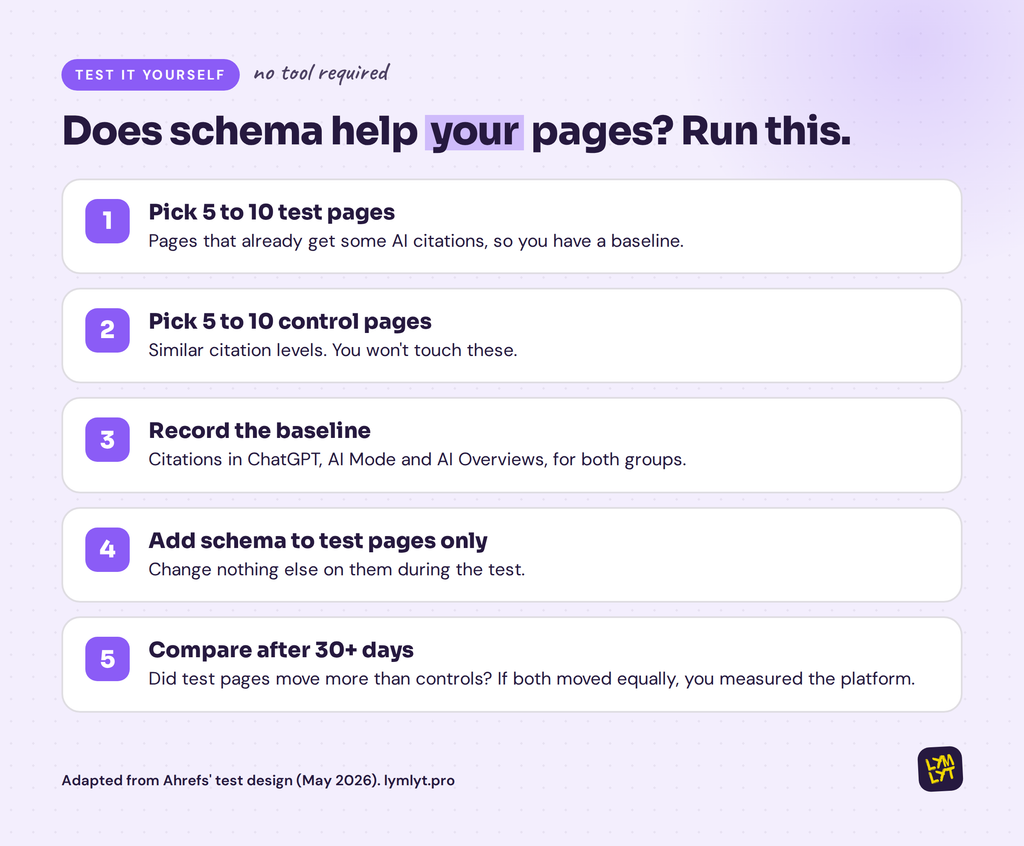
Ahrefs’ result covers pages that were already heavily cited. If you want to know what schema does for your site, run a small version of their test:
- Pick 5 to 10 test pages that already get some AI citations, so you have a baseline.
- Pick 5 to 10 control pages with similar citation levels that you will not touch.
- Record baseline citations for both groups across ChatGPT, Google AI Mode and AI Overviews, and log citations and mentions separately.
- Add schema to the test pages only and change nothing else on them.
- Compare after 30 days or longer. The question is whether test pages moved more than controls did.
If both groups moved by the same amount, you measured the platform, not the schema. The same prompt log can run inside your quarterly AI visibility audit.
FAQ
Does schema markup increase AI citations? Not on current evidence. Ahrefs’ 2026 controlled test of 1,885 already-cited pages found no meaningful lift in ChatGPT or Google AI Mode after adding JSON-LD, and a small decline in AI Overviews it could not attribute to schema.
Do ChatGPT and other AI chat-bots read JSON-LD? Not when they fetch a page live. In searchVIU’s 2025 test, a price that existed only in JSON-LD was found by none of five AI systems.
Do I need special schema for Google AI Overviews? No. Google’s documentation says no special schema.org markup is needed for AI Overviews or AI Mode, and that structured data should match the visible text.
Should I remove schema from my site? No. Keep it for rich results, entity clarity and search engine understanding. Just do not add it expecting more AI citations, and never put facts only in markup.
Does schema help pages that AI does not cite yet? Untested. Ahrefs studied pages that were already heavily cited, so the effect on uncited pages is still an open question.
Conclusion: schema is plumbing, not a citation lever
The case for schema markup and AI citations was built on a correlation, and the first serious controlled test did not back it up. AI chat-bots read what is visible on your page, and the pages they cite tend to be strong in every other way too.
Keep your schema clean and accurate. Then put the effort where the evidence points: visible, specific, current content that answers the question better than the page above it.
We build B2B SaaS content that AI engines can read, quote and cite correctly. See how we approach AI visibility.
Sources
- Ahrefs, We Tracked 1,885 Pages Adding Schema. AI Citations Barely Moved. (May 2026)
- searchVIU, Schema Markup and AI in 2025: What ChatGPT, Claude, Perplexity and Gemini Really See (December 2025)
- Citera, An Analysis of 350,000 B2B SaaS Articles (May 2026)
- Google Search Central, AI features and your website
- Search Engine Roundtable, Microsoft Confirms Schema Helps Its LLMs (Copilot) Understand Your Content (March 2025)

Jay is the co-founder of LymLyt and an AI partnership consultant helping B2B SaaS companies grow through content strategy, SEO, and AI integration. He writes about content marketing, what makes B2B content convert, and how SaaS teams can build content systems that drive real pipeline.