Content Freshness and AI Citations: Does it Matter?
If you are trying to get cited by ChatGPT or Perplexity, someone has probably told you to keep your content fresh. Update your old posts, change the date, and AI will treat them as current. It sounds reasonable. AI answers are supposed to reflect what is true now, so newer pages should win.
The data mostly agrees, with two big catches. A study of 17 million AI citations found that AI assistants cite pages about a year newer than the ones Google ranks. A separate lab study found that simply adding a newer date to a passage can push it up an AI model’s ranking, even when nothing else changes.
So what is the real link between content freshness and AI citations? Below is what the data shows, which engines care most, why faking a date is a bad bet, and what a B2B SaaS team should actually update.
The short answer:
| Question | What the evidence says |
|---|---|
| Do AI assistants cite newer pages than Google ranks? | Yes. On average about a year newer, across 17 million citations |
| Does “fresh” mean new? | No. The average AI-cited page is still about 2.9 years old |
| Which engine leans newest? | ChatGPT. Google AI Overviews leans oldest, much like Google itself |
| Can a newer date alone change how AI models rank text? | In lab tests, yes, for every model tested |
| Should you change dates without changing content? | No. Google warns against it, and it does not make the page better |
What 17 million AI citations show
In 2025, Ahrefs pulled 16.975 million URLs cited by ChatGPT, Perplexity, Gemini, Copilot and Google AI Overviews, and compared their age with pages ranking in Google’s organic results (Ahrefs).
The headline: pages cited by AI assistants averaged 1,064 days since publication, against 1,432 days for Google’s organic results. That makes AI-cited pages 25.7% “fresher”. Measured by last update instead of first publication, the gap shrinks to 13.1%.
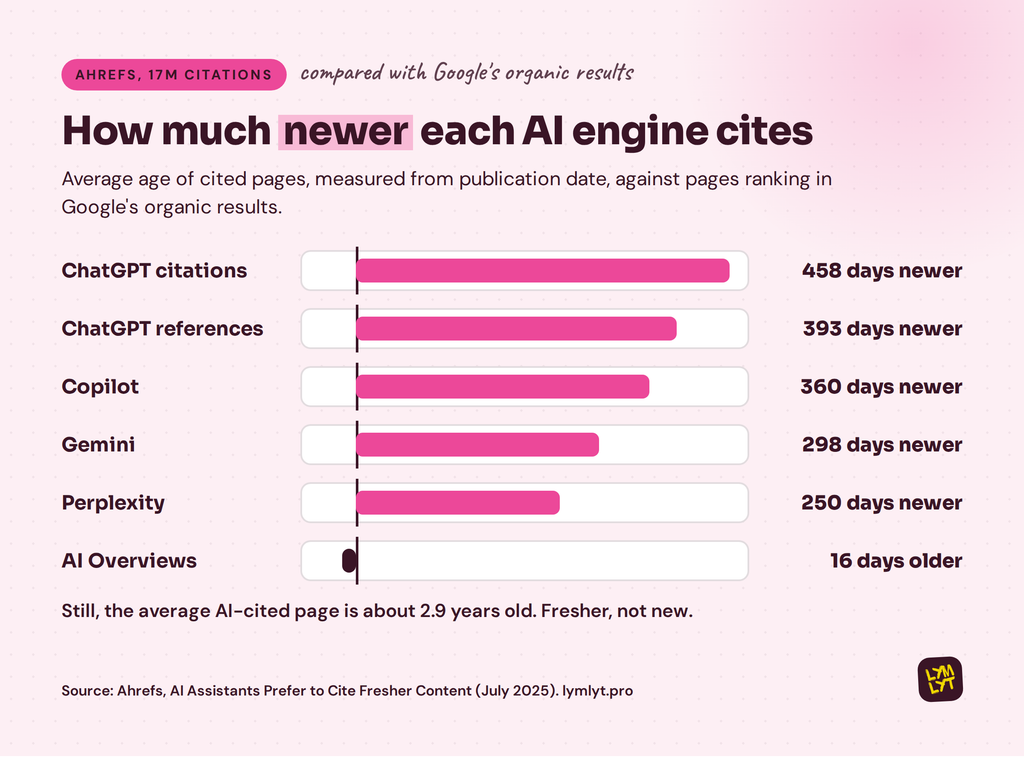
The engines are not the same. Here is how much newer each one’s citations were than Google’s organic results, measured from publication date:
| AI surface | Days newer than Google organic |
|---|---|
| ChatGPT (citations) | 458 days newer |
| ChatGPT (in-text references) | 393 days newer |
| Copilot | 360 days newer |
| Gemini | 298 days newer |
| Perplexity | 250 days newer |
| Google AI Overviews | 16 days older |
ChatGPT leans newest. Google AI Overviews barely differs from Google’s own rankings. Ahrefs also found Perplexity and ChatGPT tend to list their in-text references from newest to oldest, which matters if you want to be the first source a reader sees (more on that engine in how to get cited in Perplexity).
Fresh does not mean new
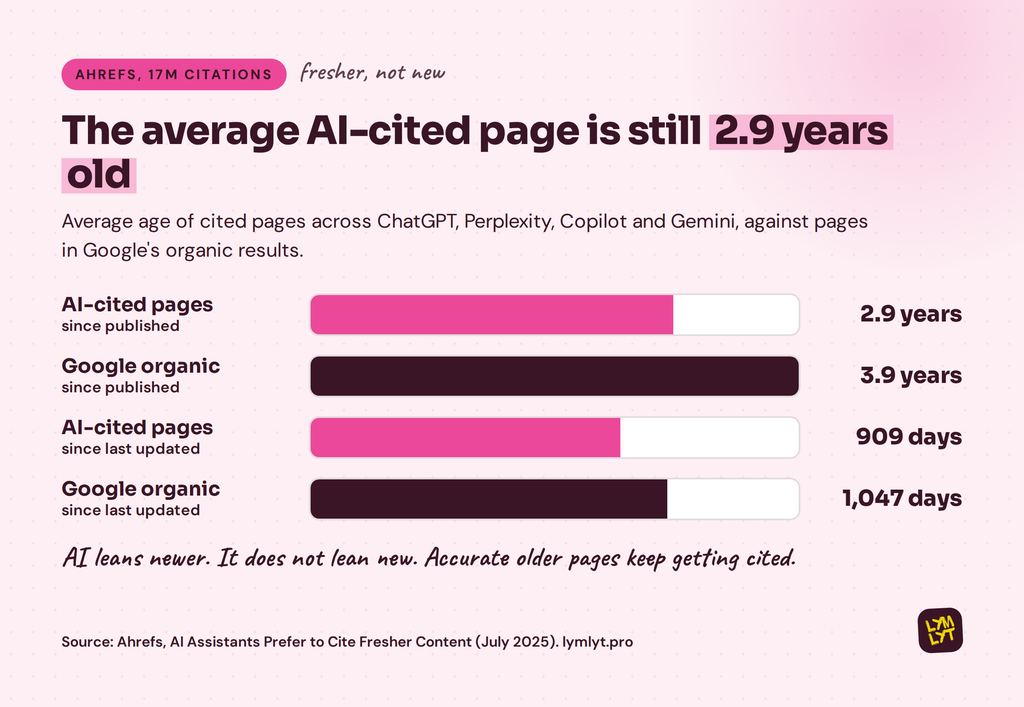
Before you start republishing everything, read the other half of the finding. The average page AI cites is still about 2.9 years old, against 3.9 years for Google’s organic results (Ahrefs). Ahrefs concludes that AI assistants, like Google, still prefer citing long-lived content, and its author suspects most brands will get more from new high-quality pages than from constant updating.
It is also a correlation. Newer pages may simply cover newer topics. The study shows what gets cited, not why.
The lab test: a newer date changes AI rankings
A 2025 study led by researchers at Waseda University tested the “why” directly. They took passages from the TREC Deep Learning test collections, asked seven AI models from OpenAI, Meta and Alibaba to rank them, then ran the same ranking again after adding fake publication dates. The text did not change. Only the date did.
What happened:
- Every model favoured the newer-dated passages. Larger models reduced the effect, but none removed it.
- The top 10 results got younger by up to 4.78 years on average.
- A single passage jumped as many as 95 places.
- When two passages were equally relevant, a fresh date flipped up to 25% of the model’s choices on average. This part was tested on four open-source models.
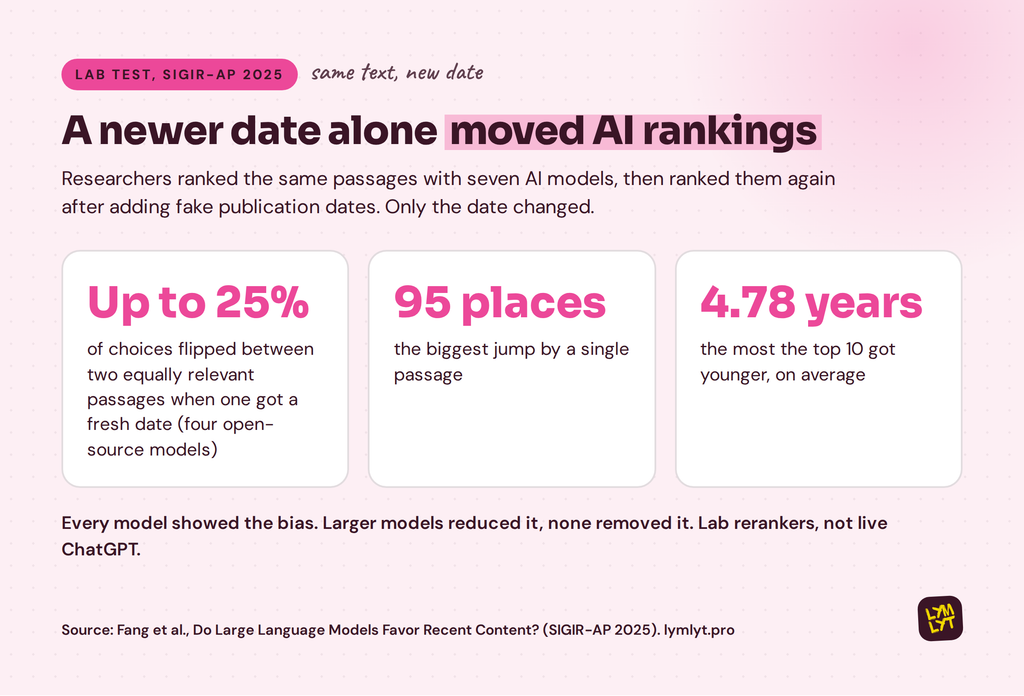
This is a lab setup, not live ChatGPT or Perplexity. But it shows the mechanism is real: when an AI model compares sources, a visible date acts like a relevance signal on its own.
Why changing the date is still a bad bet
If a date alone can sway an AI ranker, the tempting move is to bump every “last updated” date and walk away. Three reasons not to:
- Google warns against it. Google’s John Mueller has cautioned against changing publish dates without real changes to the page, a point Ahrefs repeats in its own study.
- It does not fix what gets quoted. If your pricing, features or numbers are out of date, a new date makes a wrong answer look current. That is worse than an old date.
- The edge is small next to everything else. Freshness is one signal among many. Ahrefs’ caution is blunt: low-quality content updated every day will not suddenly get cited.
Watch how this finding gets retold, too. One 2026 article describes the Ahrefs study as recent work from “earlier in 2026” (NoGood). It was published in July 2025. That is the date drift we traced in the AI citation telephone game, happening to a study about dates.
What to refresh on a B2B SaaS site
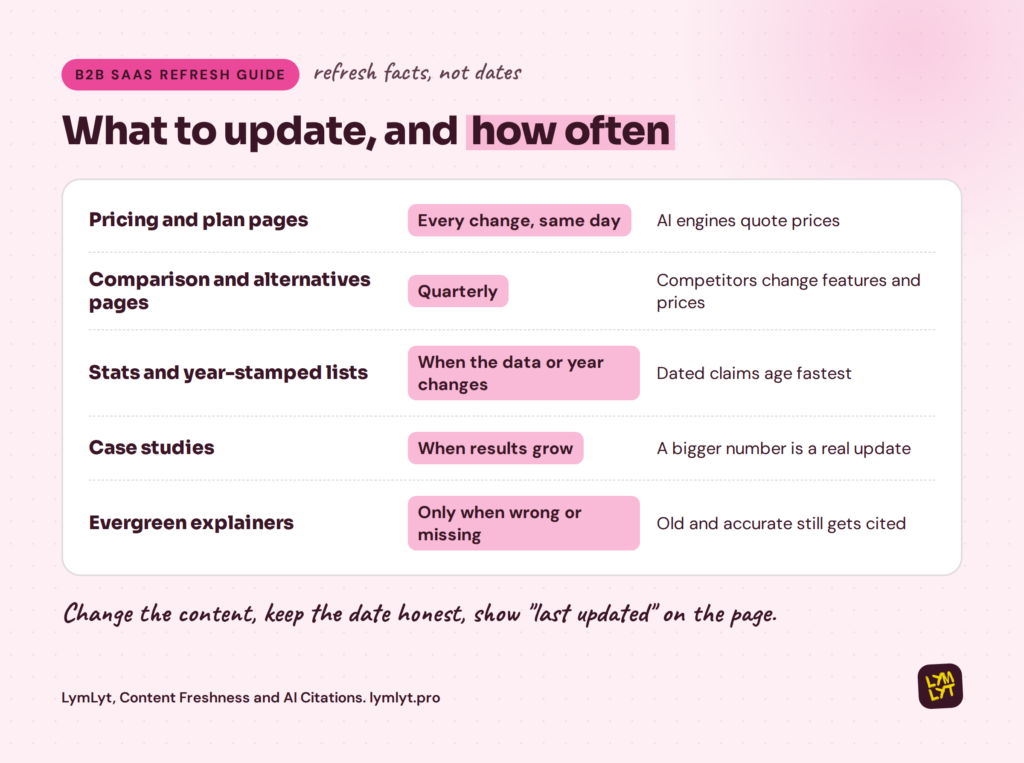
Freshness matters most where the facts change. Refresh with real edits, and show a visible “last updated” date on the page:
| Page type | Refresh? | Why |
|---|---|---|
| Pricing and plan pages | Every change, same day | AI engines quote prices, and billing details were where they slipped most in our pricing prompts study |
| Comparison and alternatives pages | Quarterly | Competitors change features and prices. See our comparison pages guide |
| Statistics and “best of 2026” lists | When the data or the year changes | Dated claims age fastest, like those in our AI SEO statistics roundup. Roughly three in four cited pages in one dataset carried the year in the title (our G2 and Capterra analysis) |
| Case studies | When results grow | A newer, bigger number is a real update. See our B2B SaaS case studies guide |
| Evergreen explainers | Only when something is wrong or missing | Old and accurate still gets cited |
Two more habits help:
- Tell search engines when you update. Fabrice Canel, principal product manager at Microsoft Bing, has said generative AI values fresh content and recommended the IndexNow API to push updates as they are published (Search Engine Roundtable).
- Track it. Add your refreshed pages to your quarterly AI visibility audit and log citations and mentions separately, so you can see whether a refresh moved anything.
FAQ
Does AI prefer fresh content? On average, yes. In Ahrefs’ study of about 17 million citations, AI assistants cited pages 25.7% newer than Google’s organic results, measured from publication date.
Which AI engine cares most about freshness? ChatGPT. Its citations were up to 458 days newer than Google’s organic results. Google AI Overviews was the exception, citing pages slightly older than Google’s own rankings.
Will updating the date on an old post get it cited more? Do not rely on it. Lab tests show AI models favour newer-dated text, but Google warns against changing dates without real changes, and a new date on outdated facts makes wrong answers look current.
Is old content still worth keeping? Yes. The average AI-cited page is about 2.9 years old. Accurate evergreen content keeps getting cited.
How often should B2B SaaS teams update content? Update pricing the day it changes, comparison pages quarterly, and stats or year-stamped pages when the data changes. Leave accurate evergreen explainers alone.
Conclusion: refresh facts, not dates
The link between content freshness and AI citations is real but narrow. AI engines lean toward newer pages, ChatGPT most of all, and a visible date carries weight with AI rankers. But the pages AI cites are still mostly years old, and a new date on stale facts only makes a wrong answer look current.
Refresh the pages where facts change, keep the date honest, and spend the rest of your effort on pages worth citing in the first place. Freshness also doesn’t replace structure: our look at schema markup and AI citations found that technical tags alone don’t move the needle either.
We build and maintain B2B SaaS content that stays accurate in AI answers. See how we approach AI visibility.
Sources
- Ahrefs, New Study: AI Assistants Prefer to Cite “Fresher” Content (17 Million Citations Analyzed) (July 2025)
- Do Large Language Models Favor Recent Content? A Study on Recency Bias in LLM-Based Reranking, SIGIR-AP 2025
- Search Engine Roundtable, Microsoft Confirms Schema Helps Its LLMs (Copilot) Understand Your Content (March 2025)
- NoGood, The Impact of Content Freshness on AI Citations (cited as an example of date drift)

Jay is the co-founder of LymLyt and an AI partnership consultant helping B2B SaaS companies grow through content strategy, SEO, and AI integration. He writes about content marketing, what makes B2B content convert, and how SaaS teams can build content systems that drive real pipeline.