AI SEO Statistics for 2026: The Numbers Marketers Actually Need
Your rankings held. Your traffic didn’t.
That gap is the whole story of search right now. Position one still means something, it just means less than it did eighteen months ago. The numbers below explain where those clicks went, what replaced them, and which parts of this are worth changing your strategy over.
Every stat here links to its source. Skip to whatever section matches the argument you’re trying to win.
The nine numbers to remember
If you only screenshot one section, make it this one.
- 68.01% of US Google searches ended without a click in early 2026 (SparkToro, June 2026)
- Click-through rate on the top-ranking page drops 58% when an AI Overview appears (Ahrefs, December 2025 data)
- AI Overviews trigger on 48% of tracked commercial queries (BrightEdge, February 2026)
- AI-referred visitors convert at 4.4x the rate of traditional organic visitors (Semrush)
- 92% of B2B buyers say AI shaped their vendor shortlist (Semrush, July 2026)
- Only 7% say brand recognition made them notice a vendor inside an AI answer (Semrush, July 2026)
- ChatGPT’s share of AI web traffic fell from 76% to 53% in twelve months (Similarweb, May 2026)
- Only 12% of AI-cited URLs rank in Google’s top 10 for the same prompt (Ahrefs, May 2026)
- Around 14% of marketers track AI visibility at all (GoodFirms, 2026)
Zero-click search: the clicks left, and they aren’t coming back
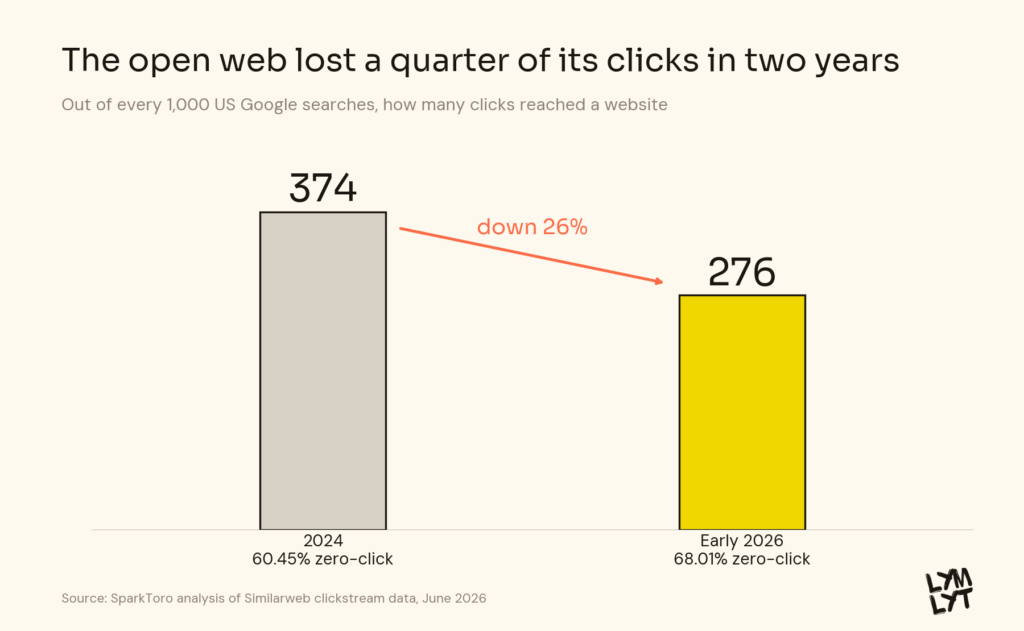
SparkToro found that 68.01% of US Google searches ended without a click during the first four months of 2026. The study used Similarweb clickstream panel data across desktop and mobile.
| Metric | 2024 | Early 2026 | Change |
|---|---|---|---|
| Searches ending without a click | 60.45% | 68.01% | +7.56 pts |
| Clicks reaching the open web per 1,000 searches | 374 | 276 | -26% |
| Share of searches leading to another Google search | baseline | +7.2 pts | rising |
The ratio row is the one to quote. The open web lost roughly a quarter of its clicks per thousand searches in two years.
Where the rest went:
- People refine inside Google instead of leaving it
- Clicks that do happen increasingly land on Google-owned properties like Maps and YouTube
- Search behavior itself shifted, with longer, more conversational queries replacing keyword-style ones
What this means for you: traffic volume as your headline SEO KPI is structurally broken. Not your SEO. The metric. Rand Fishkin’s own recommendation is to invest in brand awareness on the platforms your audience already uses, whether or not those efforts drive a direct visit. Branded search, local queries, and high-intent transactional terms still pay.
AI Overviews: how often they appear
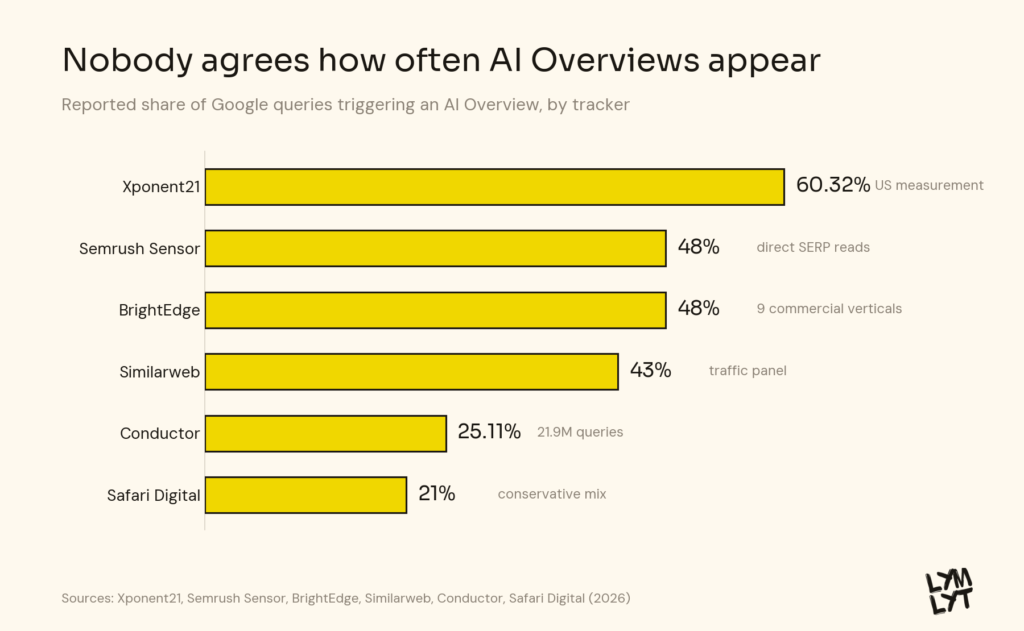
Prevalence numbers vary a lot, and that variation is the honest answer.
| Tracker | Prevalence | Period | Method |
|---|---|---|---|
| Xponent21 | 60.32% | April 2026 | US, AdvancedWebRanking-derived |
| BrightEdge | 48% | February 2026 | 9 commercial industries, daily tracking |
| Semrush Sensor | ~48% | Mid 2026 | Direct SERP observation |
| Similarweb | ~43% | Mid 2026 | Blended traffic panel |
| Conductor | 25.11% | Q1 2026 | 21.9 million queries |
| Safari Digital | ~21% | 2026 | Conservative non-branded mix |
Each tracker uses a different keyword set, geography, device mix, and detection method. Quote the range, name the tracker, and you’ll never get caught out.
Vertical splits are more useful than the global average. BrightEdge tracked these across twelve months:
| Industry | Feb 2025 | Feb 2026 |
|---|---|---|
| Healthcare | not tracked | 88% |
| Education | 18% | 83% |
| B2B technology | 36% | 82% |
| Restaurants | 10% | 78% |
| Insurance | not tracked | ~63% |
If you sell into B2B tech, four out of five of your buyer’s queries now return an AI summary before a single blue link.
What AI Overviews cost you
Three independent studies, three methods, same direction.
| Study | Finding | Sample |
|---|---|---|
| Ahrefs (Dec 2025 data) | 58% CTR drop at position one | 300,000 keywords, GSC data |
| Ahrefs (Apr 2025 data) | 34.5% CTR drop at position one | Same methodology, earlier period |
| Pew Research (Jul 2025) | Clicks fell from 15% to 8% of visits | 68,879 searches, 900 US adults |
| Seer Interactive (Apr 2026) | CTR floor of 1.3%, recovering to 2.4% | 53 brands, 5.47M queries, 2.43B impressions |
Two findings from Pew that most roundups skip:
- Clicks on a link inside the AI summary happened just 1% of the time
- Users ended their browsing session entirely 26% of the time after a search with an AI summary, against 16% without one
That second one matters most. Roughly one in four of those sessions ends. That traffic didn’t go to a competitor. It stopped existing.
There is a counter-trend worth knowing. Seer’s read is that AI Overviews redistribute clicks rather than only deleting them:
- Pages cited inside an AI Overview get more clicks than uncited pages on the same results page
- Both still get fewer clicks than a search with no AI Overview at all
- CTR on searches without AI Overviews rose from 2.8% in early 2025 to 3.8% by February 2026
Worth separating AI Overviews from Google AI Mode, which is a different surface with different citation behavior. Most reporting conflates them.
What this means for you: queries where AI Overviews don’t fire are quietly getting more valuable. Audit which of your terms trigger one, and treat the clean SERPs as protected inventory.
AI referral traffic: tiny, growing fast, worth more than the volume suggests
Absolute volume is still small. Ignore anyone who tells you otherwise.
SE Ranking’s analysis of 101,574 websites found ChatGPT’s worldwide share of referral traffic went from 0.23% in April 2026 to 0.32% in May 2026. That’s a 36.7% jump in a single month, after four months of almost no movement.
The spike had a cause. On May 7, 2026, ChatGPT started surfacing brand links as visible clickable callouts inside answers instead of burying them in footnotes.
| ChatGPT referral behavior | Before May 7, 2026 | Late May 2026 |
|---|---|---|
| Share of referrals landing on homepages | 26 to 29% | 62 to 63% |
| Pattern after the spike | rising slowly | plateaued, no decay |
Similarweb’s read is that this is a permanent shift, not a novelty bump. A plateau instead of a decay curve is the tell.
That changes what the traffic is. Someone landing on your homepage from inside a ChatGPT answer has often already decided about your brand before they arrive, which makes the visit behave more like the tail end of an ad impression than a search click.
Does AI traffic actually convert?
Four studies, four samples, one direction.
| Source | Finding |
|---|---|
| Semrush | AI search traffic converts at 4.4x organic, across 500+ B2B topics |
| Ahrefs | 0.5% of sessions, 12.1% of signups, a 23x differential |
| Opollo | 14.2% conversion from AI vs 2.8% from Google organic, 312 B2B tech firms |
| RankScience | Same 14.2% vs 2.8% pattern, reproduced across 12 million visits |
| Multiple e-commerce studies | 10 to 30% lift over non-branded organic, a much smaller premium |
The premium tracks with how complex the purchase is. High-consideration B2B SaaS sits at the top of that range. Impulse e-commerce sits at the bottom.
One attribution caveat worth carrying into any board meeting: many AI-influenced conversions show up as branded organic searches in Google Analytics, not as AI referrals.
What this means for you:
- Stop benchmarking AI referrals against organic on volume. Benchmark on pipeline.
- Fix your homepage, because that’s where a growing share of this traffic lands.
- If traffic is up and demos are flat, the reasons B2B SaaS content stops converting usually sit downstream of the click.
The platform mix stopped being a one-horse race
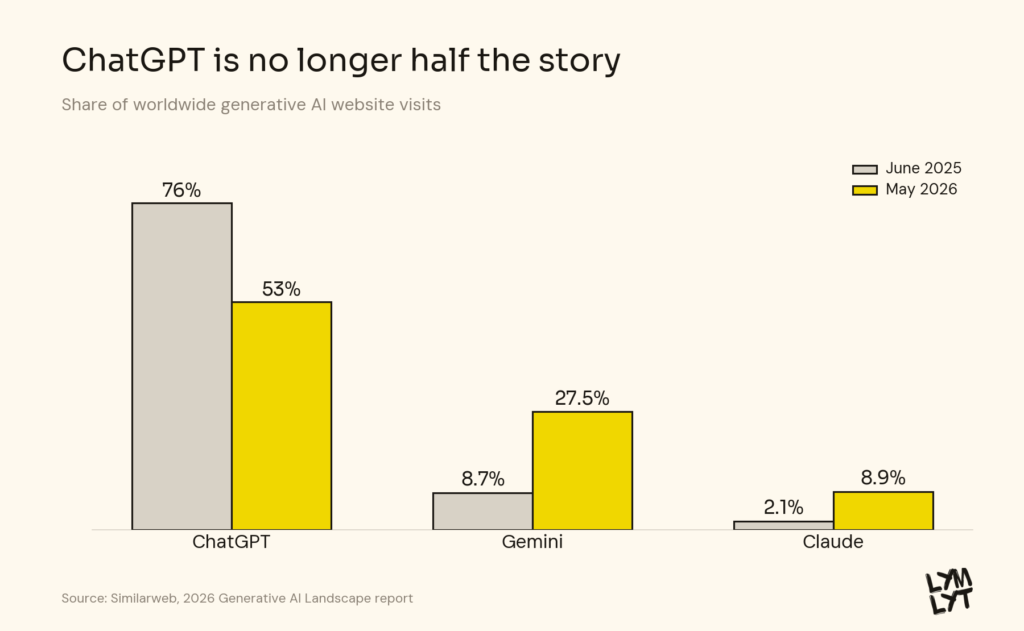
Optimizing for ChatGPT alone used to cover most of the audience. It doesn’t now.
| Platform | Share, June 2025 | Share, May 2026 |
|---|---|---|
| ChatGPT | ~76% | ~53% |
| Gemini | under 9% | 27 to 28% |
| Claude | ~2% | close to 9% |
Three things that number hides:
- ChatGPT’s absolute visit count stayed roughly flat. The category grew fast enough that a flat leader looks like a shrinking one.
- Gemini absorbed most of the share ChatGPT lost, riding distribution Google already owns through Search, Android, and Workspace.
- Claude grew fastest proportionally, roughly quadrupling, but from a small base.
Category growth, for context: average monthly visits across generative AI platforms grew 70% year over year to 9.5 billion between June 2025 and May 2026, while unique visitors grew 57% to 655 million. People are opening these tools more often, not just signing up for the first time.
B2B referral splits look different from raw web traffic. Goodie’s panel of brand sites measured this across March and April 2026:
| Platform | Share of measurable B2B AI referrals |
|---|---|
| ChatGPT | 62.6% |
| Claude | 18.5% |
| Gemini | 10.6% |
| Perplexity | 7.3% |
| Copilot | ~4% |
What this means for you: a strategy built around ChatGPT alone now reaches roughly half the market. If you track AI visibility on one platform, you’re measuring a fraction. Claude at 18.5% of B2B referrals is the number most teams have never checked.
Citations: what these engines actually pull from
This is where GEO stops being a buzzword and starts being a content brief.
Ahrefs ran 15,000 long-tail prompts through Google and Bing, then asked the same questions to four AI assistants:
- On average, only 12% of links cited by ChatGPT, Gemini, and Copilot appeared in Google’s top 10 for the same prompt
- Perplexity is the outlier, with nearly one in three citations pointing to a top 10 page
- Measured against Bing’s top 10, overlap sits around 10%
Ranking and getting cited are different jobs.
The source mix skews heavily toward community and platform content:
| Domain | Share of LLM citations | Source |
|---|---|---|
| 40.1% | Semrush, 150,000+ citations | |
| Wikipedia | 26.3% | Semrush |
| YouTube | 23.5% | Semrush |
Shares overlap, since one answer can cite several domains. Peec AI’s analysis of 30 million directly cited sources ranks Reddit first across ChatGPT, Google AI Mode, Gemini, Perplexity, and AI Overviews.
Three findings you can act on directly:
- SE Ranking’s study of 129,000 domains found sites with millions of Reddit brand mentions averaged 7 ChatGPT citations, against 1.8 for domains with minimal Reddit presence
- Listicle content earns 21.9% of all AI citations, the highest of any content format (Wix, March 2026)
- LinkedIn is the most cited domain for professional queries across all six major platforms, with citation frequency doubling between November 2025 and February 2026 (Profound, 1.4 million citations)
Citation rate itself is still low, and it varies hard by category:
| Category | ChatGPT citation rate |
|---|---|
| Travel and hospitality | ~23% |
| Automotive | ~20% |
| All US prompts (average) | ~6.8% |
| Professional services | under 4% |
Similarweb tracked the overall rate climbing from about 1.6% in June 2025 to 6.8% by May 2026.
What this means for you: the field is not saturated. Most brands still aren’t showing up in AI citations most of the time. If you’re in a low-citation category, you have runway. If you’re in travel or automotive, you have less. The reasons a site doesn’t show up in ChatGPT are usually fixable, and usually not what teams assume.
B2B buyers: AI shapes the shortlist before your CRM sees anything
Send this section to your CEO. Semrush surveyed 643 US business professionals across March and April 2026, basing findings on the 519 who use AI tools for work.
Usage is habitual, not experimental:
- 84% use AI tools for work
- 69% of those use them daily, 95% at least weekly
- 66% regularly use AI to research products, vendors, or solutions, plus another 29% occasionally
AI shows up at every stage of the purchase:
| Stage | Share using AI |
|---|---|
| Early research, scoping, requirements | 72% |
| Actively comparing vendors | 62% |
| Narrowing the shortlist | 48% |
| Supporting the final decision | 45% |
| Post-purchase evaluation | 29% |
| Not using AI at all | 2% |
And it moves the outcome:
| Decision point | Influenced by AI | Called it significant |
|---|---|---|
| Discovering new vendors | 97% | 44% |
| Shaping the shortlist | 92% | 45% |
| Final vendor choice | 83% | 32% |
These are real budgets. 43% typically evaluate purchases between $1,000 and $10,000, 42% between $10,000 and $100,000, and 14% above $100,000.
The finding that should change your content brief
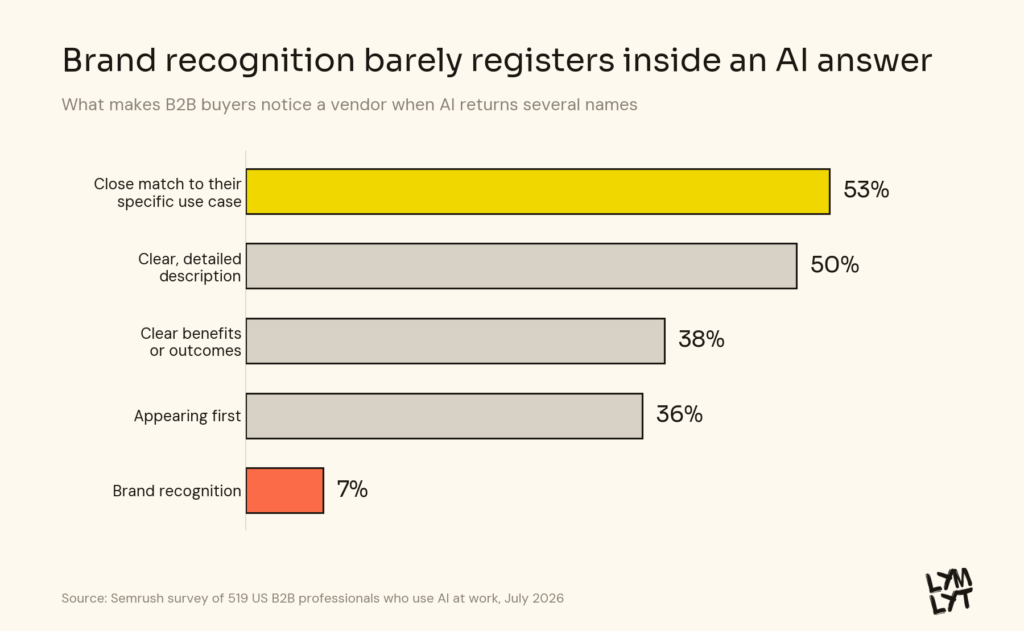
When AI returns several vendor names, here’s what makes one stand out:
| What makes a vendor stand out | Share |
|---|---|
| Close match to the buyer’s specific use case | 53% |
| Clear and detailed description | 50% |
| Clear benefits or outcomes | 38% |
| Appearing early or mentioned first | 36% |
| Brand recognition | 7% |
Semrush frames this as a leveling of the field. A smaller vendor with precise, use-case-specific presence in AI can outperform a better-known competitor.
Buyer complaints point the same direction:
- 33% say AI recommendations are too generic for their specific use case
- 28% say responses lack depth or accuracy
- 27% say recommendations don’t reflect real pricing or contract structures
- 25% say AI missed vendors they knew were relevant
AI doesn’t end the journey, it starts a shorter one
When AI mentions a vendor, buyers do this next:
| Next action | Share |
|---|---|
| Visit the vendor’s website | 71% |
| Search the company on Google | 63% |
| Compare against alternatives | 46% |
| Return to AI with follow-up questions | 41% |
| Check reviews on G2 or similar | 38% |
| Ask colleagues | 14% |
The sequence has flipped for a plurality of buyers: 41% now start with AI and validate through search, 35% start with search and use AI to synthesize, and 20% move between both.
Which means strong AI visibility paired with a weak website, thin reviews, or poor search presence loses the buyer at the very next step. That’s the case for treating B2B SaaS SEO strategy and AI visibility as one system instead of two budgets.
Separately, G2 found in March 2026 that 51% of B2B software buyers now begin research in an AI chatbot rather than a search engine, up from 29% a year earlier.
What marketers are actually doing about it
Adoption is settled. Measurement is not.
| Metric | Figure | Source |
|---|---|---|
| Marketing teams using AI | 91% (up from 52% in 2022) | HubSpot, State of Marketing 2026 |
| Content marketers using AI | 96% | HubSpot |
| SEO specialists using AI | 93% | HubSpot |
| Marketers tracking AI visibility | ~14% | GoodFirms, 2026 |
| Brands systematically tracking AI search performance | 16% | October 2025 |
| Senior SEOs whose leadership asked about AI visibility | ~91% | Search Engine Land |
That gap between 91% adoption and 14% measurement is the entire opportunity.
Budget is moving:
- 44.8% of brands increased PR investment because of AI search, as third-party content influence on LLM answers became measurable (May 2026)
- Forrester sets 15% of search budget as the floor for mid-market B2B brands shifting toward AI search visibility
- Enterprises in AI-exposed verticals like healthcare and finance go to 30% or higher
The pain is documented at scale. HubSpot data covered in June 2026 showed a 27% organic traffic decline across nearly 300,000 of its customers, alongside AI search overtaking product demos as a driver of CRM purchase intent.
How to actually use these numbers
Five moves, in order of how fast they pay off.
1. Rebaseline your reporting. Impressions and rankings will look fine while clicks fall. Add a citation or mention metric before your next board deck, because the traffic line alone will misrepresent what’s happening. Our AI visibility checklist covers what to track and how.
2. Segment your keywords by AI Overview presence. Terms without one are getting more valuable. Terms with one need you inside the citation set or they’re dead weight.
3. Write for use-case fit, not category authority. 53% versus 7% is not a close call. A page titled for your exact buyer scenario beats a page titled for your category. This is the same logic behind building a content engine rather than a publishing calendar.
4. Put real pricing and comparison content on your own site. Buyers name missing pricing as a top complaint, and 71% visit your site after AI mentions you. Comparison pages do this job better than blog posts, because they answer the exact question the buyer brought over from the AI answer.
5. Get mentioned where the engines already look. Reddit, LinkedIn, YouTube, review sites, industry publications. Third-party presence moves citations in a way owned content alone does not. If you’d rather hand this off, we compared the AI SEO agencies that actually get clients cited.
Unfamiliar terms in this piece are defined in the AI visibility glossary.
A note on the data
Prevalence and CTR figures vary between studies because the panels, keyword sets, geographies, and detection methods vary. Treat any single number as directional.
- Where studies converge, like the click-through decline from AI Overviews, the trend is safe to act on
- Where they diverge wildly, like AI Overview trigger rates, quote the range and name the tracker
- Google has publicly disputed the Pew methodology, arguing the queryset wasn’t representative of search traffic. Pew’s study is still the most behaviorally rigorous data available, because it tracks actual browsing rather than modeled panels
- Several of these studies come from companies selling AI visibility tools. The samples are specific and disclosed, which is why they’re here, but the framing serves the vendor
Sources
- SparkToro, zero-click search study (June 2026)
- Search Engine Land coverage of the SparkToro study (June 2026)
- Ahrefs, AI Overviews reduce clicks (December 2025 data)
- Ahrefs, AI citation and Google top 10 overlap (May 2026)
- Pew Research Center, clicks on links in AI summaries (July 2025)
- Seer Interactive AIO CTR update, via Search Engine Land (April 2026)
- Similarweb, 2026 AI search stats (July 2026)
- Similarweb, ChatGPT referral traffic after the May link change (May 2026)
- SE Ranking, ChatGPT referral traffic analysis (May 2026)
- Semrush B2B buying study, via PPC Land (July 2026)
- Semrush, AI SEO statistics
- Goodie, AI search traffic report (May 2026)
- 5WPR First-Stop Index (2026)
- Contently, most-cited sources in LLMs (April 2026)
- GoodFirms, SEO and AI search survey (2026)
- PPC Land, AI search and PR investment (May 2026)
- PPC Land, HubSpot AEO tool and organic traffic decline (2026)

Jay is the co-founder of LymLyt and an AI partnership consultant helping B2B SaaS companies grow through content strategy, SEO, and AI integration. He writes about content marketing, what makes B2B content convert, and how SaaS teams can build content systems that drive real pipeline.