B2B SaaS SEO Strategy: A No-Nonsense Guide for Founders
Your buyers are not waiting for your cold email. They are not watching your ads. They are searching, comparing, asking ChatGPT, reading Reddit threads, and shortlisting vendors before anyone on your team picks up the phone. A strong B2B SaaS SEO strategy is what puts you in front of that search before the shortlist is made.
67% of B2B buyers prefer a rep-free buying experience in 2026. The deal doesn’t start with a discovery call. It starts with a search query. If your B2B SaaS SEO strategy doesn’t put you in front of that query, you were never in the conversation.
This guide is the complete playbook. Not a surface-level overview. Not ten tips that apply to every industry. A practical, no-nonsense framework built specifically for B2B SaaS founders who want organic search to become their most defensible growth channel.
Why B2B SaaS SEO is different from regular SEO
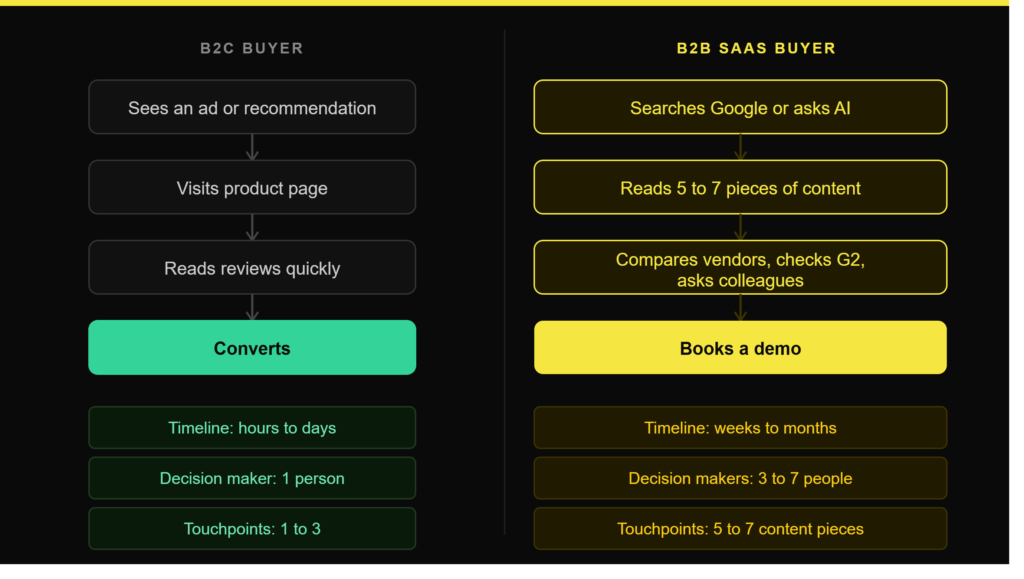
Most SEO advice is written for e-commerce or local businesses. It doesn’t map to how B2B SaaS buyers actually behave. Before building a strategy, it helps to understand what makes this category distinct.
Longer buying cycles
A B2B SaaS buyer doesn’t land on a page and convert. They read five to seven pieces of content before engaging with sales. They consult multiple stakeholders. They compare vendors for weeks. Your SEO strategy has to reach them across that entire journey, not just at the moment they search “best [category] software.”
Lower volume, higher value keywords
The keywords that matter in B2B SaaS rarely have the search volume of consumer keywords. A term getting 200 searches a month that converts at 15% is worth far more than a term getting 50,000 searches a month that converts at 0.2%. Volume is not the metric. Intent is.
Multiple stakeholders with different needs
The founder reads one thing. The marketing lead reads another. The CFO wants to see ROI. The technical buyer wants to know about integrations. A B2B SaaS SEO strategy has to speak to all of them, which means content mapped to role and funnel stage, not just to a keyword.
AI search is now part of the buyer journey
51% of B2B buyers now begin their research using AI chatbots more frequently than traditional search engines. Your SEO strategy in 2026 has to account for both Google and the AI answer layer sitting on top of it. These are increasingly separate competitions with separate winners.
The numbers that make the case
Before the strategy, here are the numbers founders need to internalize.
- Organic search drives 44.6% of B2B revenue, more than any other channel.
- SaaS SEO leads convert at 14.6% versus 1.7% for outbound, an 8.6x quality gap.
- B2B SaaS companies investing in SEO see an ROI of 702% and a breakeven average of about seven months.
- Organic SEO customer acquisition cost averages $560 versus $802 for paid search, and the gap widens as content compounds.
- Companies that build deep topic clusters see 3.2x more AI citations than single-page competitors.
The compounding math is the part most founders miss. Paid ads acquire customers at a fixed unit cost that scales upward with competition. SEO acquires customers at a unit cost that scales downward over time. After month 12, every additional ranking lowers your blended CAC without adding spend.
The five pillars of a B2B SaaS SEO strategy
A complete B2B SaaS SEO strategy rests on five pillars. Skipping any one of them is the most common reason founder-led SEO stalls.
Pillar 1: Technical SEO, the foundation
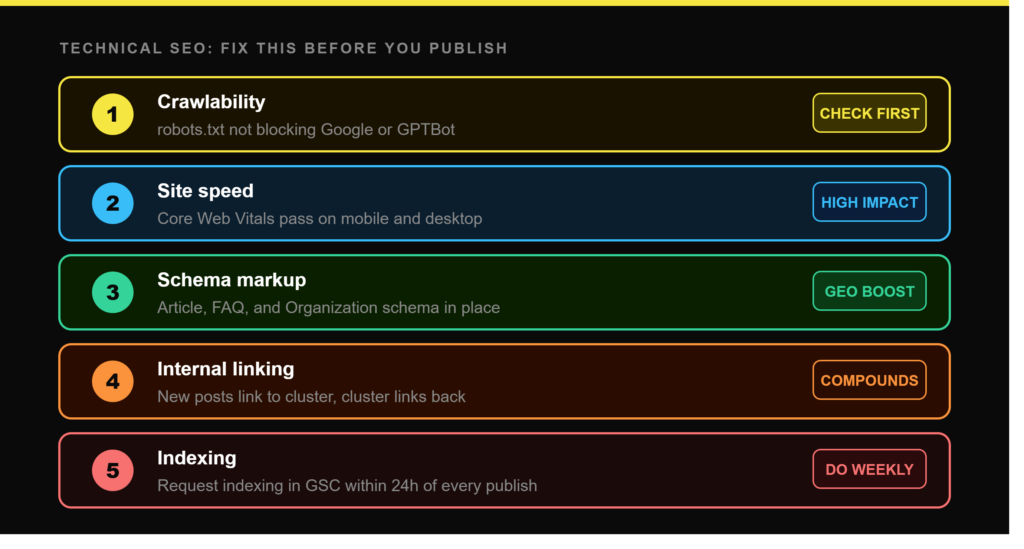
Content on a broken site is expensive decoration. Before publishing a single post, get the technical foundation right.
What technical SEO covers:
- Crawlability: Can Google (and AI crawlers) actually reach and index your pages? Check your robots.txt file. Many sites unknowingly block crawlers through a hosting default that was changed without anyone noticing. Even on pages crawlers can reach, AI crawlers render JavaScript far less than Google does, so content that loads client-side can be invisible to ChatGPT while looking fine in Search Console.
- Site speed: Core Web Vitals directly affect rankings. Slow pages lose ground to faster competitors, especially on mobile.
- Schema markup: Structured data helps Google and AI engines understand what your content is about and how to display it in search results.
- Internal linking structure: How pages link to each other tells search engines which content is most important. A site where every page is equally linked to everything is a site that ranks for nothing in particular.
- Indexing: Check Google Search Console regularly. Pages sitting in “Discovered, not indexed” are invisible to Google regardless of their quality.
The fastest way to find technical issues is a full crawl audit using a tool like Screaming Frog or Ahrefs Site Audit. Run one before anything else. Fix what you find. Then build on top of a solid foundation.
Pillar 2: Keyword research built around buyer intent
Most B2B SaaS companies do keyword research wrong. They chase volume. The right approach chases intent.
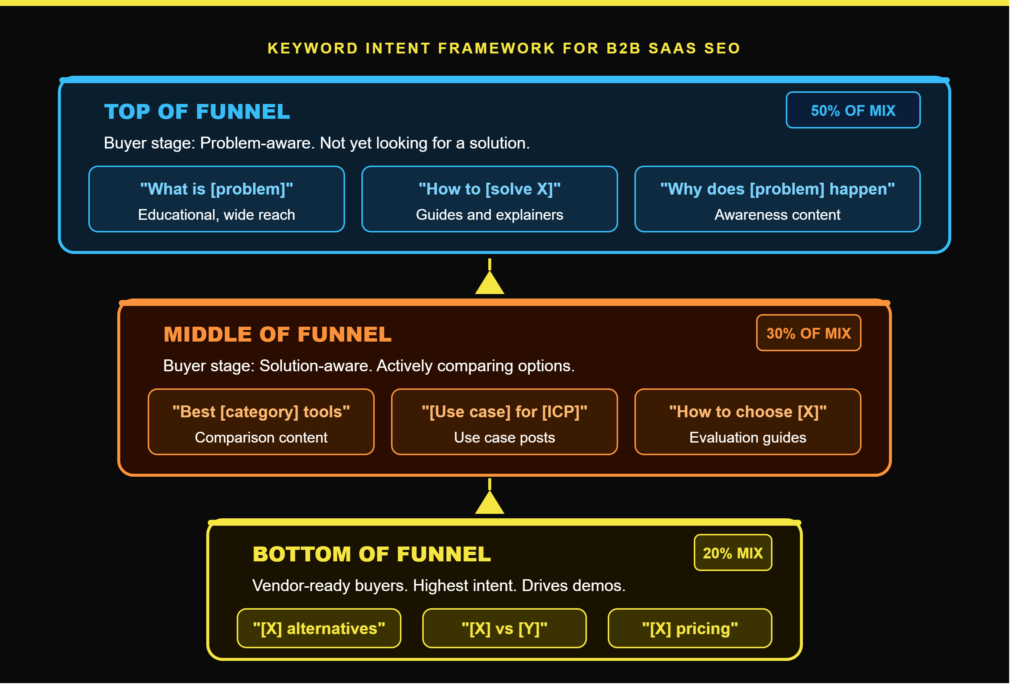
There are three types of keywords worth targeting in B2B SaaS:
Bottom-of-funnel (BOFU) keywords: start here. These are the keywords people search when they are actively evaluating vendors. They have low volume and high intent. Examples:
- “[Your category] software for [your ICP]”
- “Best [your category] tools”
- “[Competitor] alternatives”
- “[Your category] pricing”
- “[Your product] vs [competitor]”
One BOFU page that converts 10 visitors into demos is worth more than a TOFU post that gets 10,000 visitors and converts none. Start with BOFU.
Middle-of-funnel (MOFU) keywords: build trust. These are comparison and evaluation keywords. Buyers using them are narrowing down their options. Examples:
- “How to choose [your category] software”
- “[Use case] tools compared”
- “What to look for in [your category]”
Top-of-funnel (TOFU) keywords: build awareness. These are educational and informational keywords. Buyers here are problem-aware but not yet solution-aware. Examples:
- “What is [problem your product solves]”
- “How to [solve the problem your product addresses]”
- “Why [problem] happens”
The mix should be roughly 50% TOFU, 30% MOFU, and 20% BOFU. Most B2B SaaS companies run 80% TOFU and wonder why their content doesn’t generate pipeline.
For the mechanics of building a keyword list, the best keyword research tools available in 2026 cover everything from competitor gap analysis to AI search query research.
Pillar 3: Topical authority, the compounding engine
Ranking for a single keyword is a short-term win. Building topical authority is a compounding asset.
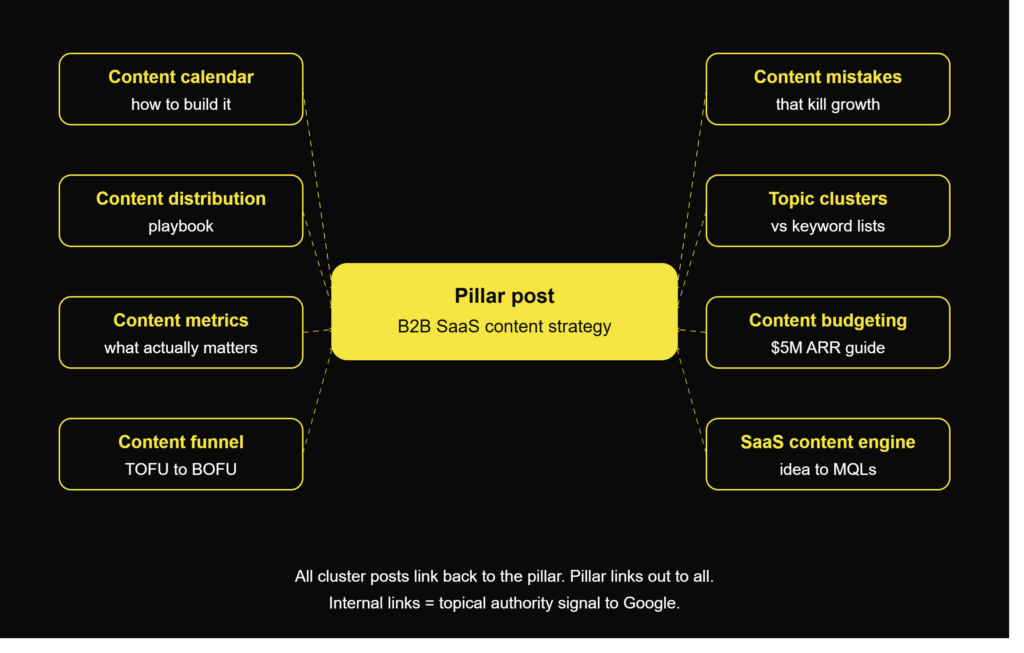
Topical authority is Google’s measure of how comprehensively a site covers a subject. A site with one post on a topic signals shallow expertise. A site with a pillar post, six supporting cluster posts, strong internal links, and consistent publishing signals that it owns the territory.
How topic clusters work:
A topic cluster has two components. The pillar post covers a broad topic comprehensively at a high level and links to every supporting post. The cluster posts each cover a specific subtopic in depth and link back to the pillar and to each other.
For a B2B SaaS SEO strategy, a cluster might look like this:
- Pillar: B2B SaaS SEO Strategy (this post)
- Cluster posts: Keyword research tools, topical authority, SEO content writing, GEO for SaaS, content calendar, SaaS content engine, why content doesn’t convert
Every post in the cluster reinforces the others. Internal links pass authority from high-ranking pages to newer ones. The pillar becomes the go-to source on the topic over time.
The mistake most founders make is publishing without a cluster structure. They produce 20 disconnected posts on vaguely related topics, build authority on nothing, and rank nowhere. The discipline is to go deep on one cluster before expanding to the next. Topic clusters versus keyword lists is the fundamental choice that determines whether your content compounds or sits idle.
Pillar 4: SEO content, what actually gets written
The strategy produces a content plan. The content plan produces pages. The quality of those pages determines whether the strategy works.
What good B2B SaaS SEO content looks like:
Good SEO content writing for B2B SaaS is not about keyword density. It is about depth, specificity, and buyer language.
Depth means going further on a topic than any competing page. Specificity means naming the exact ICP, the exact pain, the exact use case. Buyer language means writing the way your actual customers describe their problems, not the way your product team describes solutions.
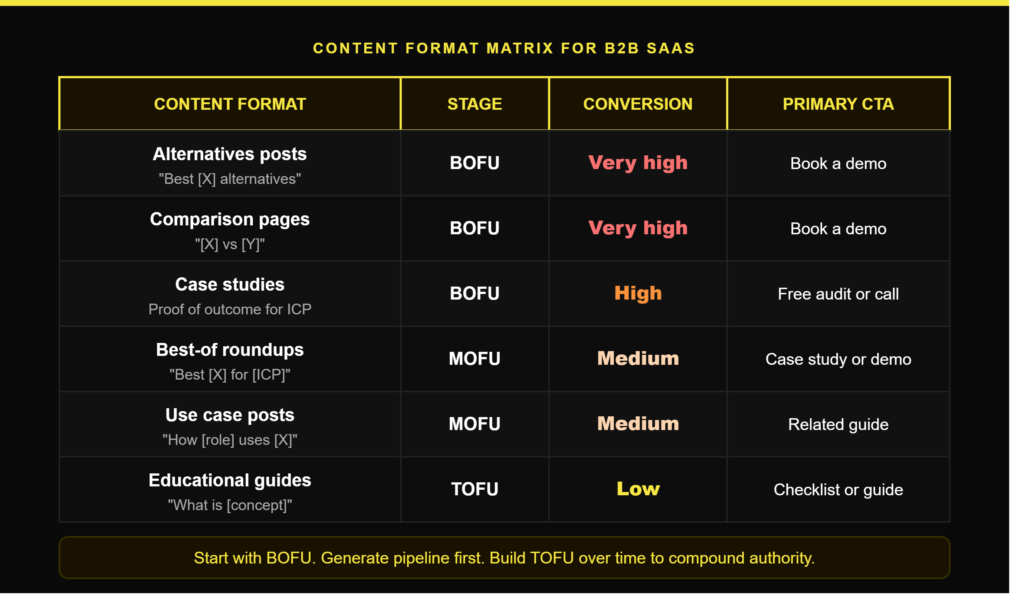
The content formats that drive pipeline in B2B SaaS:
- Comparison and alternatives posts: “Best [competitor] alternatives” and “[Your product] vs [competitor]” are among the highest-converting content types in SaaS. Buyers using these queries are in active evaluation mode.
- Use case posts: “How [type of team] uses [your category] to [outcome]” targets buyers by role and goal, which is exactly how B2B buyers think about software.
- Best-of roundups: “Best [category] tools for [ICP]” captures buyers who are building their shortlist. If you are not on the list, you are not in the consideration set.
- Case studies: Documented proof that your product delivers a specific outcome for a specific type of customer. The most underused content type in early-stage SaaS.
- Educational hub posts: Comprehensive guides like this one that build topical authority and keep buyers on your site long enough to build trust.
What to avoid:
- Generic “what is” posts that have no ICP specificity and no buying intent
- Posts that cover a topic shallowly just to hit a keyword
- Content that reads like a product spec sheet rather than a solution to a real problem
- Publishing without a B2B SaaS content calendar that maps each piece to a pipeline stage
Pillar 5: GEO, the new layer you cannot ignore
Traditional SEO gets you into Google. GEO gets you cited inside AI answers.
These are now two different competitions. AI Overviews cut organic click-through rates by 61%, but brands cited in AI answers earn 35% more clicks on the queries they win. The buyers who arrive via an AI citation are already in evaluation mode. They convert at a meaningfully higher rate than traditional organic traffic.
Generative Engine Optimization, GEO for short, is the practice of structuring content so that AI systems like ChatGPT, Perplexity, and Google AI Overviews retrieve, cite, and recommend your brand when generating an answer.
What GEO requires in practice:
- Self-contained passage structure: AI engines break pages into passages and evaluate each one independently. Every section should function as a complete answer to a specific question on its own.
- Freshness: AI retrieval systems weight recency more heavily than traditional search. A quarterly refresh cycle on cornerstone content is closer to the minimum than the ideal.
- Third-party validation: AI systems triangulate. Consistent, accurate brand information across review platforms strengthens the signal that your brand is a credible source, though the citation data on G2 and Capterra is more complicated than most advice implies.
- Technical crawlability for AI bots: Check that GPTBot and other AI crawlers are not blocked in your robots.txt. If they cannot reach your content, nothing else matters.
The good news is that the fundamentals of GEO are the same as the fundamentals of good SEO: depth, topical authority, and quality. The difference is the execution layer on top. Our complete guide to GEO for SaaS covers that layer in full.
How to connect SEO to pipeline: the measurement framework
Traffic is not a business metric. Pipeline is.
The most common SEO measurement failure in B2B SaaS is stopping at sessions and rankings. The correct framework connects organic search activity to demos, SQLs, and closed revenue.
Set up in Google Search Console first:
Track which queries are driving clicks, what positions you hold for your target keywords, and which pages are being indexed. Request indexing for every new post within 24 hours of publishing. Use the URL Inspection tool to verify pages are live on Google before you assume they are.
Connect organic to your CRM:
Tag every organic contact with their first landing page. Over time, this shows you which posts are generating actual pipeline, not just traffic. A post getting 500 visits a month with 10 demo requests is performing 10x better than a post getting 5,000 visits with 2 demo requests.
The metrics that matter:
- Organic-sourced demo requests per month
- Organic-sourced SQLs per month
- Organic-sourced pipeline value
- Keyword rankings for your target BOFU terms
- Indexed pages in Google Search Console
- AI citations (track manually by testing your category queries in ChatGPT, Claude and Perplexity monthly)
What to expect on the timeline:
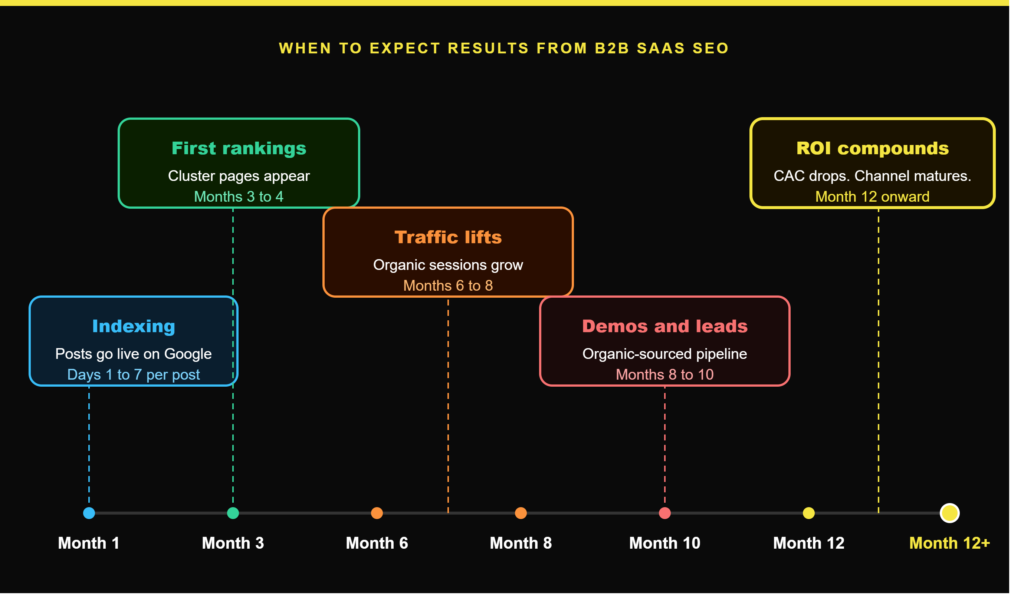
Ranking improvements for less competitive cluster pages typically appear within three to four months of publication. Traffic and lead volume improvements follow at six to eight months. Pipeline impact often takes twelve months or more, reflecting the length of B2B SaaS sales cycles.
Set expectations accordingly. SEO is a compounding investment, not a 30-day win. The founders who quit at month six are the ones who never see month 12.
The founder-led SEO playbook: what to do in which order
Most founders try to do everything at once and end up doing nothing well. This is the correct sequence.
Months 1 to 2: Foundation
- Run a technical audit. Fix crawlability, speed, and indexing issues.
- Define your ICP and the three to five problems they search for.
- Map out your first topic cluster: one pillar topic, six to eight supporting subtopics.
- Build your keyword list focused on BOFU and MOFU terms first.
- Publish your first three cluster posts. Internal link them from day one.
Months 3 to 5: Build the cluster
- Publish one to two posts per week within your first cluster.
- Request indexing for every new post in Google Search Console.
- Begin building internal links from older posts to newer ones.
- Track which posts are getting impressions in GSC. Double down on what’s moving.
- Identify two or three BOFU keyword opportunities with low competition and publish directly.
Months 6 to 9: Compound and expand
- The first cluster should be approaching topical authority. Start cluster two.
- Add GEO optimization to existing posts: restructure sections as self-contained answers, add freshness updates.
- Begin link acquisition: guest contributions, original research, expert commentary.
- Connect organic sources to your CRM and start tracking pipeline attribution.
- If execution capacity is the bottleneck, this is the right time to evaluate B2B SEO agencies that specialise in SaaS and understand pipeline attribution, not just rankings. For earlier-stage teams, the best SEO agencies for startups covers leaner options built for smaller budgets.
Months 10 to 12: Optimize and scale
- Refresh top-performing posts with updated data and expanded content.
- Identify posts ranking in positions 5 to 20 with meaningful impressions in GSC. These are your fastest wins: small improvements push them to page one.
- Expand into a third cluster.
- Track AI citation frequency for your brand on category queries in Claude, ChatGPT and Perplexity.
The three questions every founder should answer before starting
Before you write a single post, answer these three questions clearly.
1. Who exactly is your buyer? Not “B2B SaaS companies.” The specific role, company size, industry, and stage that your product is built for. SEO content that speaks to everyone converts no one.
2. What do they search for at each stage of the buying journey? Map searches to stages. Problem-aware searches look different from solution-aware searches, which look different from vendor-comparison searches. Your content needs to be present at each stage, not just at awareness.
3. What does a conversion look like for each piece of content? Every post should have a specific next action that matches the reader’s stage. A TOFU post should offer a deeper resource. A MOFU post should offer a comparison or case study. A BOFU post should offer a demo or a call. If you cannot answer what happens after the reader finishes the post, the post is not finished.
The B2B SaaS SEO mistakes founders make most often
Treating SEO as a separate initiative from content. SEO and content strategy are not two different workstreams. They are the same program. Every piece of content is an SEO asset or it is not strategic. There is no middle.
Publishing without an internal linking system. Unlinked posts are orphaned pages. They rank slower, build no cluster authority, and give readers nowhere to go when they finish. Every new post should link to at least two existing posts and receive a link from at least two existing posts on the day it goes live.
Optimizing for rankings instead of pipeline. A page ranking in position one for a keyword with zero buying intent is a vanity metric. Optimize for pages that generate demos, not pages that generate sessions.
Starting with TOFU when you should start with BOFU. The instinct is to educate first and sell later. The correct order for SEO is the opposite. Publish BOFU and MOFU content first. It generates pipeline faster. TOFU builds over time and reinforces the cluster.
Expecting results in 30 days. The timeline is six to twelve months for meaningful pipeline from organic. Founders who quit before month six never see the compounding effect that makes SEO the most cost-effective channel in their stack by month 18.
Building the system: content + SEO + distribution
An SEO strategy without a publishing system is a document, not a program. The posts need to ship consistently. Consistent shipping requires a system.
A working SaaS content engine has four components:
- A documented brief process: Every post starts with a brief that defines the target keyword, the ICP, the funnel stage, the CTA, and the internal links before a word is written.
- A publishing cadence the team can sustain: One post per week beats three posts in January and nothing until April. Consistency compounds. Bursts don’t.
- An internal linking protocol: Every post links to existing cluster posts. Every existing cluster post gets updated to link to the new post.
- A refresh cycle: Content published more than 12 months ago needs a quarterly review. Outdated data, stale examples, and missing GEO structure are conversion killers.
The founder who treats SEO as a system rather than a project is the one who still has organic momentum at month 24 while competitors who started at the same time have nothing to show for it.
Where to go from here
This post is the hub. Everything below it goes deeper.
- Keyword research: Best keyword research tools for B2B SaaS
- Topical authority: What is topical authority and how to build it
- Topic clusters: Topic clusters vs keyword lists
- SEO content writing: SEO content writing for B2B SaaS
- Content calendar: B2B SaaS content calendar
- Content engine: How to build a SaaS content engine
- GEO: What is GEO and does it matter for SaaS
- Conversion: Why your B2B SaaS content isn’t converting
- Best B2B SEO agencies: 10 best B2B SEO agencies
- Best SEO agencies for startups: 10 best SEO agencies for startups
Want a B2B SaaS SEO strategy built around your ICP, your cluster, and your pipeline targets?

Jay is the co-founder of LymLyt and an AI partnership consultant helping B2B SaaS companies grow through content strategy, SEO, and AI integration. He writes about content marketing, what makes B2B content convert, and how SaaS teams can build content systems that drive real pipeline.