GEO vs AEO vs SEO: What Is Actually Different
GEO vs AEO vs SEO is one of the most-asked disambiguation questions in marketing right now. Most answers make it sound more settled than it actually is.
The terminology is genuinely new. It’s genuinely unstandardized across the industry. Vendors selling tools in this space have every incentive to make their category sound more distinct than it is.
This is the straightforward version of GEO vs AEO vs SEO, without the sales pitch.
The Short Version
SEO (search engine optimization) is getting a page to rank in traditional Google search results, the ten blue links.
GEO (generative engine optimization) is getting content cited, quoted, or referenced inside an AI-generated response from tools like ChatGPT, Perplexity, or Google’s AI Overviews. Our own complete guide to what GEO actually is goes deeper on this specific term if the short version here isn’t enough.
AEO (answer engine optimization) is structuring content so it gets extracted and surfaced as a direct answer, whether that’s a featured snippet, a voice assistant response, or an AI-generated answer.
That’s the full GEO vs AEO vs SEO breakdown in three sentences. The nuance is in what happens next.
In practice, AEO and GEO describe almost the same underlying work. EMARKETER’s July 2026 research put it plainly: no common taxonomy exists for this category. AEO and GEO describe the same approach applied to slightly different output formats.
If a vendor is selling you a hard, precise line between the two, be skeptical of the pitch more than the terminology.
Where the Terms Actually Came From
The three terms in GEO vs AEO vs SEO don’t share a birthday, and that history explains some of the confusion.
SEO is the oldest by decades. The practice dates back to the mid-to-late 1990s, as the first commercial search engines made ranking position valuable enough to optimize for.
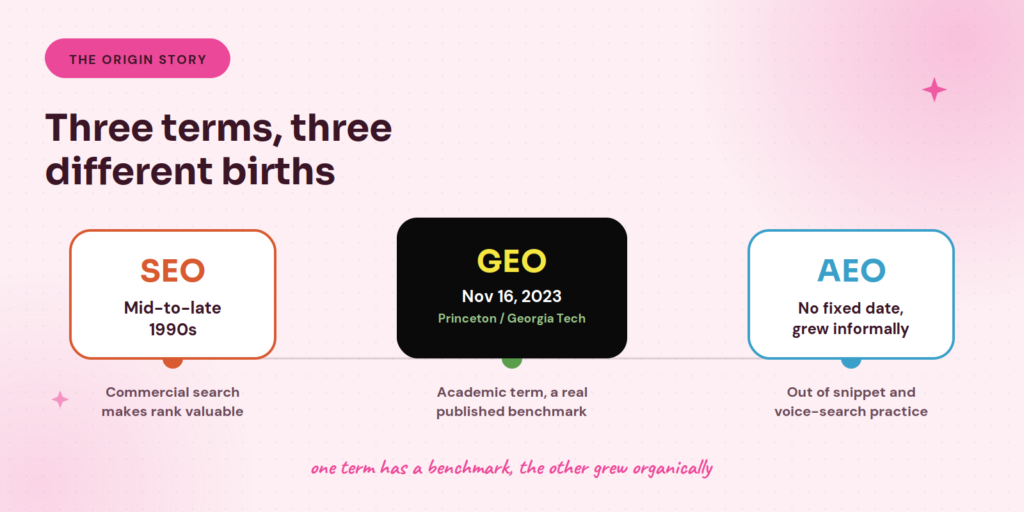
GEO has a surprisingly precise origin. It was coined November 16, 2023, in a paper titled “GEO: Generative Engine Optimization”, written by researchers at Princeton, Georgia Tech, the Allen Institute for AI, and IIT Delhi. The term started as an academic framework with measurable benchmarks, not a marketing label. Mainstream use only followed through 2025 and 2026.
AEO has a fuzzier history. It grew informally out of practitioner conversation around featured snippets and voice search optimization, concepts that predate ChatGPT by several years, and picked up its current name as AI search made the underlying skill newly urgent.
That gap between a precise academic term and a loosely adopted practitioner term is a lot of why GEO vs AEO vs SEO still doesn’t have a settled answer. One side of the comparison was defined with a benchmark. The other grew organically.
Where They Actually Diverge
The genuinely useful distinction in GEO vs AEO vs SEO isn’t AEO versus GEO. It’s traditional SEO versus everything else, because that’s where the mechanics actually change.
Traditional SEO optimizes for a ranking algorithm that returns a list. The searcher decides what to click. Success is measured in position and click-through rate.
GEO and AEO both optimize for a synthesis process instead of a ranking. The system fans a query out into several sub-searches, retrieves candidates from each, weighs them by confidence and authority, and stitches a single answer together from the pieces that survive.
Success here isn’t a position number. It’s whether your content got pulled into that final synthesis at all. That’s a binary outcome per query, not a rank you can nudge up gradually.
That’s also why Ahrefs’ citation-overlap study found only about 12% of AI-cited sources overlap with a page’s Google top-10 ranking for the same query. Ranking and citation are correlated, not the same contest. Our complete guide to AI visibility for B2B SaaS covers what that actually means for a content strategy.
A Genuinely Practical Difference: Query Shape
One difference in GEO vs AEO vs SEO that does matter operationally: the query format each surface responds to.
Traditional SEO still rewards keyword-anchored phrasing, since that’s what search engines were built to match. AI search increasingly runs on longer, more conversational, multi-part questions.
Google’s own May 2026 usage report put the average AI Mode query at roughly three times the length of a traditional search query. Separately, Semrush’s clickstream analysis of over a billion lines of US data found that between 65% and 85% of ChatGPT prompts had no matching term in a traditional keyword database at all.
Content written to satisfy a five-word keyword and content written to satisfy a full sentence question aren’t the same content, even when they’re about the same topic. Our piece on how search behavior has changed since AI arrived covers six more shifts like this one.
What This Looks Like on the Page
Take a single question: “what’s the best CRM for a 20-person SaaS sales team.” Here’s how the same underlying research produces different output depending on which side of GEO vs AEO vs SEO you’re optimizing for.
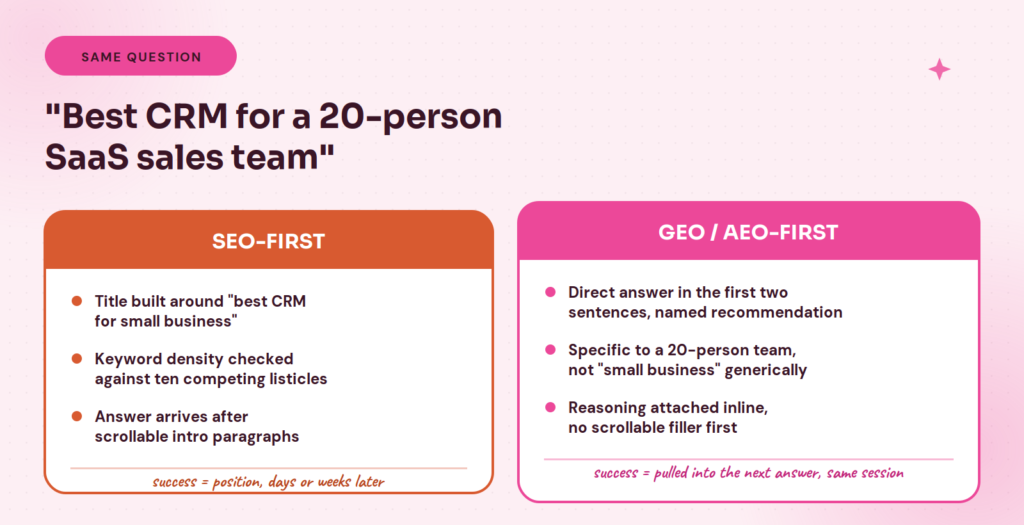
SEO-first version: A title tag built around “best CRM for small business,” a keyword density check, and a page structured to rank against ten competing listicles. Success is measured by position on a results page days or weeks later.
GEO/AEO-first version: The direct answer stated in the first two sentences, specific to a 20-person team rather than “small business” generically, with a named recommendation and the reasoning attached inline rather than buried under scrollable filler. Success is measured by whether that paragraph gets pulled into a synthesized answer on the next query, sometimes within the same session.
The research underneath both versions can be identical. What changes is where the direct answer sits, how specific the framing is, and how quickly a reader gets to the part that resolves the question. Our guide to topical authority for B2B SaaS covers how to build that specificity at the cluster level, not just the single page.
Where This Leaves a B2B SaaS Team
You don’t have to pick one between GEO, AEO, and SEO. Nobody serious in this space argues SEO is dead.
Gartner’s own 2024 prediction that search volume would fall 25% by 2026 has arrived at its deadline with a more gradual, less dramatic outcome than the headline suggested. Traditional search is smaller than it was, not gone.
The practical sequence, in order:
- Get the technical foundation right first. If your AI-facing content is client-side rendered, none of this matters, since the crawlers behind GEO and AEO alike may never see the words. Our guide to AI crawler rendering covers exactly how to check this, and our B2B SaaS SEO strategy guide covers the foundational work most teams skip before any of this.
- Write for the question, not just the keyword. Content that directly and specifically answers a full question, with the answer stated early and supported with real evidence, works for AEO, GEO, and increasingly for traditional SEO’s own featured-snippet mechanics at the same time.
- Measure both surfaces separately. A rank tracker tells you nothing about AI citation rates, and an AI visibility tool tells you nothing about your Google position. Our roundup of the best AEO tools for B2B SaaS covers the current field if you don’t have this instrumented yet.
Frequently Asked Questions
Common follow-up questions on GEO vs AEO vs SEO, answered directly.
Is AEO just a rebrand of GEO?
Largely, yes, in current industry usage, though their origins differ. GEO has a precise academic birth date; AEO grew more informally out of practitioner discourse around featured snippets and voice search. No standardized taxonomy separates them cleanly today.
Some practitioners use AEO specifically for structured direct-answer formats like featured snippets and voice assistants, and GEO more broadly for any AI-generated synthesis. That distinction isn’t consistently applied across the industry.
Do I need a different content strategy for GEO versus AEO?
No, in practice. The underlying content requirements serve both goals simultaneously: answering a specific question clearly, supporting it with verifiable evidence, and structuring it so the key claim is easy to extract.
Should I stop doing traditional SEO?
No. Traditional search still represents meaningful traffic and intent. The technical and authority signals that support SEO, clean site structure, real backlinks, topical depth, also support GEO and AEO rather than competing with them.
Which term should I actually use in my own content and reporting?
Use whichever term your buyers and stakeholders already search for and recognize. Since no standardized definition exists yet, consistency within your own organization matters more than picking the theoretically correct term.
Does the GEO vs AEO vs SEO debate matter for a small B2B SaaS team?
Less than the vendor marketing around it suggests. A small team gets more value from picking one term for internal use and focusing on the actual work, technical accessibility, question-shaped content, separate measurement, than from resolving a terminology debate the industry itself hasn’t settled.
If you want help figuring out where your own content actually stands across the full GEO vs AEO vs SEO picture, let’s connect.

Jay is the co-founder of LymLyt and an AI partnership consultant helping B2B SaaS companies grow through content strategy, SEO, and AI integration. He writes about content marketing, what makes B2B content convert, and how SaaS teams can build content systems that drive real pipeline.