How to Build a SaaS Content Engine in 2026
2025 was the year everyone “tried content.” 2026 is the year teams either build a real SaaS content engine or get outranked into irrelevance. The gap is widening fast, especially for companies that still treat content as an experiment instead of infrastructure.
Content now powers the entire SaaS growth spine. It drives demand, establishes SEO authority, educates buyers, supports sales, and shapes community perception. Teams that understood this early and used the right research stack, like the ones covered in Best Keyword Research Tools, are already pulling ahead.
Here is the reality most SaaS teams hate admitting:
More content does not mean better results. Better systems create better results. If more posts have not moved your numbers, AI didn’t cause content blindness, marketers did explains why volume was never the fix.
Most companies still publish disconnected pieces: a keyword blog here, a thought-leadership post there, a random product update sprinkled in for good luck. The outcome is predictable: traffic stalls, conversions stay flat, and your competitor with half your volume outranks you with ease.
A SaaS content engine solves this. Not a content calendar. Not “we will post twice a week.” A real engine is made of processes, repeatable workflows, and a clear link to pipeline. If you already run on a fixed publishing schedule, our guide to the B2B SaaS content calendar covers how to structure one around keywords instead of dates.
A strong SaaS content engine is:
- Predictable, so each content type consistently delivers outcomes
- Scalable, so increasing volume doesn’t increase chaos
- Measurable, using the metrics that actually matter
- Pipeline-driven, so content doesn’t stop at traffic, it creates MQLs
This guide walks through the five stages required to build that engine:
Planning → Infrastructure → Production → Distribution → MQLs.
By the end, you’ll have a blueprint to create a content system that compounds month after month. No inflated teams, no burnout, no guesswork.
Strategy: The Foundation Most SaaS Teams Skip
Most SaaS content fails for a simple reason: teams jump straight into keywords, topics, and “what should we post this month,” without stepping back to think. If that sounds familiar, our breakdown of SaaS content marketing mistakes that kill growth covers the most common versions of this failure in detail.
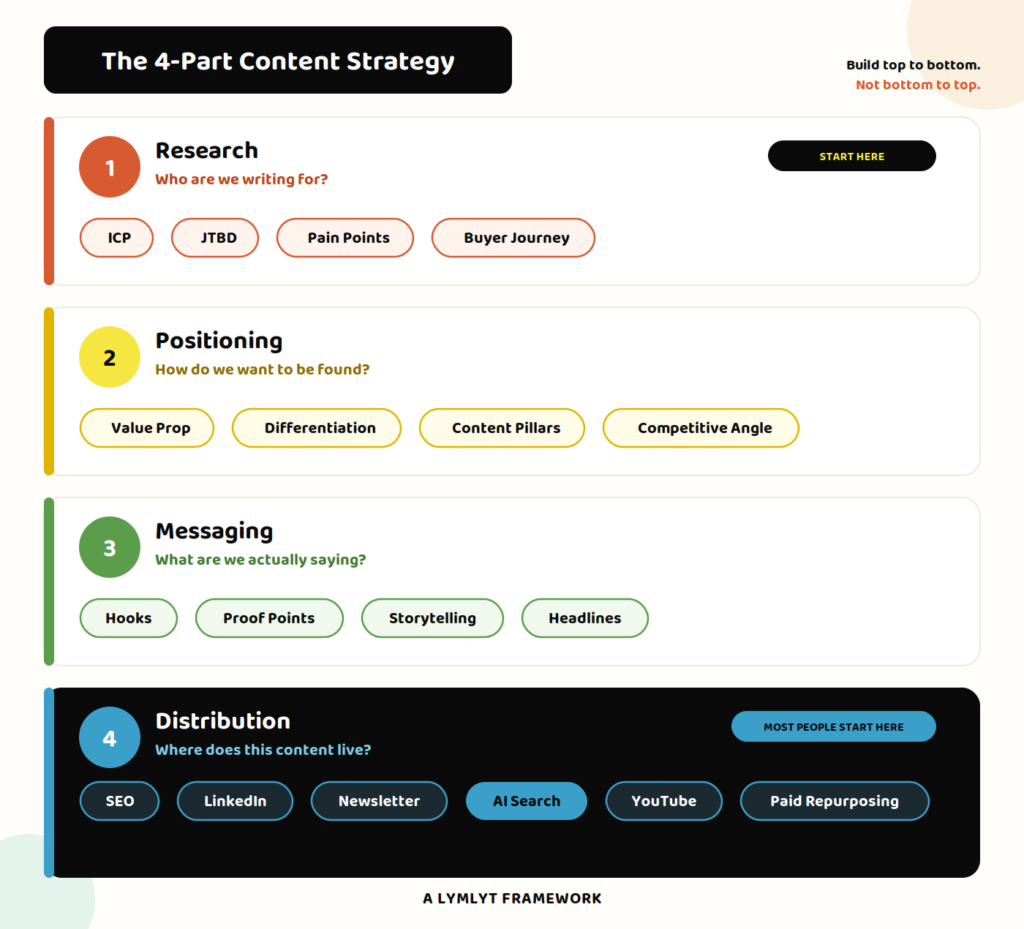
A real content engine doesn’t start with keywords.
It starts with clarity.
To build that clarity, you need to answer four questions that almost every SaaS team glosses over.
1. Who is the buyer, really?
This is where everything breaks or works.
Skip the vague personas like “Growth George” or “Marketing Maya.”
You need to know:
- the actual job title
- the real goals they are measured on
- the pressure they care about
- the pain that keeps coming back every week
- the job-to-be-done your product supports
If you cannot describe the buyer’s day and the KPI they are judged on, your content will never land.
2. What problem is your product solving?
Every SaaS product has two problems: the feature problem (the UI/technical thing it solves) and the business problem (the outcome your buyer pays for). Only the second one matters in content.
Example: “Improve team productivity” is noise. “Reduce customer activation time by 27 percent” is a decision-making lever. Your content needs to speak that language. If you are still deciding whether content or the product itself should carry that message, content marketing vs. product-led growth is worth settling first.
3. How does your buyer make decisions?
Every buyer follows a predictable journey:
Awareness: they are figuring out their problem. Content here educates and introduces mental models.
Consideration: they compare solutions. Content here includes frameworks, comparisons, scorecards, and category explainers.
Decision: they want proof. Content here is built on case studies, ROI calculations, and implementation guides.
If your content does not cover each of these steps, you are leaving deals on the table. This is what the SaaS content funnel maps to demos at every stage.
4. What content do they actually consume?
Founders love 2,000-word philosophical essays. Buyers often prefer:
- skimmable frameworks
- checklists
- comparison charts
- quick wins
- tactical how-tos
- visuals that reduce cognitive load
Your content engine performs best when the format fits the decision-making stage, not the writer’s preference.
Once this is clear, then you do keyword research. The best keyword research tools will help you identify terms that align with actual purchase triggers, not just traffic volume.
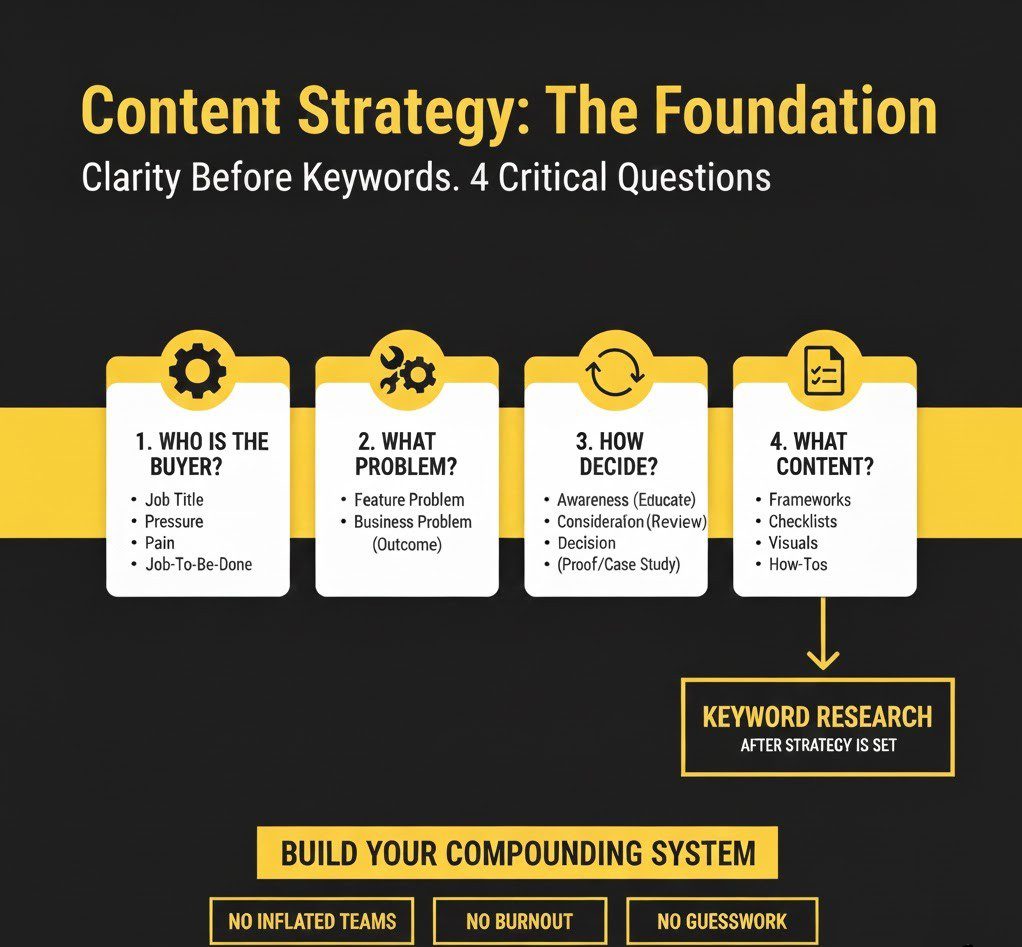
Once this is clear, then you do keyword research. The best keyword research tools for SEO will help you identify terms that align with actual purchase triggers, not just traffic volume.
Build SEO & Content Infrastructure
Before you can run a content engine, you need the plumbing.
Most SaaS teams skip this, which is why their content looks busy on paper and empty in results.
This stage is about building the foundation that makes everything else scalable and predictable.
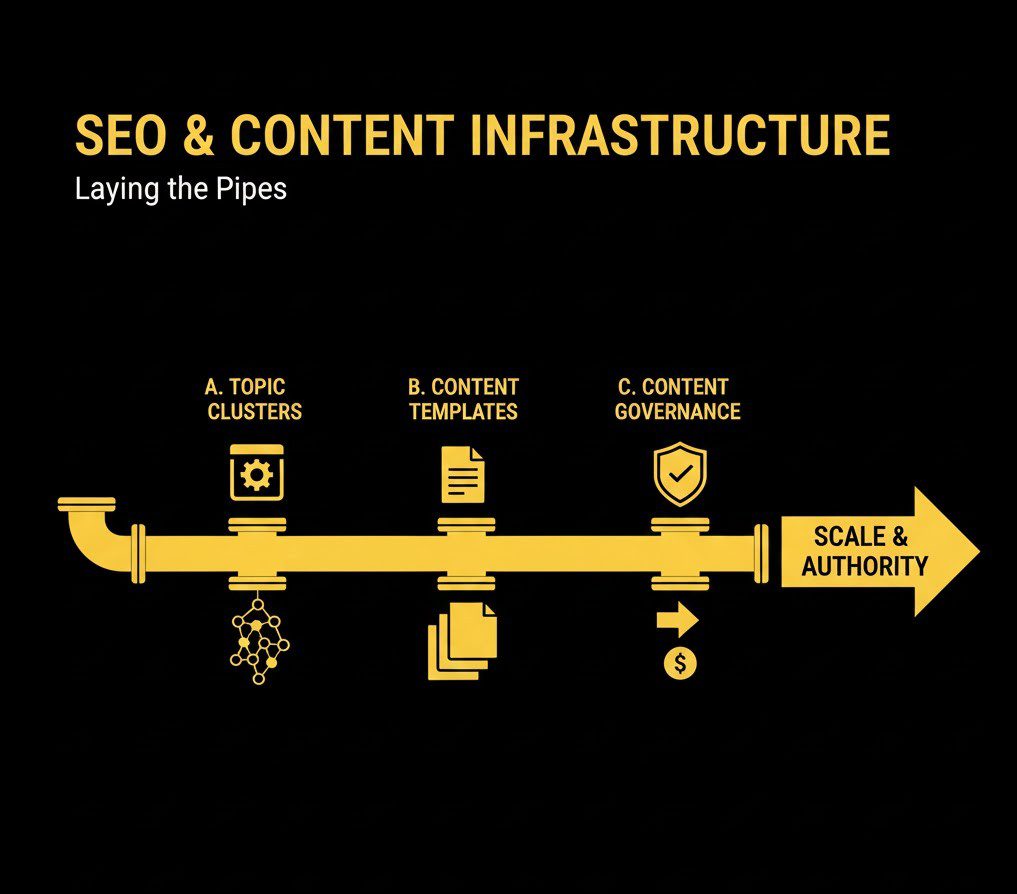
A. Topic Clusters, Not Scatter-Blogs
Google in 2026 rewards topical depth, not volume. Forty random blogs won’t get you authority, traffic, or trust. Clusters will.
Understanding topical authority for B2B SaaS is the starting point. And if you are new to clusters, topic clusters vs. keyword lists breaks down exactly why the cluster approach outperforms standalone keyword targeting every time.
How to structure your clusters
- Pick 3 to 5 core pillars that represent the problem categories your product solves
- Each pillar should have 8 to 15 supporting articles, all internally linked and mapped to the pillar’s problem space
For example, a project-management SaaS might choose: Workflows, Productivity, Team Collaboration, Automation.
This structure alone improves how Google understands your site, how efficiently your pages get crawled, and how readers perceive your authority. It’s the single highest-leverage SEO structure you can implement. Our B2B SaaS SEO strategy guide covers the foundational work most teams skip before they ever get to clusters, and understanding the Google Knowledge Graph explains why entity consistency matters just as much as the content itself.
B. Build Content Templates & Briefs
A content engine collapses quickly if every writer follows their own style guide. Templates fix this.
You need templates for blog briefs, case studies, landing pages, comparison pages, playbooks, and feature deep-dives.
A proper content brief does three things:
- Makes quality consistent across writers
- Speeds up production because structure stays constant
- Keeps messaging aligned, especially as teams grow
Most SaaS teams don’t scale content because they lack templates, not because they lack writers.
C. Add Content Governance
Governance is the guardrail that keeps your content engine from becoming a content landfill.
Here’s the rule: if an article doesn’t move a metric, it doesn’t get published.
Pick one: traffic, links, conversions, education, or sales enablement.
Governance ties directly into the content funnel. See our guide on how the SaaS content funnel maps to demos for how that connection actually works. Governance keeps your content focused, strategic, and directly tied to the pipeline, not word count.
Production: The Part Everyone Overcomplicates
Most SaaS teams think production is about writing. It is not. A content engine is 20 percent creativity and 80 percent workflow.
A. Use a Predictable Process
A real production system looks boring, which is exactly why it works.
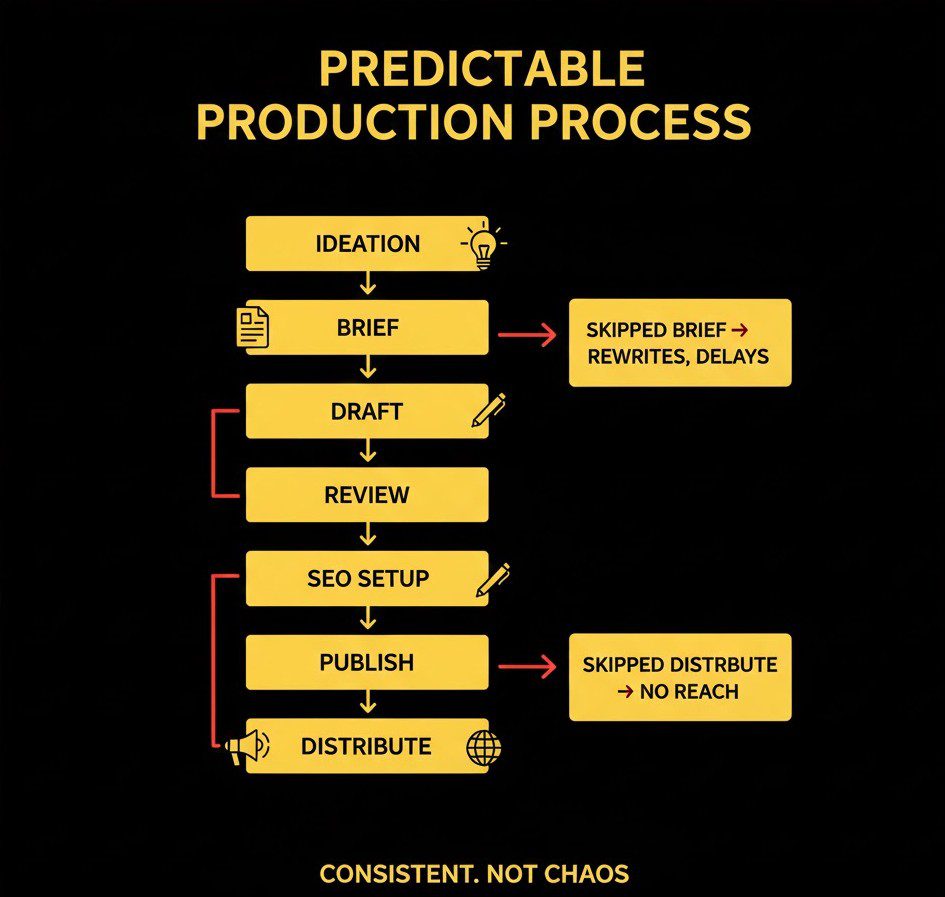
The process:
- Ideation
- Brief
- Draft
- Review
- Edit
- SEO setup
- Publish
- Distribute
If you get these eight steps right, you’re already ahead of 80 percent of SaaS content teams.
Most teams break the system in two places. Skipping briefs leads to rewrites, misalignment, and bloated timelines. Skipping distribution leads to “we published but nothing happened.”
B. Balance Quality & Speed
The sweet spot is consistent good quality plus ruthless prioritisation. Not every piece needs to be a masterpiece. Not every piece needs to be fast. Every piece needs to serve a purpose.
If you ever find yourself in a situation where the founder wants to write every blog themselves, why founders shouldn’t write their own blog posts will save your timeline, sanity, and half your marketing budget. If the fix is closer to founder-led content done right rather than founder-written content, executive ghostwriting is the model that actually scales that voice, and our best executive ghostwriting agencies guide covers who does that work well.
Because in a content engine:
- Not every piece needs to be a masterpiece
- Not every piece needs to be fast
- Every piece needs to serve a purpose
C. AI in Production: Use It Right
AI is not the writer. AI is the assistant.
The goal is not to replace humans, it is to remove friction.
What AI should do: create outlines, assist with research, summarize long inputs, rewrite for clarity, extract insights from PDFs or reports, repurpose content into short formats.
What AI should not do: define your strategy, create your POV, build frameworks, replace case studies, generate expertise or original thought.
This is where teams lose their voice, differentiation, and credibility.
AI accelerates your production. It does not run it. Which model you use for which task matters more than most teams assume; our ChatGPT vs. Claude for B2B SaaS content comparison breaks down where each one actually wins.
If you’re exploring AI tools, see LymLyt’s Best AI Video Generators and Best AI Newsletters for staying current on the tools that matter, our Best AI Writing Tools for B2B SaaS roundup for the production layer specifically, or the full Top 100 AI Tools list if you want the whole category in one place.
Distribution: The Step That Actually Drives Leads
Most SaaS teams think publishing the content is the finish line.
It’s not even halfway there.
Publishing gets you indexed.
Distribution gets you traffic.
Re-distribution gets you compound, long-tail traffic.
If production is the engine, distribution is the fuel.
This is the stage where content turns into leads, backlinks, authority, and pipeline.
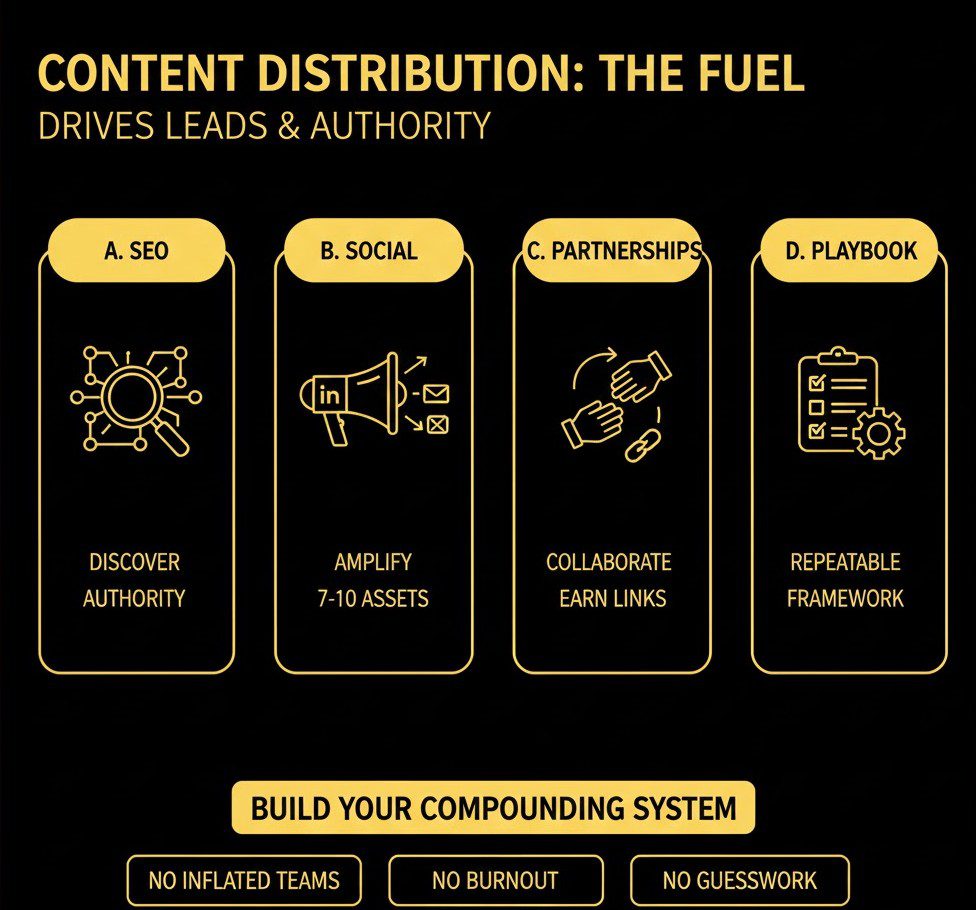
A. SEO Distribution
The minimum effective SEO setup includes:
- Internal linking, especially pillar pages linking to supporting articles
- Updating top performers every 3 to 6 months to retain rankings
- Fixing keyword cannibalization so pages do not compete with each other
- Pruning dead or low-value posts that drag down topical authority
- Optimising for search intent, not vanity keywords
Understanding the difference between SEO and content writing is what separates teams that build authority from teams that just publish. Increasingly, that also means optimizing for generative engine optimization, since search intent now gets satisfied inside AI answers before a click ever happens. Our AI visibility for B2B SaaS guide covers that shift end to end, and if you’d rather have a team build the SEO layer for you, 10 Best B2B SEO Agencies breaks down who does it well.
This is the silent work that turns scattered blogs into authority-building assets.
B. Social Distribution
Every blog should become a 7 to 10 asset package, not a single URL. From one piece, produce:
- 3 to 5 LinkedIn posts (insights, diagrams, snippets, contrarian takes)
- 2 to 3 X/Twitter insights (short, punchy, high-signal lines)
- 1 newsletter snippet
- 1 to 2 product-friendly graphics (carousel, chart, or stat visual)
And remember: consistency matters more than virality.
C. Partnerships & Backlinks
Instead of cold outreach, focus on collaborations with influencers in your niche, co-created reports, customer story highlights, and sharing frameworks inside relevant communities. Good content earns links. Great content gets referenced automatically.
D. Content Distribution Playbook
If you want a repeatable, scalable distribution framework, LymLyt’s SaaS Content Distribution Playbook breaks down:
- when to distribute
- what formats to use
- how to repurpose efficiently
- how to map distribution to buying stages
- how to avoid content decay over time
This should be your core playbook.
Build it once, use it forever.
Measurement: What Actually Leads to MQLs
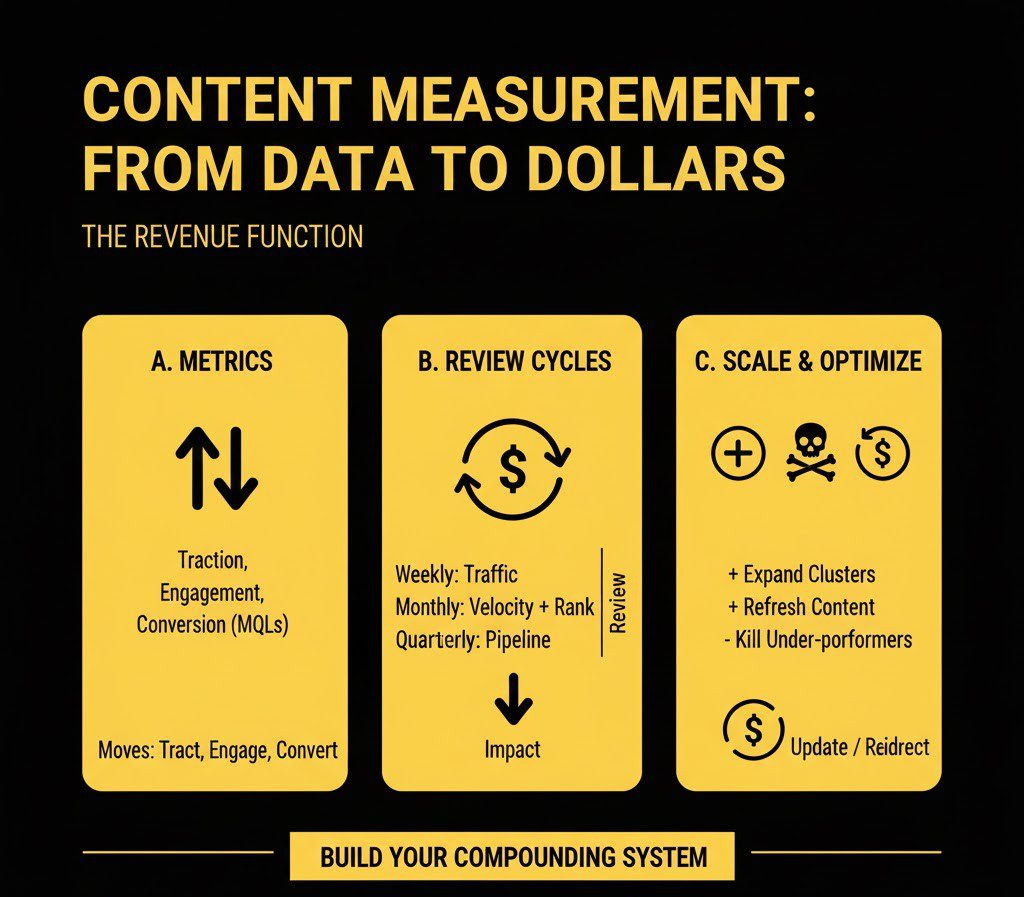
Most SaaS teams aren’t underperforming because their content is bad. They’re underperforming because they’re measuring the wrong things.
You don’t need 18 dashboards and a BI analyst whispering in your ear. You need clarity, consistency, and a measurement system that ties directly into the pipeline. If the tracking and attribution layer itself is the gap, our best marketing operations agencies guide covers who builds that infrastructure well.
Measurement is where your content engine stops being “a marketing activity” and becomes a revenue function.
A. Metrics That Matter
LymLyt breaks this down deeply in SaaS Content Marketing Metrics That Actually Matter.
A true content engine ties every piece of content to one of three buckets:
1. Content → Traction: CTR, impressions, SERP lift, new keywords gained. This tells you whether your distribution and SEO setup are actually working. Increasingly this also means tracking citations, not just rankings; our best AI visibility tracking tools roundup covers what to use for that layer.
2. Content → Engagement: time on page, scroll depth, repeat visits, return sessions. High engagement is a signal of intent. Low engagement is a signal of misalignment.
3. Content → Conversion: demo bookings, trial starts, assisted conversions, MQLs. This is where content proves its worth, the moment it stops being a cost center and becomes a revenue engine.
If a piece doesn’t move traction, engagement, or conversion, it’s noise.
B. Set Review Cycles
You cannot measure content casually. You need structured review cycles so you can course-correct before your engine stalls.
- Weekly: distribution and traffic
- Monthly: content velocity and rankings
- Quarterly: content to pipeline impact
A content engine operates like a flywheel. Consistent review keeps it spinning.
C. Keep Scaling the Engine
Scaling is not about publishing more. It is about expanding intelligently:
- Expand your topic clusters
- Refresh top-performing content
- Build new landing pages tied to search intent
- Add competitor comparison pages and alternative pages
- Create a reservoir of case studies and customer stories
And you must kill underperformers. A ruthless content engine is a healthy one. Dead content drags down rankings, authority, and crawl budgets. If a piece is not performing, update it. If updating does not fix it, redirect it.
Bonus: Using AI & Automation Without Losing Your Soul
I won’t replace SaaS content teams. But it will replace teams that refuse to learn how to work with it.
The goal is simple: use AI to accelerate the engine, not to build the engine.
Use AI to: research faster, summarize documents and messy inputs, repurpose long-form into 12–15 micro assets, transcribe customer calls and surface insights, turn webinars into blog posts and clips, generate outlines and content scaffolds, identify SERP opportunities and gaps.
Don’t use AI to: replace original thinking, generate your POV or frameworks, create case studies, fake expertise, produce entire articles end-to-end.
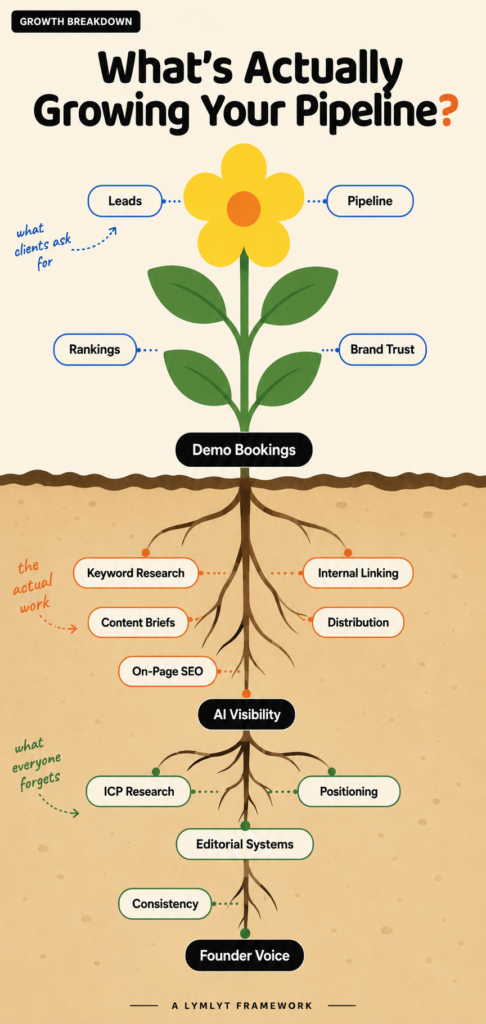
The strongest content engines in 2026 will be the ones that combine human judgment and AI acceleration without losing voice, thought leadership, or depth.
Conclusion: Your Content Engine Starts Today
You do not need a 10-person team. You do not need a newsroom. You do not need a miracle quarter. What you need is a system.
A system where:
- Strategy drives priorities: you never create content just because “we need something this week”
- SEO builds authority: Google recognises you as the expert in your category
- Production runs predictably: content ships on time without chaos or burnout
- Distribution amplifies everything: each piece reaches the audience it deserves
- Measurement ties content to revenue: the engine powers pipeline instead of vanity metrics
This is what content marketing for SaaS startups looks like when it is built as a system, not a series of one-off experiments.
A well-built content engine keeps compounding quietly in the background, attracting, educating, and converting buyers long after each piece is published.
Your content engine starts the moment you stop treating content as an activity and start treating it as a system.
If you want help building it, let’s talk. Or see how the field breaks down in our guide to the best SaaS content marketing agencies if you’re comparing partners before you commit, or best thought leadership agencies if the gap is specifically founder voice at scale.

Jay is the co-founder of LymLyt and an AI partnership consultant helping B2B SaaS companies grow through content strategy, SEO, and AI integration. He writes about content marketing, what makes B2B content convert, and how SaaS teams can build content systems that drive real pipeline.