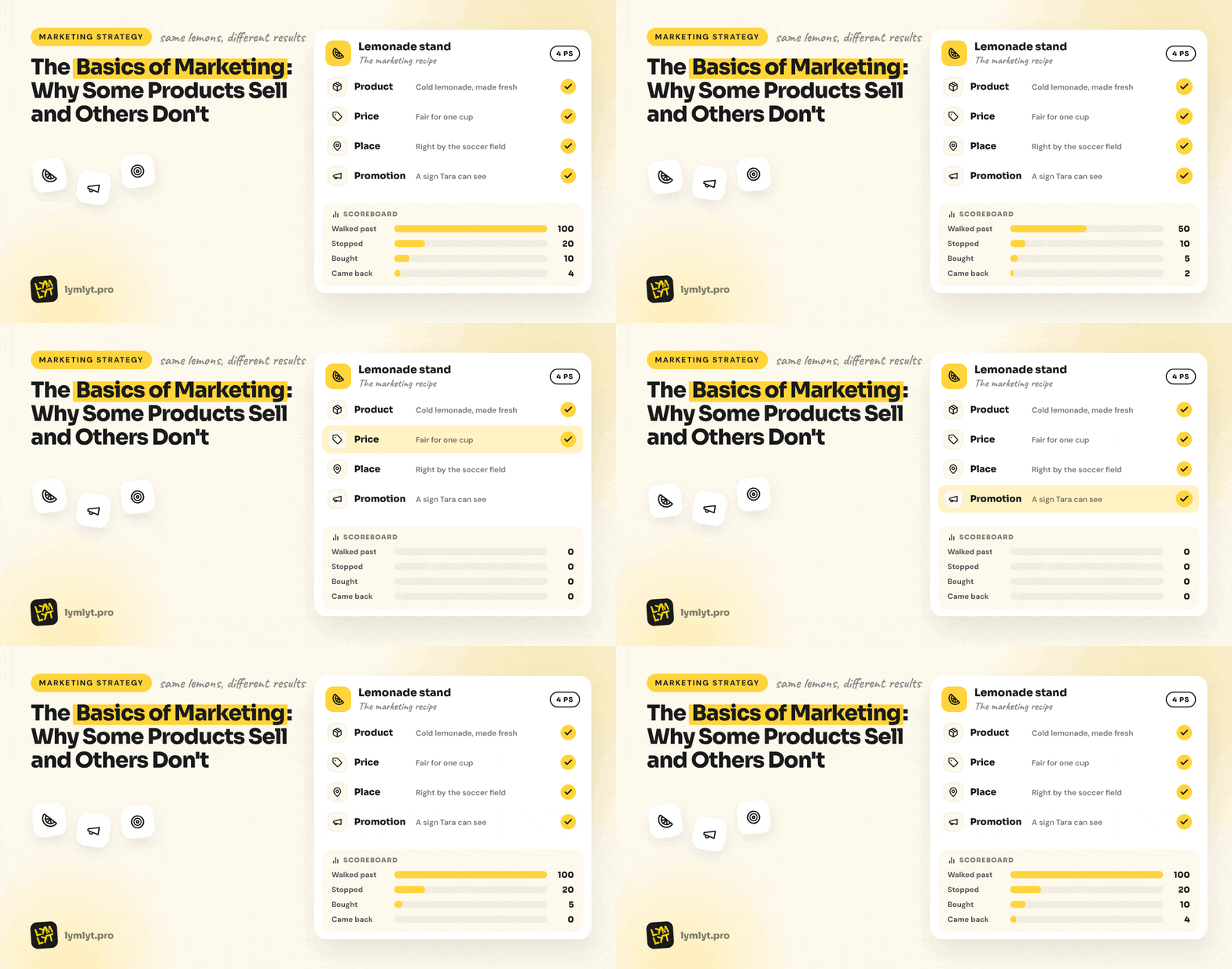
The Basics of Marketing: Why Some Products Sell and Others Don’t
Two lemonade stands open on the same street on a hot Saturday. Same lemons. Same sugar. Same price.
By evening, one stand has a line. The other has a wasp.
The lemonade wasn’t the difference. The first stand got four basics of marketing right, and the second didn’t:
| Stand with the line | Stand with the wasp | |
|---|---|---|
| Who it served | Soccer players walking home after evening games | Anyone who happened to pass |
| Where it stood | The corner by the soccer field, on the players’ route | In front of its own house, on a quiet stretch |
| What its sign said | “Ice-cold. Ready in 10 seconds.” | “Lemonade” |
| When it opened | Just before the games ended | At noon, and out of ice by 4 |
The first stand also handed out free sip-sized tasting cups. People who tasted it cold wanted a full cup.
That’s the whole trick: the right people, the right spot, one clear message, the right time. None of it needed better lemons.
This guide breaks each move down in plain English. Every idea gets a lemonade example and a real company example. Two of those companies, Michelin and John Deere, started marketing ideas over 120 years ago that are still running today.
What you’ll learn:
- What marketing actually is (hint: it’s not just ads)
- How to pick the right customers
- The 4 Ps every marketer uses
- How a brand gets stuck in people’s heads
- How people go from “never heard of you” to “I’ll take one”
- Where to spread the word, and how to tell if it worked
- The one rule you can never break
The basics of marketing in 30 seconds
| Big idea | In plain words |
|---|---|
| Marketing | Helping the right people find, like, buy and come back for what you make |
| Customer | The person you’re trying to help |
| Positioning | The one thing you want people to remember about you |
| The 4 Ps | Product, Price, Place, Promotion: your recipe |
| Brand | The feeling people get when they hear your name |
| Funnel | The path from “never heard of you” to “I bought it” |
| Channels | The places where you talk to people |
| Measuring | Counting what worked, so you can do more of it |
| Honesty | The rule you never break |
What is marketing? The simplest definition
Marketing is everything you do to help the right people find, like, buy and come back for what you make.
That’s it. That one sentence holds all the basics of marketing.
Notice what the sentence does not say. It doesn’t say “shouting.” It doesn’t say “tricking people.” It doesn’t even say “ads.” Ads are one small tool inside marketing, like a hammer inside a toolbox.
There’s an official version too. It comes from the American Marketing Association (AMA), a big professional group for marketers. The AMA describes marketing as “creating, communicating, delivering, and exchanging offerings that have value” for customers, partners and society. In plain words: make something useful, tell people about it, get it to them, and trade it fairly.
Fun fact: even the experts keep rethinking it. In 2026, the AMA set up a working group to decide whether its definition needs an update. The current wording dates back to 2007, according to the AMA’s own call for feedback.
The marketing iceberg
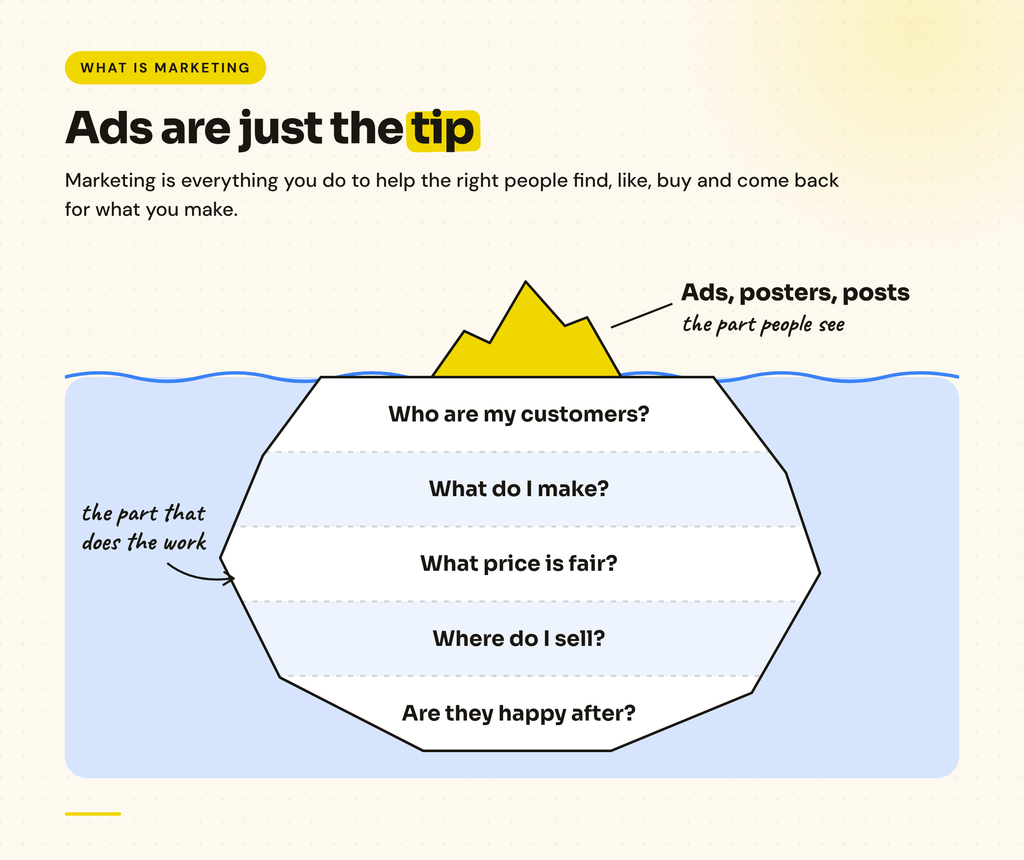
Think of marketing like an iceberg. The small part above the water is what you see: ads, posters and social media posts. The giant part under the water is everything else:
- Figuring out who your customers are
- Deciding what to make
- Picking a fair price
- Choosing where to sell
- Making sure customers are happy afterwards
The part above the water gets the attention. The part below the water decides whether it works.
Why marketing matters, even if your product is great
Imagine you make the best lemonade in the world. You set up your stand behind your house, where nobody walks past. How many cups do you sell?
Zero.
Great products don’t sell themselves if nobody knows they exist. Marketing fixes that. But the best marketing does more than shout “we exist.” It makes people’s lives a little easier, so they remember you.
The tire company that wrote a food guide
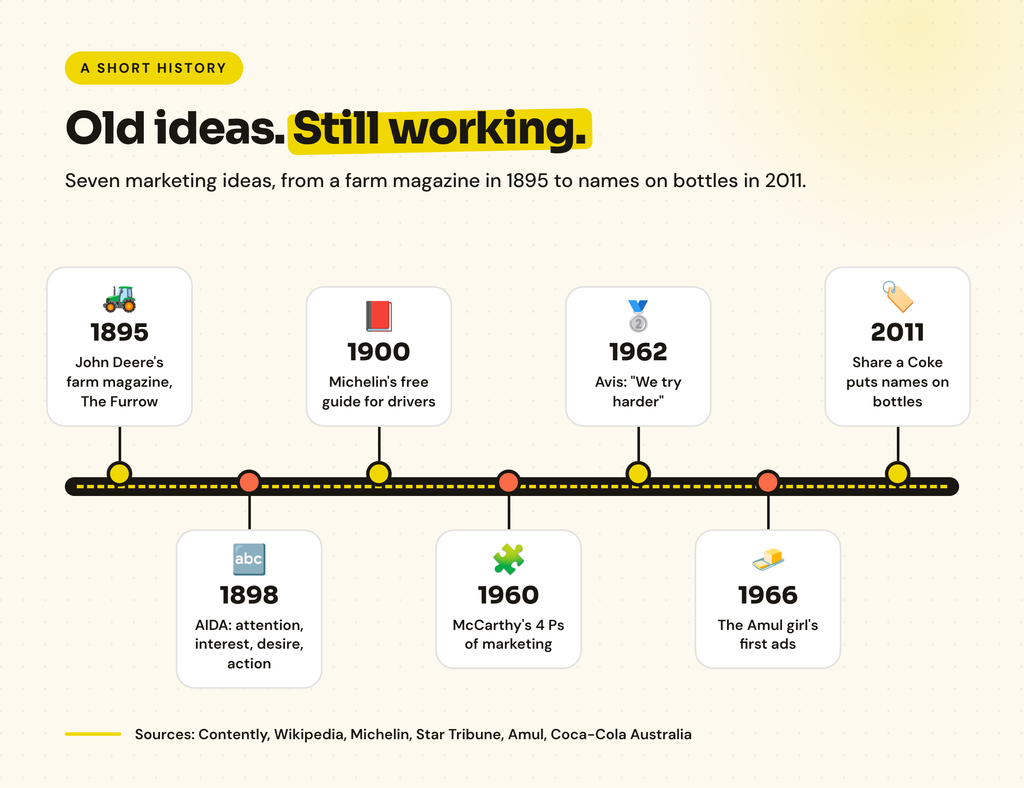
In 1889, two brothers named André and Édouard Michelin started a tire company in France. They had a big problem. France had fewer than 3,000 cars at the time, according to Michelin’s own history of its guide. Few cars meant few tires to sell.
So in 1900, they made a free guidebook for drivers. It listed hotels, restaurants, mechanics and fuel stations. They gave away 35,000 copies. The idea was simple. If driving felt easy and fun, people would drive more. More driving wears out tires. Worn-out tires need replacing.
That little book became the Michelin Guide, the famous restaurant guide that hands out Michelin stars.
Here’s an honest footnote. A historian told CNN there’s no evidence the guide actually raised tire sales. It did make people more confident about driving. It also gave Michelin a name people trusted. Good marketing often works like this. It’s slow and hard to measure, but people remember who helped them.
Marketing vs. advertising vs. sales
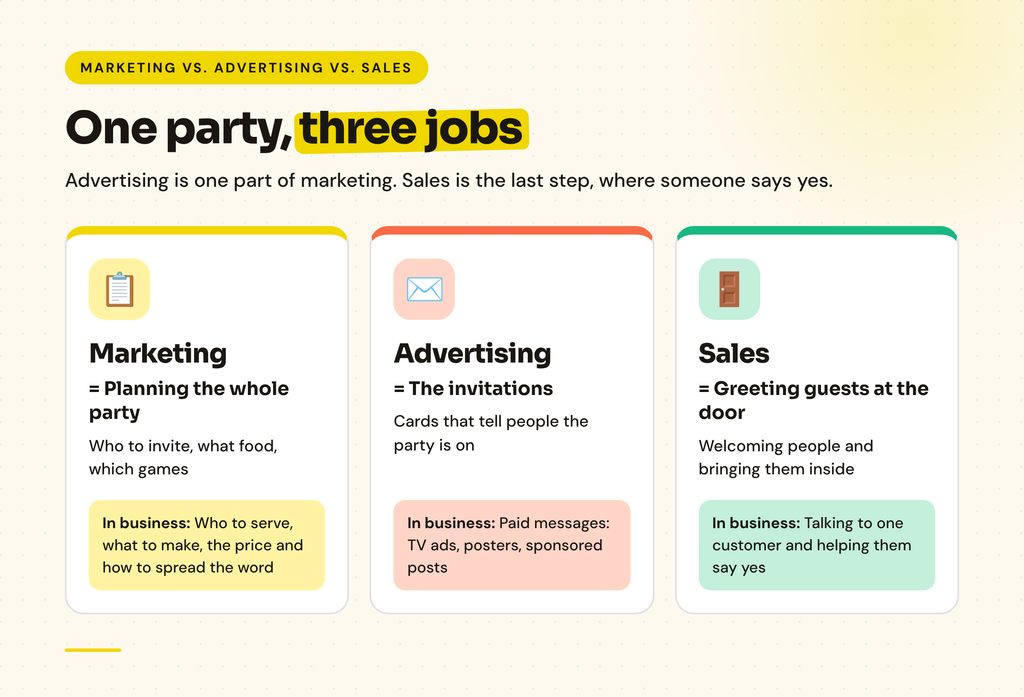
People mix these three up all the time. Here’s an easy way to keep them apart. Imagine you’re throwing a birthday party.
| Party version | Business version | |
|---|---|---|
| Marketing | Planning the whole party: who to invite, what food, which games | Deciding who to serve, what to make, the price and how to spread the word |
| Advertising | The invitations you send out | Paid messages: TV ads, posters, sponsored posts |
| Sales | Greeting guests at the door and bringing them inside | Talking to one customer and helping them say yes |
Advertising is one part of marketing. Sales is the last step, where someone actually buys.
A famous business thinker named Peter Drucker put it boldly. In his 1973 book Management: Tasks, Responsibilities, Practices, he wrote that “the aim of marketing is to make selling superfluous.” Superfluous means “not needed.” His point was this: understand your customers well enough, and your product fits them so well it nearly sells itself.
Real companies still need both teams. When marketing and sales don’t work together, customers fall through the cracks. Our guide to sales and marketing alignment shows how B2B teams fix that.
Step 1: Know exactly who your customer is
Here’s the first mistake beginners make. They say, “My lemonade is for everyone!”
When you talk to everyone, you talk to no one. A message that tries to please everybody ends up boring everybody.
Smart marketers split people into groups with similar needs. This is called segmentation. Then they pick the group they can help most. That group is the target audience.
Look at who walks past a lemonade stand:
| Group | What they care about | What might win them over |
|---|---|---|
| Players walking home from soccer practice | Hot, thirsty, not much cash on them | Big cold cups at a small price |
| Parents pushing strollers | Healthy choices, a quick stop | A sign saying “Fresh lemons, less sugar” |
| Joggers | Not stopping their run | A cup they can grab and go |
| Grandparents walking dogs | A friendly chat | A bowl of water for the dog |
Each group needs a different message. You probably can’t win all four at once. So pick one group and become its favorite.
Make a customer card
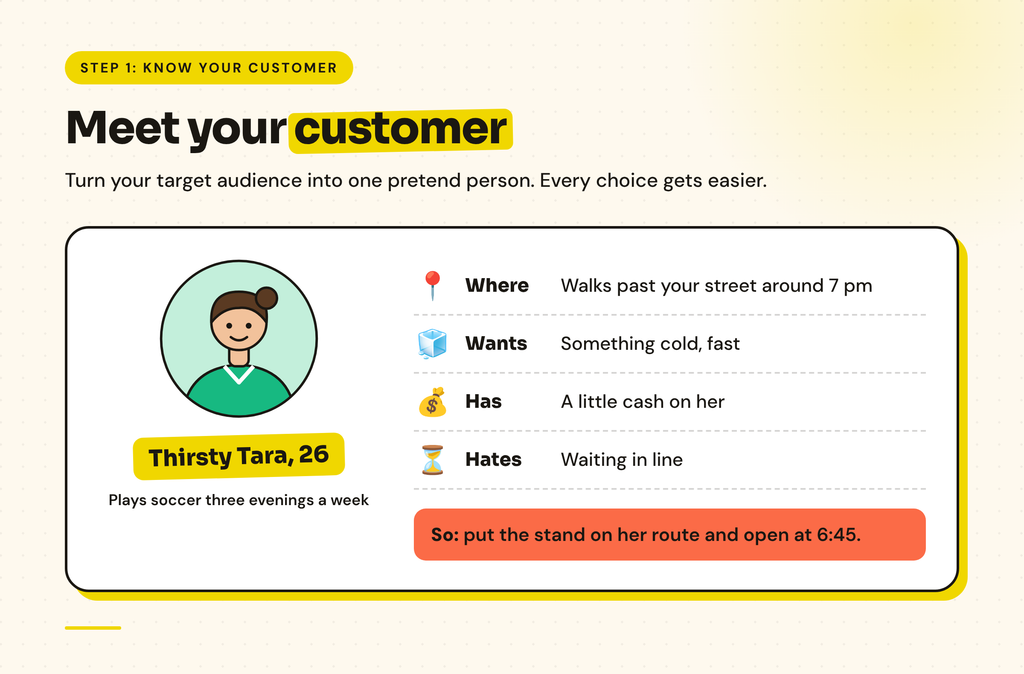
Marketers often turn their target audience into one pretend person. This is called a buyer persona. For our lemonade stand, it might look like this:
Thirsty Tara, 26. Plays soccer three evenings a week. Walks home past your street around 7 pm. Carries a little cash. Cares about getting cold, fast. Hates waiting in line.
Now every choice gets easier. Where should the stand go? On Tara’s route home. When should it open? Just before 7 pm. What should the sign say? “Ice-cold. Ready in 10 seconds.”
Companies that sell to other companies build a bigger version of this, called an ideal customer profile. Here’s how to build an ideal customer profile step by step. If you’d rather study real people than guess, start with these audience research tools.
Try it yourself: Pick something you’d love to sell. Write a customer card for one person who would love it. Give them a name.
Step 2: Decide what makes you different (positioning)
Your customer has choices. There might be three lemonade stands on one street. So why should anyone pick yours?
The answer is your positioning. Positioning is the one idea you want to own in a customer’s mind. Not ten ideas. One.
Examples for a lemonade stand:
- “The coldest lemonade on the street”
- “The only stand with pink lemonade”
- “Lemonade in 10 seconds flat”
The company that bragged about being number two
In 1962, the car rental company Avis had a problem. It always came second behind a bigger company, Hertz. Plenty of companies would hide that. Avis did the opposite.
Its ads admitted it was only number two. Then they explained that being second meant it had to try harder for every customer. The slogan was “We try harder.”
People loved it. Being second suddenly sounded like a promise. Within a year, Avis went from losing $3.2 million to earning $1.2 million. That was its first profit in over a decade, according to a column reprinted in the Star Tribune.
The lesson: positioning doesn’t mean pretending to be the best at everything. It means picking an honest spot that nobody else owns.
Selling to businesses? Our guide to B2B positioning shows how software companies do it.
Step 3: Mix the recipe with the 4 Ps of marketing
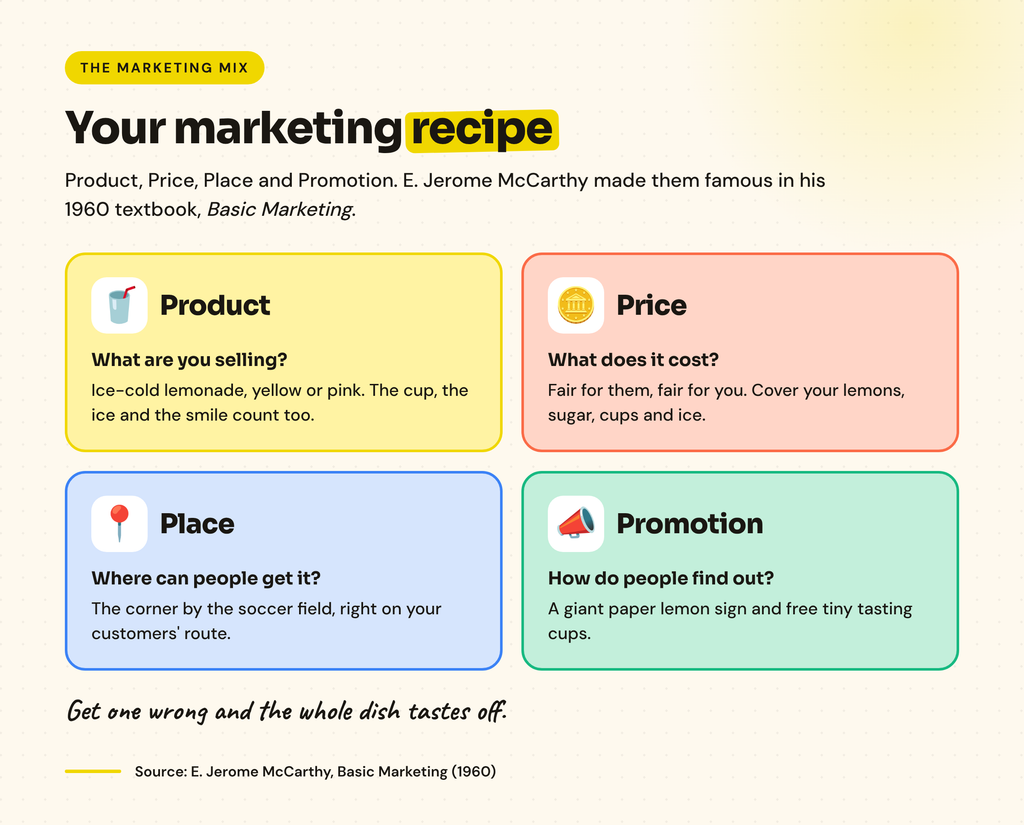
Every product needs four ingredients. Marketers call them the 4 Ps: Product, Price, Place and Promotion.
A professor named E. Jerome McCarthy made them famous in his 1960 textbook, Basic Marketing (Wikipedia). More than 60 years later, they’re still taught in marketing classes.
Think of them like a recipe. Get one ingredient wrong, and the whole dish tastes off.
Product: what are you selling?
The product is the thing itself. But it’s also everything that comes with it: the cup, the ice, the straw, the smile.
Ask yourself: what problem does it solve? Tara’s problem is “I’m hot and thirsty.” Your lemonade solves it. A tiny paper umbrella on the cup doesn’t solve anything. But it might make her smile, and that counts too.
Price: how much does it cost?
Price it too high, and people walk away. Price it too low, and you lose money on every cup.
A simple way to start:
- Add up what one cup costs you to make: lemons, sugar, cup and ice.
- Check what other stands charge.
- Ask what your customer can actually afford.
Price also sends a message. A very low price can say “great deal!” It can also say “maybe not very good.”
Place: where can people get it?
Place means where and how customers buy. For a lemonade stand, it’s the corner you choose. For a company, it could be a shop, a website, an app or a delivery service.
The best spot is wherever your customers already are. Put the stand near the soccer field, not behind your house.
Promotion: how do people find out?
Promotion is how you spread the word. Signs, flyers, posts, telling friends, free tasting cups. When people say “marketing,” this is usually the part they mean. Now you know it’s only one P out of four.
Fun fact: some marketers now use 7 Ps. They add People, Process and Physical evidence, as this Coursera guide explains. The original four are still the best place to start.
Step 4: Build a brand people remember
A brand is not just a logo. A brand is the feeling people get when they hear your name.
Your logo, colors, name, the way you talk and how you treat people all add up to that feeling. It works like a person’s reputation. It’s built from hundreds of small moments, not one big one.
The way your brand “talks” is called your brand voice. Is it silly? Serious? Kind? Cheeky? Pick one and stay consistent.
The butter girl who jokes about the news
In 1966, the Indian dairy brand Amul needed ads for its butter. Ad man Sylvester daCunha and his art director created a cheeky little girl in a polka-dot dress. Amul’s own history page tells the story.
The Amul girl started making butter puns about whatever was in the news. She has kept doing it for decades. One 2018 report counted more than 4,000 of these ads (The Express Tribune).
Why does it work? The girl never changes, so you always know it’s Amul. The jokes always change, so you always want to look.
The lesson: stay the same where it matters (how you look and sound). Stay fresh where it counts (what you say).
The bottle with your name on it
In 2011, Coca-Cola in Australia tried something bold. It printed 150 of the country’s most popular first names on its bottles. People hunted through fridges for their own name, and their friends’ names.
The idea, called “Share a Coke,” spread to other countries. In China, the bottles carried nicknames instead of first names, according to the same Coca-Cola page.
The lesson: people love brands that make them feel seen. A name on a bottle is a tiny thing. But it turned a drink into a gift.
Step 5: Guide people through the marketing funnel
Nobody goes from “never heard of you” to “I’ll buy ten” in one second. People move through steps.
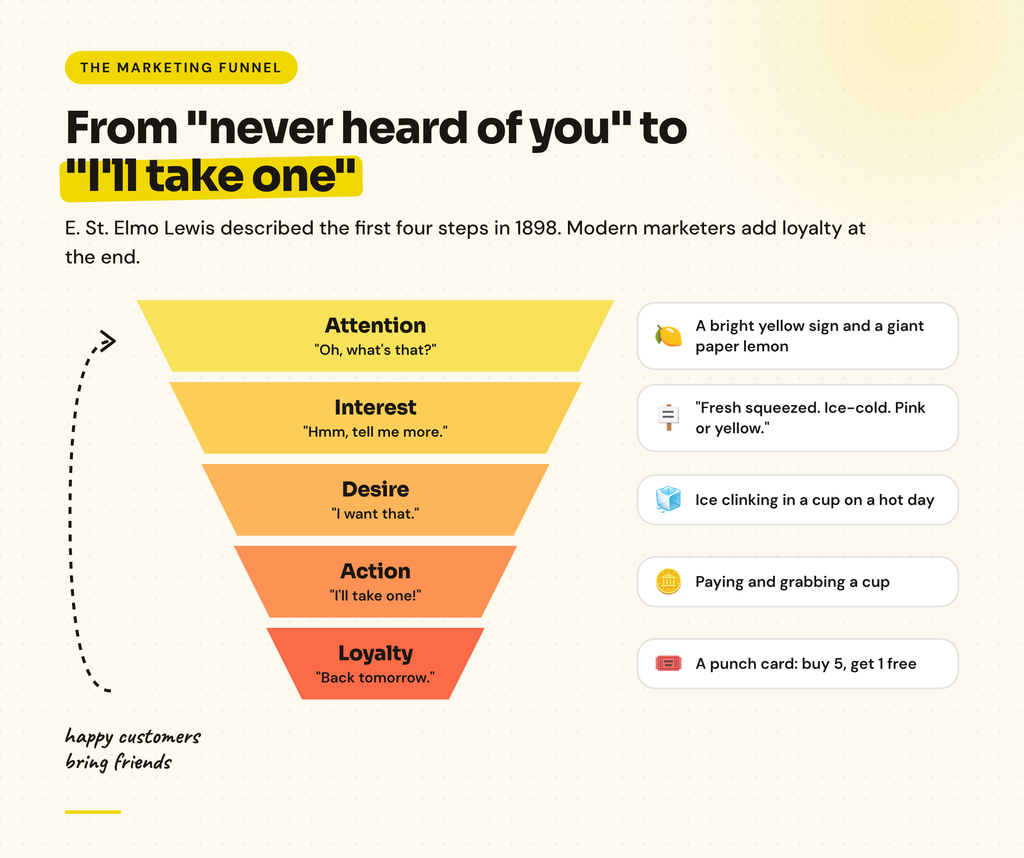
Back in 1898, an American advertising pioneer named E. St. Elmo Lewis described those steps. Attract attention. Maintain interest. Create desire. He later added a fourth step: get action (Wikipedia). Today we shorten it to AIDA.
Marketers usually draw these steps as a funnel. Lots of people enter at the wide top. Fewer reach the narrow bottom.
| Stage | What the customer thinks | Lemonade example |
|---|---|---|
| Attention | “Oh, what’s that?” | A bright yellow sign and a giant paper lemon |
| Interest | “Hmm, tell me more.” | “Fresh squeezed. Ice-cold. Pink or yellow.” |
| Desire | “I want that.” | Seeing ice clink in a cup on a hot day |
| Action | “I’ll take one!” | Paying and grabbing a cup |
| Loyalty | “I’m coming back tomorrow.” | A punch card: buy 5, get 1 free |
Loyalty wasn’t part of the 1898 version. Modern marketers add it because keeping a customer is worth so much. More on that in Step 7.
Real life is messier than a funnel
Real people don’t move in a neat line. They hear about you and forget. Then they see a friend with your lemonade, read your sign, leave, and come back two days later.
Companies that sell to other companies see this even more. Their buyers do lots of research before they talk to anyone. We unpack it in the B2B buying journey and the marketing funnel. For content that fits each stage, read our SaaS content funnel guide.
The funnel is still useful. It reminds you that each stage needs a different message.
Step 6: Choose where to talk to people (channels)
A channel is any place where you reach customers. A sign is a channel. So is a website, an email, or a friend saying “you have to try this.”
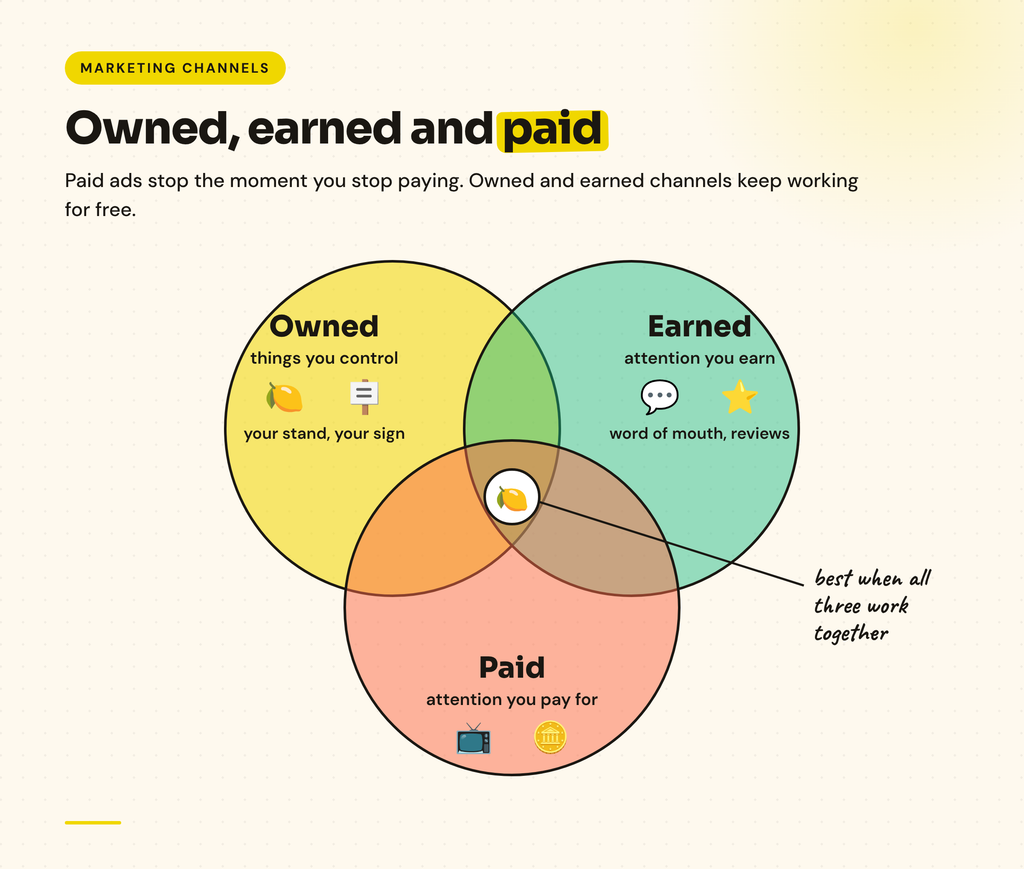
Marketers sort channels into three easy buckets:
| Type | What it means | Lemonade version | Business version |
|---|---|---|---|
| Owned | Things you control | Your sign, your stand, your flyer | Website, blog, email list, app |
| Earned | Attention you earn for free | Neighbors telling neighbors | Reviews, news stories, people sharing your post |
| Paid | Attention you pay for | Paying a friend to hold a sign at the corner | Search ads, social media ads, TV ads |
Here’s how each main channel works.
Content: be useful first
Content marketing means making helpful stuff people actually want, like articles, videos, guides and tips. You help first. People remember you when they’re ready to buy.
This idea is old. In 1895, the farm equipment company John Deere started a free magazine for farmers called The Furrow. It was packed with farming advice, not product ads, and it’s still published today (The Drum). By 1912, it reached more than 4 million readers, according to Contently.
Lemonade version: hand out a free “make your own lemonade” recipe card with every cup. It sounds like giving away your secret. But the person who learns from you remembers you.
Running a software company? Our guide to content marketing for SaaS startups shows how this works today.
Search: show up when people look
When people need something, they search for it. SEO (search engine optimization) means making your website easy for search engines to find, understand and show.
Google publishes a free SEO Starter Guide for beginners. It walks through simple ways to help search engines find and understand your pages. For writing that ranks, try our SEO writing tips.
Lemonade version: making sure your stand shows up on the map app when someone nearby searches “cold drinks.”
People now ask AI assistants for answers too. Getting mentioned there is a newer skill, sometimes called GEO or AEO. Here’s how GEO, AEO and SEO compare.
Email: talk to people who asked to hear from you
Email lets you reach people who said “yes, tell me more.” That permission is precious. Treat it with respect: send useful things, not spam.
Lemonade version: a list of neighbors who want to know when you open next Saturday.
Starting from zero? Pick one of these free email marketing tools.
Social media: join the conversation
Social media is where people chat, share and scroll. It works best when you post things people enjoy, like behind-the-scenes photos, tips, jokes and stories. Posting “BUY NOW” every day gets ignored fast.
Planning posts ahead helps teams stay consistent, and these social media scheduling tools make it easier.
Ads: pay to be seen
Ads put your message in front of people fast. But they stop working the moment you stop paying. That’s why smart marketers mix paid ads with owned and earned channels, which keep working for free.
Step 7: Turn customers into fans
Getting a new customer is hard work. Keeping one is easier, and often worth much more.
Word of mouth beats almost everything
Who do you trust more: an ad, or your best friend?
In 2021, Nielsen surveyed more than 40,000 people around the world about advertising. 88% said they trust recommendations from people they know more than any other channel.
So happy customers are your best marketers. You can’t buy that. You earn it by being great, then making it easy to share.
Lemonade version: give regulars a “bring a friend and you both get a cookie” deal.
In business, a lot of recommending happens in private chats that companies never see. We dug into that in referrals your CRM never sees.
Keeping customers is a superpower
In a 2000 Harvard Business Review article, Fred Reichheld and Phil Schefter of Bain & Company studied online businesses. They found that keeping just 5% more customers could raise profits by 25% to 95%.
Why so much? Loyal customers buy more over time. They cost less to look after. And they tell their friends.
Lemonade version:
- Remember your regulars’ names
- Remember their favorite flavor
- Say thank you, every time
- Fix mistakes fast (spilled cup? Free refill.)
Step 8: Measure what works
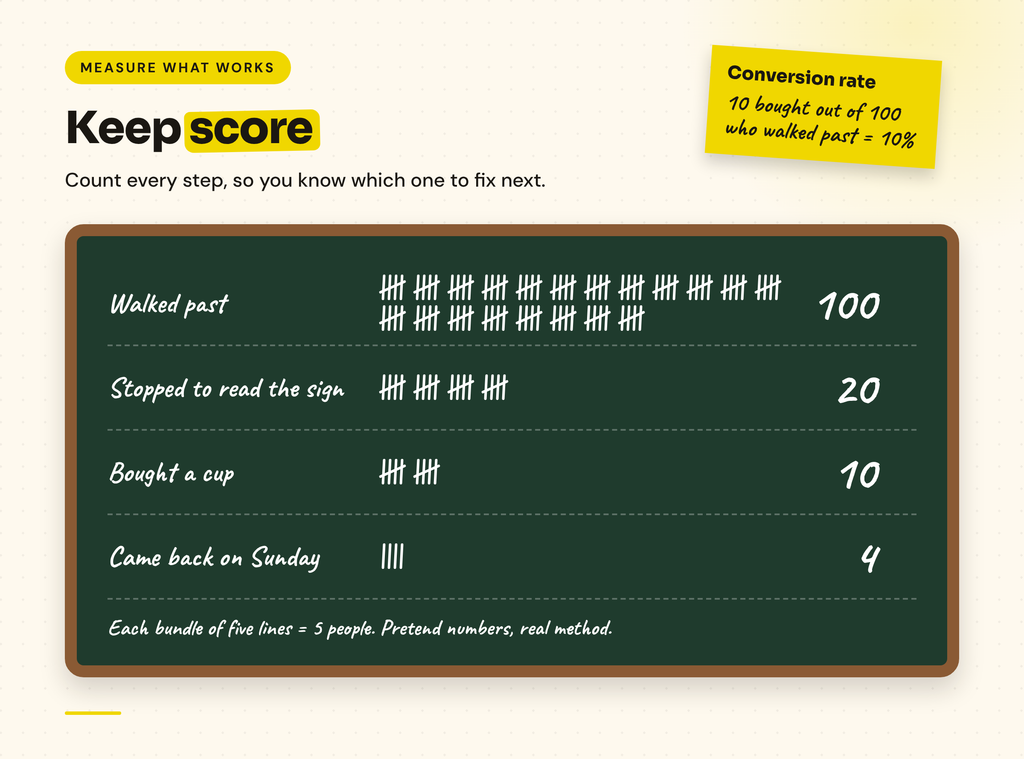
Marketing without measuring is like playing a game without keeping score. You can’t tell if you’re winning.
Here’s a pretend Saturday at the lemonade stand. These are made-up numbers, just to show the idea:
| What you count | Number | What it tells you |
|---|---|---|
| People who walked past | 100 | How many people you could reach |
| People who stopped to read the sign | 20 | Your sign caught 1 in 5 people |
| People who bought a cup | 10 | Half the people who stopped, bought |
| People who came back on Sunday | 4 | 4 in 10 buyers liked it enough to return |
The most useful number here is the conversion rate. It’s the share of people who do what you hoped. Ten buyers out of 100 people walking past is a 10% conversion rate.
Test one thing at a time
Want more buyers? Change one thing and compare. Try a yellow sign, then a pink sign. Which one makes more people stop? That’s called an A/B test.
Change only one thing at a time, or you won’t know what made the difference. Real A/B tests also show both versions at the same time. That way, the weather or the day of the week can’t fool you.
Bigger teams also track things like cost per customer and return on investment (ROI). If you ever need to show a boss that marketing is paying off, here’s how to prove marketing ROI.
The golden rule: never lie
This one isn’t optional. Good marketing is honest marketing.
In the US, the Federal Trade Commission (FTC) enforces the rules for ads. Ads must be truthful and not deceptive. Advertisers must have evidence to back up their claims. The FTC also says paid endorsements must be disclosed. Other countries have similar rules.
What that means for your lemonade stand:
- Don’t say “real lemons” if you used powder.
- Don’t say “doctors recommend it” unless doctors really do.
- If a friend gets free lemonade for praising it, they should say so.
Here’s a useful habit. Next time you see an ad, ask three questions. What are they selling? Who is it for? What are they not telling me? That’s how marketers think, and it makes you much harder to trick.
A lie might win one sale. It loses the customer for good. And remember, word of mouth works both ways.
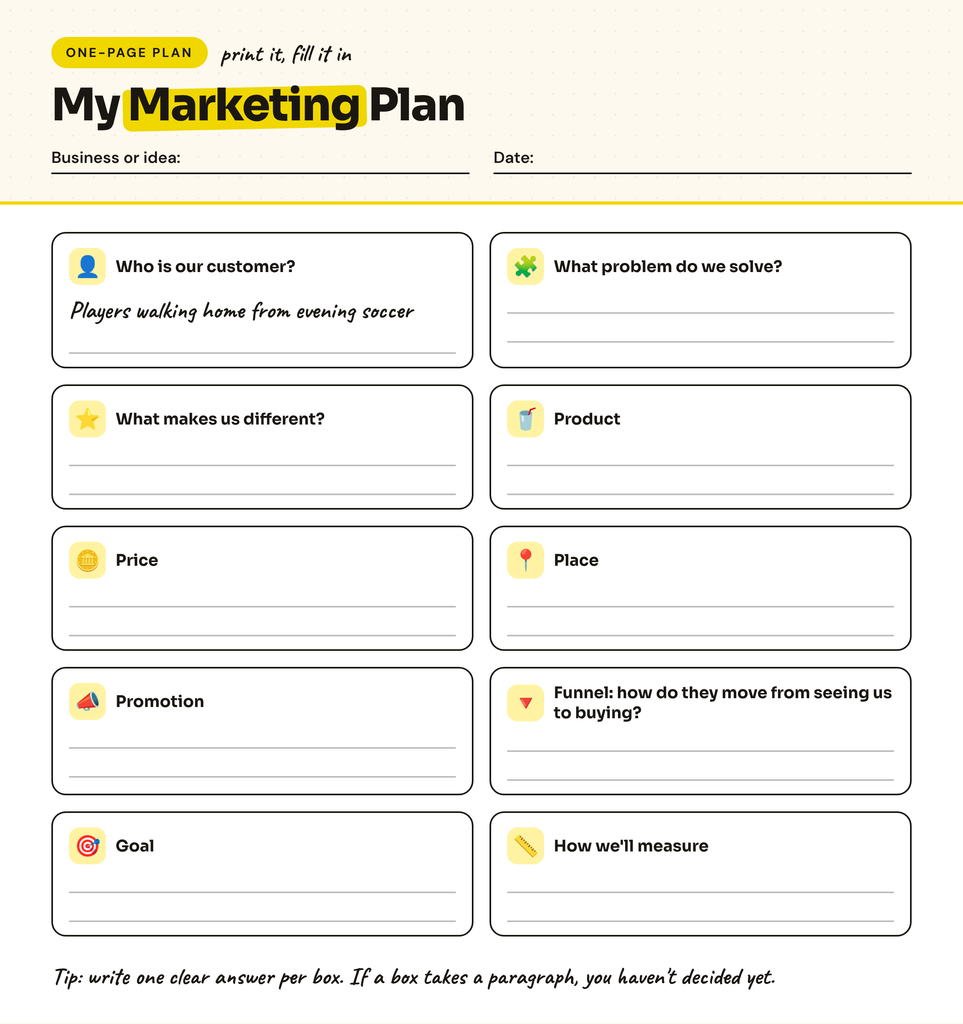
Put the basics of marketing together: a one-page plan
You now know every step. Here’s how they all fit on a single page, using our lemonade stand:
| Question | Our answer |
|---|---|
| Who is our customer? | Thirsty Tara: players walking home from evening soccer |
| What problem do we solve? | Hot and thirsty, with not much money |
| What makes us different? | The coldest lemonade on the street, ready in 10 seconds |
| Product | Ice-cold lemonade, yellow or pink |
| Price | Small cup for a little, big cup for a bit more |
| Place | The corner by the soccer field, 6:30 to 8 pm |
| Promotion | A giant paper lemon sign and free tiny tasting cups |
| Funnel | The sign grabs attention, tasting cups create desire, a punch card brings them back |
| Goal | Sell 30 cups on Saturday |
| How we’ll measure | Tally marks for walked past, stopped, bought and came back |
Copy this table, swap in your own idea, and you’ve got a real marketing plan.
7 beginner marketing mistakes (and the fix)
| Mistake | Why it hurts | The fix |
|---|---|---|
| Selling to “everyone” | Your message gets bland | Pick one customer and win them first |
| Talking only about yourself | Customers care about their problem | Lead with what they get |
| Copying the stand next door | Nobody has a reason to choose you | Find your one different thing |
| Only using ads | Results stop when the money stops | Build owned and earned channels too |
| Not measuring | You can’t tell what works | Count, compare, repeat |
| Giving up after one day | Trust takes time | Show up again and again |
| Exaggerating | Lost trust is hard to win back | Only promise what you can deliver |
Software companies make these too. Here are the content marketing mistakes that kill SaaS growth.
Marketing words cheat sheet
| Word | What it means |
|---|---|
| Audience | The people you want to reach |
| Brand | The feeling people get from your name |
| Buyer persona | A pretend person who stands for your ideal customer |
| Campaign | A planned burst of marketing with one goal, like “Summer Lemonade Week” |
| Channel | A place where you reach people: sign, website, email, social media |
| Conversion | When someone does what you hoped, like buying |
| Funnel | The steps from “never heard of you” to “bought it” |
| Positioning | The one idea you want to own in people’s minds |
| SEO | Helping search engines find and show your website |
| Segmentation | Splitting people into groups with similar needs |
| Target audience | The group you choose to serve first |
| Word of mouth | People telling other people about you |
Want more? Browse the full LymLyt content marketing glossary.
FAQ
What are the basics of marketing? Know your customer, decide what makes you different, get the 4 Ps right and build a brand. Then guide people through the funnel, pick your channels, keep customers happy, measure results and always tell the truth.
What are the 4 Ps of marketing? Product, Price, Place and Promotion. E. Jerome McCarthy made them famous in his 1960 textbook, Basic Marketing.
What is the difference between marketing and advertising? Advertising is one part of marketing: paid messages like TV ads or posters. Marketing is the whole plan, from understanding customers to keeping them happy.
Is marketing the same as selling? No. Marketing gets the right people interested. Selling is the final step, when someone says yes.
Do small businesses need different marketing basics? No. A lemonade stand, a bakery or a local gym uses the same basics of marketing that big companies use.
What is the most important marketing skill? Understanding people. Learn what your customer wants, worries about and talks about. The rest gets much easier.
Conclusion: marketing is helping, out loud
Strip away the jargon, and the basics of marketing come down to one idea. Find people you can truly help. Make something they want. Then tell them about it honestly.
A tire company made a food guide, because drivers needed places worth driving to. A farm equipment company made a magazine, because farmers wanted advice. A butter brand made a cartoon girl who jokes about the news people already talk about. A soda printed your name, because people like being seen.
Now go back to that street with two lemonade stands. The one with the line didn’t have better lemons. It knew the players walked past after games, wanted something cold and fast, and would stop for a free taste. Then it stood in their path and told them so.
Running marketing at a B2B SaaS company? We turn these basics into content that brings in customers. Book a 30-minute call with the LymLyt team.

Rashmita is content marketer with 8 years of experience building and growing SaaS brands. Now she tests various AI tools for marketers and shares her feedback on this blog, LinkedIn, Instagram, and YouTube.