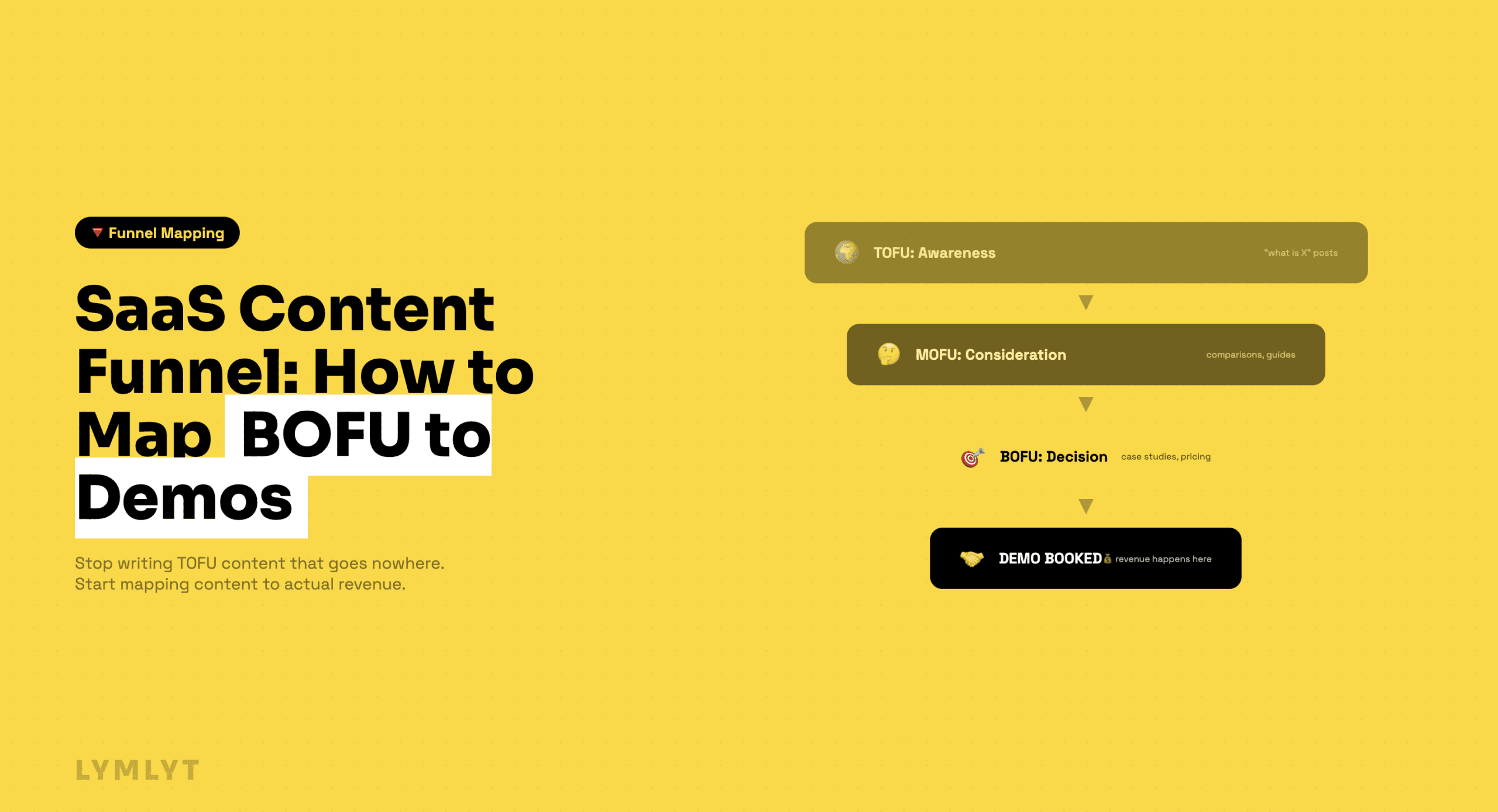
SaaS Content Funnel: How to Map BOFU to Demos
The SaaS content funnel is a structured approach to content marketing that aligns different types of content with each stage of a potential customer’s journey, from discovering your product to booking a demo or becoming a paying user. If your SaaS content strategy stops at traffic and vanity metrics, you’re leaving money on the table.
The real magic? Mapping Bottom-of-the-Funnel (BOFU) content directly to demo bookings. Now that you are done figuring out the differences between Landing page and Homepage for your website and everything is configured as per the new gen SEO vs. AI, we can focus on active conversion.
These are the three stages of the SaaS marketing funnel, representing how users move from discovering a problem → exploring solutions → buying your product.
What the SaaS Content Funnel Actually Is
The SaaS content funnel is a framework for matching content to where a buyer is in their journey. Different buyers need different things. Someone who just discovered they have a problem needs different content than someone who is comparing your product against a competitor.
Get this wrong and you push cold prospects to book a demo before they trust you. Or you educate warm prospects without ever giving them a reason to act. Both are equally expensive mistakes.
The three stages:
- TOFU (Top of Funnel): Get discovered by people who have the problem your product solves
- MOFU (Middle of Funnel): Build trust with people who are actively looking for solutions
- BOFU (Bottom of Funnel): Convert people who are ready to evaluate and buy
Each stage has a different job. Each stage requires different content. Skipping a stage does not accelerate growth. It creates gaps that lose buyers you already paid to attract.
TOFU (Top of Funnel) :Get Discovered
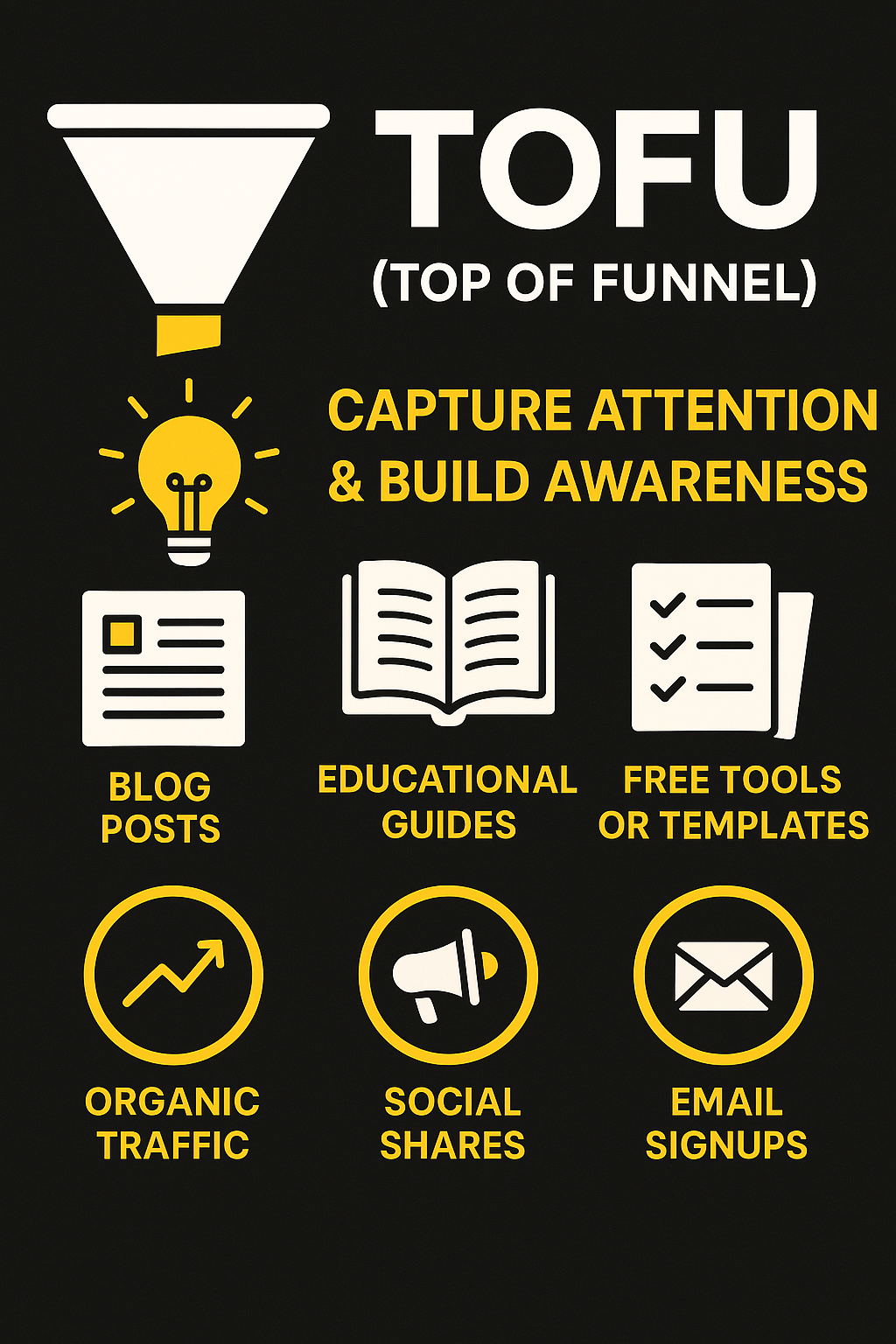
Goal: Capture attention and build awareness.
Audience: People who have a problem but are not yet looking for a specific solution. They do not know your product exists yet.
What works:
- Blog posts addressing the pain your product solves (not the product itself)
- Educational guides that explain a concept or framework
- SEO-optimised content targeting informational keywords
- Free tools, templates, or checklists
What to measure: Organic traffic, time on page, newsletter signups, new visitors.
The most common TOFU mistake is writing about your product instead of your buyer’s problem. A CRM company writing “How to Stop Losing Sales Deals” will reach more people and build more trust than one writing “Why Our CRM Is the Best.” The product comes later. The problem comes first.
Why every business needs a blog covers this in depth. And writing for your ICP rather than a broad audience is what makes TOFU content actually attract the right people.
SaaS Example:
A CRM company writes “How to Stop Losing Sales Deals” — not about their tool, but about the pain their tool solves.
MOFU (Middle of Funnel) : Build Trust
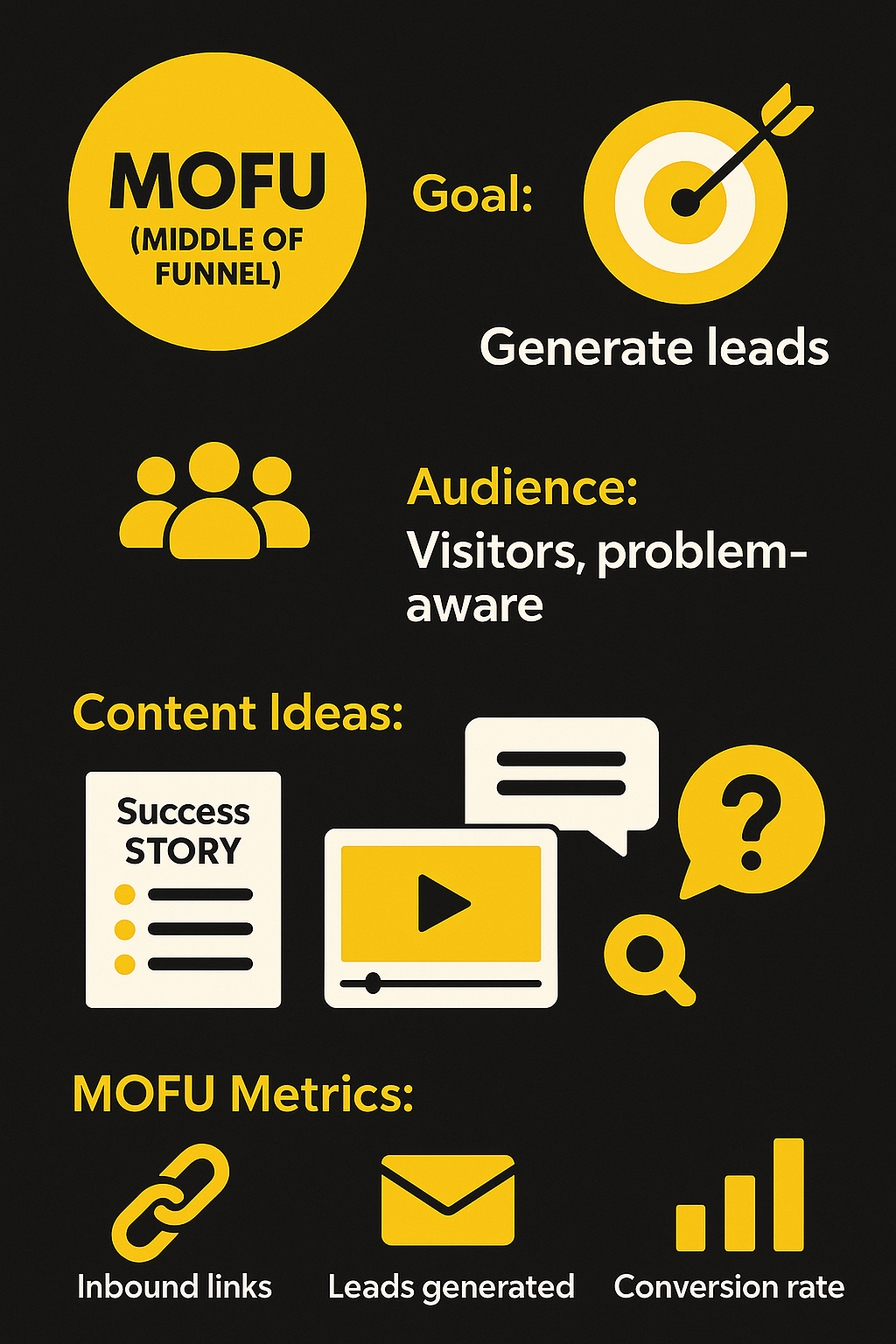
Goal: Nurture and qualify leads by showing how you solve the problem.
Audience: People who know they have the problem and are now exploring types of solutions.
What works:
- Case studies with specific, named results
- Comparison posts (your approach vs alternatives)
- Webinars and product-focused content
- Content that addresses specific objections
What to measure: Lead magnet downloads, webinar registrations, product page visits, email click-throughs.
MOFU is where most SaaS content teams underinvest. They publish TOFU blogs and BOFU demo pages and leave nothing in the middle to move a buyer from “I have this problem” to “I think this product might solve it.”
Competitor comparison pages are the most underused MOFU asset in SaaS. A buyer comparing you to a competitor is already warm. If you are not there with a well-built comparison page, your competitor is.
SaaS Example:
A project management tool runs a webinar on “How Fast-Growing Teams Stay Organized Across Departments”, featuring their product subtly.
BOFU (Bottom of Funnel) : Drive conversions
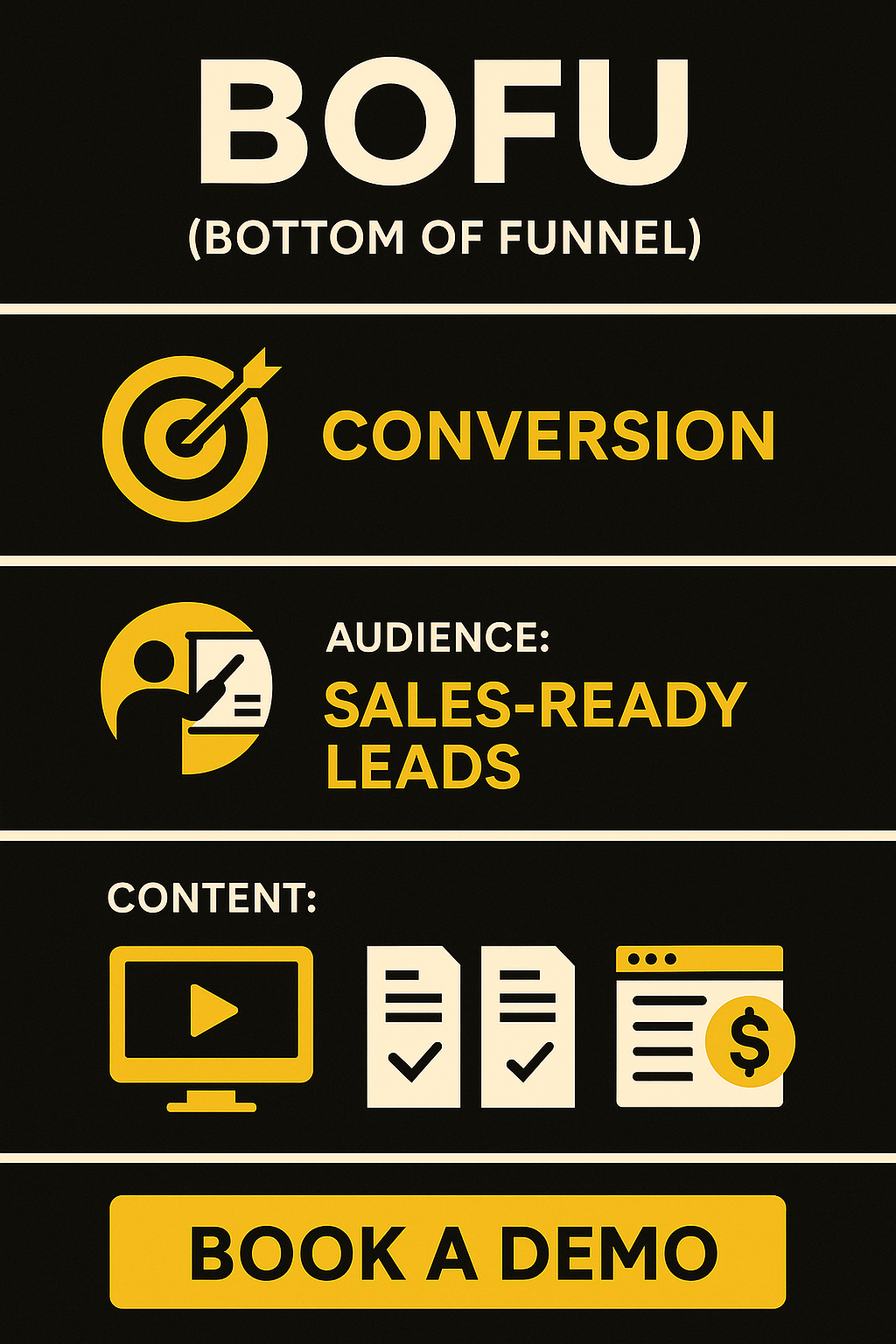
Goal: Convert leads who are actively evaluating solutions into demo bookings or trial signups.
Audience: People who know their problem, know the category, and are now deciding which specific product to buy.
What works:
- Feature comparison pages with clear side-by-side tables
- Competitor alternative pages (“Best alternatives to [Tool]”)
- Industry-specific use case pages (“CRM for Real Estate Teams”)
- Product walkthrough videos and on-demand demos
- Pricing pages with FAQ, testimonials, and demo CTAs
- ROI calculators and case studies with specific results
What to measure: Demo requests, free trial signups, sales-qualified leads, pipeline value.
BOFU is where buying decisions happen. It is not the place for educational content. It is the place to show your product in action, handle objections, prove ROI, and make the next step obvious.
A buyer landing on a BOFU page already knows they need a solution. Your job is to make it clear that your solution is the right one for them specifically.
SaaS Example:
“Why Teams Are Switching From Asana to [Your Tool]” with a Calendly embed to book a demo.
How They Work Together
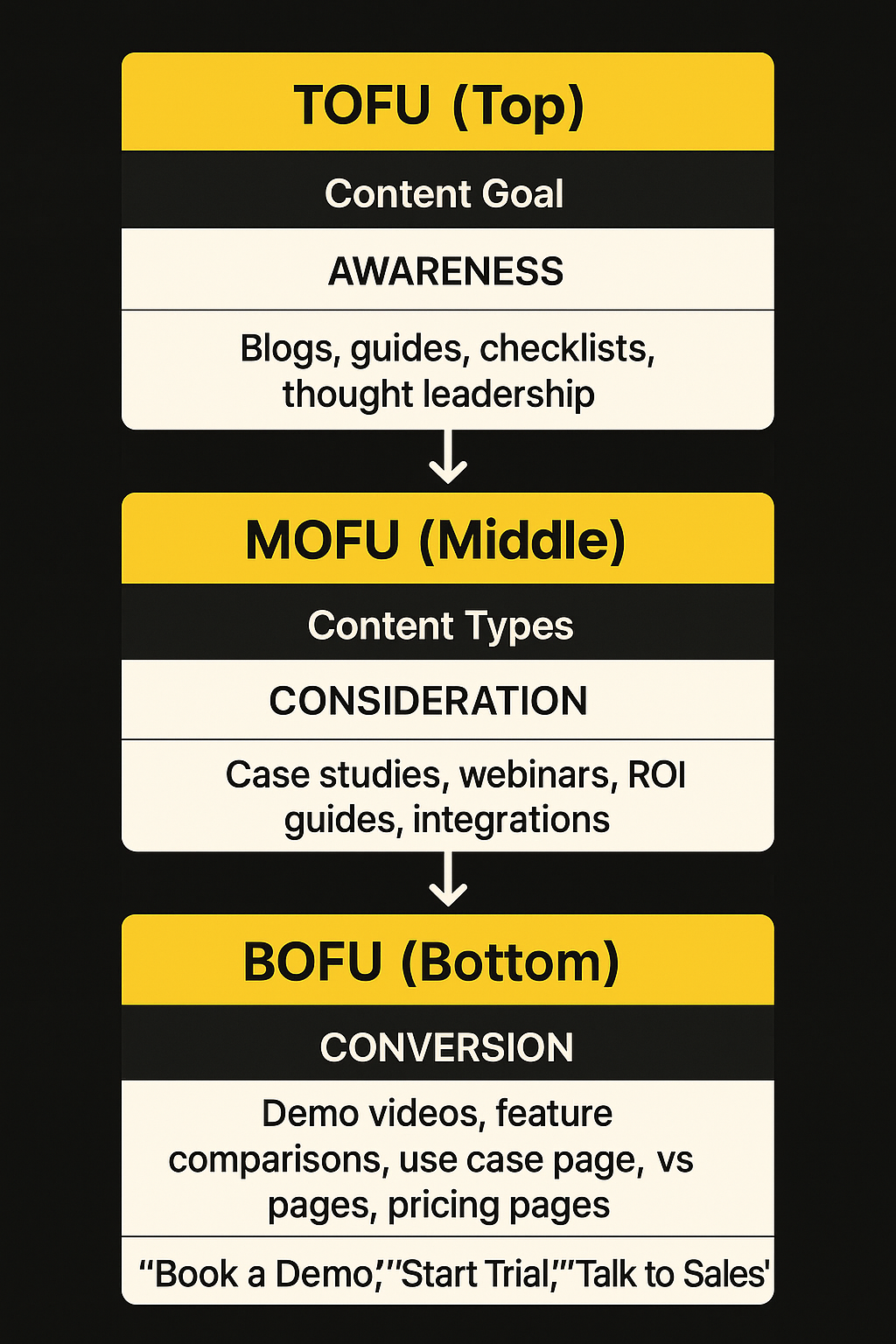
Imagine this as a relay race:
- TOFU draws people in
- MOFU builds trust and authority
- BOFU seals the deal
Skipping a stage in the SaaS Content Funnel doesn’t accelerate growth, it sabotages it.
TOFU vs MOFU vs BOFU (The SaaS Content Funnel)
| Funnel Stage | Content Goal | Content Types | CTA |
| TOFU (Top) | Awareness | Blogs, Guides, Checklists, Thought Leadership | Newsletter or Lead Magnet |
| MOFU (Middle) | Consideration | Case Studies, Webinars, ROI Guides, Integration | Learn More / See How It Works |
| BOFU (Bottom) | Conversion | Demo Videos, Feature Comparisons, Use Case Pages, VS Pages, Pricing Pages | Book a Demo / Start Trial / Talk to Sales |
You’re pushing prospects to act before they’re informed, engaged, or convinced. That’s not strategy, that’s spray and pray.
What Is BOFU Content in SaaS Content Funnel?
BOFU (Bottom of the Funnel) content is designed for prospects who are actively evaluating solutions. They know their problem. They know the category. Now, they need to know why your SaaS is the best option.
This isn’t the time for fluffy tips. It’s time to:
- Show your product in action
- Handle objections
- Prove ROI
- Guide users to a demo or trial
Step-by-Step: How to Map BOFU Content to Demos
1. Identify High-Intent Search Queries
High-intent queries are the ones buyers search when they are close to a decision. They sound like:
- “[Your SaaS] vs [Competitor]”
- “Best [Tool Category] for [ICP]”
- “[Your SaaS] pricing”
- “[Your SaaS] alternatives”
- “[Your SaaS] + [Integration name]”
These queries have demo intent built in. Someone searching “[Your Product] vs [Competitor]” is not researching. They are evaluating. Use the best keyword research tools to find every high-intent query in your category and build a content piece for each one.
Pro Tip: Use tools like Ahrefs, Semrush, or Google Search Console to identify keywords with demo intent.
2. Build Conversion-Focused Content Types
▶ Feature Comparison Pages
- Break down features with side-by-side tables
- Highlight what sets you apart
- End with “Book a Demo” CTA
▶ Competitor Alternatives Pages
- People search for alternatives. Use it.
- E.g., “Top Alternatives to [Competitor]”
▶ Industry-Specific Use Cases
- Customize content by vertical (e.g., “CRM for Real Estate Teams”)
▶ Product Walkthroughs & On-Demand Demos
- Embed 2-5 minute video demos
- Add Calendly or form beneath
▶ Pricing Pages
- Be transparent, but also smart
- Include mini-FAQ, testimonials, and demo CTAs
3. Use Strong, Low-Friction CTAs
Step 3: Use CTAs That Remove Friction
Most SaaS CTAs are too vague or too aggressive.
- Too vague: “Learn more”
- Too aggressive: “Buy now”
- Right: “Book a 20-minute demo with a product expert”
The best CTAs name a specific action, set a time expectation, and reduce perceived risk. “See it in action” works. “Start your free trial, no credit card required” works. “Submit” does not work.
Consider embedding demo request forms mid-page rather than only at the bottom. A buyer who is convinced halfway through reading does not want to scroll to find the CTA.
Innovative Ideas:
- Use chat widgets that pop up on scroll (“Want a live walkthrough?”)
- Embed demo request forms mid-page, not just at the end
- Use intent pop-ups based on exit behavior
4. Internal Linking That Converts
BOFU pages are only valuable if buyers can find them. Internal links are how you route traffic from TOFU and MOFU content to your conversion pages.
Every TOFU blog post should link to at least one MOFU or BOFU page. Every MOFU comparison guide should link to a specific demo page or use case page. This is what a real SaaS content engine looks like: not just creating content, but connecting it so buyers move through the funnel.
Use descriptive anchor text. “Compare [Your Tool] vs [Competitor]” converts better than “click here.” The anchor text sets the expectation for what the buyer will find on the other side.
This is also what topical authority is built on. Posts that connect to each other around a topic cluster tell Google that your site comprehensively covers the subject, and that lifts rankings for every page in the cluster.
5. Track and Optimize Relentlessly
Traffic is not the metric for BOFU content. Pipeline is.
The SaaS content marketing metrics that actually matter for BOFU pages are:
- Demo requests per page
- Trial signups attributed to specific content
- Time from first content touch to demo booking
- Pipeline influenced by content (tracked via UTMs or CRM attribution)
Use heatmaps (Hotjar or Microsoft Clarity) to see where buyers drop off on BOFU pages. Use GA4 to build conversion paths from first touch to demo. The goal is to know which specific pages are booking demos and double down on those.

BOFU Content That Converts: Examples
“Notion vs Airtable: Which Tool Is Right for Ops Teams?” Side-by-side comparison with a clear CTA to book a demo. The buyer already knows both tools. You are giving them the deciding argument.
“Calculate Your ROI With [Tool]” Interactive calculator followed by a Calendly form. The calculator does the persuasion. The form captures the conversion.
“How [Customer] Increased Retention 35% With [Tool]” A case study that leads directly to a demo form. Specific results from a named company are more persuasive than any feature list.
“[Tool] for Healthcare Startups” A use case page with tailored messaging for one specific ICP. A healthcare founder reading this feels understood in a way a generic page never achieves.
How the Funnel Connects to Distribution
Creating the content is half the job. A real SaaS content distribution playbook is what gets BOFU content in front of buyers at the right moment. LinkedIn, email nurture sequences, retargeting, and sales enablement are all distribution channels for BOFU content.
A B2B newsletter is particularly effective for BOFU distribution. You have already built trust with subscribers through TOFU and MOFU content. Sharing a comparison page or a new case study with that audience converts at a much higher rate than cold traffic.
Common SaaS Content Funnel Mistakes
Skipping MOFU entirely. Most teams go straight from TOFU blogs to a demo CTA. There is no trust built in between. The conversion rate suffers.
Building BOFU pages but not linking to them. A competitor comparison page that no other page links to will not rank and will not convert. Internal links are what activate BOFU content.
Using the same CTA everywhere. A TOFU reader is not ready to book a demo. A BOFU reader does not want to download an ebook. Match the CTA to the funnel stage.
Measuring BOFU with TOFU metrics. Pageviews and time on page are not the right metrics for a demo page. If your BOFU reporting only shows traffic numbers, you cannot tell whether the content is working.
For the full list of mistakes that kill SaaS content programs, see top 10 SaaS content marketing mistakes.
Final Thoughts
The SaaS content funnel works when all three stages are built and connected. TOFU brings buyers in. MOFU builds the trust they need to consider your product seriously. BOFU converts that consideration into a demo booking.
Miss a stage and you have gaps. Gaps mean buyers fall out before they convert. The fix is not more content. It is the right content, at the right stage, with the right internal links connecting it all.
If you want help building a content funnel that books demos, let’s talk.

Jay is the co-founder of LymLyt and an AI partnership consultant helping B2B SaaS companies grow through content strategy, SEO, and AI integration. He writes about content marketing, what makes B2B content convert, and how SaaS teams can build content systems that drive real pipeline.