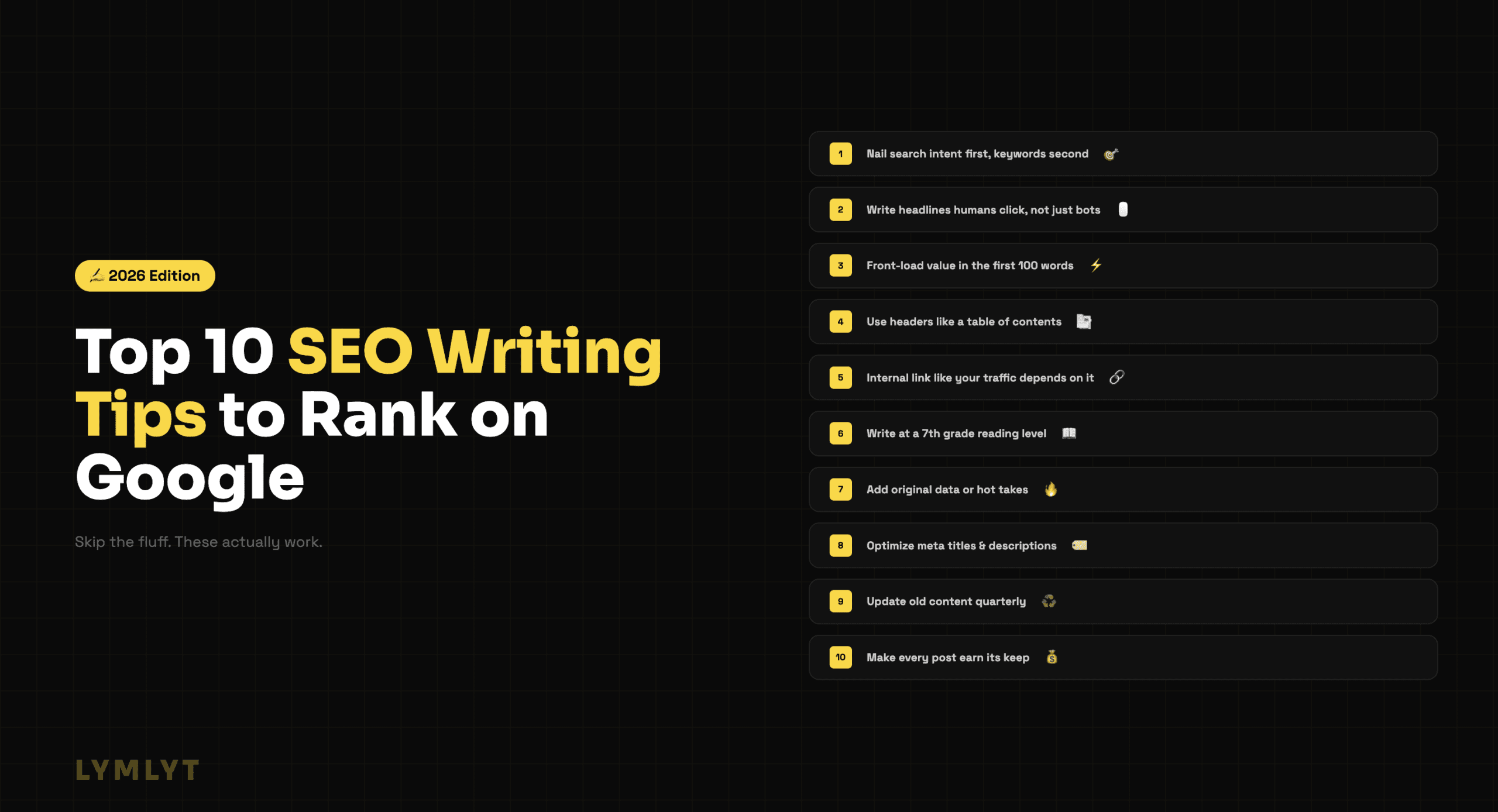
Top 10 SEO Writing Tips to Rank on Google in 2026
Millions of web pages compete for attention every day. SEO has become the difference between content that gets found and content that sits unseen, regardless of how good it is.
A well-optimised website ensures your content reaches the right audience, ranks higher on search engine results, and drives organic traffic that compounds over time. By mastering SEO writing, businesses can build visibility, establish credibility, and convert readers into leads.
Here are the ten tips that actually move the needle.
Why is SEO Important?
Before the tips, the case for why SEO matters in the first place:
- Increases visibility: Ranks your content higher on SERPs so the right people find it
- Drives organic traffic: Visitors without ad spend, compounding over time
- Builds credibility: High-ranking pages are perceived as more authoritative
- Improves user experience: Fast pages, clean structure, mobile-friendly layouts
- Boosts conversions: The right audience finds you at the right moment
- Competitive advantage: Optimised content consistently outperforms unoptimised competitors
- Supports content marketing: SEO and content work together, not against each other
Understanding the difference between SEO and content writing is the starting point. They are not the same discipline, but both are needed.
What Makes SEO Writing Different
Knowing SEO matters is not the same as knowing how to write for it.
Most content fails not because it lacks information but because it was written without a clear SEO strategy behind it. The keyword was guessed. The structure was an afterthought. The meta description was auto-generated. The internal links were never added.
SEO content writing is a specific discipline. It sits at the intersection of what your audience is searching for, what Google needs to understand and rank the page, and what actually makes a reader stay, trust, and convert.
The ten tips below cover each of these dimensions in order. Start with how you research and plan, move through how you write and structure, and finish with how you maintain and compound the results over time.
1. Conduct Thorough Keyword Research
Keyword research is where SEO writing starts. Not with what you think your audience searches for, with what they actually type.
- Use tools like Google Keyword Planner, Ahrefs, or SEMrush to find high-volume, low-competition keywords.
- Identify long-tail keywords that match user intent.
- Incorporate primary and secondary keywords naturally in your content.
- Analyze competitors’ keyword strategies for insights.
The best keyword research tools for SEO will show you not just volume but intent, which is what determines whether a ranking actually drives traffic that converts.
One level up from keyword research is understanding how individual keywords fit into a broader content structure. Topic clusters outperform standalone keyword targeting every time for sites trying to build long-term organic authority.
Example: If you’re writing about digital marketing trends, include keywords like “latest marketing strategies 2024” or “emerging SEO trends.”

2. Craft Engaging, Click-Worthy Headlines
Your title is what gets clicked in the search results. Even a page one ranking is wasted if the headline does not earn the click.
- Keep titles under 60 characters for optimal display in SERPs
- Use numbers, power words, and questions to increase CTR
- Match the headline to what the reader actually gets from the post
- Test different headlines to see which drives more traffic
Weak: “SEO Tips for 2026” Strong: “10 Proven SEO Writing Tips to Rank on Google in 2026”
The second tells the reader exactly what they are getting and why it is worth clicking.
Pro tip: You can use free online headline generators such as Easy-Peasy.AI or Free Headline Generator
Example: Instead of “SEO Tips for 2025,” use “10 Proven SEO Writing Tips to Skyrocket Your Google Rankings!”.

3. Optimize Meta Titles and Descriptions
Your meta title and description are your organic ad copy. They determine whether someone clicks or scrolls past.
- Meta title: under 60 characters, focus keyword near the front
- Meta description: under 160 characters, benefit-led, not just descriptive
- Every page needs a unique title and description. No duplicates.
- Include the primary keyword naturally in both
Example meta description: “10 SEO writing tips to rank higher on Google. Learn keyword research, content structure, E-E-A-T signals, and how to write for both humans and search engines.”
The right meta optimisation also lifts your landing pages. But a well-optimised meta is only one part of what makes a landing page convert.
4. Focus on Readability and Structure
Google reads structure signals. So do human readers. A post that is hard to scan gets abandoned, and a high bounce rate signals to Google that the content did not satisfy the search.
- Short sentences and paragraphs: three lines max before a break
- H2 and H3 tags to organise the content hierarchy clearly
- Bullet points and numbered lists for scannable sections
- Transition words to maintain flow between ideas
The structural principles that work for blog posts also apply to other page types. Understanding what makes a homepage different from a landing page is part of knowing how to structure content for each specific purpose.
5. Leverage Internal and External Links
Internal links are one of the most underused SEO levers on most B2B SaaS blogs. Every post is an opportunity to pass authority to other pages, but only if the links are actually there.
- Link to relevant internal posts with descriptive anchor text
- Link to credible external sources to strengthen E-E-A-T
- Use anchor text that describes the destination, never “click here”
- Every new post should link to at least 3-5 existing posts
Internal linking is also what turns a collection of posts into a content cluster. Building a real SaaS content engine depends on this structure being in place before the traffic starts coming.
6. Optimize Images and Multimedia
Images that are not optimised slow pages down and miss SEO opportunities. Every image is a chance to reinforce your topic to search engines.
- Use descriptive file names:
seo-writing-tips-2026.jpgnotIMG1234.jpg - Write alt text that describes the image accurately, not keyword stuffing
- Compress images before uploading to improve page load speed
- Add captions and transcripts to videos for accessibility and indexability

7. Write for Humans, Optimize for Search Engines
The mistake most SEO writers make is optimising for algorithms at the expense of the reader. The result is content that ranks briefly and converts nobody.
- Write to satisfy the reader’s intent first, then layer in keyword optimisation
- Avoid keyword stuffing: place keywords where they read naturally
- Use a tone that matches where the reader is in their journey
- Answer the question the reader came with, clearly and specifically
This is exactly where SEO content writing differs from general content writing. The craft is in doing both at the same time, not choosing between them.

8. Improve E-E-A-T (Experience, Expertise, Authoritativeness, Trustworthiness)
Google’s quality guidelines weight E-E-A-T heavily, especially for content in competitive niches. A post without any credibility signals will consistently underperform one that demonstrates genuine expertise.
- Add author bios with real credentials on every post
- Link to credible sources and studies rather than making unsupported claims
- Showcase real-world experience: specific examples, client results, named case studies
- Cite Google updates, research, or expert perspectives where relevant
One of the most overlooked E-E-A-T signals is having a proper content brief behind every post. A content brief that includes the argument, the reader, and the CTA forces the kind of specificity that Google’s quality raters reward.
9. Prioritize Mobile-Friendliness
More than 60% of searches happen on mobile. A page that performs poorly on mobile loses more than half its potential traffic regardless of how well it ranks.
- Use responsive design that adapts to all screen sizes
- Optimise font sizes and button placements for touch navigation
- Minimise intrusive pop-ups that hurt mobile user experience
- Test mobile usability regularly using tools like Google’s Mobile-Friendly Test or Sitechecker

10. Keep Content Fresh and Updated
Google favours content that stays current. An article published in 2023 that has never been updated will lose ground to one that has been refreshed with current data, updated examples, and new internal links.
- Revisit older posts every 6-12 months and update statistics, examples, and links
- Refresh content that was published without a clear strategy behind it
- Repurpose strong posts into new formats: newsletters, LinkedIn posts, video scripts
- Monitor GSC for posts that are losing impressions and prioritise those for updates
This is one of the core reasons most B2B blogs fail to maintain rankings over time. They publish and move on. The ones that compound are the ones that maintain.

Putting It Together
These ten tips are not a checklist to run through once. They are a writing standard to apply to every piece of content you publish.
Keyword research informs the topic. The headline earns the click. The meta description gets the impression to convert. The structure keeps the reader. The internal links build authority. The E-E-A-T signals build trust. The updates keep it relevant.
Miss one and the others compensate poorly. Get all ten right and the content compounds. This is what topical authority for B2B SaaS looks like in practice. Not one great post, but a consistent standard applied across everything you publish.
If you need content written to this standard, let’s talk.

Jay is the co-founder of LymLyt and an AI partnership consultant helping B2B SaaS companies grow through content strategy, SEO, and AI integration. He writes about content marketing, what makes B2B content convert, and how SaaS teams can build content systems that drive real pipeline.