9 Content Agency Proposal Red Flags B2B SaaS Teams Should Check
The proposal says eight blogs a month, SEO optimization, and a monthly strategy call.
Looks reasonable. Then you start asking questions.
Who interviews your product team? Does “delivery” mean a Google Doc or a published page? Who fixes a draft that gets your product wrong? And why are all eight topics things your buyers would never search for?
A content agency proposal should tell you what you’re buying, why the work matters, and what your team still needs to do. If those answers only exist in the sales conversation, ask for them in writing.
We’re a content agency too. Apply these checks to us.
The examples below are illustrative proposal language, not quotes from named agencies.
1. There’s a content count, but no reason for the content
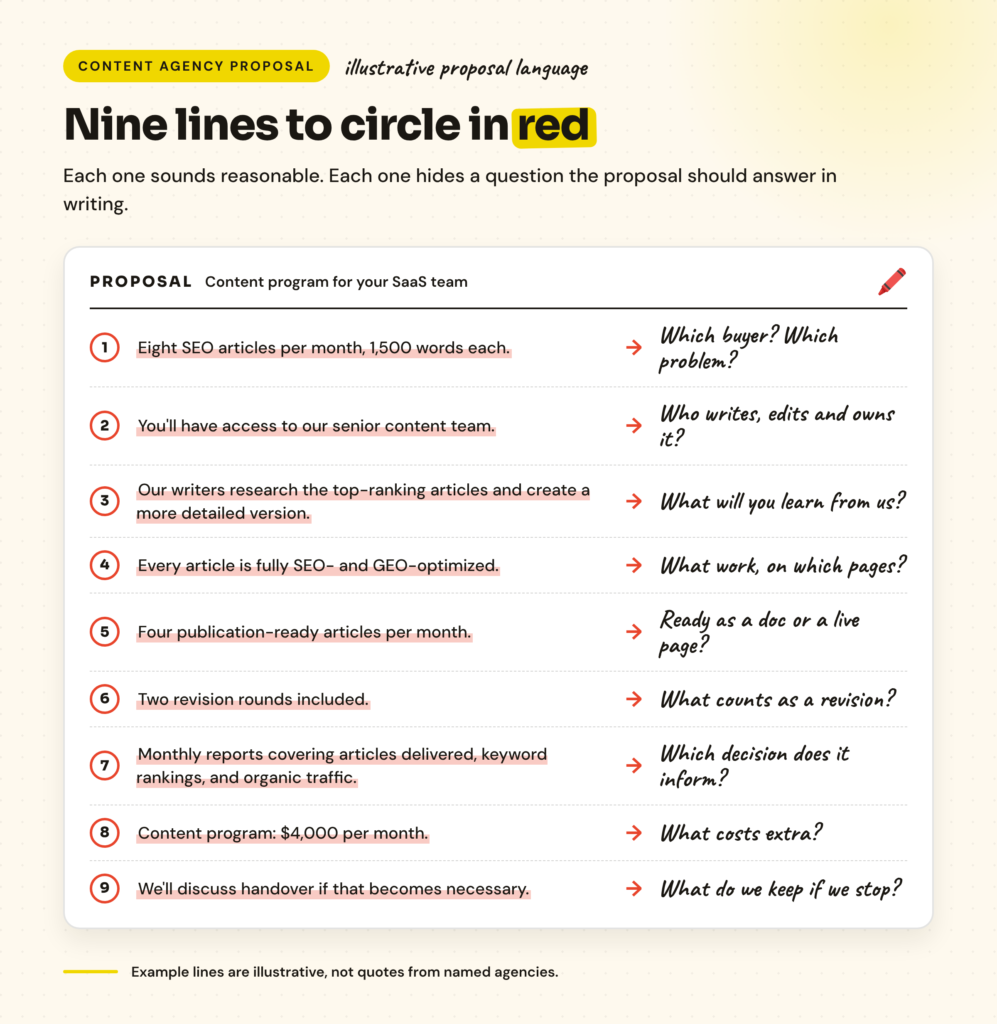
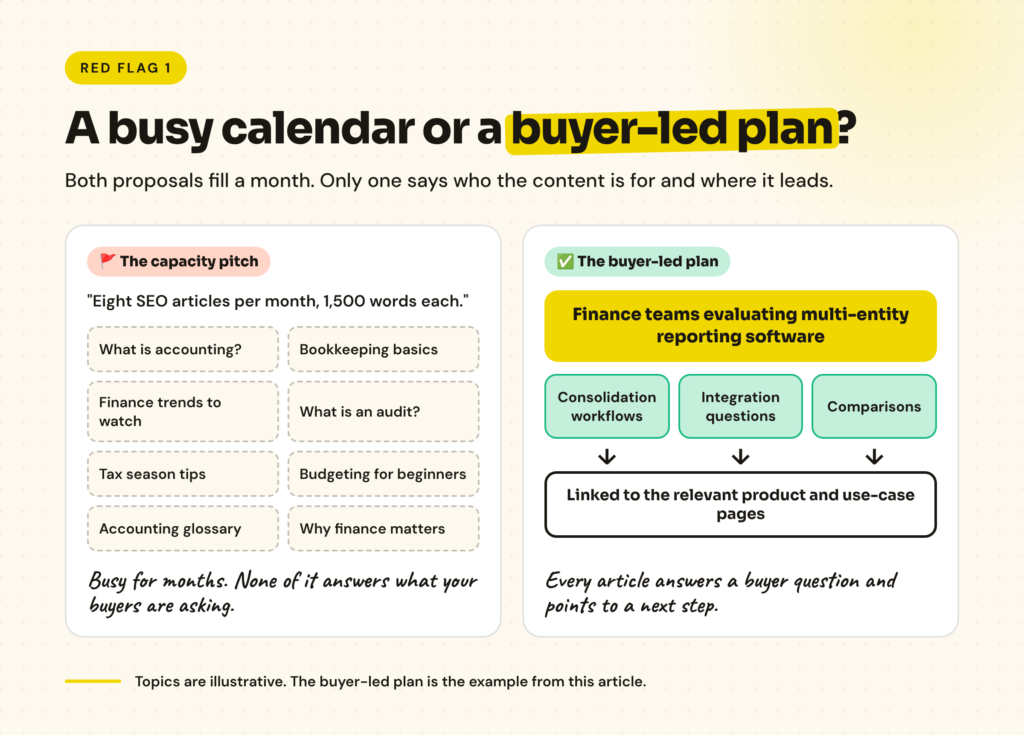
Watch for: “Eight SEO articles per month, 1,500 words each.”
That describes production capacity. It leaves the important decision unresolved: what should those articles help your business achieve?
Suppose you sell financial reporting software to multi-entity businesses. A calendar full of “What is accounting?” articles could keep everyone busy without answering the questions your actual buyers have.
A more useful proposal connects the work to a specific audience and problem:
“Build a content cluster for finance teams evaluating multi-entity reporting software. Start with consolidation workflows, integration questions, and comparisons. Link each article to the relevant product or use-case page.”
The agency may need discovery before recommending exact titles. That’s reasonable. The proposal should still explain how those decisions will be made.
Ask: “Show us how you’d choose our first three topics—and what you’d deliberately leave out.”
Our guide to content briefs covers the decisions that should happen before drafting starts.
2. You’ve met the salesperson, but the delivery team is a mystery
Watch for: “You’ll have access to our senior content team.”
Who, specifically?
An agency doesn’t need to introduce every future contributor before you sign. It should explain who owns strategy, who writes, who edits, and who resolves problems.
Ask to see a relevant piece of work and understand the proposed team’s involvement. A logo on the agency’s website tells you very little about who produced the work or what they contributed.
A clearer commitment would be:
“Your editor owns the content plan and reviews every draft. A writer with relevant subject experience handles production. Your account lead manages scheduling and feedback.”
Then clarify what happens if those people change.
Ask: “Who will work on our first article, who checks it, and who is accountable if it misses the brief?”
For context on the management work each setup requires, see our comparison of freelancers, agencies, in-house hires, and fractional marketers.
3. Research means reading whatever already ranks
Watch for: “Our writers research the top-ranking articles and create a more detailed version.”
Competitor research is useful. It cannot tell a writer how your product behaves, which limitations matter, or why a customer chose you.
Without access to original material, the agency may produce an accurate summary of your category that could sit on any competitor’s blog.
Look for a practical research plan: a product walkthrough, access to relevant documentation, approved customer evidence, and a route for questions to reach the right expert. If interviews are included, clarify who arranges them and how many the scope covers.
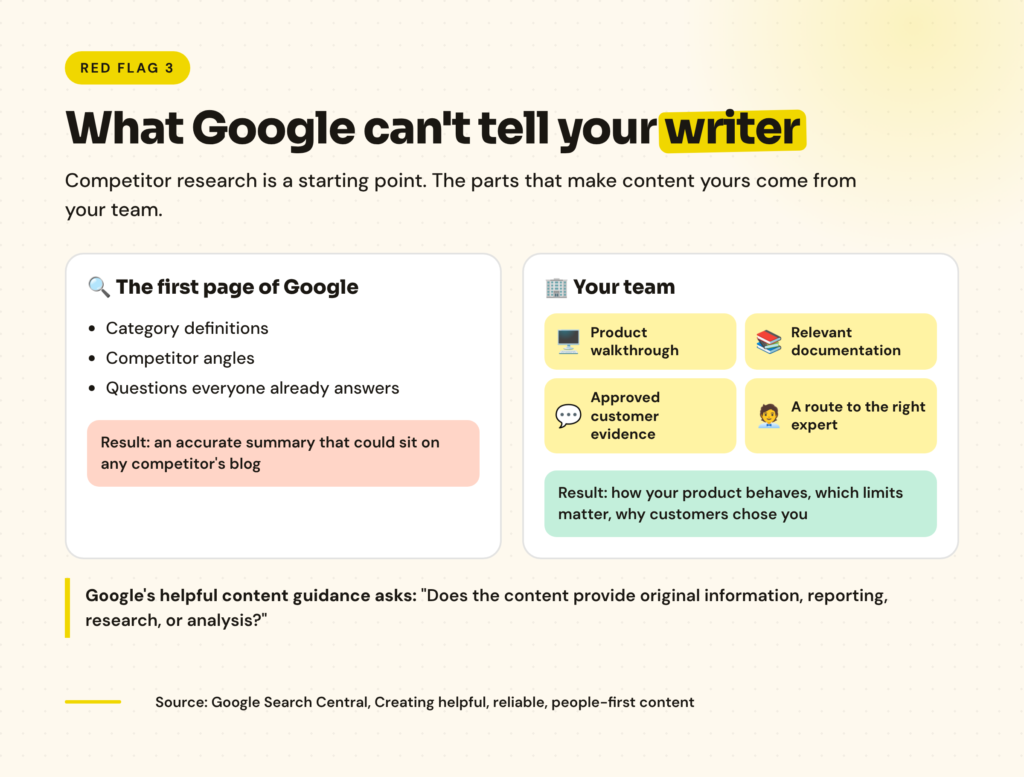
Google’s content-quality guidance explicitly asks whether content adds original information or analysis beyond its sources.
AI use belongs in this conversation too. Ask which tasks involve AI, how claims are verified, and what approval is needed before confidential material enters those tools.
Ask: “What will you learn from us that you couldn’t learn from the first page of Google?”
4. “SEO and AI visibility” have no defined work behind them
Watch for: “Every article is fully SEO- and GEO-optimized.”
Ask the agency to unpack that sentence.
Does it include search-intent research, internal links, metadata, product examples, technical recommendations, or monitoring selected AI questions? Which changes will they implement, and which will they send to your developer?
A proposal should name the work and distinguish it from the hoped-for result.
“We’ll research buyer questions, improve the agreed pages, add relevant internal links, and monitor a defined set of prompts across the agreed AI platforms.”
That is something you can inspect.
Treat guaranteed first-place rankings as a serious warning. Google’s hiring guidance specifically advises against providers promising first place.
For Google AI Overviews and AI Mode, Google also says there are no special additional optimizations required, and meeting its requirements doesn’t guarantee inclusion. That guidance concerns Google’s features; it doesn’t establish how every AI assistant selects sources.
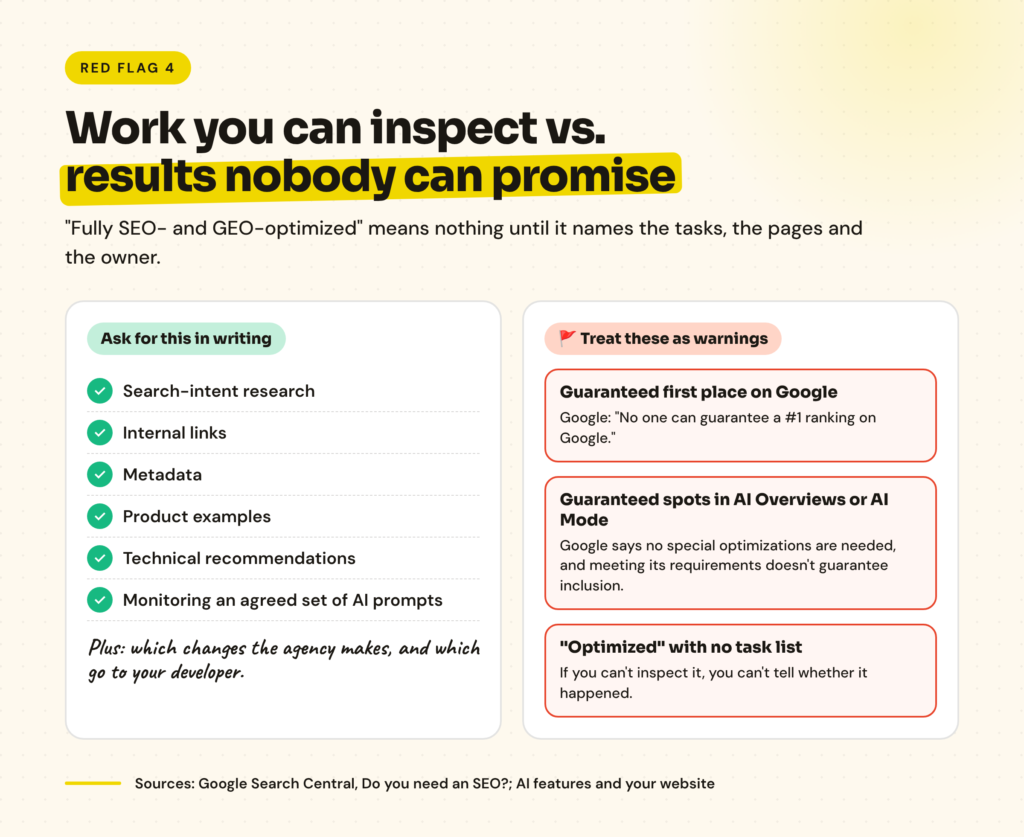
Ask: “What will you change, where will you change it, and what evidence will show whether it helped?”
5. “Delivered” leaves half the work on your desk
Watch for: “Four publication-ready articles per month.”
Publication-ready according to whom?
A finished draft can still need screenshots, image permissions, formatting, internal links, metadata, CMS entry, and a final check on the live page.
Writing-only engagements can work perfectly well. The problem is buying one while expecting the agency to own publishing.
Distribution needs the same clarity. “Social support” might mean three suggested captions. You might be expecting designed posts, scheduling, and reporting.
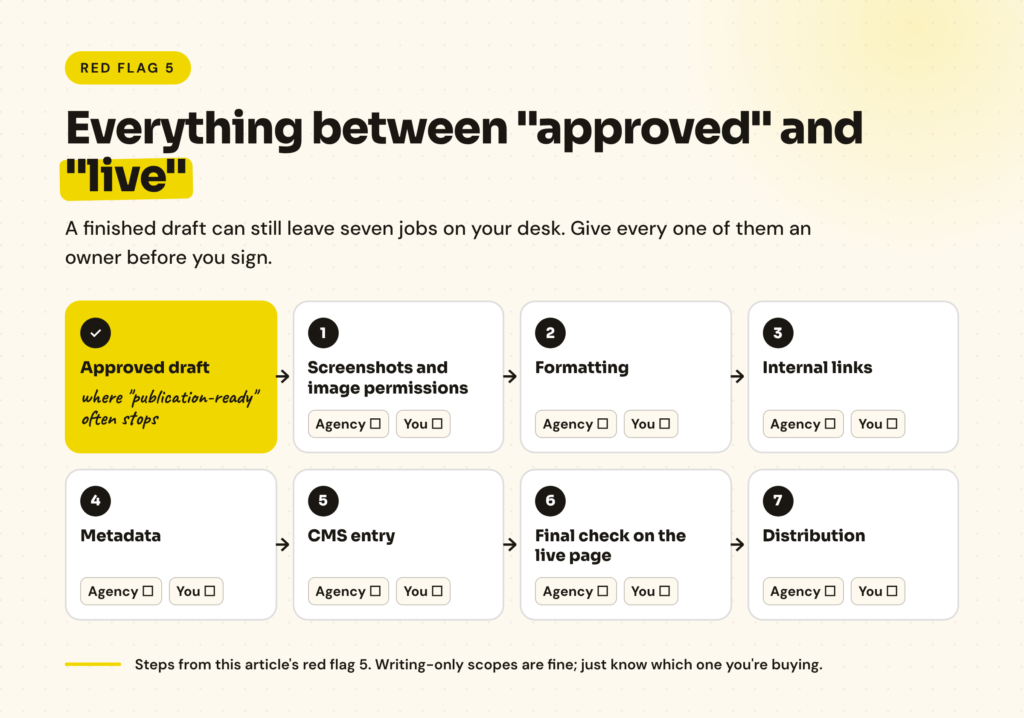
Ask for a handoff table:
| Task | Agency owns | Your team owns |
|---|---|---|
| Research and drafting | Named deliverables | Product access and answers |
| Screenshots and visuals | Agreed assets | Any excluded design work |
| CMS publishing | Included or excluded | Named publishing owner |
| Distribution | Specific formats and channels | Approvals and excluded activity |
Ask: “Walk us through everything that happens between an approved draft and a live, checked page.”
Our content distribution playbook can help you identify the work that needs an owner after publication.
6. Revisions sound generous until you need one
Watch for: “Two revision rounds included.”
That may be enough. You still need to know what counts as a revision.
Correcting the wrong product feature is different from changing the audience after approving the brief. A useful agreement explains both situations.
For example:
“The scope includes two rounds of consolidated feedback against the approved brief. Corrections to agency-introduced factual errors don’t consume a revision round. A change of audience, argument, or asset type may require a revised scope.”
That’s an illustrative arrangement, not a universal rule. Agree on one that fits the work.
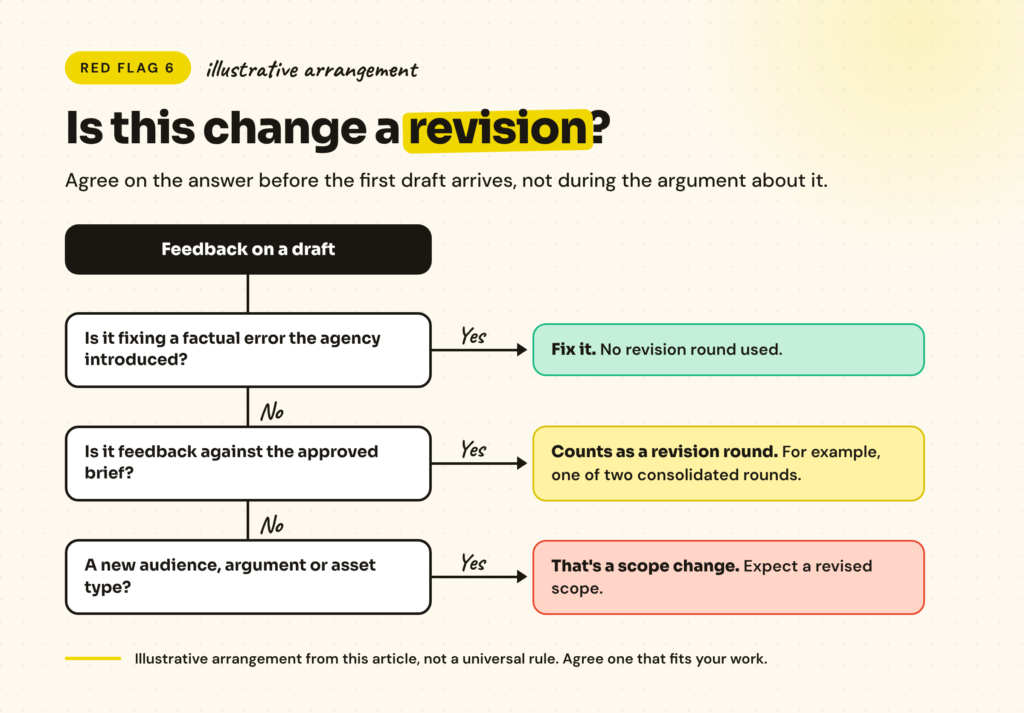
Your responsibilities need defining too. Who collects internal feedback? How long do reviewers have? What happens to the schedule if the subject expert disappears for two weeks?
Ask: “If the first draft misses the approved brief, how do you fix it—and does that count against our revision allowance?”
7. Reporting celebrates activity without helping you make decisions
Watch for: “Monthly reports covering articles delivered, keyword rankings, and organic traffic.”
Those numbers have a place. They don’t explain whether the content is reaching suitable buyers or helping them take the next step.
The proposal should distinguish delivery reporting from business performance. It should also acknowledge what the agency cannot measure without your help.
A comparison page might be evaluated through relevant visits, demo requests, and sales feedback. A customer story may be useful because sales sends it during active deals. Neither should be judged only by total traffic.
Even analytics needs definitions. Google Analytics distinguishes lead submission from lead qualification. Counting a form fill doesn’t establish that the person is a suitable prospect.
Ask: “What decision will your report help us make, and what data do you need from us?”
Our guide to SaaS content marketing metrics explains the reporting questions worth settling early.
8. The retainer is clear; the total cost isn’t
Watch for: “Content program: $4,000 per month.”
That number becomes useful once you know what sits around it.
Are onboarding, interviews, illustrations, software, CMS work, and rush requests included? Does a case study replace a blog post or cost extra? Is there a minimum commitment?
Then consider your own team’s time. A lower fee may come with substantial work in briefing, editing, project management, and publishing.
For an illustrative comparison:
| Cost | Proposal A | Proposal B |
|---|---|---|
| Monthly fee | $3,000 | $4,000 |
| Publishing | $500 extra | Included |
| Agreed visuals | $500 extra | Included |
| Total agency spend | $4,000 | $4,000 |
The headline difference disappeared before you considered internal time.
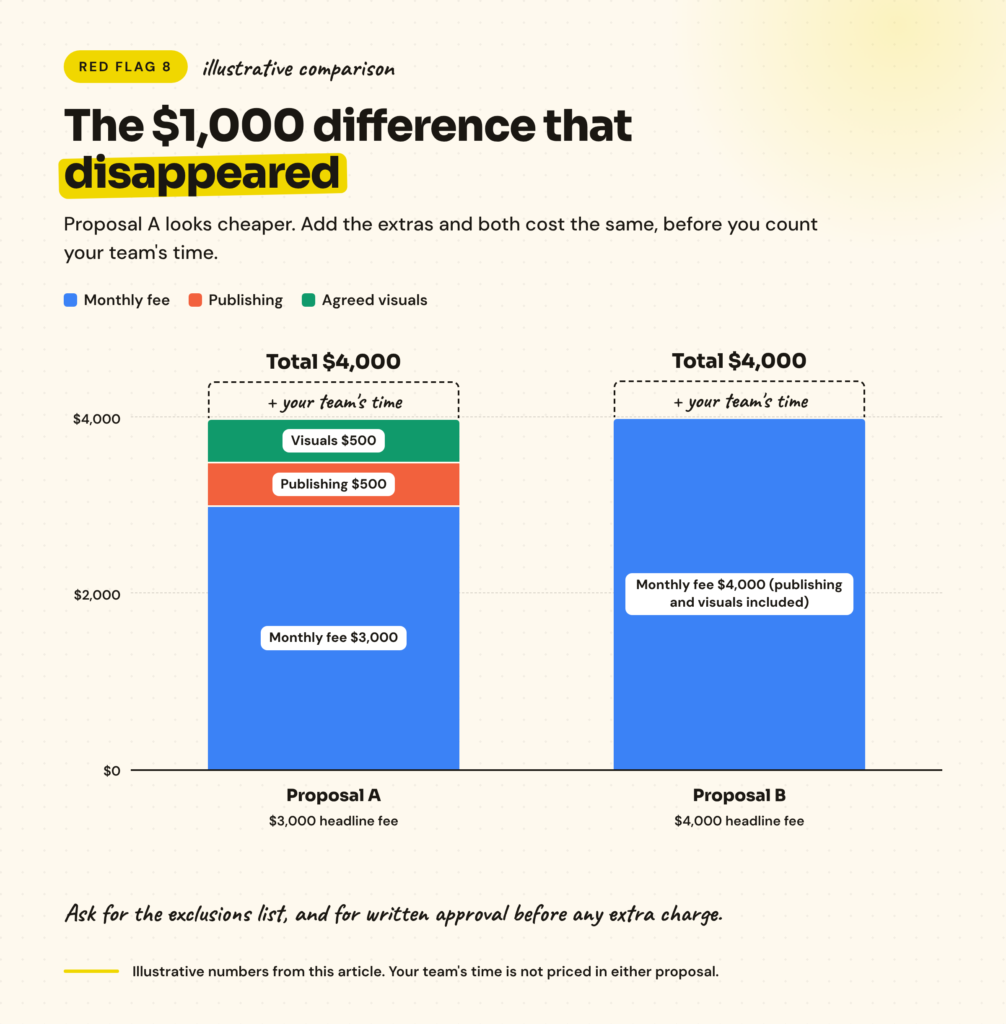
Ask for exclusions and the process for approving additional charges. A clear “this costs extra” is useful information.
Ask: “What could increase our invoice, and will you get written approval before doing that work?”
For the wider budgeting questions, see what content marketing costs for B2B SaaS.
9. Nobody has explained what happens when the engagement ends
Watch for: “We’ll discuss handover if that becomes necessary.”
Discuss it now, while everyone is enthusiastic.
Ask what you’ll receive, in which formats, and when. Include editable drafts, commissioned visuals, research, approved briefs, content plans, and relevant reporting.
Separate bespoke work from licensed assets and the agency’s existing templates. Ask the agreement to state the usage rights, ownership arrangements, and any payment conditions for each.
Also clarify account access. If reporting sits in the agency’s dashboard, can you export the underlying data? If it manages publishing, how will access be removed and unfinished work transferred?
A longer engagement can be sensible. It should come with a clear term, notice process, and handover plan.
Ask: “If we stop after the agreed term, what exactly do we keep, what gets transferred, and what remains unfinished?”
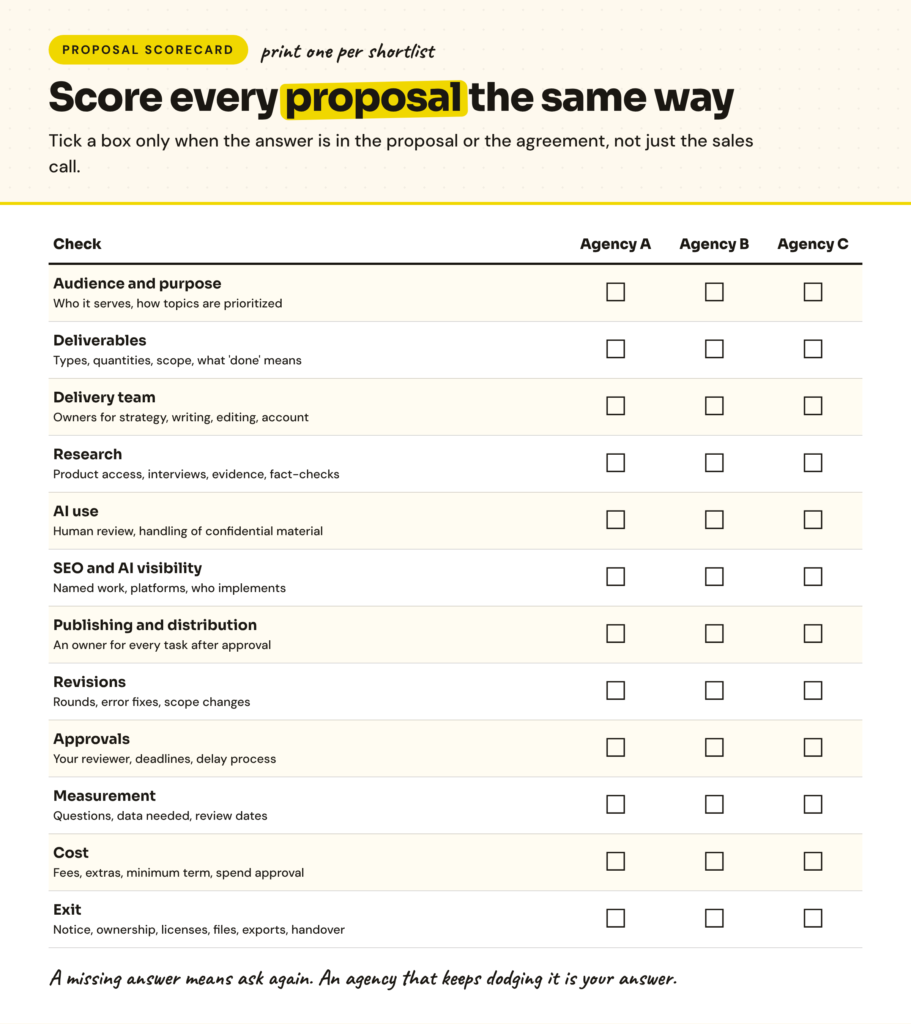
Copy this content agency proposal checklist
Use this for every shortlisted provider. Mark an item complete only when the answer appears in the proposal or accompanying agreement.
- Audience and purpose: The agency explains who the content serves and how topics will be prioritized.
- Deliverables: Asset types, quantities, scope boundaries, and completion criteria are clear.
- Delivery team: Strategy, writing, editing, and account responsibilities have named owners or clearly defined roles.
- Research: Product access, interviews, evidence, and fact-checking responsibilities are agreed.
- AI use: The workflow explains human review and handling of confidential material.
- SEO and AI visibility: Specific work, platforms, and implementation responsibilities replace vague promises.
- Publishing and distribution: Every task after draft approval has an owner.
- Revisions: Included rounds, error corrections, and scope changes are defined.
- Approvals: Your reviewer, feedback deadlines, and delay process are agreed.
- Measurement: Reports include useful performance questions, data requirements, and review dates.
- Cost: Fees, extras, minimum commitment, and approval for additional spending are explicit.
- Exit: Notice, ownership, licenses, editable files, data exports, and handover are documented.
A missing answer is a reason to ask for clarification. An agency that keeps avoiding the answer gives you a stronger reason to move on.
Before you sign, ask for one worked example
Pick one real content need. A comparison page, a customer story, or an article that needs rewriting will do.
Ask each agency to explain how it would approach that piece: the research, required inputs, deliverables, review process, publishing work, and intended next step for the reader. You’re asking for a walkthrough of the service, not a free finished article.
You’ll learn more from that conversation than from another slide about “full-funnel growth.”
At LymLyt, we help B2B SaaS teams plan, create, improve, and publish content. You can see our plans and what they include, then bring a specific need to the conversation.
Start with the piece your team keeps putting off. Agree on what “done” means before anyone starts writing.

Rashmita is content marketer with 8 years of experience building and growing SaaS brands. Now she tests various AI tools for marketers and shares her feedback on this blog, LinkedIn, Instagram, and YouTube.