B2B Marketing Budget Allocation: How to Split Your 2027 Budget
Budget season is here, and the number probably isn’t moving.
Gartner’s 2026 CMO Spend Survey found marketing budgets at 7.8% of company revenue, up from 7.7% the year before. More than half of CMOs, 56%, said they don’t have the budget to deliver their 2026 strategy (Gartner).
So B2B marketing budget allocation is the real lever. Not how much you get, but where it goes. This guide covers the benchmarks, where budgets actually go, and a 5-step method to split your 2027 budget by job, stage and channel.
How much B2B companies spend on marketing
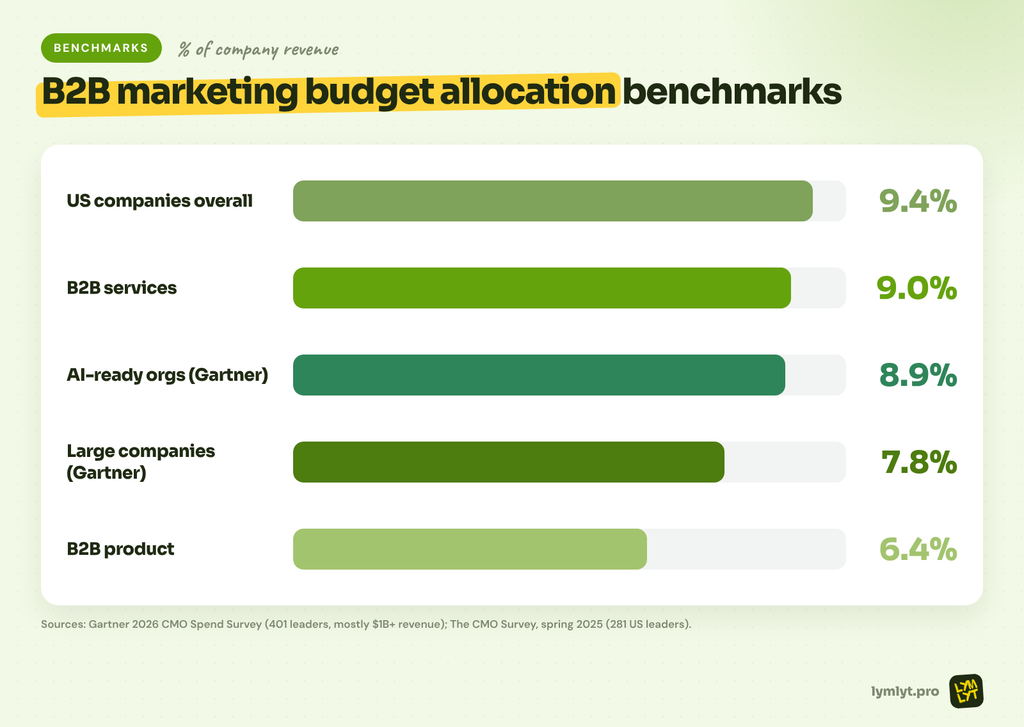
Two surveys give the best benchmarks, and they measure different companies.
| Benchmark | Marketing budget as % of revenue | Source |
|---|---|---|
| Large companies (mostly $1B+ revenue), 2026 | 7.8% | Gartner CMO Spend Survey, 401 leaders |
| AI-ready organizations, 2026 | 8.9% | Gartner CMO Spend Survey |
| US companies overall, 2025 | 9.4% | The CMO Survey, 281 leaders |
| B2B services companies, 2025 | 9.0% | The CMO Survey |
| B2B product companies, 2025 | 6.4% | The CMO Survey |
Sources: Gartner and The CMO Survey, spring 2025 edition.
Use these as a sanity check, not a target. A $5M ARR SaaS company trying to grow 80% a year won’t look like a $5B industrial firm protecting share. For early-stage numbers, see our guide on how $5M ARR founders should budget for content marketing.
Where B2B marketing budgets actually go
- Paid media is the biggest line. In Gartner’s 2025 survey, paid media took 30.6% of marketing budgets, about 2.4% of company revenue. Gartner noted media inflation means CMOs get less for every dollar (Business Wire).
- AI is now a budget line. CMOs put an average of 15.3% of marketing budgets toward AI in 2026, and AI-ready organizations put in 21.3% (Gartner).
- Agencies and headcount are under pressure. In 2025, 39% of CMOs planned to cut agency budgets and 39% planned to reduce labor costs. 22% said generative AI had already reduced their reliance on external agencies for creativity and strategy (Business Wire).
- Digital keeps growing faster than the total. The CMO Survey found overall marketing spend up 3.3% over the prior year, and digital marketing spend up 7.3% (The CMO Survey).
The pattern: flat budgets, more paid media inflation, more AI, fewer people and agencies. That’s a recipe for spending more on capture and less on the work that creates demand.
Allocate by job, not by channel
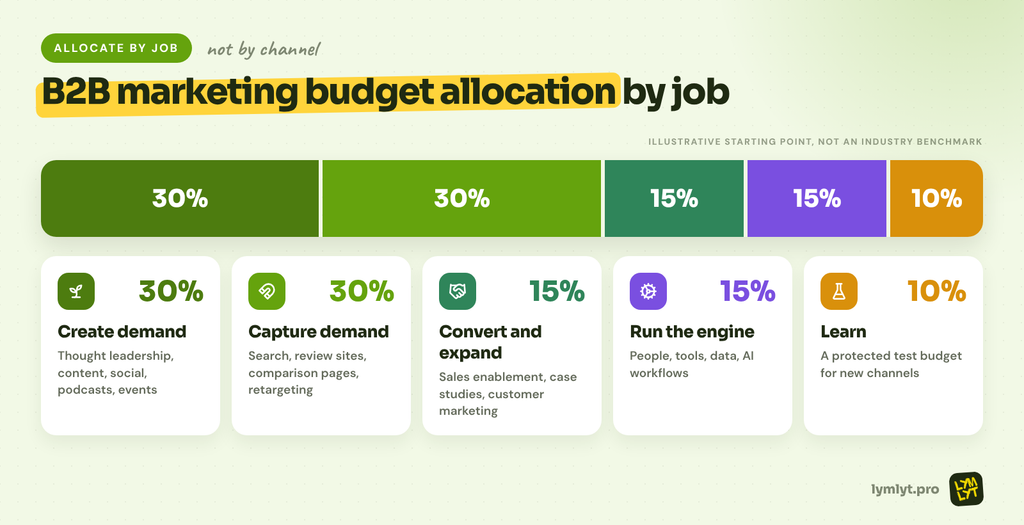
Channels change every year. The jobs don’t. Every B2B marketing budget has to fund five jobs:
- Create demand with buyers who aren’t in market yet: thought leadership, content, social, podcasts, events
- Capture demand from buyers who are ready now: search, review sites, comparison pages, retargeting
- Convert and expand: sales enablement, case studies, customer marketing
- Run the engine: people, tools, data, AI
- Learn: a protected test budget for new channels and formats
The split between the first two matters most. Les Binet and Peter Field’s analysis for the B2B Institute found B2B brands grow best with roughly 46% of budget on brand building and 54% on activation (LinkedIn). Our guide to demand generation vs demand capture explains why most teams sit far below that.
How to build your B2B marketing budget in 5 steps
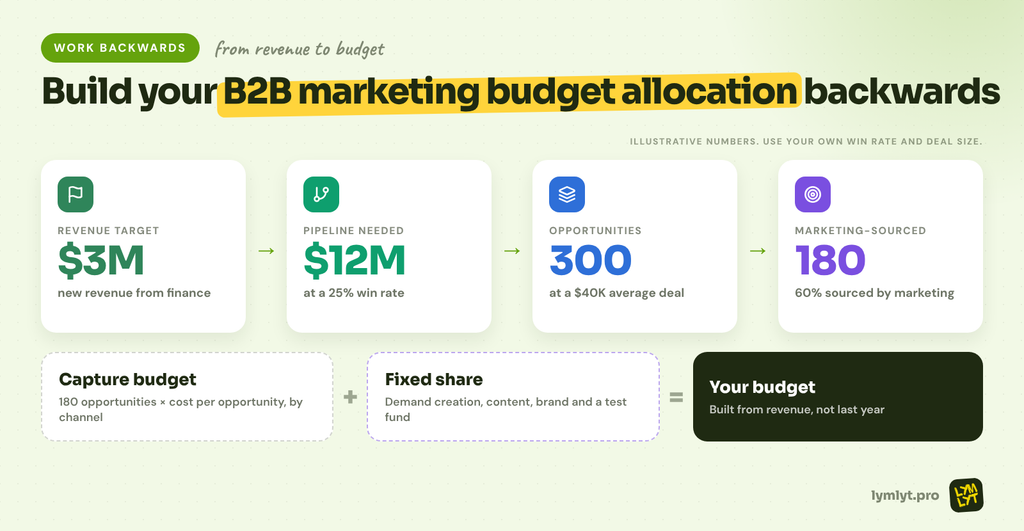
Work backwards from revenue, not forwards from last year’s spreadsheet.
Step 1: Start with the revenue target
Take next year’s new-revenue target from finance. That’s the number marketing’s budget exists to serve.
Step 2: Turn it into pipeline
Divide by your win rate. If you need $3M in new revenue and win 25% of opportunities, you need $12M in pipeline. Then agree what share marketing sources. Our guide to sales and marketing alignment covers how to set that number together.
Step 3: Turn pipeline into opportunities
Divide by average deal size. $12M at a $40,000 average deal is 300 opportunities. If marketing sources 60%, that’s 180.
Step 4: Price each opportunity by channel
Use last year’s cost per opportunity by channel. Fund the channels that produce opportunities at a cost you can afford, up to the point where they stop scaling. Our list of B2B marketing attribution tools helps get that number, and our guide to the dark funnel covers what it misses.
Step 5: Add the jobs that don’t show up in last-touch data
Demand creation, content and brand rarely win on last-click cost per opportunity. Fund them anyway, as a fixed share. Then protect a test budget so next year’s channels have a chance to prove themselves.
The numbers in steps 2 and 3 are illustrative. Use your own win rate and deal size.
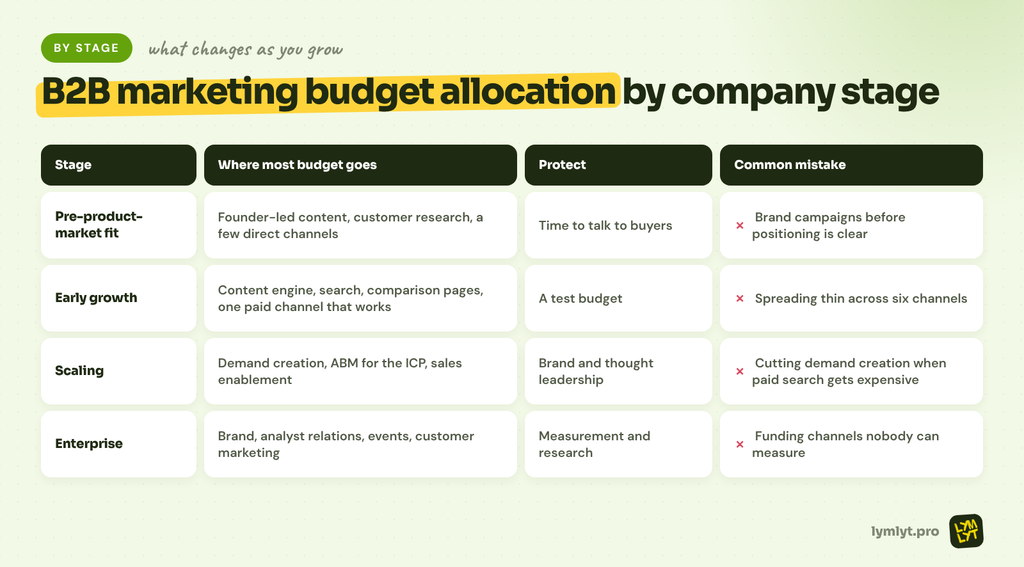
B2B marketing budget allocation by company stage
| Stage | Where most budget goes | What to protect | Common mistake |
|---|---|---|---|
| Pre-product-market fit | Founder-led content, customer research, a few direct channels | Time to talk to buyers | Paying for brand campaigns before positioning is clear |
| Early growth | Content engine, search, comparison pages, one paid channel that works | A test budget | Spreading thin across six channels |
| Scaling | Demand creation, ABM for the ICP, sales enablement | Brand and thought leadership | Cutting demand creation when paid search gets expensive |
| Enterprise | Brand, analyst relations, events, customer marketing | Measurement and research | Funding channels nobody can measure or defend |
6 rules for B2B marketing budget allocation in 2027
1. Fund content as an asset, not a campaign. A good comparison page or case study works for years. Budget for a content operations engine, not one-off posts, and prioritize the pages that sell: comparison pages, case studies and lead magnets that still work.
2. Put AI on the budget with process first. Gartner found 70% of CMOs say their internal processes aren’t mature enough to scale AI (Gartner). Build AI marketing workflows before buying more seats.
3. Budget for AI search visibility. Buyers now shortlist in AI answers. Fund the comparison pages, original research and third-party mentions that get you cited. Start with our AI visibility guide for B2B SaaS and run an AI visibility audit first.
4. Fund people, not just logos. Personal profiles out-engage company pages on LinkedIn. Our employee advocacy statistics show why the budget should follow, and why B2B marketing now lives across LinkedIn, YouTube and Instagram. HubSpot took this to the extreme and bought its audience outright.
5. Decide what you’d cut first, in advance. Budgets get cut mid-year. Rank your lines now, so a cut hits the weakest channel instead of the slowest-to-prove one.
6. Report spend in finance language. Pipeline-to-spend, cost per opportunity and CAC payback defend a budget far better than impressions. See how to prove marketing ROI.
Agency, in-house or both?
With 39% of CMOs cutting agency budgets, the question isn’t whether to use outside help, it’s where. Keep strategy, positioning and customer knowledge in-house. Buy specialist execution where hiring is slow or expensive: SEO, content production, design, paid media.
If you’re comparing options, start with our lists of B2B SaaS content marketing agencies, AI SEO agencies, AI marketing agencies, thought leadership agencies and social media and influencer agencies, or read how to grow SaaS marketing without a full-time hire.
Frequently asked questions
What percentage of revenue should a B2B company spend on marketing?
Large companies averaged 7.8% in Gartner’s 2026 survey. B2B product companies reported 6.4% and B2B services companies 9.0% in The CMO Survey. Fast-growing SaaS companies often spend more.
How should I split my B2B marketing budget?
By job: create demand, capture demand, convert and expand, run the engine and test. Binet and Field’s B2B research suggests roughly 46% brand and 54% activation as a long-term balance.
How much of the marketing budget goes to paid media?
Paid media took 30.6% of marketing budgets in Gartner’s 2025 survey.
How much should go to AI?
CMOs allocated 15.3% of budgets to AI in 2026, per Gartner. Spend it on workflows with clear owners, not on tools nobody has time to set up.
The bottom line
B2B marketing budget allocation isn’t a spreadsheet exercise. It’s a decision about which jobs you fund when the total won’t move. Fund demand creation on purpose, price capture by cost per opportunity, and keep a test budget nobody’s allowed to raid.
If content is the line you need to fill, LymLyt’s plans are published, month to month, from $1,499/month. Build your plan in our pricing calculator.

Jay is the co-founder of LymLyt and an AI partnership consultant helping B2B SaaS companies grow through content strategy, SEO, and AI integration. He writes about content marketing, what makes B2B content convert, and how SaaS teams can build content systems that drive real pipeline.