$5M ARR Founders, How Should You Budget For Content Marketing
You have hit $5M ARR. The product works. Customers are staying. Now everyone is telling you to invest in content marketing. The questions pile up fast. What should your content marketing budget actually be? Who should you hire? Where do you start?
This post gives you a direct answer to each of those questions, with real numbers, real case studies, and a framework you can act on this week.
Why Content Marketing? (Spoiler: It Works)
At $5M ARR, paid acquisition is probably working but getting more expensive. You are competing for the same keywords and audiences as larger companies with larger budgets. Content marketing is how you build a channel that compounds over time rather than one that demands more spend to maintain the same output.
The numbers back this up. Content marketing costs 62% less than paid ads but delivers 3x the leads. Companies that blog generate 67% more leads than those that do not. These are not reasons to do content instead of paid. They are reasons to do content alongside it, so your CAC comes down as the organic channel matures.
Every B2B SaaS business needs a blog as a long-term growth asset. Not because it is cheap but because it is the only marketing channel that keeps working after you stop paying. A well-ranked post generates leads in month 18 the same way it did in month 6.
The other reason content matters at this stage: your buyers are doing research before they ever talk to sales. If your ICP is not reading your blog right now, it is not because they do not read. It is because the content you have is not written for them specifically.
SaaS brands like GrooveHQ scaled to $5M ARR by pivoting from ads to customer-centric content. The lesson is not that ads do not work. It is that content builds an asset ads cannot: a compounding source of qualified organic traffic that does not require a budget line every month to sustain.
Step 1: Set Your Budget (Let’s Crunch Numbers)
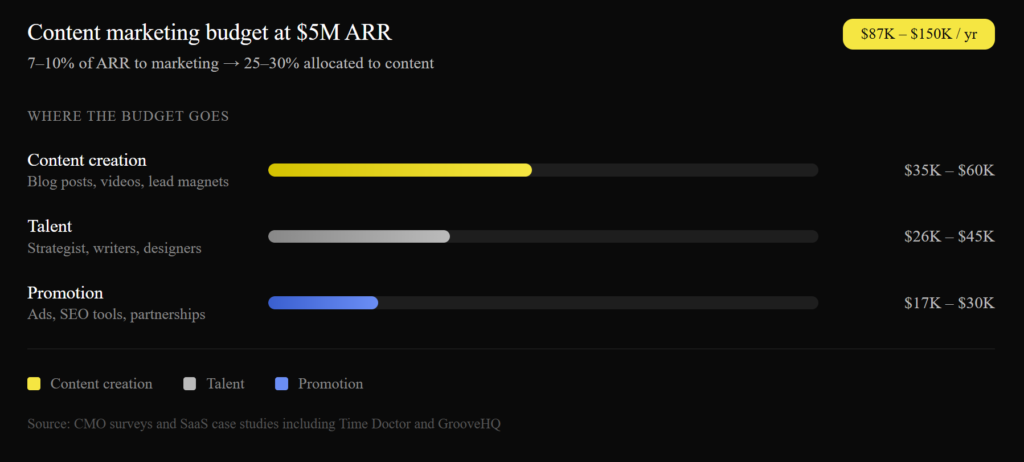
For a 5M ARR SaaS business, experts recommend allocating 7%-10% ($350K – $500K/year) of yearly revenue in marketing. Of that, 25%-30% (87K–$150K/year) should go into content marketing. Here’s how to split it:
| Category | Budget Range (annually) | What It Covers |
| Content Creation | $35K-$60K | Blog posts ($1K-$2K/post), videos ($500-2k/video), lead magnets (e.g., ebooks). |
| Promotion | $17K-$30K | Social ads, influencer partnerships, SEO tools (Ahrefs/SEMrush). |
| Talent | $26K-$45K | Fractional strategists ($2K-$8K/month), freelance writers, designers. |
Source: Data aggregated from CMO surveys and SaaS case studies like Time Doctor and GrooveHQ.
Pro Tip:
“Start with 2–4 high-quality blog posts per month and 1–2 lead magnets per quarter. Quality trumps quantity every time.”
— Alex Turnbull, CEO of GrooveHQ
Step 2: Build Your Team (In-House vs. Freelancers)
Hiring too fast? That’s a common mistake. For a $5M ARR business, start lean:
| Role | Cost (Monthly) | Why You Need Them |
| Fractional Strategist | $2K-$8K | Maps your content roadmap, aligns with business goals, and tracks ROI. |
| Freelance Writer | $500-$2K/post | Specializes in SEO or technical content (e.g., “How to Optimize SaaS Onboarding”). |
| Designer/Video Editor | $1K-$3K/project | Turns blogs into infographics, tutorials, or short-form videos. |
Source: Siege Media’s SaaS marketing benchmarks.
Keep strategy in-house or with a trusted partner. Outsource execution to specialists.
A real example of this working: Time Doctor spent $4.5K on a single ebook but drove 309 qualified leads over two years through gated content. Their approach was to outsource writing and design to niche specialists while keeping strategy and oversight internal. The result was high-quality content at a fraction of the cost of a full in-house team.
If you are evaluating whether to hire in-house or work with an agency, the full breakdown of agency vs freelancer vs in-house covers what nobody tells you about each option before you sign the contract.
Case Study:
Time Doctor spent $4.5k on a single ebook but drove 309 qualified leads in 2 years through gated content. Their secret? Outsourcing to niche writers and designers while keeping strategy in-house.
Also read: Why Every Business Needs a Blog (And How to Do It Right)
Step 3: Focus on High-ROI Content Formats
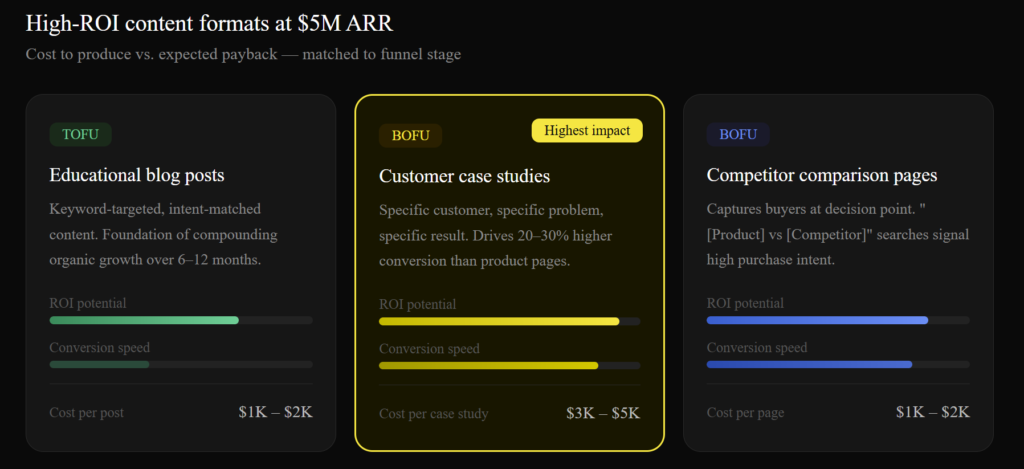
Not all content delivers equal returns. At $5M ARR, these three formats consistently give the best payback.
Educational blog posts
The foundation of organic growth. Keyword-targeted, intent-matched, internally linked. Time Doctor’s blog drove over 10,000 monthly visitors using this exact format, targeting specific pain point queries their ICP was already searching for.
SEO writing tips that actually rank start with understanding what the reader needs, not just which keyword to target. A post written for a specific person with a specific problem will outperform a post optimised for a keyword every time.
Cost: $1K to $2K per post for quality execution.
Customer case studies
The most underused format at this stage. A case study with a specific customer, a specific problem, and a specific measurable result is more persuasive than any amount of feature copy. According to MarketingSherpa, case studies drive 20 to 30% higher conversion rates than standard product pages. They also work as sales enablement. Your team can send them to prospects who are evaluating you against a competitor.
Cost: $3K to $5K for a properly written and designed case study.
Competitor comparison pages
Competitor comparison pages are the most underrated asset in B2B SaaS. Someone searching “[Your Product] vs [Competitor]” is close to a buying decision. If you are not ranking for that query, your competitor is answering it on your behalf.
Cost: $1K to $2K per page, potentially one of the highest-converting assets on your site.
Step 4: Build the Right Content System
Budget and team are inputs. The system is what determines whether those inputs generate pipeline or just content.
Every post needs a brief before a writer touches it. A proper content brief includes the reader, the argument, the funnel stage, the CTA, and the internal links. Without it, writers make assumptions. Assumptions lead to rewrites. Rewrites eat budget.
Every post needs to connect to a cluster. Isolated posts do not build topical authority. Topic clusters vs keyword lists explains exactly why a cluster-based approach outperforms targeting individual keywords. The structure is what tells Google your site genuinely covers the subject.
Every post needs distribution. Publishing is not distributing. A real SaaS content distribution playbook treats every post as an asset to be actively promoted across email, LinkedIn, and relevant communities for 30 to 60 days after publication.
Step 5: Measure What Actually Matters
Most content teams at this stage measure traffic and call it success. Traffic is a leading indicator. Pipeline is the outcome.
The SaaS content marketing metrics that actually matter at $5M ARR are:
- Content-attributed demo requests and trial signups
- Organic traffic growth (aim for 20 to 30% year-on-year)
- Lead-to-customer conversion rate from organic (5 to 10% is healthy for SaaS)
- CAC payback period for content-sourced customers
Liam Martin, Co-Founder of Time Doctor, put it clearly: “We killed underperforming content and doubled down on tutorials. Our blog now drives 30% of new MRR.”
That result came from measuring the right things and being willing to cut what was not working. Set up UTM parameters before you start distributing anything. Build a simple dashboard in GA4 that shows organic traffic, conversion by page, and pipeline influenced by content.
“We killed underperforming content and doubled down on tutorials. Our blog now drives 30% of new MRR.”
— Liam Martin, Co-Founder of Time Doctor
Common Mistakes at This Stage
Spending on volume before strategy. Publishing 8 posts a month without a clear cluster strategy or ICP focus is the fastest way to waste a content budget. Most B2B blogs fail at exactly this point. More content without more strategy is just more noise.
Ignoring the full funnel. Most $5M ARR SaaS teams publish TOFU content and wonder why it does not convert. Mapping your content funnel to demos requires MOFU and BOFU content that moves a warm prospect toward a decision. TOFU brings them in. BOFU closes them.
Measuring too early. Content compounds over 6 to 12 months. A post published today will rank higher in month 9 than month 1. Set realistic expectations with leadership before you start and commit to a minimum 6 month window before evaluating ROI. As Alex Turnbull says: “Content compounds, but only if you are patient.”
Not building internal links. Every post published without links to and from other posts on your site is a missed opportunity. Internal linking is what activates the authority you are building with each new piece of content.
Final Takeaway: Start Small, Scale Fast
You do not need a 10-person team or a $500K budget to win at content marketing at $5M ARR. You need a clear strategy, the right structure, and a system that connects every piece of content to pipeline.
Start with a fractional strategist to build the roadmap. Add 2 to 3 specialist freelancers for execution. Focus on the 3 to 4 content formats that deliver the highest ROI for your specific ICP. Measure pipeline, not pageviews. Reinvest in what is working.
Content compounds. But only if the system behind it is built correctly from the start.
If you want help building that system, let’s talk.

Rashmita is content marketer with 8 years of experience building and growing SaaS brands. Now she tests various AI tools for marketers and shares her feedback on this blog, LinkedIn, Instagram, and YouTube.