Migration Prompts: What AI Tells Buyers About Leaving You
Migration prompts are the highest-intent question a buyer can ask. Nobody researches how to move off a tool they are happy with. If someone is asking an AI engine how to leave your competitor, they have already decided. If they are asking how to leave you, so have they.
We ran 32 migration prompts across four engines: two SEO tools, two CRMs, in both directions, plus four questions about difficulty and loss. It is the evaluation-stage work that sits under AI visibility generally.
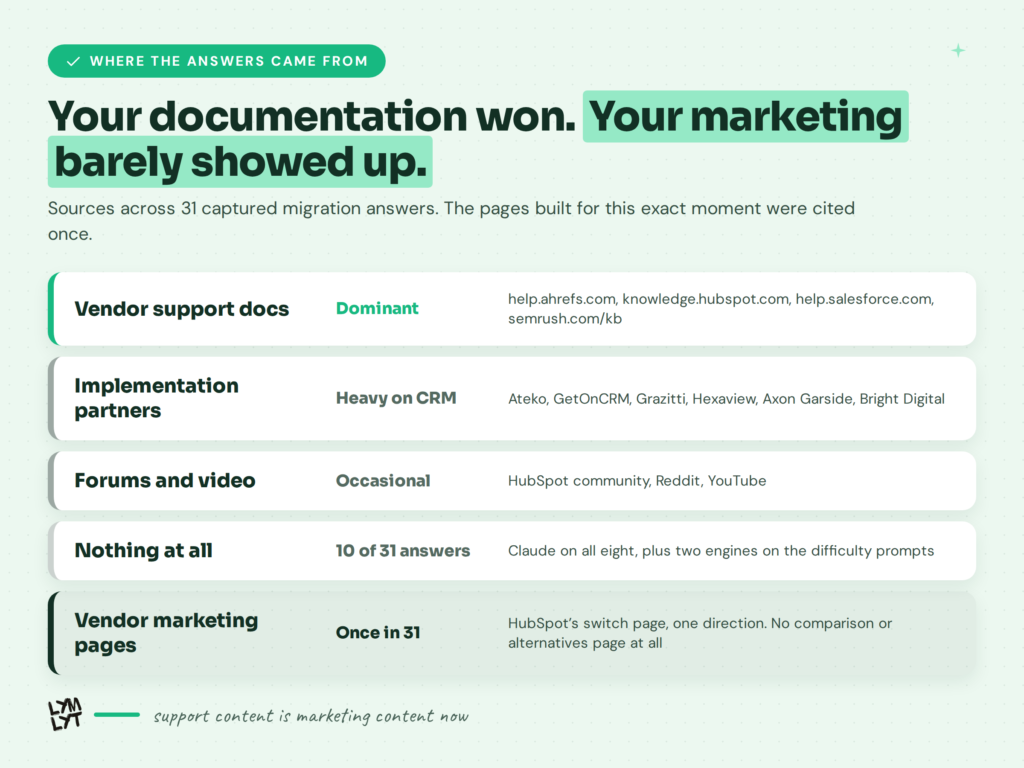
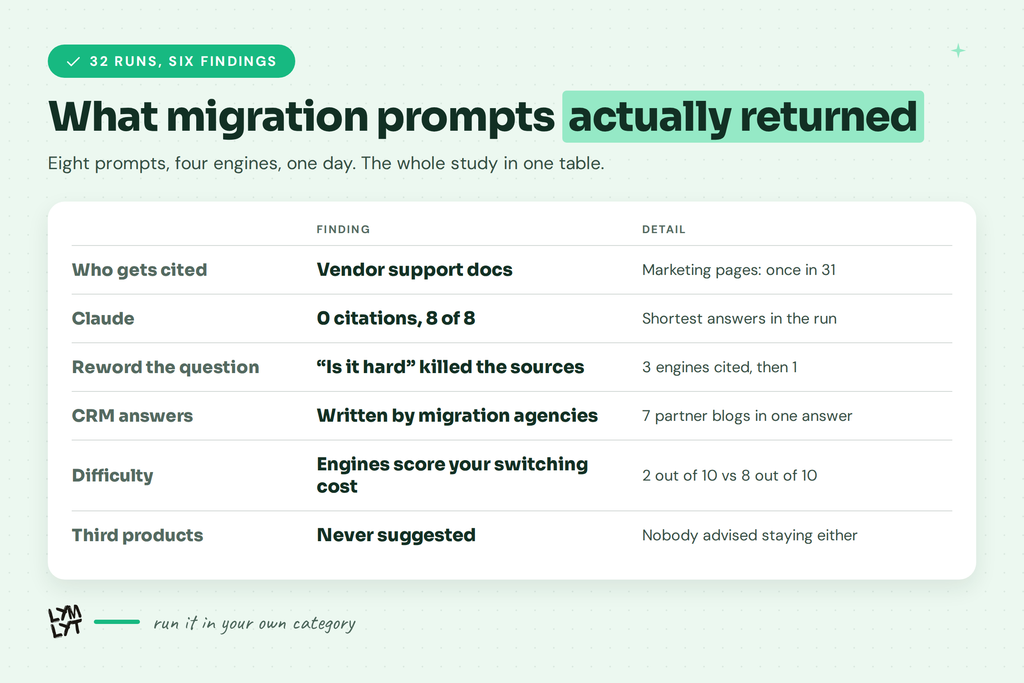
The headline finding is the one we did not expect. Vendor documentation dominated these answers, and vendor marketing pages never appeared once. Not a comparison page, not a switching landing page, not a single piece of the content most companies spend their budget on.
What we ran
Eight migration prompts, four engines, 32 runs. Ahrefs and Semrush in both directions, HubSpot and Salesforce in both directions, then four questions on whether the switch is hard and what a buyer loses by leaving.
The engines were ChatGPT, Claude, Google AI Mode and Perplexity, free tier, default model, logged out, one prompt per fresh conversation. They retrieve and cite differently, which this run shows more starkly than either of the previous two.
This is the migration run of the shortlist prompts framework, and the last of the four types. The comparison run is here, the pricing run is here, and the method is written up as a repeatable audit.
One gap, stated up front. Prompt seven, “what do I lose if I leave HubSpot”, has no Google AI Mode capture. That run is missing rather than excluded, so the counts below are out of 31 where they concern all four engines.
We also wrote down a hypothesis before starting: that answers would come from support forums and community threads, because almost nobody publishes a guide to leaving a competitor. Half right, and the half that was wrong is the more useful half.
Finding one: migration prompts run on support docs, not marketing
Across every prompt that produced citations, the sources were overwhelmingly vendor knowledge bases.
help.ahrefs.com. knowledge.hubspot.com. help.salesforce.com. developers.hubspot.com. semrush.com/kb. ChatGPT built its entire Ahrefs to Semrush answer on Semrush knowledge base articles about CSV import, position tracking and site audit configuration.
Not one engine cited a vendor comparison page, an alternatives page or a switching landing page. The pages built for this exact moment were absent from answers about that exact moment.
That is the opposite of what we found on comparison prompts, where vendor-owned pages won when engines cited anything, and different again from our wider citation study, where third parties carried most of the load. Different question, different corner of your site.
The implication is direct. Your documentation is doing marketing work whether or not anyone in marketing reads it. If the support article on exporting data is thin, out of date or buried, you are absent from the highest-intent conversation in your category. It is the same structural point as llms.txt and crawlable formatting, applied to the part of the site marketing never touches.
Finding two: Claude cited nothing, eight times out of eight
Claude produced an answer for every prompt and a source for none of them.
It was also consistently the shortest. Between 154 and 458 words, against ChatGPT’s 498 to 1,826. On the first prompt it gave 154 words with no links while ChatGPT gave over a thousand with five knowledge base citations.
The answers were not bad. On “is it hard to migrate from Ahrefs to Semrush” it replied “not technically hard, but it takes real time and some data will shift in ways you can’t control”, which is the most honest sentence any engine produced in the run. It just came from nowhere a buyer can check.
This matches what we found on comparison queries, where Claude cited zero sources across five prompts, and on pricing, where it could not find our company at all. Three studies, one consistent pattern.
For anyone building an AI visibility programme, that is a strategic fact rather than a complaint. On one of the four major engines, there is no citation to win. What decides the answer is what the model already absorbed, which is a slower and more diffuse problem than publishing a page, and closer to why sites fail to show up in ChatGPT at all.
Finding three: rephrasing the question deleted the sources
This is the finding worth the whole study.
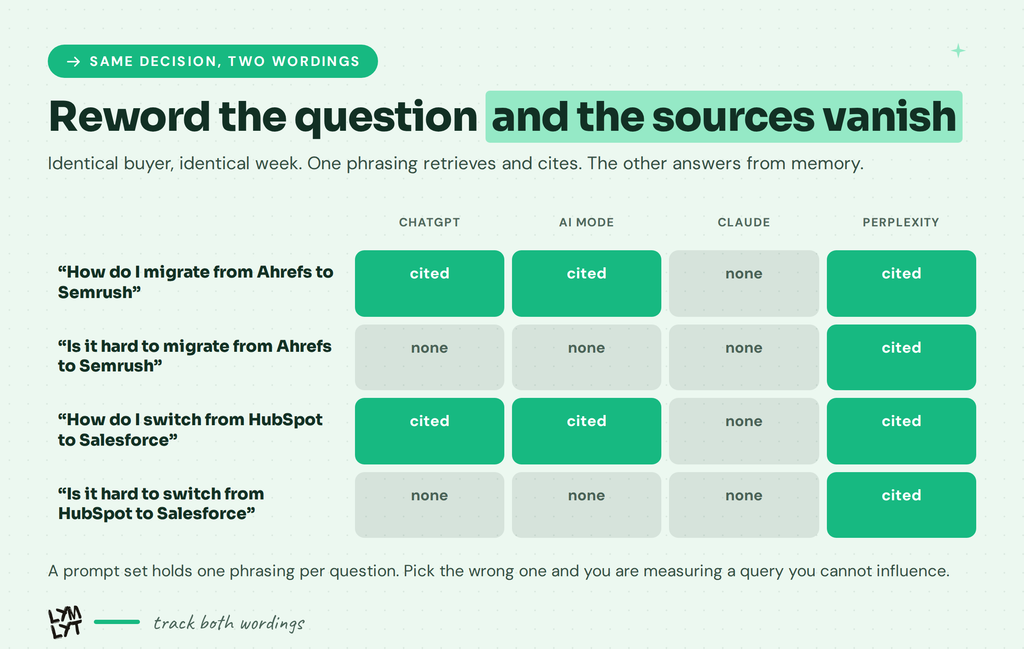
“How do I migrate from Ahrefs to Semrush” produced citations from ChatGPT, Google AI Mode and Perplexity. “Is it hard to migrate from Ahrefs to Semrush” produced citations from Perplexity alone. ChatGPT and AI Mode both answered at length, confidently, with no sources whatsoever.
The same collapse happened on the CRM pair. “How do I switch from HubSpot to Salesforce” drew on Salesforce and HubSpot documentation plus seven partner blogs. “Is it hard to switch from HubSpot to Salesforce” drew on nothing, in two of four engines.
Same buyer, same decision, same week. One phrasing retrieves and cites. The other answers from memory.
Nobody’s AI visibility score captures this, because a prompt set contains one phrasing per question. If yours uses the how-to form, you are measuring a version of the query where your documentation can win. If it uses the is-it-hard form, you are measuring a version where nothing you publish this quarter will move the answer.
Keyword tools will not help you spot the difference either, since both phrasings show near-zero volume in a research tool. Track both phrasings of every prompt that matters. It is the cheapest change you can make to a prompt set and it exposes the difference between a question you can influence and one you cannot.
Finding four: for CRM, the answer came from agencies
Google AI Mode’s HubSpot to Salesforce answer was assembled from Ateko, GetOnCRM, Grazitti, Hexaview, Radix2, the HubSpot community and a YouTube video. The reverse direction pulled Axon Garside, Bright Digital, Elefante RevOps and Uspeh.
Those are implementation partners. Companies that sell CRM migration services.
So the answer to “how do I leave HubSpot” is substantially written by firms whose business is being paid to move you. Not a conspiracy, just the shape of the content market: they publish the most detailed migration content because migration is what they sell. The same dynamic puts agency blogs and forums and video into answers where vendors assume they own the narrative.
Two things follow. If you are a vendor, the narrative around leaving your product is being authored by service firms with their own commercial interest. If you sell services, migration content is a live acquisition channel that almost nobody is deliberately working, which is the same gap we found in outreach and earned media.
It is also a cleaner version of the third-competitor pattern from the vs keywords teardown. There, a rival product intercepts the comparison. Here, a rival service intercepts the switch.
Finding five: the engines rate how hard it is to leave you
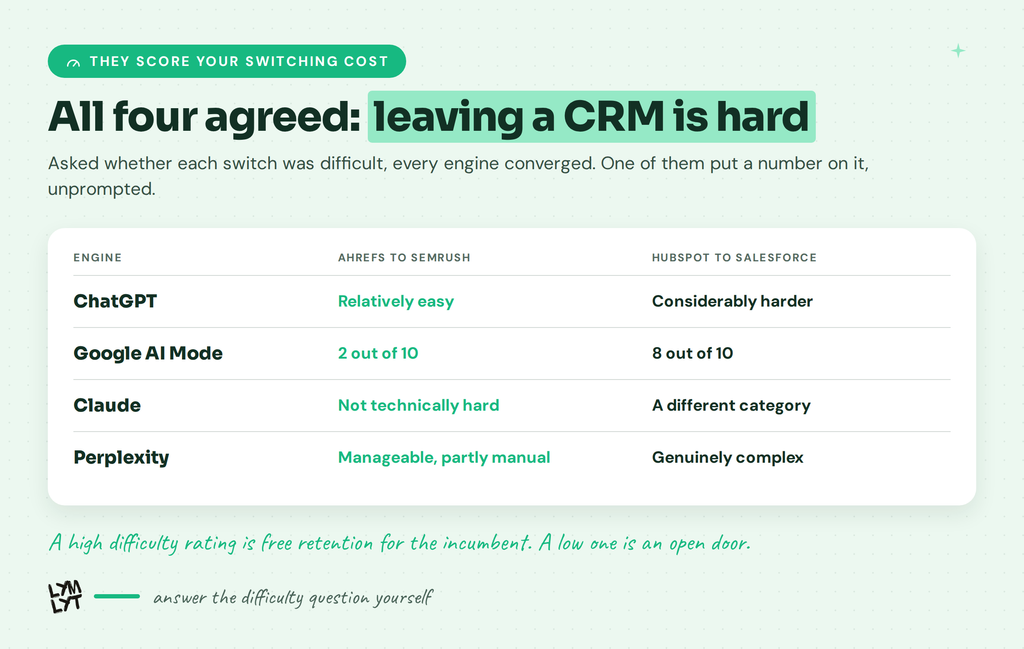
Google AI Mode gave numbers. Ahrefs to Semrush scored “2 out of 10” on difficulty. HubSpot to Salesforce scored “8 out of 10”, with the explanation that Salesforce enforces a rigid relational data model and demands extensive manual configuration.
All four engines converged on the same shape. The SEO tool switch is manageable and partly manual. The CRM switch is genuinely complex. ChatGPT put it as “considerably harder than Ahrefs to Semrush, because you’re migrating an actual CRM and business process”. Perplexity called it “moderately difficult for a small, simple CRM and genuinely complex for a mature operation”.
Read that as a vendor and it is switching-cost guidance delivered straight to someone considering leaving. A high difficulty rating is free retention. A low one is an open door.
Read it as a challenger and it is the objection you have to answer before anyone will move. If the engines are telling your prospects that leaving the incumbent is an 8 out of 10, your migration guide is not a nice-to-have. Switchers are also your best case study material, since they have already done the hard thing you are asking the next buyer to do.
Finding six: nobody suggested staying, and nobody named a third product
Worth recording because we expected otherwise.
Across 31 answers, no engine advised the buyer to reconsider and stay put. None introduced a third product as a better destination. Asked how to move from A to B, every engine helped with A to B.
That is a meaningful contrast with comparison prompts, where a third competitor frequently intercepts the question, and with pricing prompts, where one engine coached the buyer on how to spend less and then named a cheaper rival.
Migration answers are pure execution help. Once a buyer reaches this question, the engines stop selling and start assisting. Which is another way of saying the decision is already made, and the only remaining variable is whether the move is easy enough to follow through.
What to do about it
Write the switching guide, in both directions. How to move to you from each major rival, and honestly, how to move off you. The second one sounds mad and it is the page that gets cited, because it is the page the documentation-shaped answer is looking for.
Treat your knowledge base as marketing. This is generative engine optimisation applied to support content. Export instructions, data portability, API documentation. These were the cited pages in this run. If your support content is thin on leaving, you are invisible at the moment someone decides to arrive.
Answer the difficulty question explicitly. If engines are scoring your category 8 out of 10, publish the realistic timeline, what transfers, what does not, and who does the work. A vs page that ignores migration is answering half the question.
Track both phrasings. How-to and is-it-hard, for every rival that matters. They behave like different queries because they are, and any tracking tool will run both if you ask it to.
Then check who is writing it instead of you. If partner agencies own the migration narrative in your category, that is either a threat or a channel depending on which side of the table you sit.
Run it yourself
Eight prompts: how to move to you and away from you for your two closest rivals, then is-it-hard and what-do-I-lose for each.
Four engines, logged out, one prompt per fresh conversation, whole set in one sitting. Screenshot everything including the expanded source panel.
Log two extra columns beyond the standard audit fields: whether the answer names a real migration path, and whose documentation it is reading. Those two answer the whole question.
Then read your own knowledge base against what the engines quoted. In this run that gap was the finding.
FAQ
What are migration prompts? One of the four shortlist prompts, alongside comparison, alternatives and pricing. They are the questions a buyer asks when they have decided to move and are working out how.
Should we really publish a guide to leaving our product? It is the page most likely to be cited, and the buyer who wants to leave is leaving either way. A clear export path is also a trust signal for the buyer who is arriving.
Why did Claude cite nothing again? Consistent with our comparison and pricing runs. It answers from model knowledge rather than retrieval on these question types. Whether that is a deliberate product choice or a retrieval gap, we cannot say.
Is this the same as an alternatives page? No. An alternatives page gets you onto a shortlist. A migration guide helps someone who has already chosen, which is why it is answered by documentation rather than by marketing.
Is this sample big enough to act on? It is 32 runs on one day with one row missing. Treat it as a method to copy and a set of hypotheses to check in your own category, not a benchmark.
The highest-intent question in your category is being answered by your support documentation, by agencies that sell migrations, and in one engine by nothing you can see or influence. Very little of it by your marketing.
That is the job we do. See how we approach AI visibility and how we write comparison pages, look at our work, check pricing.

Jay is the co-founder of LymLyt and an AI partnership consultant helping B2B SaaS companies grow through content strategy, SEO, and AI integration. He writes about content marketing, what makes B2B content convert, and how SaaS teams can build content systems that drive real pipeline.