The SaaS Content Distribution Playbook: How to Turn Every Blog Into 10X More Traffic & Leads
Most SaaS founders think the hard work ends once they hit “publish” on a blog post. Without a robust SaaS content distribution strategy, even the best-written article will sit unread.
And in a world where SaaS competition is fierce and attention spans are short, distribution isn’t just optional. It’s a growth necessity.
Publishing a blog post is only half the job. The real challenge? Getting it in front of the right people, repeatedly, until it drives meaningful traffic, leads, and revenue.
Most SaaS companies pour weeks into creating great content, hit “publish,” and then move on to the next piece. The result? A handful of views, a spike in traffic that dies in days, and zero impact on the pipeline.
In reality, creating content is just 20% of the work. The other 80% is distribution, the process of turning one blog into a constant source of visibility and conversions across multiple channels.
In this playbook, we’ll break down exactly how to turn every blog into 10X more traffic, leads, and conversions using proven distribution tactics tailored for SaaS companies. From owned and earned channels to repurposing frameworks and advanced amplification tactics, you’ll learn exactly how to squeeze every drop of ROI from your content.
If you’re ready to stop letting your best ideas collect dust and start multiplying their reach, let’s dive in.
What is SaaS Content Distribution?
SaaS Content Distribution is the process of strategically promoting and delivering your SaaS content such as blog posts, whitepapers, videos, case studies, and webinars across multiple channels to reach your target audience, drive engagement, and generate leads.
It is the second half of content marketing, making sure your content gets seen by the right people, multiple times, until they convert. If content creation is planting the seed, content distribution is watering, fertilizing, and giving it the right sunlight to grow.
Why SaaS Content Distribution is Critical
SaaS competition is intense, attention spans are shorter than ever, and winning your audience’s time now requires more than simply publishing great content. Without a clear plan for reaching the right people, even the best ideas get buried in the noise. That’s why having a strong content marketing strategy for SaaS startups is the foundation for making your distribution efforts work.
Without a proper SaaS Content Distribution plan:
- Even the best-written articles will sit unread.
- Organic reach will plateau.
- Your competitors will dominate mindshare.
Key reasons distribution matters for SaaS:
- Short buyer attention windows — you need repeated exposure.
- Complex buying journeys — prospects need multiple touchpoints before converting.
- Algorithm-driven platforms — without consistent distribution, your content won’t surface.
- Content fatigue in SaaS markets — unique distribution angles give you an edge.
Mapping SaaS Content Distribution to the Funnel
Not every piece of content belongs everywhere. For SaaS distribution to work, it needs to meet buyers where they are in their journey. A prospect who has just discovered your product needs different messaging and channels than someone who is ready to buy.
Here’s how to align your distribution strategy with each stage of the funnel:
| Funnel Stage | Goal | Best Content Types | Best Distribution Channels |
|---|---|---|---|
| TOFU (Awareness) | Get attention | Blog posts, guides, infographics, videos | SEO, LinkedIn organic, guest posts, podcasts |
| MOFU (Consideration) | Educate and nurture | Case studies, webinars, templates, product comparisons such as content marketing vs product-led growth | Retargeting ads, email nurture sequences, LinkedIn groups |
| BOFU (Decision) | Convert | Product demos, ROI calculators, free trials, and mapping bottom-of-funnel content to demos | Sales outreach with content links, in-app prompts, remarketing ads |
Why SaaS Content Fails Without Distribution
Many SaaS blogs never take off because they treat publishing as the finish line instead of the starting point. These are just a few examples of how promising content strategies fail, and they are surprisingly common. In fact, the top SaaS content marketing mistakes often follow the same pattern: publishing great content without any plan to amplify it.
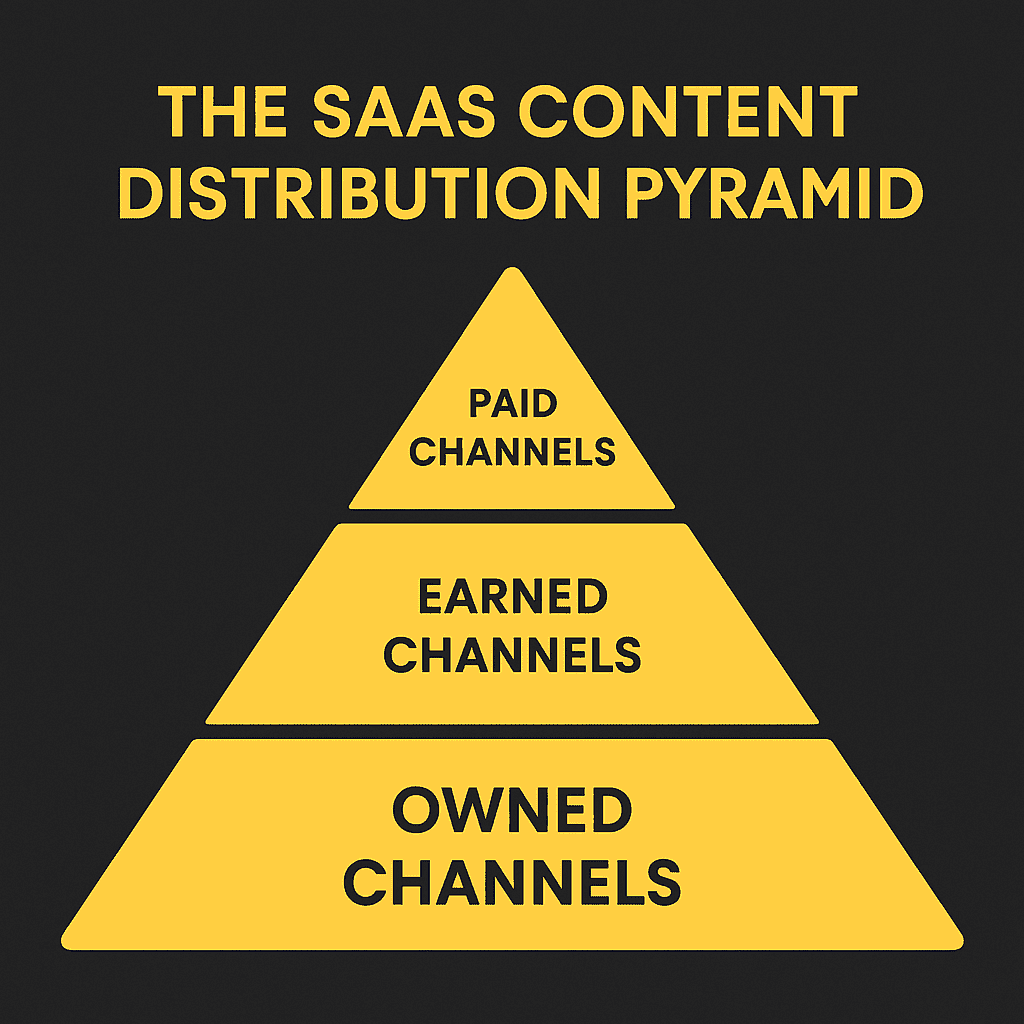
- Over-reliance on organic SEO – SEO is valuable, but it is slow. Waiting 6 to 12 months for rankings without amplifying content through SaaS content distribution channels means you miss out on early traffic, leads, and brand visibility.
- One-and-done publishing – Most teams post once, share it briefly, and move on. The result is that up to 90% of potential reach is lost. A strong SaaS content distribution plan ensures content is repurposed, resurfaced, and promoted multiple times over weeks or months.
- No audience-first mindset – Even great content fails if it is pushed to the wrong places. Effective SaaS content distribution starts by identifying where your ICP (ideal customer profile) actually spends time, whether that is LinkedIn, niche Slack groups, or specific newsletters, and focusing your efforts there.
Takeaway: Without deliberate SaaS content distribution, your content is like hosting a webinar without sending invites. You have great material but nobody sees it.
The SaaS Content Distribution Pyramid
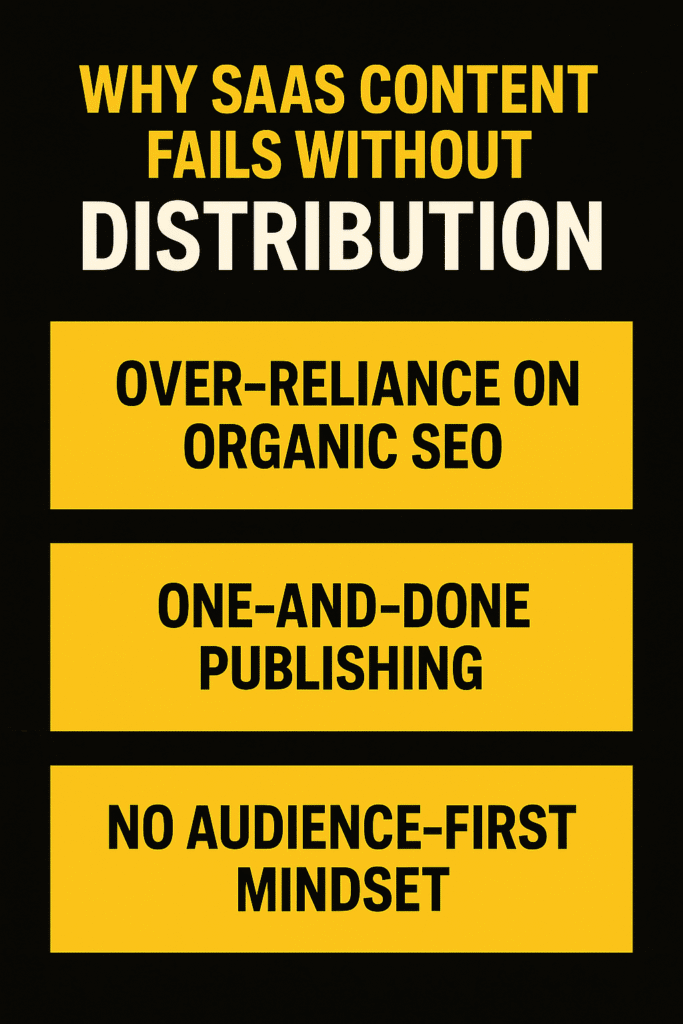
The SaaS Content Distribution Pyramid is a simple framework that organizes your promotion efforts into three layers: owned, earned, and paid, and helps you understand where to start and how to scale. At the base, owned channels like your blog form the foundation. This is where having a clear grasp of the difference between SEO and content writing becomes critical for balancing search visibility with audience engagement. It is also where applying proven SEO writing tips to rank on Google in 2025 can give your content the best chance to perform before you amplify it through earned and paid channels.
Think of distribution as a three‑layer system that you build from bottom to top.
- Owned (lowest cost, highest control)
- Earned (high credibility, no ad spend)
- Paid (fastest reach, budget required)
Operate it like a cadence. Publish on owned, amplify through earned, then scale with paid. Repeat for every major asset.
1. Owned Channels (foundation)
Owned channels are your platforms. You control the message, timing, frequency, and data. This is where distribution starts for every piece of content.
Company blog
The blog is the hub. Every distributed piece of content should link back to it. For the blog to pull its weight, SEO writing tips that actually rank need to be embedded from the start. Not added after. Intent-matched content with proper internal links and clear CTAs is what makes the blog a distribution asset rather than a content archive.
Focus on: pillar posts, comparison pages, use case pages, case studies, and how-tos. These formats earn links, rank well, and give readers a reason to come back.
Email newsletter
Email is the highest-ROI distribution channel for most SaaS companies. A properly built B2B newsletter gives you direct access to buyers who have already opted in. Every new blog post should be featured in the next send with a clear reason to click.
Segment your list. Customers, active evaluators, past evaluators, and cold subscribers all need different angles on the same content. A case study that resonates with a customer will land differently for someone who has never heard of you.
Tactics that work: a same-day email for major pieces, a weekly digest feature, and 3 to 5 follow-up snippets that resurface the post over 30 to 60 days with different angles.
Customer communities
Share content with your existing customer base before it goes wide. A power user who quotes your post or shares it with their network adds social proof that paid distribution cannot replicate. Build a community thread around major pieces. Track engagement and capture quotes for future use.
Product onboarding flows
This is the most underused owned channel. In-app banners, tooltips, and post-signup emails can route users to relevant content at exactly the moment they need it. A new user struggling with a specific feature does not need a generic blog link. They need the right guide, in the right place, at the right time.
Your platforms. You control the message, timing, frequency, and data. Start here for every asset.
2. Earned Channels (credibility layer)
Earned distribution means borrowing other people’s audiences. This layer adds credibility and new reach that owned channels cannot generate alone.
Guest posting
The goal is not a backlink. It is a targeted introduction to an audience that already trusts the publication. Write for publications your ICP actually reads. Pitch a data-driven or framework-based angle that adds value to their readers, not a promotional piece about your product.
Place one link to your core asset high in the article. If the publication allows it, add a contextual BOFU link as well. Track referral traffic quality, not just volume.
PR and industry publications
Decision-makers who do not read vendor blogs do read industry publications. Proprietary data, significant customer outcomes, and product milestones with market context are the hooks that earn coverage. Share an embargo brief with relevant reporters, publish the full dataset on your blog, and link to the press coverage from your post.
Newsletter mentions
A mention in a niche newsletter that your ICP reads is often worth more than a feature in a general publication. Share a short blurb and a compelling chart or data point with editors. Make it easy for them to share. Track click-through and first-touch attribution carefully.
Influencer and partner amplification
Co-create a mini case study or teardown with a relevant influencer. Host a recorded walkthrough that they can share with their audience. Secure a newsletter feature with a deep link to your content. Micro-influencers with highly engaged niche audiences consistently outperform larger accounts with broader, less targeted followings.
3. Paid Channels (scale layer)
Paid distribution scales what is already working. Do not start here. Start with owned and earned, identify what is performing, then use paid to accelerate it.
LinkedIn Sponsored Content
The best channel for reaching B2B decision-makers by role and company size. Run one awareness campaign promoting the asset in-feed and one retargeting campaign for site visitors pushing toward a trial or demo. Test 3 to 5 creative variations. Track cost per qualified lead, not just cost per click.
Google Ads for BOFU keywords
High-intent searches close to a purchase decision are worth paying for. Target “[Competitor] alternative,” “[Product category] for [ICP],” and “best [category] software” queries. Send traffic to a high-converting landing page with the relevant content asset as proof. Track conversion rate and cost per demo.
Retargeting for blog readers
Someone who read your blog post is a warmer prospect than someone who has never visited your site. Retarget them with social proof and a clear CTA to trial, demo, or calculator. Keep frequency caps tight. Exclude active customers. Use 30 to 90 day membership windows.
Sequencing That Works
Week 0 to 1
- Publish to blog
- Email to segments
- Community thread
- Small LinkedIn test
Week 2 to 4
- Newsletter mentions and influencer collabs
- 2 guest posts that cite the asset
- Retargeting live
Month 2 to 3
- Second wave email with a new angle
- One PR moment if data‑worthy
- LinkedIn scale based on quality pipeline
Pro Tip: Every SaaS content distribution strategy should start with owned, then amplify with earned and paid.
Owned builds the hub and captures data. Earned adds trust and new reach. Paid scales what is already working.
The 10X Distribution Checklist
This is the repeatable process for every major piece of content.
Week 0 to 1: Launch
- Publish to blog with proper internal links to BOFU pages and related cluster posts
- Send launch email to segmented list
- Post in relevant community channels
- Share on LinkedIn with a personal take, not a link dump
- Run a small LinkedIn paid test to identify resonance
Week 2 to 4: Amplify
- Secure 1 to 2 newsletter mentions
- Publish 1 to 2 guest posts that cite the asset
- Launch retargeting campaign for blog readers
- Reach out to influencers or partners for amplification
Month 2 to 3: Sustain
- Send a second email wave with a new angle on the same content
- Push for PR placement if the content has data worth citing
- Scale LinkedIn spend based on pipeline signal
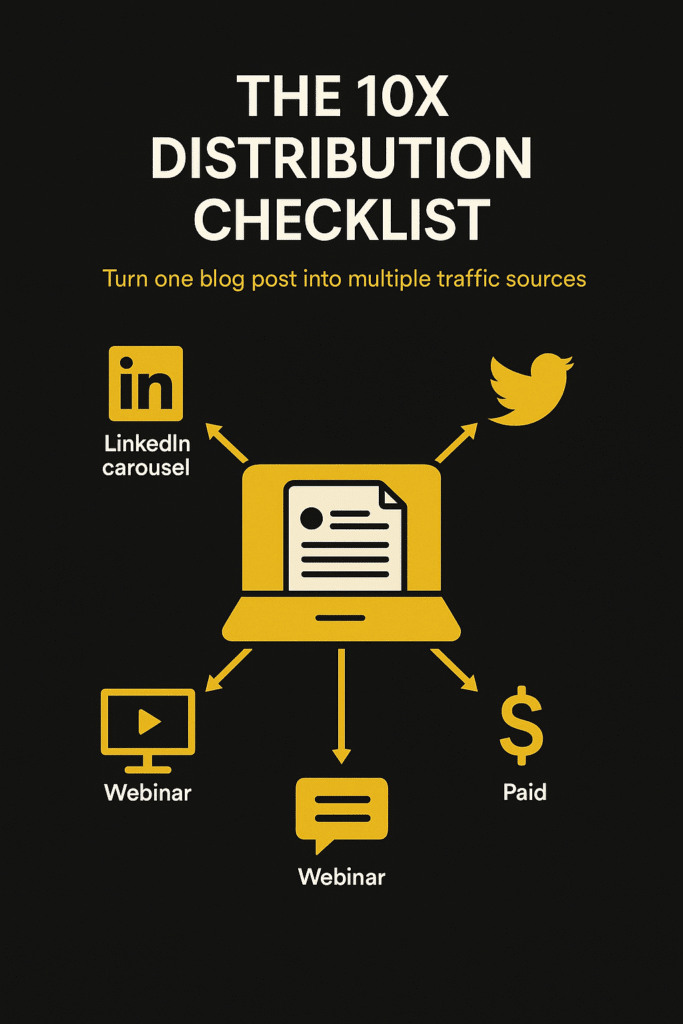
- Repurpose into new formats (LinkedIn carousel, short video, Twitter thread)
Measuring Distribution ROI
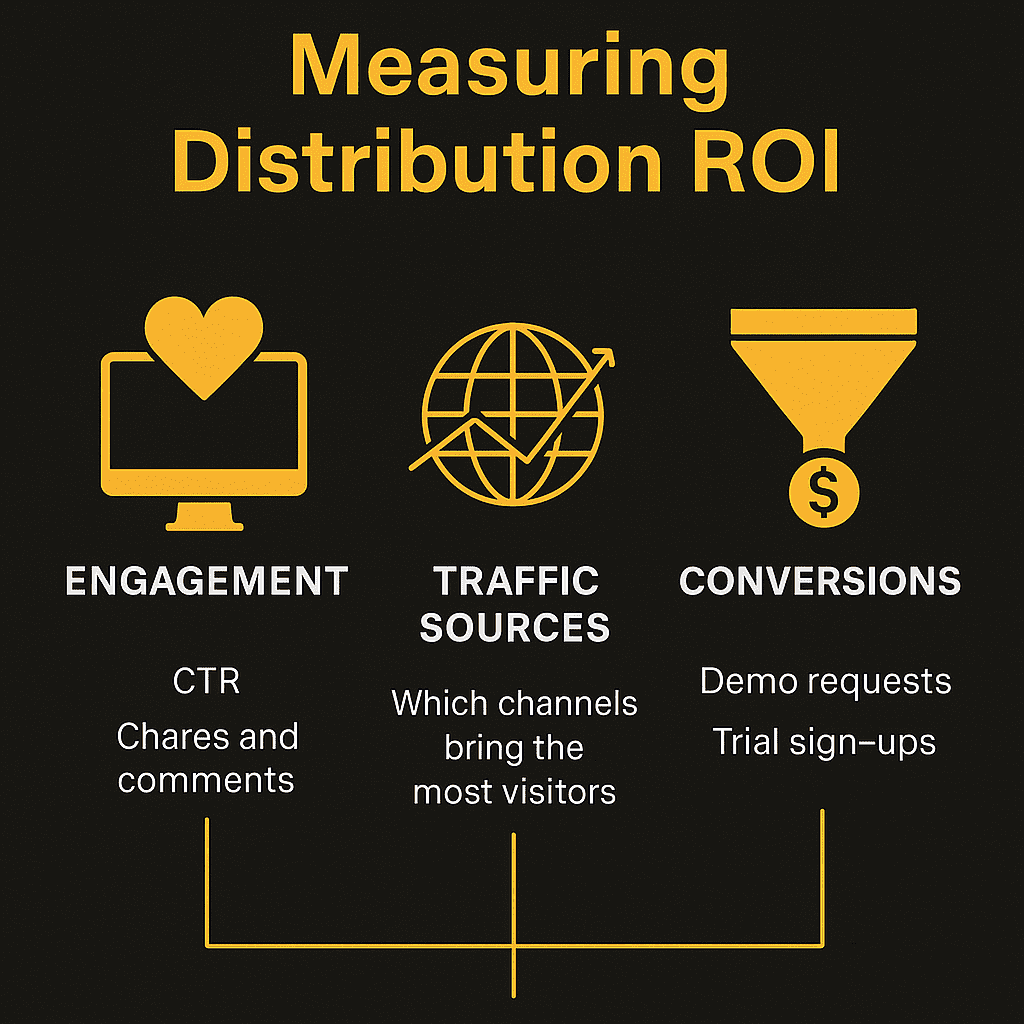
Distribution is only valuable if it delivers measurable outcomes. Treat it as a revenue driver, not just a brand exercise. The SaaS content marketing metrics that actually matter for distribution are:
1. Engagement
Engagement shows how well your distributed content resonates with your audience.
What to track:
- Click-through rates (CTR): How many people clicked from the channel to your content.
- Shares: How often your content is reposted, shared in groups, or linked in other discussions.
- Comments & replies: Indicators that your audience finds the content worth responding to.
Why it matters: High engagement signals that your content is relevant and valuable, making it more likely to perform well on algorithms and spark organic reach.
2. Traffic Sources
Understand which distribution channels are actually delivering visitors.
What to track:
- Channel-level traffic in Google Analytics or similar tools.
- Referral sources from backlinks or mentions.
- Direct traffic from email newsletters or in-app messages.
Why it matters: If one channel is consistently outperforming others, you can double down on it and refine underperforming channels or tactics.
3. Conversions
This is where distribution proves its ROI.
What to track:
- Demo requests: Leads showing high intent.
- Free trial sign-ups: Key for SaaS product-led funnels.
- Lead magnet downloads: Top-of-funnel conversions that nurture into sales.
Why it matters: These metrics tie content distribution directly to pipeline growth and revenue impact, not just vanity metrics.
Pro Tip: Use UTM Parameters for Every Link
Add UTM tags to every distributed link so you can track:
- Source: The platform or channel (LinkedIn, newsletter, guest post).
- Medium: Type of traffic (paid, organic, referral).
- Campaign: The specific asset or promotion
Repurposing: Making One Post Do More Work
Every piece of long-form content can become multiple assets for different channels and audiences.
Long-form to LinkedIn carousel. Condense the post into 5 to 7 slides with one key insight per slide. The carousel format performs consistently on LinkedIn for B2B audiences.
Long-form to Twitter/X thread. Break the post into curiosity-driven tweets that hook readers and link back to the original. Works best for posts with a contrarian take or a surprising data point.
Long-form to short video. A 60 to 90 second explainer covering 2 to 3 main points. Distribute on LinkedIn, YouTube Shorts, or wherever your ICP watches short-form video.
Long-form to webinar. A 20-minute deep dive with live Q&A extends the life of the content and generates a new list of qualified attendees.
This is how a real SaaS content engine turns one asset into weeks of distribution without starting from scratch every time.
Advanced SaaS Distribution Tactics
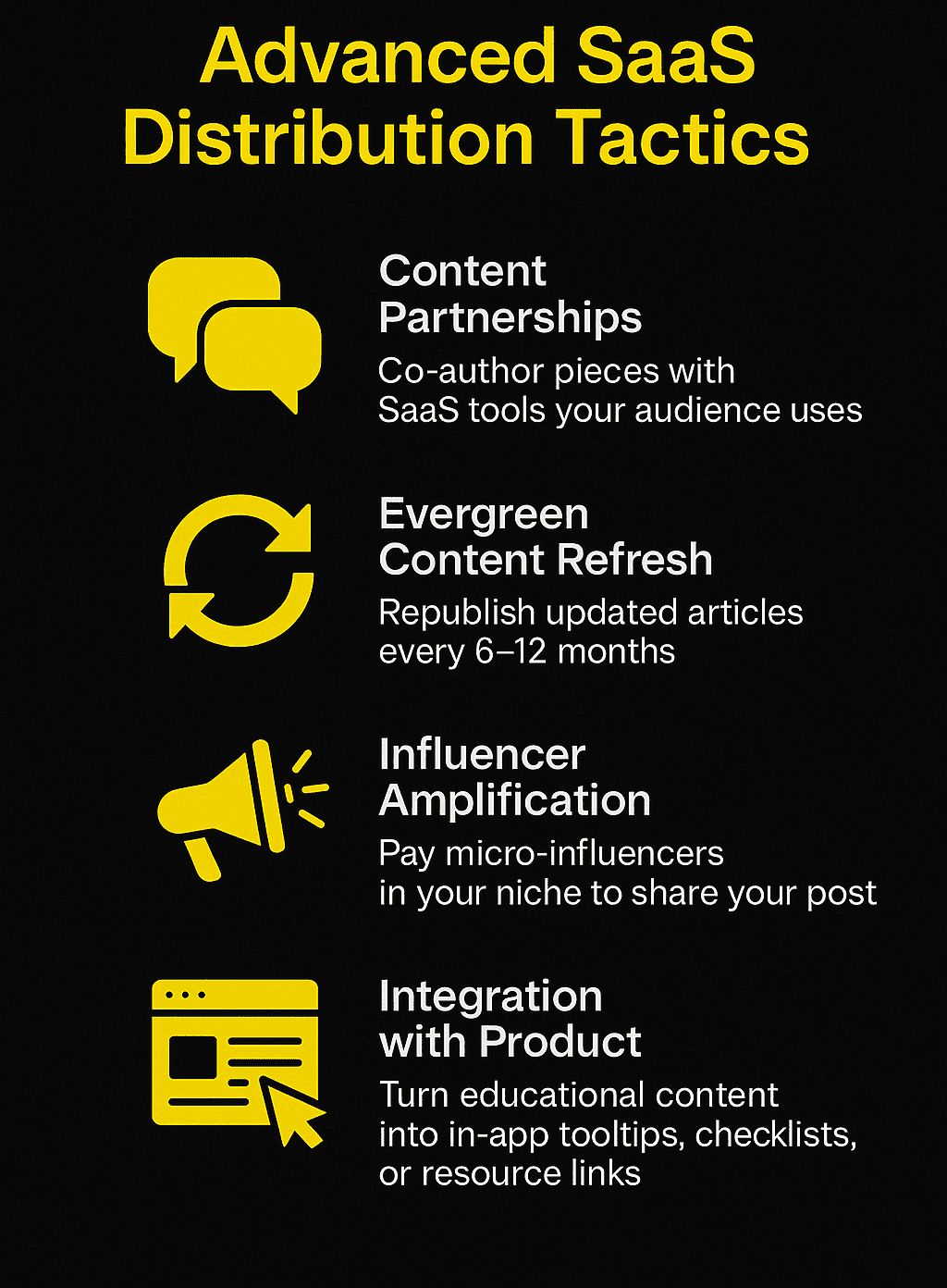
Once you’ve mastered the basics, these tactics can help you amplify reach, extend content lifespan, and drive higher conversions.
1. Content Partnerships
What it is: Collaborate with SaaS tools your audience already uses to create co-branded articles, guides, or research.
Why it works:
- You tap into each other’s audience, effectively doubling reach.
- The partnership adds credibility and positions your brand alongside trusted tools.
Example: If you’re a CRM SaaS, co-author a sales productivity guide with a proposal software tool.
2. Evergreen Content Refresh
What it is: Revisit and update high-performing articles every 6–12 months.
Why it works:
- Keeps content relevant for SEO and audience needs.
- Signals freshness to search engines, improving rankings.
Example: Updating a “SaaS Pricing Strategy 2024” post to “2025” with fresh examples, charts, and insights.
3. Influencer Amplification
What it is: Partner with micro-influencers in your niche to share your post, either as a paid promotion or a value exchange.
Why it works:
- Micro-influencers have highly engaged, niche audiences.
- Their endorsement acts as social proof and boosts trust.
Example: Paying a SaaS growth consultant to share your industry report with their LinkedIn network.
4. Integration with Product
What it is: Embed educational content directly into your SaaS product experience.
Why it works:
- Provides value at the exact moment the user needs.
- Increases engagement with both your product and content.
Examples:
- In-app tooltips linking to help articles.
- Checklists with embedded guides for onboarding.
- A “Resources” tab inside your dashboard.
The Most Common SaaS Distribution Mistakes
Distributing before the content is ready. A post with broken links, no clear CTA, and a weak meta description will convert poorly regardless of how well you distribute it. Fix the content first.
Using the same message across every channel. LinkedIn audiences respond differently than email subscribers. Twitter/X readers behave differently than newsletter readers. Adapt the angle and format for each channel rather than posting the same text everywhere.
Distributing once and moving on. Most content has a 48-hour window where teams actively promote it. After that, it is forgotten. Build a 30 to 60 day distribution calendar for every major piece. The second and third waves of promotion often outperform the first.
Not connecting distribution to the content funnel. Distribution that does not route buyers toward a demo or trial is just traffic generation. Every piece of distributed content should have a clear next step that moves the reader down the funnel.
For a full list of what kills SaaS content programs, see the top 10 SaaS content marketing mistakes.
Conclusion
A strong SaaS content distribution strategy does not just give your content more eyeballs. It shortens the time from publish to pipeline.
Before you write your next blog post, answer this question: do you have a plan to get it in front of your ideal customer in at least five different ways over the next 30 days?
If not, the content is doing half the work it could.
If you want help building a distribution system that turns content into pipeline, let’s talk.

Jay is the co-founder of LymLyt and an AI partnership consultant helping B2B SaaS companies grow through content strategy, SEO, and AI integration. He writes about content marketing, what makes B2B content convert, and how SaaS teams can build content systems that drive real pipeline.