What Is Executive Ghostwriting? (& is it right for you?)
Every week, a B2B SaaS founder watches a competitor post on LinkedIn and thinks one of two things. Either “that is not very good, I could do better” or “that is really good, there is no way they wrote that themselves.” In both cases, they are probably right. Executive ghostwriting is more common than most people admit, more legitimate than most people assume, and more valuable than most founders realise until they try it.
This guide covers what executive ghostwriting actually is, how it works in practice, when it makes sense, and how to know if it is right for you specifically as a B2B SaaS founder.
What is executive ghostwriting?
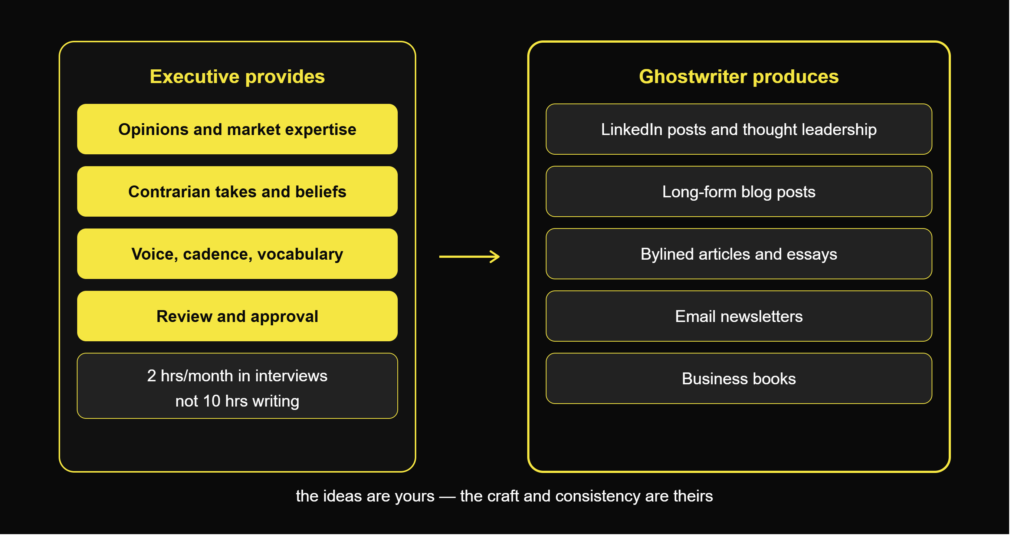
Executive ghostwriting is the practice of hiring a professional writer to produce content under your name, in your voice, representing your thinking. The writer’s name does not appear. The content goes out as yours because, in the ways that matter, it is yours: the ideas, the opinions, the perspective, and the expertise all come from you. The writer’s job is to extract that thinking and turn it into content that reads exactly like you at your best.
The format has expanded significantly in recent years. Executive ghostwriting today covers:
- LinkedIn posts and thought leadership content
- Long-form blog posts and bylined articles
- Email newsletters
- Founder-led social media programs
- Business books and long-form narrative projects
The executives winning on these channels are not the ones writing every word themselves. They are the ones who found a partner who could capture their thinking and publish it consistently, without the five to ten hours a week that writing it themselves would require.
Executive ghostwriting is not new. Politicians, CEOs, and public figures have used ghostwriters for decades. What is new is the application of the model to ongoing digital content programs, where the goal is not a book or a speech but a consistent presence across channels that builds topical authority over time.
Is executive ghostwriting ethical?
The short answer is yes, with one condition: the ideas must genuinely come from the executive.
Ghostwriting is one of the oldest professional practices in written communication. The business book you read last year was almost certainly written with a collaborator. The LinkedIn post your favourite founder published on Monday was probably drafted by someone on their content team. The op-ed the industry analyst wrote for Forbes was likely shaped by a ghostwriter who conducted a series of interviews and turned the analyst’s thinking into a polished argument.
None of this is deceptive. The executive’s thinking drives the content. The writer’s craft shapes it. The executive reviews and approves it. The executive’s name appears on it. This is a legitimate division of labour, not a form of dishonesty.
The only version that crosses an ethical line is when the executive has no genuine connection to the ideas being published: someone manufacturing expertise they do not have, or publishing opinions they do not actually hold. That is a different thing entirely, and it is also a bad business strategy, because it eventually falls apart when someone asks a question in person that the content implied the founder could answer.
For B2B SaaS founders who have genuine expertise, genuine opinions, and genuine thinking about their market, executive ghostwriting is simply a way to make that thinking visible consistently, without it requiring a second job.
Why B2B SaaS founders use executive ghostwriting
The founders who invest in executive ghostwriting are not doing it because they have nothing to say. They are doing it because they have too much to say and not enough time to say it well, consistently, and in the formats that reach the right people.
The specific reasons B2B SaaS founders hire ghostwriters break into four categories:
Time. Founders at Series A to C are not short on ideas. They are short on uninterrupted hours. Writing a genuinely useful 1,200-word blog post takes three to five hours when done properly. A LinkedIn content program that posts three times a week requires regular blocks of focused writing time that most founders simply cannot protect. Ghostwriting reclaims that time.
Consistency
Most founders who try to write their own content post intensely for two or three weeks, disappear for a month, and then feel too guilty to restart. A ghostwriting program runs whether or not the founder had a good week. Consequently, consistency compounds: a founder who posts every week for twelve months builds authority that a sporadic poster never will, regardless of individual post quality.
Quality
Founders know their subject but not always their craft. Writing clearly, structuring an argument, opening with a hook that earns the reader’s attention, and closing with something that moves them to act, these are learnable skills that take years to develop. A skilled ghostwriter brings those skills to the founder’s ideas. The result is content that is both more accurate to the founder’s expertise and more effective at reaching the right people.
Pipeline
The best content marketing for SaaS founders is not about vanity metrics. It is about making the right buyers understand how you think before they ever get on a call. Furthermore, when a buyer has been reading a founder’s posts for three months before reaching out, the sales conversation starts at a completely different level of trust. Executive ghostwriting makes that possible at scale.
How executive ghostwriting actually works
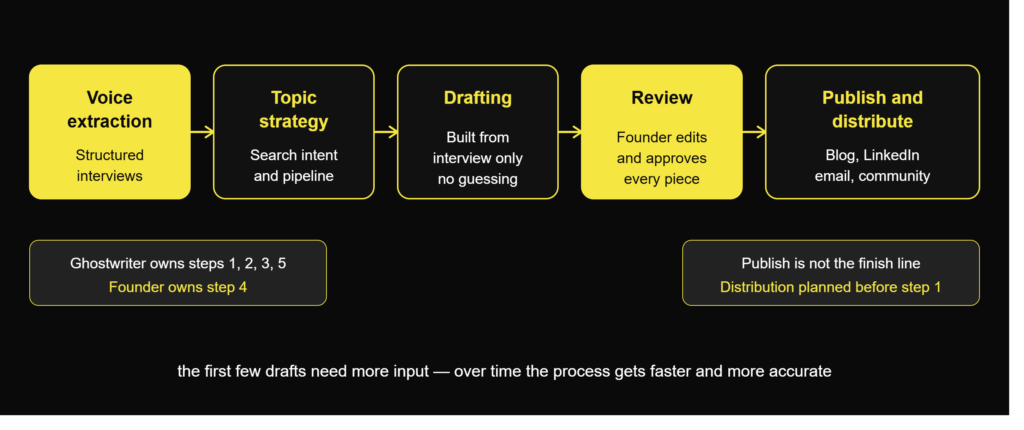
The process varies by agency and format, but for ongoing content programs covering blog and social, the core workflow looks like this:
Voice extraction
Before any content is written, the ghostwriter needs to understand how you actually think and speak. This is not about mimicking your writing style. It is about capturing your opinions, your contrarian takes, the specific vocabulary you use to describe your market, your go-to analogies, and your underlying beliefs about your category. Good ghostwriters do this through structured interviews, not a one-hour onboarding call.
Topic strategy
The best ghostwriting programs are not reactive. Topics are chosen based on search intent, pipeline stage, and topical cluster strategy, not based on what the founder happened to be thinking about this week. Every piece of content should connect to a content calendar that maps topics to buyer personas and funnel stages before writing begins.
Drafting
The writer produces a draft built entirely from the founder’s thinking and voice. The draft reflects how the founder would have written it if they had had the time and the craft to do it at their best. Notably, the first few drafts in any engagement require more input from the founder. Over time, as the ghostwriter develops a deeper understanding of the founder’s voice and thinking, the drafts get closer with less iteration.
Review and approval
The founder reviews, edits, and approves every piece before it publishes. This is non-negotiable in any legitimate ghostwriting program. The founder’s name goes on the content, so the founder needs to be able to stand behind every word. In practice, most founders find they are making fewer and fewer edits as the relationship matures.
Publishing and distribution. The content goes live on the appropriate channels. Importantly, a well-run ghostwriting program does not treat publish as the finish line. The content distribution strategy is planned before writing begins, so every piece is pushed to the right channels and audiences after it goes live.
What executive ghostwriting is not?
There are a few common misconceptions worth clearing up before you decide whether this is right for you.
It is not AI-generated content with your name on it. The best executive ghostwriting agencies use human writers who spend significant time extracting the founder’s actual thinking. AI tools may support parts of the workflow, but the voice, the opinions, and the specific perspective have to come from real conversations with the founder. Content that is AI-generated and lightly edited to sound like you will not sound like you, and your audience will notice.
It is not a shortcut for founders with nothing to say. Executive ghostwriting amplifies genuine expertise. It does not manufacture it. Founders who try to use ghostwriting as a way to appear knowledgeable about topics they do not understand will produce content that rings hollow. The best output comes from founders who have strong opinions, direct market experience, and genuine views on how their category works.
It is not a replacement for being present. A ghostwriting program handles the written content. The founder still needs to show up for the conversations that content starts: the comments, the DMs, the sales calls where a buyer says “I’ve been following your posts for months.” The content creates the opportunity. The founder closes it.
It is not just for LinkedIn. Many founders think of executive ghostwriting exclusively in terms of social media. However, the most effective programs combine LinkedIn content with long-form blog posts that build organic search authority over time. A LinkedIn post has a lifespan of 24 to 48 hours. A blog post that ranks organically keeps working for years.
The difference between a ghostwriter and a content writer
This is a distinction worth making clearly, because the two roles are often confused and require completely different skills.
A content writer produces articles, blog posts, and web copy based on a brief. They research the topic, write to the target keyword, follow your brand guidelines, and deliver a piece of content that represents your company’s point of view on a subject.
A ghostwriter captures a specific person’s voice, opinions, and way of thinking, and writes in that voice so convincingly that readers cannot tell the difference. The output is not a representation of the company’s point of view. It is a representation of a specific individual’s point of view, with all the idiosyncrasy, specificity, and personality that implies.
The best ghostwriting programs for B2B SaaS founders do both: they produce content that reflects the founder’s individual voice and perspective, and they connect that content to a strategic framework that builds search authority and drives pipeline. This is why the best SaaS content marketing agencies that offer ghostwriting services treat the two disciplines as complementary, not separate.
Signs executive ghostwriting is right for you
Executive ghostwriting makes the most sense for founders who can say yes to most of the following:
- You have genuine opinions about your market that you rarely have time to share in written form
- You have tried writing your own content and found that consistency is the hardest part
- You have watched competitors build audiences and visibility through content while you have stayed quiet
- You understand that your personal brand and your company’s brand are connected, and that buyers research you before they buy from you
- You can make time for a monthly or bi-weekly interview with your ghostwriter, even if you cannot make time to write
- You are willing to review and refine drafts rather than simply approving them blindly
- You are thinking about content as a long-term compound investment, not a quick lead-generation tactic
If most of those are true, executive ghostwriting is probably the right move. The question then becomes not whether to invest in it, but which format to prioritise first and which agency is the right fit for your stage and goals.
Signs executive ghostwriting is probably not right for you yet
Equally important: there are situations where executive ghostwriting is the wrong investment at the wrong time.
If you are pre-product-market-fit and still figuring out what your company actually does, ghostwriting will amplify confusion rather than authority. Get clear on your positioning first.
If you cannot commit to the voice extraction process, specifically the structured interviews that make good ghostwriting possible, the output will be generic. The ghostwriter can only work with what the founder gives them. A founder who is too busy to do even two hours a month of interviews is too busy for a ghostwriting program to work well.
If you expect immediate pipeline results in the first 30 days, content marketing is the wrong channel for that expectation. Executive ghostwriting builds compounding authority over months and years. Why founders should not write their own blog posts is partly about time, but it is also about having realistic expectations about what content does and when.
How to evaluate an executive ghostwriting agency
When you are ready to hire, the quality of the agency comes down to three things that are not visible in their portfolio:
The voice extraction process. Ask specifically how they capture your voice. A one-hour onboarding form is not enough. Look for structured interview frameworks, ongoing sessions, and a written voice guide that documents your specific vocabulary, opinions, and tone.
Topic strategy ownership. Do they bring topics to you based on search intent and pipeline stage, or do they wait for you to tell them what to write? The best agencies own the strategy. The founder approves it, but they are not generating the briefs themselves.
Pipeline attribution. How do they measure whether the content is working? If the answer is impressions and follower growth, that is not good enough for a B2B SaaS founder. The right answer involves content metrics that connect to pipeline: inbound lead quality, demo requests attributed to content, and sales conversations where buyers reference specific posts.
For a full breakdown of the agencies worth considering and how to choose between them based on your stage and goals, the best executive ghostwriting agencies guide covers the field in detail.
The bottom line
Executive ghostwriting is not a hack. It is not a shortcut. It is a professional service that lets founders with genuine expertise show up consistently in writing, reach the right buyers before any sales conversation begins, and build the kind of compounding organic presence that paid channels cannot replicate.
The question is not whether it is legitimate. It is whether you have the expertise, the opinions, and the commitment to the process to make it work.
If you do, the next question is finding the right partner. LymLyt ghostwrites for B2B SaaS founders specifically: blog posts, LinkedIn content, and long-form thought leadership built around your voice and your pipeline goals. If you want to see what that looks like in practice, book a free intro call. No pitch deck, no pressure.

Jay is the co-founder of LymLyt and an AI partnership consultant helping B2B SaaS companies grow through content strategy, SEO, and AI integration. He writes about content marketing, what makes B2B content convert, and how SaaS teams can build content systems that drive real pipeline.