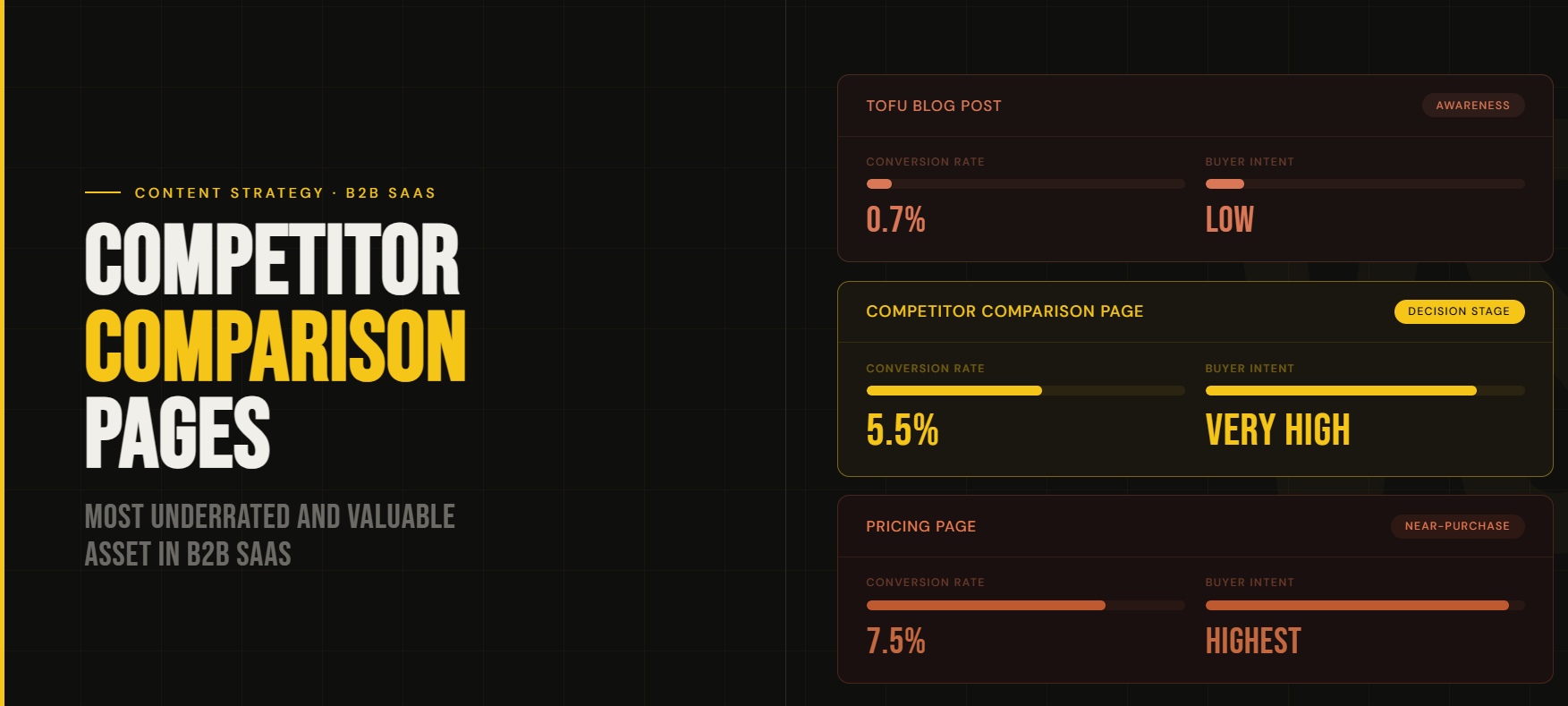
Competitor Comparison Pages: Most Underrated and Valuable Asset in B2B SaaS
Competitor comparison pages, meaning “vs pages” and “alternatives pages,” sit at the bottom of the funnel where decisions actually happen. They target buyers who are already sold on the category. They just haven’t picked a winner yet.
And almost nobody writes them well.
Your buyers are already Googling “your product vs their other option.” They’re reading G2 reviews. They’re asking in Slack communities.
The comparison is happening with or without you. The question is whether you’re controlling it.
What Is a Competitor Comparison Page?
A competitor comparison page is a dedicated page on your website that directly names a competitor and compares your product against theirs. It is not a generic “why us” page. It targets a specific search, someone already in evaluation mode who is deciding between you and someone else. That specificity is exactly what makes it so valuable.
Two formats. Both work.
“Your Brand vs. Competitor” pages
- Direct head-to-head comparison hosted on your site
- Example: “Notion vs. Confluence: Which Is Right for Your Team?”
- You control the framing without being embarrassingly biased
“Best Alternatives to [Competitor]” pages
- Target buyers already dissatisfied with a competitor
- Example: “7 Best Asana Alternatives for Fast-Moving Teams”
- Your product gets the most prominent placement
Both formats catch buyers in decision mode, not research mode. That distinction matters enormously for conversion. (More on this in our post on how to map BOFU content to demos.)
Why They Convert Better Than Almost Everything Else You’ll Publish
Someone searching “project management software” is exploring. Someone searching “ClickUp vs Monday.com for marketing teams” is deciding.
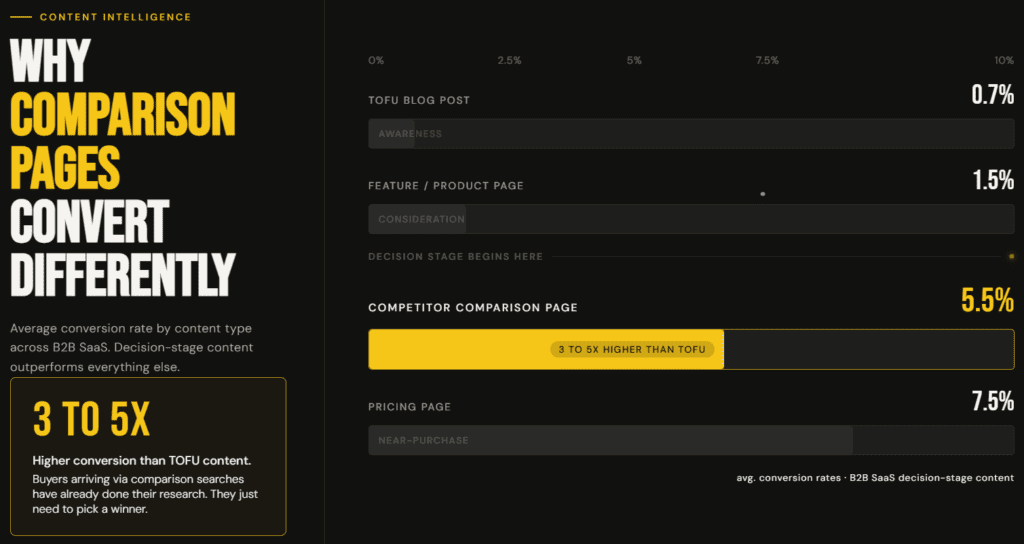
That’s the entire case.
- Bottom-of-funnel content converts at 3 to 5x the rate of top-of-funnel content
- Traffic volume is lower, but buyer intent is as high as it gets in organic search
- Comparison keywords have surprisingly low difficulty. Competitors won’t write them about themselves, and review sites produce generic takes
- These pages compound. Traffic builds, rankings hold, and the content keeps closing deals long after you’ve published it
Most B2B SaaS content marketing mistakes come from over-investing in awareness and under-investing in decision-stage content. This is that decision-stage content.
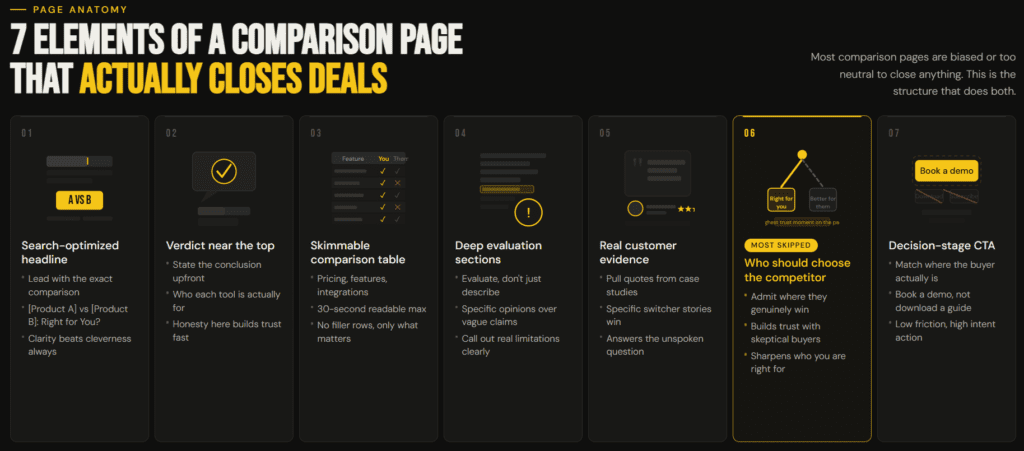
The Anatomy of a Comparison Page That Actually Works
1. A search-optimized headline Lead with the comparison. “[Product A] vs [Product B]: Which Is Right for [Persona]?” Clarity over cleverness, always.
2. A verdict near the top Don’t bury the conclusion. “If you’re a marketing team under 20 people, we’re the stronger choice. If you’re a large enterprise with complex legacy integrations, Competitor X might serve you better.” Honesty here builds trust for everything that follows.
3. A comparison table built for skimming Cover what your ICP actually cares about: pricing model, key features, integrations, support, onboarding time. Don’t pad it with 40 rows of features nobody uses.
4. Deep sections on the factors that drive the decision Go beyond describing. Evaluate. “Competitor’s reporting requires significant setup time for non-technical teams. If your marketing team doesn’t have a data analyst, you’ll hit a wall within the first month.” Specific and opinionated beats comprehensive and vague.
5. Real customer evidence Specific quotes beat generic testimonials. “We switched from [Competitor] because of X” answers the exact question the reader has before they’ve typed it. If you’ve written case studies, pull from them here.
6. A “who should choose [Competitor]” section This is what most teams skip. Don’t. Acknowledging where a competitor genuinely wins does two things: it builds credibility with skeptical buyers, and it sharpens who you’re actually right for. It’s the highest-trust moment on the page.
7. A CTA that matches buyer intent They’re in decision mode. “Download our guide” won’t cut it. “See it in action, book a 20-minute demo” is the right move.
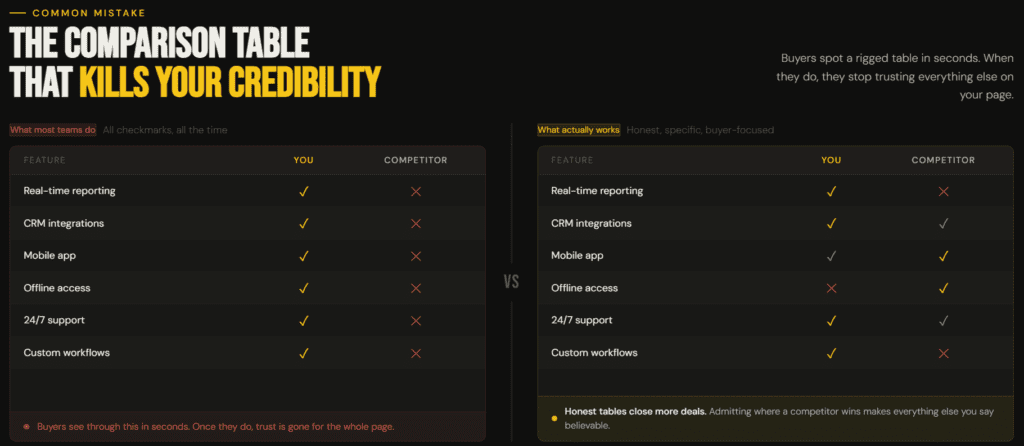
The Mistakes That Kill Most Comparison Pages
The rigged table All checkmarks on your side, all X marks on theirs. Buyers see it immediately and stop trusting the rest of the page. Be honest about where competitors are strong, then explain why it still doesn’t serve your ICP.
Writing for the crawler, not the buyer A page stuffed with keywords but no real perspective is useless to someone making an actual decision. If a reader finishes the page and still doesn’t know which product to choose, the page has failed regardless of rankings. This is exactly what AI-generated content slop looks like at the BOFU stage.
Ignoring the review site conversation G2 and Capterra are where buyers go when they don’t trust your marketing. Reference them directly. Pull in review quotes. Acknowledge a recurring criticism and explain what you’ve done about it.
One template for every competitor A comparison against your closest direct competitor looks nothing like a comparison against a category-adjacent tool. The buyer persona, key objections, and decision factors are all different. Each page needs to be built for that specific comparison.
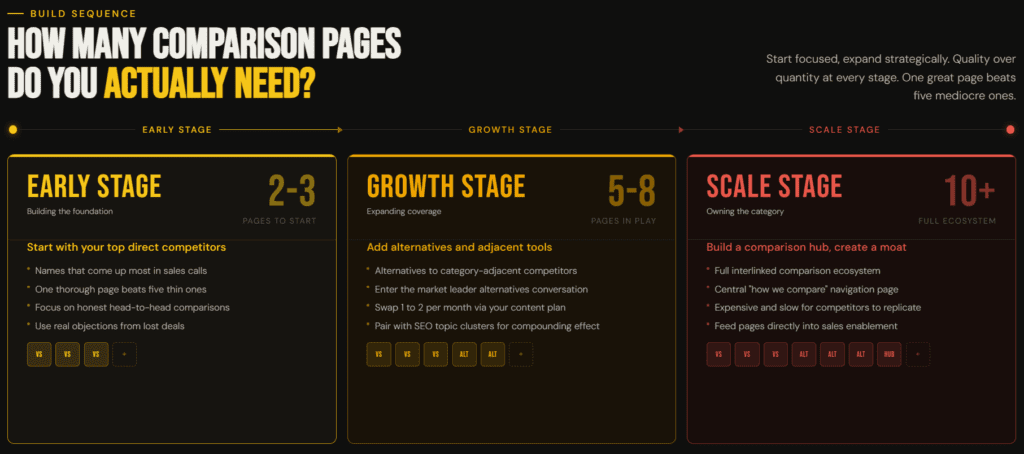
How Many Pages Do You Actually Need?
Early stage: Start with your top 2 to 3 direct competitors, the names that come up most in sales calls. Quality over quantity.
Growth stage: Add “alternatives to” pages for category-adjacent tools and market leaders. Being in the “[Leader] alternatives” conversation gets you in front of buyers you’d never otherwise reach. Pair this with a solid SEO content strategy and topic clusters.
Scale stage: Build a full comparison hub. Interlink every page. Create a central “how we compare” navigation page. At this point the ecosystem becomes a moat, expensive and time-consuming for competitors to replicate.
Do It Before Someone Else Does
Your competitors are being Googled by your prospects right now. Those prospects are landing on review sites and competitor “why us” pages. They’re forming opinions without you in the room.
If you’re not in the comparison conversation, you’ve already lost part of it.
These pages aren’t just organic content either. They’re sales assets. SDRs can send them when a prospect asks “how do you compare to X?” AEs can use them in proposal decks. They belong in your sales enablement toolkit as much as your blog.
The field is open. The intent is high. The competition is thin.
Publish well-structured comparison content in the next 90 days and you can own these searches, and the deals that follow, for years.
Conclusion
Comparison pages aren’t a nice-to-have. For B2B SaaS companies with real competition, they’re one of the highest-ROI content investments you can make.
They work because they show up at exactly the right moment: when a buyer has done their research, narrowed their options, and is ready to decide. Unlike top-of-funnel blog content that takes months to convert, a well-built comparison page can influence a deal the same week it ranks.
The formula isn’t complicated:
- Be honest about the comparison
- Be specific about who you’re right for
- Make it easy for the right buyer to say yes
Most SaaS companies skip this entirely, which means the opportunity is wide open. Start with one page. Pick your most-mentioned competitor in sales calls. Build it properly, with a real verdict, real evidence, and a real point of view.
That one page will do more for your pipeline than ten generic blog posts ever will.
We write competitor comparison pages that are honest enough to build trust and strategic enough to win deals.
No templates. Every page built around your actual product strengths and your buyers’ real objections.
Book a free strategy call -> or learn more about our competitor comparison writing service.

Jay is the co-founder of LymLyt and an AI partnership consultant helping B2B SaaS companies grow through content strategy, SEO, and AI integration. He writes about content marketing, what makes B2B content convert, and how SaaS teams can build content systems that drive real pipeline.